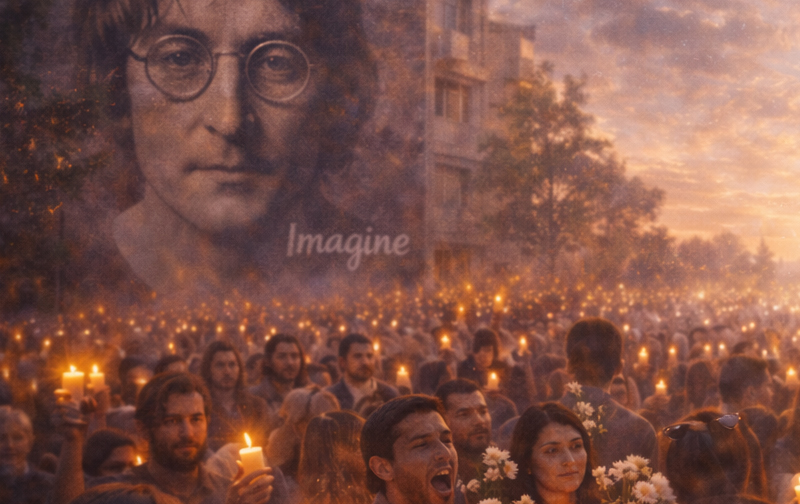
In the streets of Iran this past week, the air has been thick with anger and frustration. Crowds of ordinary people have risked their safety to protest injustices and restrictions on their freedoms. Their grievances are real, and the impulse to direct rage at those in power is understandable. Yet amid the slogans and fiery speeches, a quieter truth beckons: giving in to hatred will not set us free. However justified our fury may feel, if we allow hate to fill our hearts, we may only be harming ourselves and perpetuating the very cycle of violence we seek to escape. As the Dalai Lama reminds us, “Violence can only breed more violence and suffering. Our struggle must remain non-violent and free of hatred” . The challenge, then, is to stand firmly for justice without losing our peace of mind or our humanity in the process.
Hatred is a tempting poison in times of oppression. When faced with batons, prison cells, and bullets, many instinctively respond with thoughts of vengeance. We hear slogans demonizing the regime, calls to hate its enforcers, and cries for retribution. But we should pause and reflect: who truly suffers from the hatred we carry? There is an old saying that holding onto hate is like drinking poison and expecting the other person to die . The harm of hate accrues above all to the hater. Science and philosophy both suggest that chronic hatred and anger can eat away at a person’s well-being – elevating stress, corroding rationality, and trapping one in a mental prison of bitterness. In fact, Nelson Mandela – who endured 27 years in a prison far from his people – emerged without bitterness and famously said that if he didn’t leave hatred behind, he would remain imprisoned forever . Those words are not just metaphor. Mandela understood that by releasing hatred, he claimed his own freedom of mind. Likewise, if we cling to hate against our oppressors, we risk carrying a piece of that prison inside us wherever we go . Our oppressors would then have succeeded in stealing our peace of mind, which is perhaps exactly what they want.
Refusing to hate does not mean agreeing with the regime or surrendering to injustice. On the contrary, one can oppose a system with every fiber of one’s being without succumbing to blind hatred toward the individuals running that system. Mahatma Gandhi expressed this principle clearly: “Hate the sin and not the sinner… and that is why the poison of hatred spreads in the world” . He preached that it is right to be against unjust policies and systems, yet one must strive not to hate the people perpetrating them. “It is quite proper to resist and attack a system,” Gandhi wrote, “but to resist and attack its author is tantamount to resisting and attacking oneself… To slight a single human being is to slight those divine powers, and thus to harm not only that person but the whole world” . In other words, dehumanizing our adversaries only degrades ourselves and our cause. We can loathe tyranny, corruption, and cruelty without allowing our hearts to be consumed by malice for those who, perhaps due to their own ignorance or fear, uphold such a system.
History’s greatest apostles of change embraced this paradox of compassionate resistance. Dr. Martin Luther King Jr., leading the struggle for civil rights against a brutally racist system, constantly urged his followers to reject hatred. He observed that “Hate cannot drive out hate; only love can do that” . King knew that giving in to hatred, even of hateful people, would only multiply the darkness. Instead, he anchored his movement in love and moral courage, and that gave it enduring power. Likewise, the Dalai Lama, advocating for his people’s freedom, insists on fighting injustice without anger, believing that hatred simply reproduces an endless cycle of revenge. This aligns with the Buddhist philosophy that anger and hatred are destructive first and foremost to one’s own spirit, while compassion – even for one’s enemy – is a source of strength. Even Islamic tradition speaks to this: “Repel evil with that which is better” so that “he who is your enemy will become your friend” (Qur’an 41:34) . These teachings across cultures and faiths converge on a single insight: responding to cruelty with equal cruelty or hate ultimately perpetuates conflict rather than resolving it.
There is also a profound psychological reason to avoid hatred: we become what we habitually think and feel. The philosopher Friedrich Nietzsche warned, “Whoever battles monsters should see to it that in the process he does not become a monster himself. And when you look long into the abyss, the abyss also looks into you” . This vivid metaphor cautions that in fighting an evil, one might start mirroring that evil. We have seen this story too often in revolutions and wars: rebels topple an oppressive regime, only to become oppressors themselves if they have been consumed by rage and vengeance. Archbishop Desmond Tutu, who helped guide South Africa out of apartheid, echoed this wisdom during the Truth and Reconciliation process. “We must not allow ourselves to become like the system we oppose,” Tutu urged, insisting that freedom fighters use methods they can be proud of when history scrutinizes their struggle . If we stoop to the same brutality and hatred employed by tyrants, we will have lost our moral high ground and betrayed our own ideals. To put it plainly, hating the tyrants is a trap – it keeps us bound to them, emotionally and morally. True liberation means liberating ourselves from the cycle of hatred, not just changing the players in power.
Beyond the moral and spiritual arguments, there is a cold strategic logic in favor of disciplined nonviolence and refusing hate. Consider what happens when protesters adopt violence or bloodlust: The regime finds a perfect excuse to unleash overwhelming force in “self-defense” and to paint the opposition as thugs. “Violence just hurts those who are already hurt… Instead of exposing the brutality of the oppressor, it justifies it,” observed Cesar Chavez, a civil rights activist . In our case, if outraged citizens resort to vandalism or vengeance, the authorities can simply point to that as justification for crackdowns. Rage on our side gives credibility to the regime’s violence. Conversely, when we remain peaceful in the face of aggression, each act of repression only exposes the oppressor’s injustice more clearly to the world. The Palestinian scholar Hanan Ashrawi noted during her people’s struggles that “to meet violence with violence is to play to your opponent’s strong point and your own weak point” . The Iranian regime, with its guns and prisons, wants nothing better than an angry opponent that it can crush with superior force – an opponent it can label as violent and dangerous. Meeting them on that terrain is fighting on their terms, where they excel. By contrast, nonviolent resistance plays to our strengths: our numbers, our moral righteousness, and our ability to attract broad support. It frustrates the oppressor, who cannot easily justify oppression of unarmed, peaceful people without losing legitimacy.
History bears out the effectiveness of choosing a peaceful path. Political scientists have studied movements over the last century and found that nonviolent campaigns succeed more often than violent ones. One comprehensive analysis of conflicts between 1900 and 2006 showed that movements of civil resistance were twice as successful as violent uprisings in achieving their goals . Regimes can often outgun and outspend violent rebels, but they struggle to suppress a massive, peaceful revolt that garners sympathy at home and abroad. Think of the fall of apartheid in South Africa or the civil resistance that swept Eastern European dictatorships into the dustbin of history – these were achieved largely through strikes, protests, and perseverance, not armed militias. Even Iran’s own history offers lessons: the 1979 Revolution succeeded in part because millions of ordinary Iranians protested in the streets. Unfortunately, that revolution’s violent aftermath also taught us how cycles of hate can replace one form of tyranny with another. It is crucial that we break that cycle. Lasting change comes when the means of struggle embody the ends we seek. If we want a peaceful, free Iran, our methods of dissent and change must also be peaceful and rooted in freedom. As the saying goes, the ends and means are inseparable. Pursuing justice through unjust methods is a recipe for continued turmoil.
It is also worth recognizing our own limitations in the grand chess game of politics. We are honest citizens, not master statesmen pulling the strings of power. We do not see all the hidden moves on the political board, nor do we fully grasp the complex web of international and economic interests that might be influencing events. Politicians and power-brokers rarely show their real intentions openly; much of their “game” unfolds behind closed doors, far from the evening news . In such a climate, it is easy for the public to be manipulated into hatred. A timeworn tactic of leaders everywhere is to stoke fear and anger – to claim that the nation is under attack by some enemy, external or internal, so that people unite behind them in hatred of that enemy . We must be vigilant not to fall for such manipulation. When our minds are clouded by hatred, we become predictable and easily controlled. Steve Biko, the South African anti-apartheid activist, once said, “The most potent weapon in the hands of the oppressor is the mind of the oppressed” . If those in power can make us hateful and vengeful, they not only justify their narrative against us – they also keep us from thinking clearly or acting with the kind of unity and moral integrity that truly threatens unjust power structures. In a sense, by inciting our hatred, the regime invades our minds and diverts us from constructive action. We end up fighting on terrain of their choosing, blinded by emotion. By contrast, if we maintain our principles of peace and compassion, we deny them that psychological victory. We keep our minds clear and our movement disciplined.
Imagining peace in the midst of such turmoil is not easy, but it is necessary. Peace begins as an act of imagination – the ability to picture a future beyond the constant tit-for-tat of hatred. Great artists and leaders have long understood this. John Lennon invited the world to “imagine all the people living life in peace,” a radical suggestion that true revolution starts in the human imagination. The Dalai Lama often emphasizes inner disarmament: replacing anger with understanding and hatred with empathy. And indeed, we have to imagine peace before we can achieve it. This does not mean we become passive or ignore injustice. It means that even as we resist, we hold a vision of the kind of society we want: one ruled by hope and tolerance, not vendettas and fear. Hatred shrinks our vision to the size of our enemies; peace lets us dream as big as our ideals.
To all my fellow Iranians who feel despair and hatred when they see what is happening in our country: I urge you to remember that our aim is not only to change who is in power, but to change how power works and how we relate to one another as a people. We do not want to overthrow oppressors only to become new oppressors in their place. We want to end the spiritual cycle of violence, not perpetuate it. As the Dalai Lama wisely said, we must not turn hatred into an ideology, because hatred itself will reproduce violence endlessly . If we truly seek a better future, we must break that chain. That means tempering our justified anger with wisdom and love. It means opposing cruelty without being cruel, and fighting oppression without losing our own liberty to rage.
Let us focus our energy on what builds up, not what tears down. Our protest can be fierce in principle yet gentle in practice. We can refuse to comply with tyranny, speak truth to power, and demand our rights firmly – but do so without spewing hate at even the police conscript or the official across from us. This is difficult, profoundly so, but it is a form of strength. It gives us moral high ground and preserves our unity. When we reject hatred, we become harder to divide or demonize. We also protect our mental health and community bonds in the long run. Hatred would have us see only enemies and traitors everywhere; a peaceful outlook reminds us that after all this is over, we still must live together as one nation.
In the philosophy of nonviolence, there is a concept of the “beloved community” – an eventual society where former foes reconcile and work side by side. It is an idealistic notion, but every step toward it is meaningful. If we can find it in our hearts to stop hating even those who have hurt us, we reclaim power over our own souls. We deny the oppressors any victory over our inner lives. Our resistance then becomes not just a political struggle but a moral one – a struggle to uphold the values of humanity, empathy, and truth that no dictator can ultimately defeat.
So let us oppose the injustices of today’s Iran with all our strength, but let us do so without hate. Let us prove wrong those who expect us to become bitter or violent. We will not give them that satisfaction. Instead, we will cultivate an inner peace even as we push for outer change. This is not weakness; on the contrary, it is a profound form of courage and self-mastery. In time, it may even touch the hearts of some on the other side or inspire neutral bystanders to join our cause, seeing that we are motivated by love of justice, not lust for revenge.
The road ahead is uncertain and will test us in countless ways. But if we carry peace in our hearts, we carry a light that no darkness can extinguish. Our hatred would only scorch ourselves, but our hope and refusal to hate will keep the dream of a free and peaceful Iran alive. As one Iranian proverb goes, “drop by drop, a river is made.” Each small act of compassion, each moment we choose understanding over anger, adds a drop to the river of peace that can one day sweep away mountains of oppression. We owe it to ourselves, and to the future of our country, to nurture that peace within. In the end, overcoming hate is part of overcoming tyranny. Our opposition will be all the more powerful for being rooted in truth and love rather than in rage. By imagining peace and living it even now, in how we treat others and how we calm our own hearts, we take away the tyrant’s ultimate power – the power to make us like them. And in doing so, we take a vital step toward the genuinely free and harmonious Iran that we all yearn for.