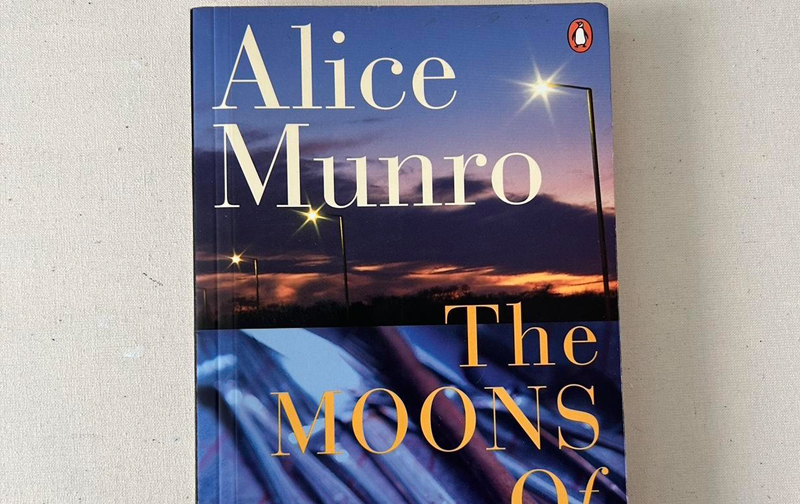
Alice Munro’s “The Moons of Jupiter” unfolds like a carefully tailored garment—each stitch, each fabric swatch, contributing to an overall ensemble that is as much about what is seen as what is implied. In this narrative, Munro’s language and style converge into a form that speaks both to the reader’s intellect and emotions, much like a well-designed outfit that communicates identity without uttering a single word. The story, which delves into themes of memory, aging, and the delicate interplay between the inner life and outer appearance, stands as a testament to Munro’s ability to blend the everyday with the profound. Her approach to storytelling, measured and nuanced, invites readers to explore the intricacies of human relationships and self-reflection, much in the same way that one might examine the layers of fabric and design in haute couture.
In “The Moons of Jupiter,” Munro employs a narrative style that is at once both restrained and richly suggestive. Her sentences are constructed with the precision of a skilled tailor, each one measured and chosen for its ability to contribute to a larger design. The language is unadorned yet deeply evocative, a quality that mirrors the best aspects of fashion: simplicity that does not compromise depth, minimalism that allows for personal interpretation, and an understated elegance that speaks volumes. The narrative unfolds in a way that does not shout its themes at the reader but instead reveals them slowly, with a delicacy that is akin to the gradual unveiling of a masterpiece on a runway. This method of storytelling, where each detail is both meticulously planned and open to interpretation, echoes the careful balancing act of creating an outfit that is both timeless and contemporary.
The interplay between form and content in Munro’s writing is strikingly apparent in the way she constructs her narrative in “The Moons of Jupiter.” Just as a designer might choose a particular fabric or silhouette to evoke a specific mood or era, Munro selects words and images that evoke the passage of time, the shifts in personal identity, and the quiet transformations that occur as life unfolds. Her writing, much like the most iconic fashion pieces, is not merely about the external appearance but about the deeper resonance of what it means to be human. The title itself, “The Moons of Jupiter,” conjures images of celestial bodies in constant motion, orbiting a vast and unknowable center—an apt metaphor for the internal lives of her characters, whose thoughts and emotions revolve around memories and experiences that are both distant and intimately familiar.
Munro’s stylistic choices invite a parallel with the world of fashion in several compelling ways. Firstly, her use of imagery and metaphor functions like the interplay of colors and textures in a well-composed outfit. Every description, every carefully chosen detail, serves as a brushstroke in a larger portrait of life’s complexities. The narrative flows with a natural rhythm, much like a well-tailored garment that moves gracefully with its wearer. This fluidity is a hallmark of Munro’s craft, where the boundaries between past and present blur, and where the ordinary becomes a canvas for exploring the extraordinary. The deliberate pacing of her prose, which allows moments of reflection to linger like the soft drape of a luxurious scarf, speaks to a deliberate economy of style—a fashion of writing that eschews flamboyance in favor of genuine expression.
Moreover, the critique of style inherent in Munro’s narrative can be seen as an exploration of how external appearances often mask internal truths. In “The Moons of Jupiter,” characters grapple with the dissonance between how they present themselves to the world and what lies beneath the surface. This internal conflict is rendered with a subtlety that is reminiscent of modernist fashion trends, where layers are both literal and metaphorical. Munro suggests that what we wear, both in terms of clothing and in the stories we tell about our lives, is imbued with meanings that can shift over time. The reflective tone of the narrative encourages readers to question whether style is merely a superficial adornment or a complex language in its own right—one that can reveal as much about the wearer as it conceals.
The fashion of writing that Munro practices in “The Moons of Jupiter” is also a critique of conventional narrative structures. Her work defies easy categorization, challenging readers to find beauty in the mundane and significance in the overlooked. This defiance is much like the avant-garde movements in fashion that reject established norms in favor of experimentation and innovation. Munro’s narrative technique—her use of introspection, subtle irony, and the quiet power of understatement—creates a space where the reader is invited to partake in the act of discovery. Each re-read of the story offers new insights, much like returning to a classic piece of fashion that reveals new details upon each examination. The layers of meaning embedded in her prose invite a dialogue between the text and its audience, a conversation that is as dynamic as it is personal.
The elegance of Munro’s language is paired with a critical awareness of the social and personal forces that shape identity. In “The Moons of Jupiter,” the act of remembering is portrayed as both an art form and a source of inevitable loss. Much like the changing seasons that influence fashion trends, memory is shown to be fluid and transient, subject to reinterpretation and selective embellishment. The story’s reflective quality resonates with those who see style not as a fixed identity but as a constantly evolving process—one that is as much about reinvention as it is about tradition. Munro’s portrayal of her characters, who navigate the complexities of love, regret, and self-acceptance, is imbued with a sensitivity that captures the dual nature of style: its power to transform and its vulnerability to decay. In this light, her writing becomes a mirror for the reader, reflecting the inherent contradictions of striving for perfection in an imperfect world.
Another compelling aspect of Munro’s narrative is her ability to merge the intellectual with the emotional, a synthesis that is equally prized in the realms of both literature and fashion. Her prose, marked by a restrained yet penetrating insight into the human condition, is crafted with the precision of a bespoke suit—tailored to fit the contours of life’s experiences. The careful modulation of tone and pace in “The Moons of Jupiter” creates an atmosphere that is simultaneously intimate and expansive, allowing readers to immerse themselves in the inner worlds of her characters. This duality is at the heart of Munro’s critique of style: while outward appearances may be meticulously curated, the true essence of one’s identity lies in the unspoken narratives that reside beneath the surface. Her work challenges the reader to look beyond the façade, to appreciate the subtleties of life that are often hidden behind the more obvious displays of beauty and order.
The narrative’s structure, with its interwoven strands of past and present, mirrors the way fashion recycles and reinvents itself over time. Munro’s ability to juxtapose different time periods and emotional states within a single narrative creates a tapestry that is rich in texture and depth. This approach not only reflects the cyclical nature of memory but also underscores the idea that style is an accumulation of experiences—each moment, each choice, adding to the overall character of the individual. In “The Moons of Jupiter,” the convergence of these elements is handled with a deftness that invites comparisons to a master couturier’s ability to blend classic silhouettes with modern accents. The story’s resonance lies in its capacity to capture the transient beauty of life while acknowledging the inevitability of change—a theme that is as relevant to the world of fashion as it is to the human condition.
The critic of style in Munro’s narrative is not merely a commentary on superficial aesthetics but a profound meditation on the nature of self-expression. Through her characters, Munro explores the tensions between conformity and individuality, between the desire to belong and the need to be authentically oneself. This exploration is rendered with an economy of language that is both precise and expansive, inviting readers to consider the ways in which personal history, social expectations, and inner desires collide and coalesce into a unique personal style. The narrative subtly critiques the ways in which societal norms can dictate the parameters of acceptable self-expression, while simultaneously celebrating the inherent beauty of deviations from the norm. In doing so, Munro aligns herself with a tradition of writers who see style not as a mere accessory but as an integral part of one’s identity—a perspective that resonates deeply with the ethos of modern fashion.
In her exploration of the “fashion of writing,” Munro appears to be in constant dialogue with the conventions of narrative art. Her prose, which often eschews grand declarations in favor of understated observations, challenges the reader to find significance in the nuances of everyday life. This approach is reminiscent of the way fashion can transform the mundane into something extraordinary through careful curation and attention to detail. Every gesture, every glance, every seemingly trivial interaction is imbued with layers of meaning, much as a single accessory can elevate an entire outfit. Munro’s narrative is an invitation to slow down, to appreciate the craftsmanship behind each carefully chosen word and image, and to recognize that the art of storytelling is, in many ways, analogous to the art of dressing well. Both require a sensitivity to context, a willingness to experiment, and an understanding that true style is as much about what is left unsaid as it is about what is boldly declared.
The beauty of Munro’s writing in “The Moons of Jupiter” lies in its ability to engage with the reader on multiple levels. At its surface, the narrative appears to be a simple meditation on life’s impermanence, yet beneath this veneer lies a complex web of symbolism and metaphor. The moons of Jupiter, with their shifting phases and distant orbits, serve as a potent symbol for the multifaceted nature of human existence. They evoke a sense of cosmic order and timeless beauty, even as they remind the reader of the inevitable cycles of change and decay. This interplay between the eternal and the ephemeral is a recurring theme in Munro’s work, one that underscores her belief in the transformative power of art. In much the same way that a carefully crafted garment can evoke memories, emotions, and aspirations, her writing captures the fleeting moments of beauty that define our lives, inviting readers to find meaning in the spaces between the lines.
The narrative voice in “The Moons of Jupiter” is one of Munro’s most compelling stylistic achievements. It is a voice that is at once intimate and detached, oscillating between the immediacy of lived experience and the reflective distance of memory. This duality creates a sense of tension and dynamism within the text, much like the contrast between bold and subtle elements in a fashion ensemble. The reader is drawn into a world where personal history is not static but continually evolving, where every recollection is colored by the passage of time and the shifting perspective of the narrator. Munro’s skillful modulation of this voice allows her to explore themes of loss, longing, and acceptance with a quiet intensity that is both disarming and deeply affecting. It is a testament to her artistry that such a seemingly simple narrative framework can be so richly layered, offering insights into the human condition that resonate long after the final page is turned.
In examining the stylistic innovations of “The Moons of Jupiter,” one cannot help but notice the meticulous attention to detail that characterizes Munro’s work. Each sentence is crafted with the care of a designer selecting fabrics for a couture collection—every word, every pause, contributing to an overall aesthetic that is both cohesive and expansive. This precision in language mirrors the discipline of fashion design, where the interplay of form, texture, and color is orchestrated to produce a harmonious whole. Munro’s narrative, with its delicate balance of simplicity and complexity, reflects an understanding that true beauty lies in the details—the quiet moments of introspection, the subtle shifts in tone, and the understated yet profound insights into the nature of human experience. Her writing invites the reader to participate in an act of creative engagement, to appreciate not just the final product but the intricate process of its creation.
The reflective quality of “The Moons of Jupiter” extends beyond its narrative structure to encompass a broader critique of the way style is constructed and perceived in both literature and life. Munro challenges conventional notions of beauty and elegance, suggesting that what we consider fashionable is often a superficial representation of deeper truths. In her work, the act of remembering is transformed into an art form—a way of reconstructing one’s identity in the face of inevitable change. This process is imbued with a sense of vulnerability and resilience, as characters navigate the delicate balance between self-presentation and authentic self-expression. The narrative does not offer easy answers or tidy resolutions; instead, it reflects the messy, unpredictable nature of life itself, where every moment is both a continuation of the past and a promise of what is yet to come. Through this lens, style becomes a living, breathing entity—ever-changing, perpetually evolving, and ultimately, a reflection of the complex interplay between memory, desire, and the inexorable march of time.
What emerges from Munro’s exploration of style in “The Moons of Jupiter” is a profound meditation on the ways in which personal narratives are constructed and deconstructed. Her writing, with its emphasis on nuance and subtlety, challenges readers to look beyond the surface and to appreciate the intricate interplay between form and content. Just as a fashion icon might challenge prevailing trends by introducing elements of asymmetry or unexpected color combinations, Munro disrupts conventional narrative expectations with her willingness to embrace ambiguity and contradiction. Her characters, like models on a runway, are presented not as static icons but as dynamic individuals whose identities are in a constant state of flux. Through this portrayal, Munro critiques the simplistic binaries that often dominate discussions of style—suggesting instead that true elegance lies in the acceptance of complexity and the celebration of difference.
In many ways, “The Moons of Jupiter” can be seen as a reflection on the nature of artistic expression itself. Munro’s prose, characterized by its clarity and restraint, is a reminder that the most enduring works of art are those that are capable of capturing the essence of life in its most unguarded moments. The narrative’s exploration of memory and identity is inextricably linked to its aesthetic sensibility, as every image and metaphor is imbued with a sense of deliberate design. This synthesis of form and meaning elevates the text beyond a mere recounting of events; it transforms the act of reading into an experience akin to wandering through a gallery of finely crafted portraits, each one offering a glimpse into the soul of its subject. The elegance of Munro’s style, much like the timeless appeal of a classic piece of fashion, lies in its ability to speak to universal truths while remaining intimately personal and contextually specific.
Ultimately, what makes “The Moons of Jupiter” such a compelling work is the way it challenges conventional notions of narrative and style. Munro’s writing is a study in contrasts—the interplay of light and shadow, of clarity and ambiguity, of past and present. Her approach to storytelling is both a celebration of the beauty found in everyday life and a critique of the societal pressures that shape our perceptions of self-worth and identity. By drawing parallels between the fluidity of memory and the transformative power of style, she invites readers to consider the ways in which our personal histories are as intricately woven as the fabrics of a designer’s collection. In doing so, Munro not only redefines the parameters of narrative art but also offers a subtle yet incisive commentary on the nature of artistic expression in a world that is often too eager to conform.
The interplay of these themes in “The Moons of Jupiter” serves as a reminder that both literature and fashion are, at their core, forms of self-expression—modes of communicating the inexpressible aspects of our inner lives. Munro’s work, with its measured cadence and reflective tone, exemplifies the idea that style is not merely an external embellishment but a deeply internal process. It is an ongoing negotiation between the past and the present, between the ideal and the real, and between the individual and the collective. In the quiet spaces between her carefully constructed sentences, one finds a meditation on the very act of becoming—on the ways in which we shape ourselves through the stories we choose to tell and the images we decide to embrace. Her narrative, rich in both substance and subtlety, challenges us to reconsider our own definitions of beauty and to recognize that the most enduring forms of style are those that arise from a place of honesty and introspection.
In reflecting on the broader implications of Munro’s work, it becomes clear that her contribution to the art of writing extends far beyond the confines of a single narrative. “The Moons of Jupiter” stands as an exemplar of how literature can serve as both a mirror and a mold for human experience. Her precise, almost surgical use of language not only captures the fleeting moments of life but also lays bare the intricate mechanics of memory and identity. Much like the most influential figures in the world of fashion, Munro’s influence is seen in the way she challenges established norms and redefines what it means to create something truly original. Her style, marked by its restrained elegance and its refusal to succumb to cliché, invites readers to appreciate the art of subtlety—a reminder that sometimes the most powerful statements are made not in bold declarations but in the quiet spaces of reflection.
The enduring appeal of “The Moons of Jupiter” lies in its ability to resonate on multiple levels. It is a work that demands engagement, urging readers to peel back the layers of narrative and uncover the deeper truths hidden within its pages. In doing so, Munro offers a form of aesthetic experience that is both intensely personal and broadly universal—a fashion of writing that transcends the limits of conventional genre or form. The story’s exploration of self, memory, and the passage of time is rendered with a clarity and honesty that few writers can achieve, inviting an ongoing dialogue about the nature of identity and the transformative power of art. Just as a timeless piece of fashion continues to captivate audiences long after its debut, Munro’s narrative endures because it speaks to the fundamental human need to understand and express the self in all its multifaceted complexity.
Throughout “The Moons of Jupiter,” the recurring motifs of reflection and transformation serve as a constant reminder that the act of writing is, in many ways, a form of self-fashioning. Munro’s deliberate choices in language and structure reveal an acute awareness of how stories are constructed—not simply as a series of events, but as a tapestry of lived experiences, each thread contributing to a larger, evolving picture of life. The parallels between the art of storytelling and the art of fashion are unmistakable: both are processes of continual reinvention, where past influences are reinterpreted in light of new insights and emerging trends. In this sense, Munro’s work stands as a subtle critique of rigid stylistic conventions, advocating instead for an approach that values fluidity, nuance, and the unexpected intersections between memory and imagination.
Ultimately, the legacy of Alice Munro’s “The Moons of Jupiter” is one that invites readers to engage in a reflective dialogue about the nature of style itself. Her writing, with its inherent tension between the unadorned and the elaborate, challenges us to reconsider our own perceptions of what it means to live and to express that life creatively. The story’s layered narrative, its interplay of subtlety and revelation, and its unyielding commitment to authenticity all serve as powerful reminders that true style is an evolving, dynamic process—one that is as much about embracing change as it is about preserving the essence of who we are. In the end, Munro’s narrative is a celebration of life in all its contradictions—a masterful demonstration of how the art of writing, much like the art of fashion, is capable of capturing the elusive beauty of the human spirit.