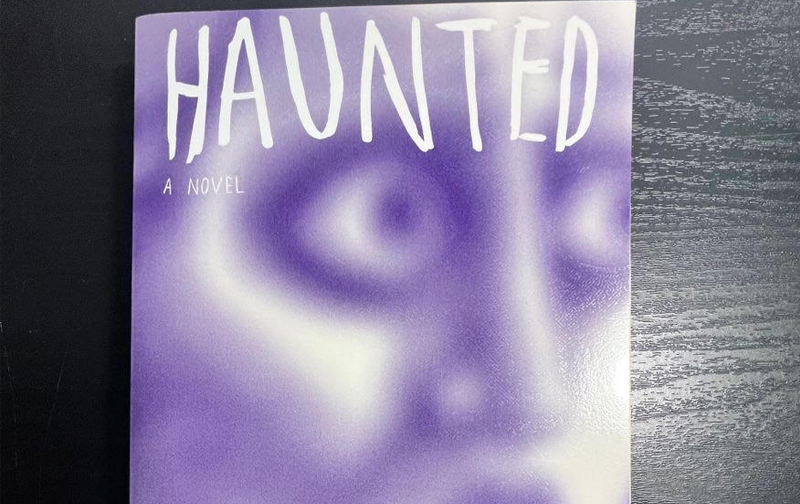
Chuck Palahniuk’s Haunted is a novel that defies conventional categorization, existing at the intersection of horror, satire, and psychological introspection. Much like Palahniuk himself, the book is both provocative and polarizing, crafted with a deliberate intensity that refuses to be ignored. His writing style is a fusion of sharp minimalism and grotesque extravagance, often oscillating between brutally direct prose and an almost lyrical dissection of human depravity. Haunted exemplifies this balance, a collection of interconnected stories framed by a nightmarish writer’s retreat, where characters descend into madness, desperation, and self-destruction.
Palahniuk’s approach to storytelling mirrors a certain aesthetic sensibility—both in literature and in personal style. He is known for his precise, stripped-down prose, reflecting a minimalist approach akin to the stark, clean lines of modernist fashion. His writing often functions like a well-tailored suit: deceptively simple on the surface but meticulously structured beneath. Yet, beneath this control, there is an undeniable element of theatricality, a willingness to shock and unsettle that aligns him more with avant-garde fashion, where form is often pushed to extremes. Just as high fashion subverts expectations through exaggerated silhouettes and bold textures, Palahniuk’s writing distorts traditional narrative structures, crafting a world that feels simultaneously grounded and surreal.
Haunted is a novel that, much like its characters, embraces the grotesque and the macabre. Its narratives often focus on physical and psychological decay, with scenes so visceral they challenge the reader’s ability to continue. This is not accidental; Palahniuk’s stylistic choices force an engagement with discomfort, much like fashion that deliberately rejects conventional beauty. His characters are not polished; they are raw, broken, and exaggerated versions of familiar archetypes. Their suffering is put on display much like the avant-garde runway pieces that reject wearability in favor of conceptual impact.
The reception of Haunted speaks to this dichotomy. Just as Palahniuk’s style resists easy classification, so too does the critical response to his work. Some hail him as a master of transgressive fiction, a writer unafraid to expose the darkest corners of human nature. Others dismiss his work as gratuitous, arguing that the shock factor overshadows deeper thematic resonance. This division in criticism reflects broader tensions in literary fashion—between excess and restraint, between raw emotional impact and carefully measured subtlety. There is a clear parallel to the fashion industry, where experimental designers push boundaries, creating collections that polarize audiences. Some see innovation; others see indulgence.
Palahniuk’s public persona further solidifies this aesthetic. He maintains a controlled, almost enigmatic presence, much like his prose—concise, direct, and often infused with a dry, dark humor. His fashion choices, while not as overtly stylized as his narratives, still reflect a deliberate sense of identity. Often seen in simple, fitted clothing, he embodies a look that is both unassuming and sharp, much like the way his stories deliver brutal truths in deceptively straightforward sentences. There is an intentional lack of excess in his personal style, a contrast to the often chaotic worlds he constructs in fiction.
Haunted and its critical reception underscore a fundamental truth about both literature and fashion: the tension between what is palatable and what is challenging. Palahniuk thrives in this space, refusing to cater to mainstream expectations. His work is not designed for comfort, just as certain fashion movements reject the idea of easy wearability. Instead, he crafts stories that linger, that provoke, that demand a response. Whether one admires or recoils from Haunted, its impact is undeniable. Like a bold fashion statement or an unforgettable piece of art, it refuses to be ignored.