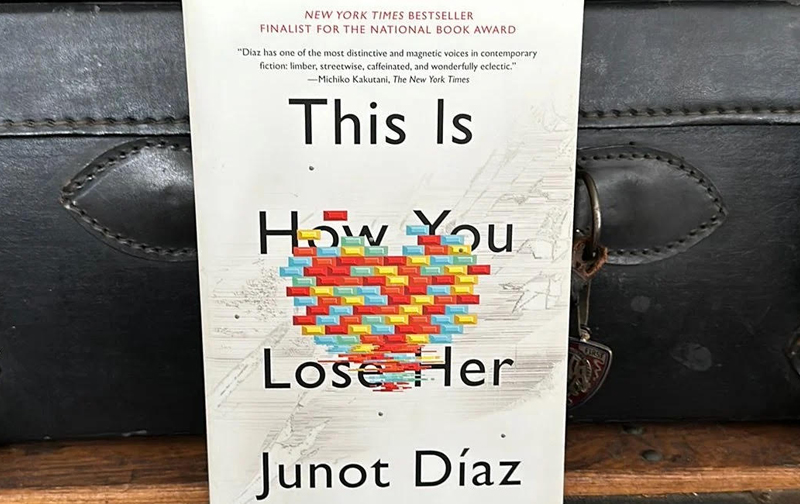
Junot Díaz’s This Is How You Lose Her is a compelling exploration of love, betrayal, and identity, with themes that resonate deeply within contemporary literature. Díaz’s writing stands out for its unique fusion of sharp, raw humor and emotional vulnerability, presenting a portrait of characters caught between their desires and the realities of their lives. What makes Díaz’s writing so distinctive is not only his deeply human characters but also the fashion of his narrative—the rhythm of his prose, the choice of language, and the style in which he conveys the complexities of personal relationships.
In examining Díaz’s work, one cannot overlook the way in which This Is How You Lose Her embraces a certain kind of literary fashion—one that is at once grounded in raw realism and propelled by a uniquely poetic cadence. His writing style reflects the contemporary fashion of literary minimalism, with stark, concise prose that carries a deep emotional punch. Yet, beneath this minimalism, there is an undercurrent of complexity, a layering of cultural references, humor, and pathos that infuses every page of the novel. This juxtaposition of simplicity and complexity mirrors the way fashion often blends the basic with the avant-garde—pairing minimalist clothing with unexpected textures, bold colors, or unexpected accessories that catch the eye.
The characters in This Is How You Lose Her are often trapped in relationships that fail to meet their expectations, yet their stories unfold with a kind of style that is undeniably Díaz’s own. The protagonist, Yunior, is a deeply flawed character, a man who loves deeply but struggles with his own insecurities, fears, and desires. Díaz’s portrayal of Yunior’s relationships is unflinching and raw—much like a fashion designer who seeks to expose the vulnerabilities beneath the surface. The heartbreak and turmoil of Yunior’s romantic entanglements are never sugarcoated; rather, they are presented with a brutal honesty that does not shy away from the messiness of love. This is where Díaz’s style becomes particularly fascinating. He does not romanticize the flaws in his characters, but instead uses them to deepen our understanding of human nature and the complexities of intimacy.
Much like the fashion world, where trends come and go but certain styles endure, Díaz’s writing defies fleeting literary trends. He does not follow the minimalist, stripped-down approach that often dominates contemporary fiction, nor does he indulge in the excessive, ornate language of past literary traditions. Instead, his style finds a balance between these extremes. His sentences are often sharp and direct, yet there is an emotional undercurrent to every word that gives his writing an almost lyrical quality. This is the fashion of his writing—a style that refuses to be tied to any one trend, but rather adapts and evolves to capture the essence of his characters and their experiences. In this way, Díaz’s writing reflects a kind of literary timelessness—something that doesn’t bend to the whims of current literary fads, but instead creates its own distinct niche in the literary world.
The narrative structure of This Is How You Lose Her also plays a significant role in its fashion as a work of literature. Each chapter of the novel is a vignette, a snapshot of Yunior’s life at different points in time, as he grapples with the complexities of his relationships. This episodic structure allows Díaz to explore different facets of Yunior’s character, offering glimpses into his struggles, his faults, and his growth. The fashion of this structure mirrors the fragmented nature of modern identity, where individuals are often torn between multiple versions of themselves—between their past and their present, between their hopes and their fears. Just as fashion trends often build upon past influences, Díaz’s narrative pulls from various literary traditions while creating something entirely new and distinct.
In the world of literary criticism, Díaz has long been a subject of both admiration and controversy. This Is How You Lose Her has been praised for its unapologetic exploration of masculinity, infidelity, and the immigrant experience. Critics have lauded Díaz for his unapologetically raw portrayal of flawed characters, noting how his work resonates with readers who see themselves in his characters’ struggles. The novel’s fashion in the realm of criticism is one of sharp praise but also pointed critique. Some critics have lauded Díaz for his unflinching look at the darker sides of love and relationships, while others have criticized him for presenting a somewhat narrow view of masculinity and the Latino experience. These critiques reflect the ever-changing nature of literary fashion—the way certain works are hailed as groundbreaking when they align with cultural shifts, but also criticized when they fail to meet the evolving expectations of contemporary discourse.
One aspect of the novel that has drawn both admiration and criticism is its portrayal of Yunior as a deeply flawed character. Yunior is not a likable protagonist; in fact, he is often selfish, irresponsible, and emotionally distant. Yet, this very unlikability is part of what makes the character so compelling. In the same way that fashion can subvert expectations, Díaz subverts the conventional notion of the “hero” by crafting a protagonist who is neither purely good nor purely bad. Yunior is a man of contradictions, and this complexity is what makes him resonate with readers. In the world of fashion, designers often take risks by creating pieces that challenge traditional notions of beauty or wearability. Díaz takes a similar approach in his writing, presenting a character who is far from perfect but whose journey is nonetheless captivating.
The fashion of This Is How You Lose Her also speaks to the changing landscape of contemporary literature. Díaz’s work is distinctly modern, but it also draws on literary traditions that have come before him. His writing is infused with elements of magical realism, an influence that harkens back to authors such as Gabriel García Márquez and Mario Vargas Llosa. Yet, Díaz makes this style his own, blending the fantastical with the gritty reality of urban life, and in doing so, creates a narrative that feels both timeless and deeply contemporary. The novel’s fashion, then, is one of reinvention—taking old traditions and melding them with new forms to create something entirely fresh.
In the world of literary criticism, This Is How You Lose Her has sparked conversations about the portrayal of love and masculinity, particularly within the context of immigrant communities. Some critics argue that Díaz’s portrayal of Yunior is a reflection of the toxic elements of traditional masculinity, while others see it as a more complex exploration of the pressures men face in a changing world. This debate mirrors the way in which fashion is often interpreted through a variety of lenses, with some seeing certain trends as empowering and others as problematic. Just as fashion can be seen as a reflection of societal values and trends, so too can literature serve as a mirror of the cultural and social tensions that shape our world.
This Is How You Lose Her is a novel about the complexities of love, identity, and self-destruction. Its fashion, both in terms of narrative style and the way it has been received by critics, reflects the ongoing evolution of contemporary literature. Díaz’s writing is both timeless and deeply modern, fusing elements of realism with fantasy, emotional depth with sharp humor. Just as fashion often transcends mere clothing to become an expression of identity, Díaz’s work transcends mere storytelling to become an exploration of the human condition in all its beauty and pain. Whether readers admire or critique it, This Is How You Lose Her stands as a testament to the power of literary fashion—something that continues to challenge, provoke, and resonate long after its initial publication.