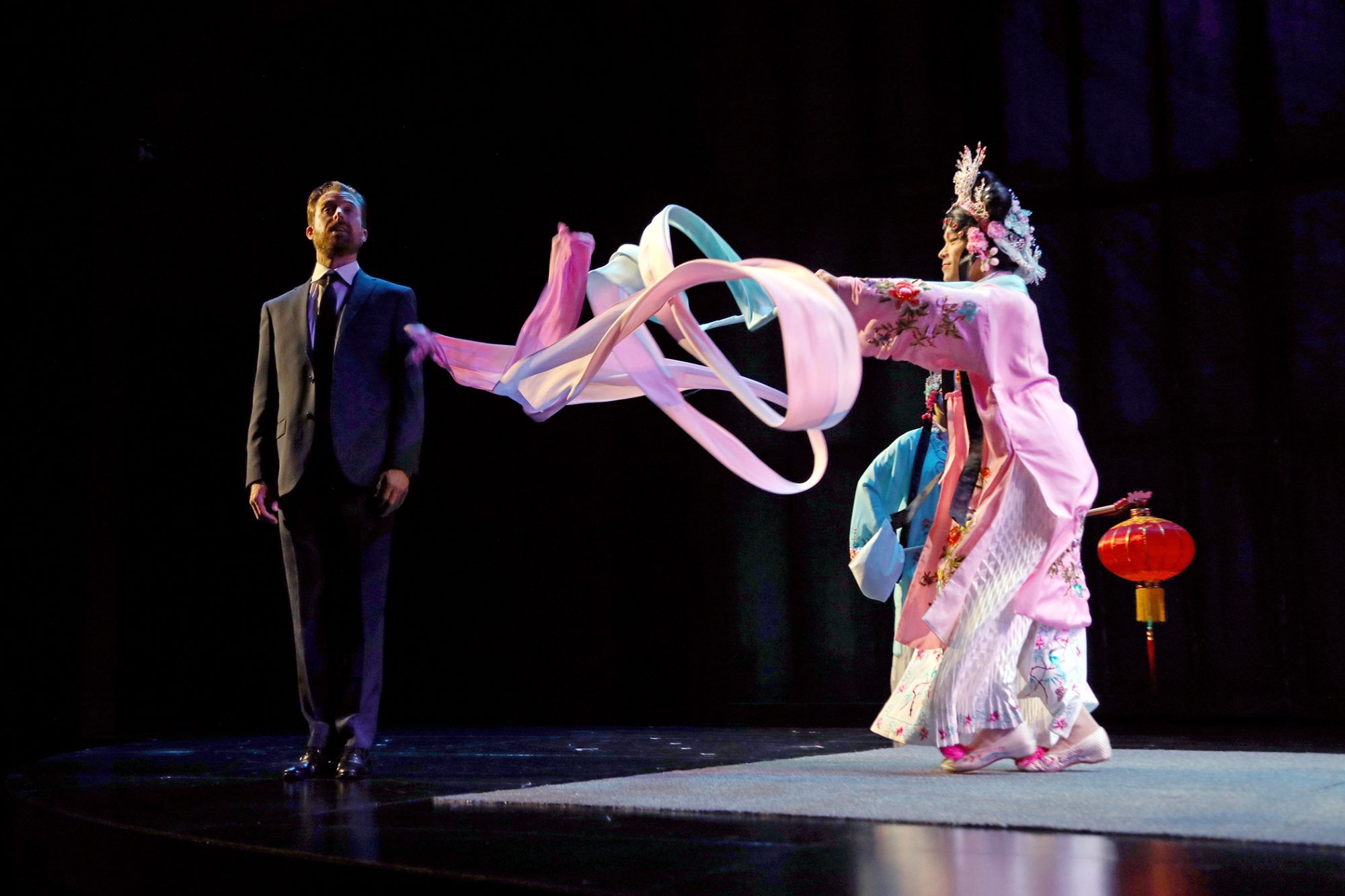
Act One ends by intertwining these two levels, as Gallimard’s triumph in the diplomatic arena-his promotion to vice-consul-coincides with his “conquering” of Song. Act Two continues these parallels, as Song appeals to Gallimard’s Orientalism in order to further hislher spying activities for the People’s Republic.
Extolling the progressiveness of France and exclaiming over hislher excitement at being “part of the society ruling the world today” (36), Song cajoles Gallimard into giving himlher classified information about French and American involvement in Vietnam. In his work, Gallimard uses his new-found masculine confidence and power and the opinions of Orientals he forms in his relationship with Song to direct French foreign policy.
We reencounter in the diplomatic arena the exchange of stereotypes pervading the relationship between Gallimard and his Butterfly. ”The Orientals simply want to be associated with whoever shows the most strength and power”; “There’s a natural affinity between the West and the Orient”; “Orientals will always submit to a greater force” (37).
Not surprisingly, Gallimard’s inability to read the complexities of Asian politics and society leads to failure. Gallimard’s predictions about Oriental submission to power are proved stunningly wrong during the Vietnam War: “And somehow the American war went wrong too. Four hundred thousand dollars were being spent for every Viet Cong killed, so General Westmoreland’s remark that the Oriental does not value life the way Americans do was oddly accurate.”
“Why weren’t the Vietnamese people giving in? Why were they content instead to die and die and die again?” (52, 53). And as the political situation in China changes, so does the relationship between Gallimard and Song change. Gallimard is sent home to Paris for his diplomatic failures; Song is reeducated and sent to acommune in the countryside as penance for hislher decadent ways.
Act Three begins with Song’s transformation into a man, as he removes his makeup and kimono on stage, revealing his masculine self. It is a manhood based on a collection of recognizably masculine conventions: an Armani suit; a confident stance, with feet planted wide apart, arms akimbo; a deeper voice; a defiant, cocky manner as he strides back and forth on the stage, surveying the audience.
He brings together the threads of gender and global politics in a French court. Questioned by a judge about his relationship with Gallimard, Song offers as explanation his theory of the “international rape mentality”: “Basically, her mouth says no, but her eyes say yes. The West b elieves the East, deep down, wants to be dominated… You expect Oriental countries to submit to your guns, and you expect Oriental women to be submissive to your men” (62).
And then Song links this mentality to Gallimard’s twenty-year attachment 46 to Song as a woman: “…when he finally met his fantasy woman, he wanted more than anything to believe that she was, in fact, a woman. And second, I am an Oriental. And being an Oriental, I could never be completely a man” (62).
Thus, Hwang-in a move suggestive of Edward Said’s Orientalism-explicitly links the construction of gendered imagery to the construction of race and the imperialist mission to colonize and dominate. Asia is gendered, but gender in tum cannot be understood without the figurations of race and power relations that inscribe it.
In this double movement, M. Butterfly calls into question analyses of race and colonialism which ignore links to gender, just as it challenges theories of gender which would ignore the cultural/racial/global locations from which they speak.
In M. Butterfly, gender and global politics are inseparable. The assumption that one can privilege gender, in advance, as a category, setting the terms of inclusion without fully considering those for whom gender alone fails to capture the multiplicity of experience, is itself an Orientalist move.
M. Butterfly would lead us to recognize that if the Orient is a woman, in an important sense women are also the Orient, underlining the simultaneity and inextricability of gender from geographic, colonial, and racial systems of dominance. And this is the “critical difference” between the implications of an M. Butterfly, on the one hand, and on the other, deconstructive analyses of gender identity.
For Hwang, the matter surpasses a simple calling into question of fixed gender identity, where a fixed meaning is always deferred in a postmodem free play of signifiers. He leads us beyond deconstructions of identity as Voice, Logos, or the Transcendental Signified, beyond refigurations of identity as the empty sign, or an instantiation of “writing inhabited by its own irreducible difference from itself” (Johnson II).
And the difference lies in his opening out of the self, not to a free play of signifiers but to a power-sensitive analysis that would examine the construction of complex, shifting selves in the plural, in all their cultural, historical, and situational specificity.
In sum, M. Butterfly enacts what I take to be a number of profoundly important theoretical moves for those engaged in cultural politics. It subverts notions of unitary, fixed identities, embodied in pervasive narrative conventions such as the trope of “Japanese woman as Butterfly.”
Equally, it throws into question an anthropological literature based on a substance-attribute metaphysics which takes as its foundational point of departure a division between self and society, subject and world. M. Butterfly suggests to us that an attempt to exhaustively describe and to rhetorically fix a concept of self abstracted from power relations and from concrete situations and historical events, is an illusory task.
Rather, identities are constructed in and through discursive fields, produced through disciplines and narrative conventions. Far from bounded, coherent, and easily apprehended entities, identities are multiple, ambiguous, shifting locations in matrices of power.
Moreover, M. Butterfly suggests that gender and race are mutually constitutive in the play of identities; neither gender nor race can be accorded some a priori primacy over the other. Most important, they are not incidental attributes, accidents ancillary to some primary substance of consciousness or rationality that supposedly characterize a self.
In M. Butterfly, we find a nuanced portrayal of the power and pervasiveness of gender and racial stereotypes. Simultaneously, Hwang de-essentializes the categories, exploding conventional notions of gender and race as universal, ahistorical essences or as incidental features of a more encompassing, abstract concept of self.
By linking so-called individual identity to global politics, nationalism, and imperialism, Hwang makes us see the cross-cutting and mutually constitutive interplay of these forces on all levels. M. Butterfly reconstitutes selves in the plural as shifting positions in moving, discursive fields, played out on levels of so-called individual identities, in love relationships, in academic and theatrical narratives, and on the stage of global power relations.
Finally, perhaps we can deploy the spatial metaphor once more, to place M. Butterfly in a larger context and to underline its significance. The play claims a narrative space within the central story for Asian Americans and for other people of color.
Never before has a dramatic production written by an Asian American been accorded such mainstream accolades: a long run on Broadway; a planned world tour; Tonys and Drama Desk Awards for both Hwang and B. D. Wong, who played Butterfly; a nomination for the Pulitzer Prize.
As an Asian American woman, M. Butterfly is a voice from the Borderlands, to use a metaphor from Gloria Anzaldua and Carolyn Steedman, a case of the “other speaking back,,, to borrow Arlene Teraoka’s phrase. Hwang’s distinctively Asian American voice reverberates with the voices of others who have spoken from the borderlands, those whose stories cannot be fully recognized or subsumed by dominant narrative conventions, when he speaks so eloquently of the failure to understand the multiplicity of Asia and of women.
“That’s why,” says Song, “the West will always lose in its encounters with the East,” and his words seem especially resonant given the history of the post-World War II period, a history including the Vietnam War and the economic rise of Asia.
The future Hwang suggestively portrays is one where white Western man may become Japanese woman, as power relations in the world shift and as the West continues to perceive the East in terms of fixity and essentialist identity.
And, when Gallimard’s French wife laments Chinese inability to hear Madama Butterfly as simply a beautiful piece of music, Hwang further suggests that his own enterprise, and perhaps by extension, ours, requires a committed, impassioned linkage between what are conventionally defined as two separate spaces of meaning, divided by the bar: aesthetics and politics.
Those like Gallimard who seek to keep the bars erect run the risk, Hwang implies, of living within the prison of their culturally and discursively produced assumptions in which aesthetics and politics, the personal and the political, woman and man, East and West form closed, mutually exclusive spaces where one term inevitably dominates the other. It is this topography of closure M. Butterfly-by its very existence-challenges.