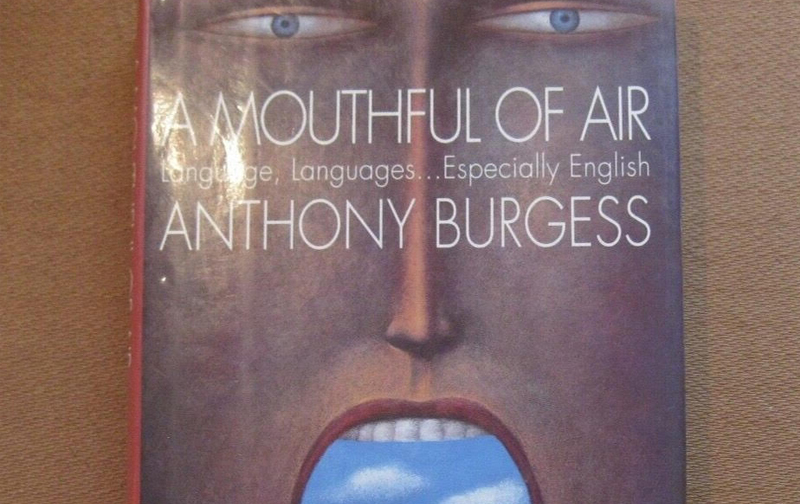
Anthony Burgess was a writer of extraordinary range, known for his linguistic ingenuity, satirical brilliance, and deep engagement with the mechanics of storytelling. While A Clockwork Orange remains his most famous work, he was far more than the author of a single controversial novel. His interests spanned music, history, and, most crucially, language itself. One of his later works, A Mouthful of Air: Language and Languages, Especially English, published in 1992, is a testament to his lifelong fascination with the structure, evolution, and beauty of words. Unlike his novels, which often experimented with language in a more playful or subversive way, A Mouthful of Air is a direct study of linguistic development, exploring how language functions, how it changes over time, and how its malleability reflects the shifting nature of human culture.
Language, much like fashion, follows trends. Certain words fall out of use, others emerge from subcultures or technology, and the rules of grammar shift according to common practice rather than rigid prescription. Burgess understood this deeply and wrote about it with both humor and erudition. He was particularly interested in how writers influence and are influenced by linguistic fashion. Shakespeare, for example, freely invented words when none suited his needs, a creative liberty that Burgess admired and often imitated in his own fiction. In A Mouthful of Air, he discusses this phenomenon with admiration, viewing it as evidence that language is not a fixed entity but a living force, shaped by the needs and imaginations of its speakers. Just as clothing trends reflect cultural changes, linguistic trends signal broader shifts in thinking, communication, and identity.
Burgess’s own style of writing in A Mouthful of Air mirrors this dynamic approach to language. His prose is rich, layered, and unapologetically playful, demonstrating the very flexibility he celebrates. Rather than presenting language as a dry academic subject, he treats it as something vibrant and alive, drawing on history, literature, and even his background in music to illustrate his points. He moves seamlessly between scholarly analysis and anecdotal storytelling, making the book accessible to both linguists and casual readers. This ability to blend intellectual depth with readability is a hallmark of Burgess’s style, setting him apart from both traditional grammarians and the highly theoretical linguists of his time. He avoids prescriptive rules in favor of a descriptive approach, showing how language evolves rather than dictating how it should be used.
The fashion of writing about language during the late twentieth century was largely dominated by structuralist and post-structuralist theories, which sought to deconstruct language and question its ability to convey stable meaning. Thinkers like Jacques Derrida and Roland Barthes argued that words do not have fixed definitions but derive meaning from their relationships with other words, a perspective that radically altered linguistic and literary studies. Against this backdrop, A Mouthful of Air stands as an intriguing counterpoint. While Burgess acknowledges the fluidity of language, he does not fully embrace the skepticism of postmodern theorists. Instead, he sees language as a creative tool, something to be celebrated for its adaptability rather than endlessly deconstructed. This puts his work in a unique position—aware of contemporary debates but unwilling to be fully consumed by them.
By writing in an engaging and accessible style, Burgess also sets himself apart from many of his contemporaries. The late twentieth century saw an increasing divide between academic linguistic studies and public discussions of language. Many books on the subject became increasingly technical, filled with specialized jargon that made them difficult for non-experts to engage with. Burgess, however, followed in the tradition of writers like George Orwell and H.L. Mencken, who believed that discussions about language should be clear, direct, and lively. His work is filled with humor, wit, and a love of storytelling, making A Mouthful of Air as much a literary experience as it is a linguistic study.
The book also engages with the broader literary tradition in which Burgess operated. Throughout his career, he was deeply interested in the relationship between language and storytelling, often experimenting with form, structure, and vocabulary in his fiction. His most famous novel, A Clockwork Orange, is built on an invented slang called Nadsat, a fusion of Russian and English that forces readers to engage with language in a new way. This linguistic playfulness is present in much of his work, from the Elizabethan pastiche of Nothing Like the Sun to the multilingual experimentation of ABBA ABBA. A Mouthful of Air serves as a kind of intellectual companion to these novels, providing insight into the theories and ideas that shaped Burgess’s approach to writing.
Critics responded to A Mouthful of Air in a variety of ways, reflecting the broader tensions in linguistic studies at the time. Some praised the book for its wit, intelligence, and ability to make complex ideas accessible. They admired Burgess’s ability to write about language in a way that was neither dry nor condescending, instead treating it as a fascinating and ever-changing subject. These critics saw the book as a refreshing alternative to the dense and highly specialized linguistic texts that had become dominant in academic circles.
However, not all responses were positive. Some critics felt that A Mouthful of Air was too traditional in its approach, failing to fully engage with the radical linguistic theories of the late twentieth century. In an era when many scholars were questioning the very foundations of language, Burgess’s celebration of its beauty and flexibility seemed, to some, overly nostalgic or even naive. Others argued that his style, while entertaining, sometimes lacked the precision needed for serious linguistic analysis. His tendency to move between scholarly discussion and anecdote, while engaging, could at times obscure his main arguments.
Despite these criticisms, A Mouthful of Air remains a valuable and insightful work, particularly for those interested in the intersections of literature and language. It captures Burgess’s deep love of words and his belief in their power to shape thought, culture, and identity. His refusal to see language as something static or restrictive allows him to present it not as a set of rules to be memorized but as a dynamic force to be explored and enjoyed.
Ultimately, A Mouthful of Air is as much about the art of writing as it is about the science of language. Burgess demonstrates that writing, like language itself, is shaped by trends and fashions but is also an arena for creativity and reinvention. His ability to blend scholarly insight with literary flair makes the book a unique contribution to discussions about language, one that stands apart from both rigidly prescriptive grammars and overly abstract linguistic theories.
In both its content and its execution, A Mouthful of Air reflects Burgess’s belief that language is not merely a tool for communication but a medium for artistic expression. Whether examining historical changes in pronunciation, the evolution of grammar, or the linguistic creativity of great writers, he approaches the subject with a sense of wonder and curiosity. This perspective allows him to craft a book that is not only informative but also deeply engaging, a work that invites readers to think about language not as a fixed system but as a living, evolving art form.
Burgess’s engagement with language in A Mouthful of Air also reflects a broader theme in his work: the relationship between tradition and innovation. Just as he saw literature as something that should build on but not be confined by the past, he saw language as something that should be respected but not rigidly preserved. His book celebrates the richness of linguistic history while also acknowledging that change is inevitable and often beneficial. In this sense, A Mouthful of Air is not just a study of language but a reflection on the creative possibilities it offers.
The book’s legacy, much like Burgess’s broader literary career, is complex. It exists in a space between traditional linguistic studies and modern literary theory, appealing to readers who appreciate both scholarly depth and narrative elegance. It is a book that resists categorization, much like its author, who consistently defied literary conventions and embraced experimentation. For those who share Burgess’s fascination with words, A Mouthful of Air remains a rewarding and thought-provoking read, a book that captures the ever-changing nature of language while celebrating its endless possibilities.