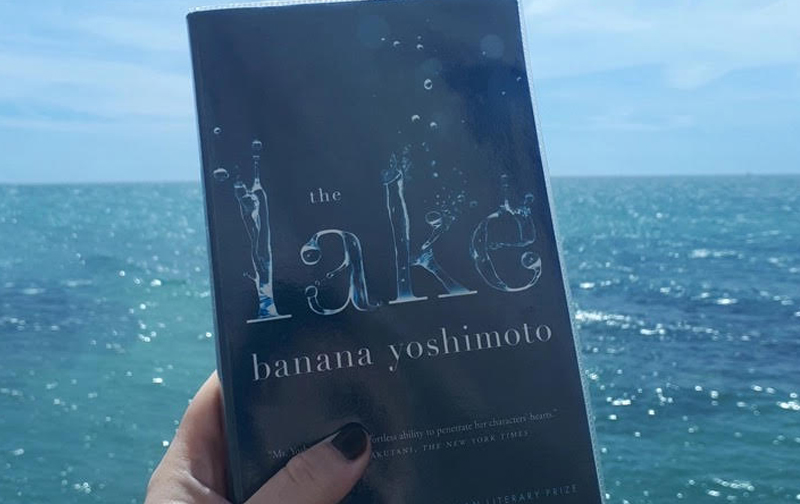
Banana Yoshimoto’s The Lake is a novel that exists in the quiet spaces between memory, longing, and emotional recovery. Her work is often associated with a delicate minimalism that carries a sense of nostalgia, and The Lake exemplifies this aesthetic both in its narrative and stylistic choices. The novel’s atmosphere is subdued yet emotionally charged, unfolding in a dreamlike state where reality and the past blur together. Yoshimoto’s approach to storytelling is deeply rooted in a kind of literary fashion that is understated yet evocative, much like the world of contemporary Japanese design—elegant in its simplicity yet profound in its execution.
The novel follows Chihiro, a muralist & Nakajima, a quiet and enigmatic man with a past that remains shrouded in mystery for much of the book. Their relationship is one that moves at an almost imperceptible pace, reflecting Yoshimoto’s signature narrative style—one that does not rush, but rather allows emotions to emerge organically. This slow unfolding is reminiscent of the way certain fashion trends are not immediately striking but gradually reveal their depth through subtle details and craftsmanship. The novel’s aesthetic sensibility, like a carefully designed garment, is not about grand statements but about the textures of everyday life, the way small gestures carry immense meaning.
Yoshimoto’s prose is often described as deceptively simple. Her sentences are crisp, her descriptions sparse, and yet there is a weight to them that lingers. This economy of language mirrors the ethos of minimalist fashion—where the absence of excess allows the true essence of the design to shine. The Lake is filled with quiet moments that seem unremarkable at first but accumulate meaning as the novel progresses. The use of space, both literal and figurative, plays a crucial role in how Yoshimoto constructs her world. Much like the Japanese aesthetic concept of ma—the space between things that gives them significance—her writing allows for silence, for unspoken emotions to resonate.
In The Lake, Yoshimoto also plays with memory as a kind of layered fabric, each recollection overlapping with another to form a complex emotional landscape. The way Chihiro and Nakajima’s relationship unfolds is not unlike the way personal style develops—through an accumulation of experiences, influences, and unconscious choices. There is an authenticity to their connection, one that does not adhere to conventional romantic arcs but instead follows a rhythm entirely its own. This mirrors the way certain fashion aesthetics reject mainstream trends in favor of a more personal, intuitive approach to self-expression.
The novel’s titular lake serves as both a literal setting and a metaphor for the depths of human emotion. It is a place of stillness and reflection, much like the novel itself. The lake is not grand or dramatic, but its presence is deeply felt—just as Yoshimoto’s writing, though seemingly quiet, carries an undeniable emotional weight. This quality aligns with the concept of “quiet luxury” in fashion, where the craftsmanship and quality of a piece speak for themselves without the need for overt branding or embellishment. The Lake does not rely on dramatic plot twists or high-intensity conflicts; instead, it immerses the reader in a world where the nuances of human connection take center stage.
Yoshimoto’s literary style is often compared to that of Haruki Murakami, another Japanese writer known for his melancholic yet surreal storytelling. However, while Murakami’s work often leans into the surreal and fantastical, Yoshimoto’s remains deeply grounded in the everyday. Her fashion of writing is one of restraint—she does not impose interpretations on the reader but instead allows emotions to emerge naturally. This restraint is also a defining feature of certain fashion philosophies, particularly in Japan, where designers like Yohji Yamamoto and Rei Kawakubo have championed the idea that absence and subtlety can be just as powerful as excess.
Critically, The Lake has been received with both admiration and skepticism. Some readers appreciate the novel’s quiet, introspective nature, seeing it as a meditation on trauma, healing, and the ways in which human beings find solace in one another. Others find its pacing too slow, its narrative too subdued. This division in reception mirrors the way certain fashion trends are received—what some see as refined minimalism, others interpret as lacking substance. Yoshimoto’s work does not cater to those seeking grand revelations or conventional storytelling; instead, it offers an experience that is deeply felt but not always easily articulated.
The fashion of The Lake as a novel lies in its ability to evoke emotions through absence rather than presence. It is not about what is explicitly stated but what lingers in the spaces between words. This aligns with the principles of wabi-sabi, the Japanese aesthetic philosophy that embraces imperfection and transience. In the same way that a well-worn piece of clothing carries history within its fabric, Yoshimoto’s writing carries an emotional resonance that does not fade once the book is closed.
Yoshimoto’s ability to capture the subtleties of human emotion with such precision is what makes her work enduring. She does not rely on elaborate descriptions or ornate language, yet her stories leave a lasting impression. This is the essence of great design—whether in literature or fashion. The ability to distill something complex into its purest form is a rare skill, and it is one that Yoshimoto possesses in abundance. Her characters, like the garments in a well-curated wardrobe, are not loud or attention-seeking, but they remain with you, their presence felt long after they are gone.
The novel’s exploration of trauma and recovery is another aspect that aligns with contemporary fashion discourse. Just as fashion is increasingly being used as a means of self-expression and healing—whether through sustainable practices, personal styling, or body-positive movements—Yoshimoto’s characters navigate their own emotional landscapes in ways that feel deeply personal yet universally relatable. Chihiro and Nakajima’s relationship is not one of grand declarations but of small, meaningful moments that accumulate over time. Their connection is built through shared silence, quiet understanding, and the gradual unveiling of their pasts. In fashion, this is akin to the way a wardrobe tells a story—not through a single outfit, but through the way pieces are combined, the way they evolve with the wearer.
Ultimately, The Lake is a novel that embodies a certain kind of literary fashion—one that is subtle yet profound, minimal yet deeply textured. It does not conform to mainstream literary expectations, just as avant-garde fashion does not adhere to commercial trends. Instead, it exists in its own space, inviting readers to immerse themselves in its quiet beauty. Like a perfectly tailored garment that does not draw attention but fits its wearer in a way that feels just right, Yoshimoto’s novel does not seek to impress with grandiosity but instead offers something far more valuable—an emotional truth that lingers, delicate yet enduring.