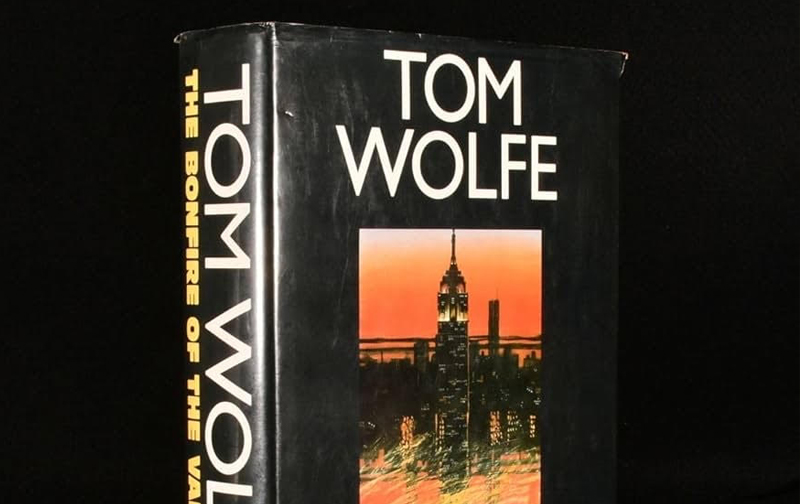
Tom Wolfe’s The Bonfire of the Vanities is a novel that, much like its author, is inseparable from its aesthetic. A book about excess, power, and social stratification in 1980s New York, it is also a work deeply concerned with the way appearances—both personal and literary—define human interactions. Wolfe was a writer who understood that fashion is more than just clothing; it is a language, a symbol, a system of signifiers that extends beyond fabric and into behavior, speech, and ultimately, prose itself. The novel’s characters are dressed as much in their words as they are in their tailored suits and designer dresses, and Wolfe, in his inimitable style, ensures that the text itself has a sartorial flair to match. The novel became a cultural phenomenon not just because of its biting satire but because of the way it captured the essence of a moment when style, wealth, and social climbing were at the heart of American consciousness.
Wolfe’s own personal style was as carefully curated as the world he depicted in his writing. His signature white suits, worn with an almost theatrical consistency, were not just a personal preference but a statement. In an era where journalists prided themselves on blending in, Wolfe chose to stand out, turning himself into a walking contradiction: a dandy chronicling the excesses of dandies, an outsider dressed like the ultimate insider. His fashion choices mirrored his literary approach—bold, performative, and unapologetically detailed. Just as he meticulously documented the sartorial choices of his characters, he embodied the very world he dissected.
Fashion in The Bonfire of the Vanities is not incidental; it is intrinsic to the novel’s themes of power, identity, and deception. Sherman McCoy, the novel’s protagonist, sees himself as a “Master of the Universe,” a title he believes he has earned through his financial prowess, but his status is just as much a product of the way he looks and presents himself. His carefully chosen wardrobe—bespoke suits, Italian shoes, and the casual elegance of a man who believes he has made it—becomes a shield and a weapon. His downfall is marked as much by the unraveling of his appearance as it is by the collapse of his social standing. In a world where status is everything, the right tie or the wrong jacket can mean the difference between admiration and humiliation.
The women of The Bonfire of the Vanities are equally defined by their fashion choices. Maria Ruskin, the Southern belle turned New York socialite, understands that clothing is a form of currency, a way to manipulate perception and wield influence. She drapes herself in designer labels not just for the luxury but for the power they bestow. Her allure is inseparable from her appearance, and she knows it. Meanwhile, Judy McCoy, Sherman’s wife, embodies a more restrained but equally calculated version of fashion. She is the epitome of Upper East Side elegance—expensive but understated, refined but never gaudy. Her clothing reflects the societal role she has been groomed to play: the perfect wife, the pillar of elite New York respectability.
Wolfe’s fascination with fashion extended beyond clothing; he was equally interested in the fashion of language. His writing style, often described as a form of literary maximalism, was as ostentatious and detailed as the characters he portrayed. He rejected the stripped-down, minimalist prose that dominated much of 20th-century American fiction, instead embracing a form of storytelling that was lush, exaggerated, and almost architectural in its construction. His use of onomatopoeia, italics, ellipses, and exclamation points created a rhythm that mimicked the cacophony of the world he depicted. If fashion in The Bonfire of the Vanities was a marker of social standing, then Wolfe’s prose was a kind of sartorial display in itself—grand, embellished, and impossible to ignore.
Critics often debated whether Wolfe’s style was an act of literary brilliance or self-indulgence. Some admired his ability to capture the zeitgeist with such precision, while others dismissed his prose as overwrought. But Wolfe understood something fundamental about storytelling: style is not just an accessory to substance; it is substance. Just as the right suit can define a man’s social status, the right turn of phrase can define a writer’s voice. Wolfe’s writing was designed to be noticed, to stand apart, to refuse the invisibility that so many of his contemporaries sought. He embraced a performative approach to literature, mirroring the very world he was critiquing.
The fashion of The Bonfire of the Vanities was not just about clothing or prose; it was also about criticism itself. When the novel was released, it was met with both acclaim and controversy. Some hailed it as a masterpiece of social satire, while others accused Wolfe of reinforcing the very stereotypes he sought to expose. The literary establishment was divided—was Bonfire a dazzling, unflinching portrait of New York’s elite, or was it an over-the-top caricature that played into sensationalism? Critics who had long been accustomed to more restrained, introspective fiction were unprepared for the sheer scale and audacity of Wolfe’s approach. He was not interested in subtlety; he was interested in spectacle.
Wolfe’s critics often reflected their own biases in their assessments of his work. Some dismissed him as a journalist playing novelist, suggesting that his talent lay in observation rather than true literary craftsmanship. Others, particularly those from the more traditional literary world, bristled at his rejection of minimalism. But what they failed to recognize was that Wolfe was not merely following trends; he was setting them. Just as fashion operates in cycles, with once-dismissed styles returning as revolutionary statements, Wolfe’s approach to storytelling defied convention only to become a model for future generations of writers.
The world of The Bonfire of the Vanities is one in which image is everything, where the right look, the right words, and the right connections determine success or failure. Wolfe understood this deeply, both in the world he depicted and in the world of literature itself. His novel remains a time capsule of an era when Wall Street excess defined America’s cultural landscape, but it is also a timeless exploration of the ways in which fashion—whether in clothing, writing, or public perception—shapes reality. Wolfe’s genius lay in his ability to see that these worlds were not separate but intertwined, that the superficial was often the most revealing, and that style, in all its forms, is never just about appearances.