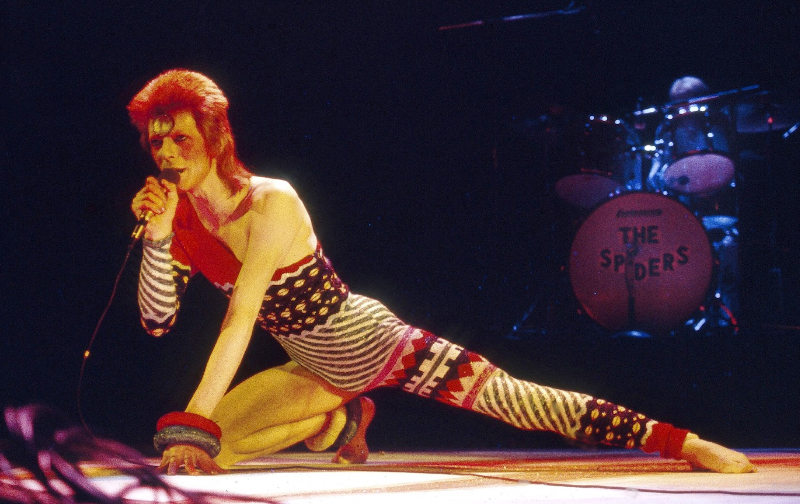
The illusion of difference between men and women has persisted throughout history, reinforced by cultural, religious, and political structures designed to divide humanity into rigid categories. But what if these differences are nothing more than constructs, a script imposed upon us rather than an inherent truth? Glam rock, with its extravagant androgyny, did not merely blur the lines between masculinity and femininity—it exposed those lines as artificial, revealing that identity is not something we are born into but something we perform, revise, and transform.
Simone de Beauvoir once wrote, “One is not born, but rather becomes, a woman.” In this single sentence, she dismantled centuries of essentialist thought that sought to define men and women as fundamentally distinct. If gender is something one becomes, then it is not an absolute state but a process, a negotiation, a performance. Glam rock embodied this philosophy long before it became a formalized theory. Its stars—David Bowie, Marc Bolan, Roxy Music, and the New York Dolls—were not just musicians; they were living works of art, constantly reshaping themselves, refusing to be pinned down by any singular identity. In their glittering jumpsuits, platform boots, and painted faces, they demonstrated that gender was not a fixed truth but an aesthetic playground, an experiment in self-creation.
Judith Butler would later articulate this idea in Gender Trouble, arguing that all gender is a performance, a “stylized repetition of acts” imposed upon the body by cultural norms. Bowie’s shifting personas—from Ziggy Stardust to Aladdin Sane to the Thin White Duke—embodied this concept with dazzling clarity. He did not merely adopt a different stage persona; he became a different person entirely, reinventing himself with every album, proving that identity is something fluid, something chosen, not something inherited. This was not mere spectacle; it was a challenge to the notion that men and women are inherently different. If Bowie could be both masculine and feminine, if Marc Bolan could wear silk blouses and feather boas while still exuding raw sexual charisma, then what did it mean to be a “real man” or a “real woman” at all?
Michel Foucault, in The History of Sexuality, argued that our understanding of gender and identity is not natural but shaped by discourse, by the structures of power that dictate what is considered normal or deviant. Glam rock was a rupture in that discourse. It was an interruption of the rigid narratives that dictated what a man or a woman should look like, behave like, and desire. By stepping onto the stage adorned in sequins and eyeliner, glam rockers exposed the arbitrary nature of these distinctions. They forced audiences to confront an uncomfortable truth: that gender norms are nothing more than conventions, upheld not by biological necessity but by the repetition of societal expectations.
This disruption had profound consequences. The visual rebellion of glam rock translated into broader cultural shifts that challenged traditional masculinity and femininity. It paved the way for punk’s rejection of norms, for the New Romantic movement’s hyper-stylized androgyny, for the rise of gender-fluid fashion in the twenty-first century. Every time a designer sends a model down the runway in a skirt without labeling it “menswear” or “womenswear,” they are echoing the revolution that glam rock set into motion. Every time a musician defies gender norms in their presentation, they are participating in the same tradition of aesthetic subversion.
But glam rock was not just about defying gender—it was about revealing that all identity is a construct. Friedrich Nietzsche, in The Birth of Tragedy, wrote about the power of art to transcend the limitations imposed by society. He saw in the Dionysian revelry of ancient Greece a force that shattered conventional boundaries, a chaotic ecstasy that allowed individuals to become something greater than themselves. Glam rock was, in many ways, a modern embodiment of this Dionysian spirit. It reveled in excess, in theatricality, in the idea that life itself could be a performance. And in doing so, it exposed the roles we are all expected to play as precisely that: roles.
The implications of this go beyond fashion, beyond music, beyond even gender. If the distinctions between man and woman are a performance, then what other categories might also be illusions? National identity, social class, even the concept of the self as a fixed entity—all of these can be questioned, reimagined, discarded. Bowie did not simply challenge gender norms; he challenged the very idea of a stable identity. In constantly reinventing himself, he showed that the self is not a static thing but an evolving work of art.
And yet, even today, the battle rages on. The androgynous revolution of glam rock laid the groundwork for contemporary discussions on gender, but resistance to these ideas remains strong. The backlash against non-binary and gender-fluid identities in politics and media reveals that the norms glam rock sought to disrupt are still deeply entrenched. There are those who cling to the belief that men and women are fundamentally different, that deviation from traditional gender roles is a threat rather than an evolution. But history shows that ideas, once unleashed, cannot be contained.
The spirit of glam rock lives on in every challenge to the gender binary, in every rejection of outdated labels, in every act of aesthetic defiance. It lives on in contemporary artists who refuse to conform, in designers who create without categories, in individuals who recognize that the boundaries imposed upon them are nothing more than illusions. Glam rock’s legacy is not just in its music or its fashion, but in its philosophy. It reminds us that identity is not something given to us but something we create. That there is no fundamental difference between men and women—only the stories we choose to tell ourselves.
To accept this is to embrace true freedom. Not just the freedom to wear what one wants or to express oneself without fear, but the deeper, existential freedom that comes from recognizing that all boundaries are permeable. That we are not defined by the roles society assigns to us but by the possibilities we dare to imagine. That, in the end, we are all artists, shaping and reshaping ourselves in an endless act of creation.
And what could be more human than that?