Kondo has used the term “referential solidity,” for it is clear that this rhetoric/ theory of the self pivots around a spatialized ideology of meaning as reference. Saussure’s influential formulation of the sign as the relation between signifier (the sound-image, “the impression it makes on our senses”) and signified (the concept inside the head, “the psychological imprint of the sound”), links the speaking subject to assumptions about meaning as plenitude, a fullness occupied by certain contents, located inside the self.
Here we find another permutation of the Cartesian dichotomy between reason and sense perception. Self is constituted culturally, but in its presence, supported by the solidity of referential meaning, “the self” takes on the character of an irreducible essence, the Transcendental Signified, a substance which can be distilled out from the specificities of the situations in which people enact themselves.
Such an essence of inner selfhood preserves the boundaries between the inner space of true selfhood and the outer space of the world. The many anthropological accounts reliant on characterizations of la notion de personne, “the concept of self,” with no reference to the contradictions and multiplicities within “a” self, the practices creating selves in concrete situations, or the larger historical, political, and institutional processes shaping those selves, decontextualize and reify an abstract notion of essential selfhood, based on a metaphysics of substance.
Echoing Madama Butterfly’s familiar narrative conventions and satisfying sense of closure, anthropological narratives recirculate tropes of a self/world boundary and a substance/attribute configuration of identity.
However, when we move from the conventions of fixed, essentialist identities in Madama Butterfly to the subversion of those conventions in M. Butterfly, we might go on to ask how selves in the plural are constructed variously in various situations, how these constructions can be complicated and enlivened by multiplicity and ambiguity, and how they shape and are shaped by relations of power.
Such an approach would open out the space of selfhood to the world, dissolving the boundaries and emptying the inner self of its plenitude, spatializing selves as conjunctions of forces produced by history, politics, culture, and narrative conventions, within a changing, complicated, and open discursive field. From clear boundaries between inner and outer, fixed identities characterized by distinctive attributes, and narrative closure to an open, shifting multiplicity of meanings, constituted in and by a changing field of discourses and forces of power, where selves in the plural are empty of reference in an essentialist sense: these are the moves suggested by an analysis of David Henry Hwang’s M. Butterfly.
The play opens with ex-diplomat Rene Gallimard in prison. (His last name, the name of a famous French publishing house, already resonates with notions of narrative and of textual truth, and his first name, which sounds the same in its masculine and feminine forms, underlines the theme of gender ambiguity).
“It is an enchanted space I occupy” (8), he announces, and indeed, it is enchanted-a space of fantasy, a prison of cultural conventions and stereotypes where Gallimard’s insistence on reading a complex, shifting reality through the Orientalist texts of the past make him the prisoner and eventually, the willing sacrificial victim of his own culturally and historically produced conventions.
Gallimard will be seduced, deluded, imprisoned by clinging to an ideology of meaning as reference and to an essentialist notion of identity. For him, clichéd images of gender and of race and geography unproblematically occupy the inner space of identity, enabling opera star Song Liling to seduce him through the play of inner truth and outer appearance.
The first encounter between Song and Gallimard occurs in a performance at the home of an ambassador, where Song plays the death scene from Madama Butterfly. Clothed as a Japanese woman, wearing a woman’s makeup, Song is “believable” as Butterfly.
This “believability” occurs on the planes of gender, size, and geography, when Gallimard gushes to Song about her/his wonderful performance, so convincing in contrast to the “huge women in so much bad makeup” (18) who play Butterfly in the West.
Gallimard adheres to stereotyped images of women and of the Orient, where he assumes a transparent relationship between outer appearance and the inner truth of self. The signs of this identity are clothing and makeup, and since Song is dressed as a woman, Gallimard never doubts Song’s essential femininity.
Gallimard’s equally essentialized readings of the Orient enable Song to throw Gallimard off balance with herlhis initial boldness, when s/he describes the absurdity of Madama Butterfly’s plot, but for the geographic and racial identities of its protagonists: Consider it this way: what would you say if a blonde homecoming queen fell in love with a short Japanese businessman?
He treats her cruelly, then goes home for three years, during which time she prays to his picture and turns down marriage from a young Kennedy. Then, when she learns he has remarried, she kills herself. Now, I believe you would consider this girl to be a deranged idiot, correct? But because it’s an Oriental who kills herself for a Westerner-ah!-you find it beautiful (18).
Later, Song becomes flirtatious, and strategically exhibits the appropriate signs of her inner, essential Oriental female self: modesty, embarrassment, timidity. Gallimard responds, “I know she has an interest in me. I suspect this is her way. She is outwardly bold and outspoken, yet her heart is shy and afraid. It is the Oriental in her at war with her Western education” (25).
Thus, Gallimard reads Song’s Westernized, masculine exterior as mere veneer, masking the fullness of the inner truth of Oriental womanhood. However she may try to alter this substance of identity, in Gallimard’s eyes, she-like Madame Butterfly-will never be able to overcome her essential Oriental nature.
This conventional reading of identity enables Song to manipulate the conventions to further herlhis ends, to become more intimate with Gallimard, and eventually, to pass on to the government of the People’s Republic of China the diplomatic secrets slhe learns in the context of their relationship. When Song first entertains Gallimard in herlhis apartment, Slhe appeals to Orientalist stereotypes of tradition, modesty, unchanging essence, invoking China’s twothousand-year history and the resulting significance of her actions: “Even my own heart strapped inside this Western dress … even it says things…. things I don’t care to hear” (27).
Her/his appeal finds a willing audience in Gallimard, who finds this Song far more to his liking, and shares with the audience his delighted discovery that “Butterfly,” as he has begun to call her, feels inferior to Westerners.
Seeing Song supposedly revealed-paradoxically, in the moment of her greatest concealment-in her feminine/Oriental inferiority, behaving with appropriate submissiveness and docility, Gallimard for the first time finds what he believes to be his true self, as a Real Man defined in opposition to Song.
Wondering whether his Butterfly, like Pinkerton’s, would “writhe on a needle” (28), he refuses to respond to her increasingly plaintive missives, and for the first time feels “that rush of power-the absolute power of a man” (28), as he cleans out his files, writes a report on trade, and otherwise enacts confident masculine mastery in the world of work.
In the phrase “the absolute power of a man,” Hwang highlights the connection between this power and the existence of a symmetrical but inverted opposite, for though presumably Gallimard was by most people’s definitions a man before he met his Butterfly, he can only acquire the “absolute power of a man” in contrast to her.
In love with his own image of the Perfect Woman and therefore with himself as the Perfect Man, Gallimard reads signs of dissimulation-that Song keeps her clothes on even in intimate moments, with appeals to her “shame” and “modesty”-as proofs of her essential Oriental womanhood. In so doing, he guards his inner space of “real, masculine” identity.
Gallimard begins with a conception of gender and racial identity based on an ideology of the inner space of selfhood. The audience, however, is allowed a rather different relationship between inner truth and outward appearance, one that initially preserves the distinction between real, inner self and outer role.
That Song is a Chinese man playing a Japanese woman is a “truth” we know from an early stage. Song plays ironically with this “truth” throughout. Its subtleties are powerfully articulated in a scene where Song is almost unmasked as a man. Gallimard, humiliated by the failure of his predictions in the diplomatic arena, demands to see his Butterfly naked. Song, in a brilliant stroke, realizes that Gallimard simply desires her to submit.
S/he lies down, saying, “Whatever happens, know that you have willed it … I’m helpless before my man” (47). Gallimard relents, and Song wins. Later, Song triumphantly recounts the crisis to Comrade Chin, the PRC emissary and then rhetorically asks her: “Why, in the Peking opera, are women’s roles played by men?” Chin replies, “I don’t know. Maybe, a reactionary remnant of male…” Song cuts her off. “No. Because only a man knows how a woman is supposed to act” (49).
Irony animates these passages. On the one hand, Song is surely a man playing a woman-and his statement is a clear gesture of appropriation. However, Hwang suggests that matters are more complicated, that “woman” is a collection of cultural stereotypes connected tenuously at best to a complex, shifting reality.
Rather than expressing some essential gender identity, full and present, “woman” is a named location in a changing matrix of power relations, defined oppositionally to the name “man.” So constructed by convention and so oppositionally defined is woman, that according to Song, only a man really knows how to enact woman properly. And because man and woman are oppositionally defined terms, reversals of male and female positions are possible.
Indeed, it is at the moment of his greatest submission/humiliation as a woman that Song consolidates his power as a man. S/he puts herself “in the hands of her man,” and it is at that moment that Gallimard relents-and feels for the first time the twinges of love, even adoration.
The vicissitudes of the Cultural Revolution and the signal failure of Gallimard’s foreign-policy predictions send Gallimard home to France, but he keeps a shrine-like room waiting for his Perfect Woman. And in his devoted love, his worship of this image of Perfect Woman, Gallimard himself becomes like a woman.
A dramatic reversal is effected in the play in Act Three through a stunning confrontation, where Song reveals his “manhood” to Gallimard. By this time Song is dressed as a man, but he strips in order to show Gallimard his “true” self. Gallimard, facing Song, is convulsed in laughter, finding it bitterly amusing that the object of his love is “just a man” (65).
Song protests in an important passage that he is not “just a man,” and tries to persuade Gallimard that underneath it all, it was always him-Song-in his full complexity. Gallimard will not be persuaded, however. Clinging to his beloved stereotypes of Oriental womanhood, now supposedly knowing the difference between fantasy and reality, he declares his intention to “choose fantasy” (67).
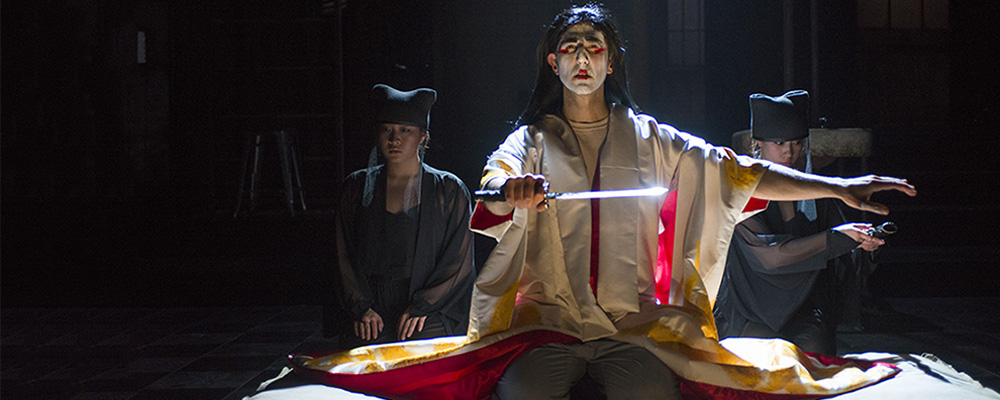
Song announces his disappointment, for his hope was for Gallimard to “become… something more. More like … a woman” (67). Song’s efforts are to no avail, and Gallimard chases Song from the stage. Gallimard returns to his prison cell in a searing finale and launches into a chilling speech as he paints his face with geisha-like makeup and dons wig and kimono.
He speaks of his “vision of the Orient” (68), a land of exotic, submissive women who were born to be abused. He continues: … the man I loved was a cad, a bounder. He deserved nothing but a kick in the behind, and instead I gave him … all my love. Yes-love. Why not admit it all. That was my undoing, wasn’t it? Love warped my judgment, blinded my eyes, rearranged the very lines on my face … until I could look in the mirror and see nothing but … a woman (68).
Gallimard grasps a knife and assumes the seppuku position, as he reprises lines from the Puccini opera: Death with honor is better than life … life with dishonor (68). He continues: The love of a Butterfly can withstand many things … unfaithfulness, loss, even abandonment.
But how can it face the one sin that implies all others? The devastating knowledge that, underneath it all, the object of her love was nothing more, nothing less than … a man. It is 1988. And I have found her at last. In a prison on the outskirts of Paris. My name is Rene Gallimard-also known as Madame Butterfly (68, 69).
Gallimard plunges the knife into his body and collapses to the floor. Then, the coup de grace. A spotlight focuses dimly on Song, “who stands as a man” (69) atop a sweeping ramp. Tendrils of smoke from his cigarette ascend toward the lights, and we hear him say “Butterfly?” as the stage darkens.
This stunning gender/racial power reversal forces the audience toward a fundamental reconceptualization of the topography of identity. “True” inner identity is played with throughout, then seemingly preserved in the revelation of Song’s “real” masculinity, then again called into question with Gallimard’s assumption of the guise of Japanese woman.
Whereas the death of Madame Butterfly in Puccini’s opera offers us the satisfaction of narrative closure, Gallimard’s assumption of the identity of a Japanese woman is radically disturbing, for in this move Hwang suggests that gender identity is far more complicated than reference to an essential inner truth or external biological equipment might lead us to believe.
As Foucault has noted, sex as a category gathers together a collection of unrelated phenomena in which male and female are defined oppositionally in stereotyped terms and posits this discursively produced difference as natural sexual difference.
M. Butterfly deconstructs that naturalness, opening out the inner spaces of true gender identity to cultural and historical forces, where identity is not an inner space of truth but a location in a field of shifting power relations.
Perhaps what Hwang might further emphasize is the inadequacy of either gender category to encompass a paradoxical and multiplicitous reality. The key statement here is Song’s, that he is more than “just a man.” In the stage directions, Song at the end “stands as a man” (69) in the clothing and the confident, powerful guise of a man.
But we cannot say with certainty that he is a man, for man is an historically, discursively produced category which fails to accommodate Song’s more complex experience of gender and subverts that ontological claim. Song attempts to persuade Gallimard to join him in a new sort of relationship, where Song is more like a man, Gallimard more like a woman.
At precisely this point Hwang suggests the inability of the categories of man and woman to account for the multiple, changing, power-laden identities of his protagonists. Gallimard refuses, saying that he loved a woman created by a man, and that nothing else will do.
Song thereupon accuses him of too little imagination. Gallimard immediately retorts that he is pure imagination, and on one level, he is right. In his obsession with the Perfect Oriental Woman, he truly remains the prisoner and then the willing sacrificial victim of his Orientalist cultural cliches-a realm of pure imagination indeed.
But this distinction between imagination and reality itself erects the bar between categories and fails to open those mutually exclusive spaces to irony, creativity, and subversion. The last word rests with Song, and in the end, his interpretation prevails: that Gallimard has too little imagination to accept the complexity and ambiguity of everyday life, too little imagination to open himself to different cultural possibilities, blurred boundaries, and rearrangements of power.
One might also argue that Gallimard’s refusal arises from his attempt to keep erect his boundaries as a heterosexual man. Gallimard’s lack of imagination appears in part to be a homophobic retreat, and there is a level at which Hwang seems to suggest that gay relationships offer the greatest potential for gender subversion.
Yet, upon inquiry, Hwang further complicates matters by refusing us the comfort of conventional binaristic categories: To me, this is not a ‘gay’ subject because the very labels heterosexual or homosexual become meaningless in the context of this story. Yes, of course this was literally a homosexual affair.
Yet because Gallimard perceived it or chose to perceive it as a heterosexual liaison, in his mind it was essentially so. Since I am telling the story from the Frenchman’s point of view, it is more specificially about ‘a man who loved a woman created by a man.’ To me, this characterization is infinitely more useful than the clumsy labels ‘gay’ or ‘straight.’
Hwang once again forces us to confront the pervasive, essentialist dualisms in our thinking and argues instead for historical and cultural specificity that would subvert the binary. Literary critics and readers of French literature will note the striking parallels between the tale of M. Butterfly and the Balzac short story, “Sarrasine,” the object of Roland Barthes’s S/Z and of Barbara Johnson’s essay, “BartheS/BaIZac.”
Both Sarrasine and Gallimard commit the same errors of interpretation in pursuing their objects of desire. Sarrasine, a sculptor, falls in love with an Italian opera singer, his image of the perfect woman. But La Zambinella is a castrato.
Sarrasine, a newcomer to Italy, is ignorant of this custom, and he pays for his ignorance, his passion, and his misinterpretation with his life, victim to the henchmen of the powerful Cardinal who is La Zambinella’s protector. Gallimard and Sarrasine are almost perfect mirrors for one another.
Signs of beauty and timidity act as proofs to both men that the objects of their love are indeed women. Both flee strong women. In Gallimard’s case, this takes the form of escape via a brief affair with another refraction of himselflhis fantasy, a young Western blonde also named Renee, who enacts a symbolic castration by commenting on his “weenie” and advancing her theory of how the world is run by men with “pricks the size of pins.”
But for Gallimard as for Sarrasine, “it is for having fled castration” (175) that they will be castrated. Both men are unmanned as the world laughs at their follies. And both are undone by their view of gender as symmetrical inversions of mirrored opposites.
For both, their own masculinity is defined in contrast to a perfect woman who is a collection of culturally conventional images, and each crafts the Other to conform to those conventions. Neither Gallimard nor Sarrasine is capable of really recognizing another, for in their insistence on clinging to their cherished stereotypes, both love only themselves.
In both cases, the truth kills. Clearly, the parallels are stunning. But Hwang does not allow us to stop there. Like these literary critics, Hwang offers us a provocative reconsideration of the construction of gender identity as an inner essence.
But for him, a challenge to logocentric notions of voice, of referentiality, of identity as open and undecidable, is only a first step. Hwang opens out the self, not to a free play of signifiers, but to a play of historically and culturally specific power relations.
Through the linkage of politics to the relationship between Song and Gallimard, Hwang leads us toward a thoroughly historicized, politicized notion of identity, not understandable without reference to narrative conventions, global power relations, gender, and the power struggles people enact in their everyday lives.
These relations constitute the spaces of gender, but equally important, the spaces of race and imperialism played out on a world stage. A double movement is involved here. As Hwang deploys them, Song’s words open out the categories of the self and the personal or private domain of love relationships to the currents of world historical power relations.
Simultaneously, Hwang associates gender and geography, showing the Orient as supine, penetrable, knowable in the intellectual and the carnal senses. The play of signifiers of identity is not completely arbitrary; rather it is overdetermined by a constitutive history, a history producing narrative conventions like Madama Butterfly.
Hwang effects this double movement and plays with the levels of personal and political by situating Gallimard and Song historically, during the era of the Vietnam War and the Cultural Revolution, taking them up to the present. In so doing, he draws parallels between the relations of Asian woman and Western man and of Asia and the West.