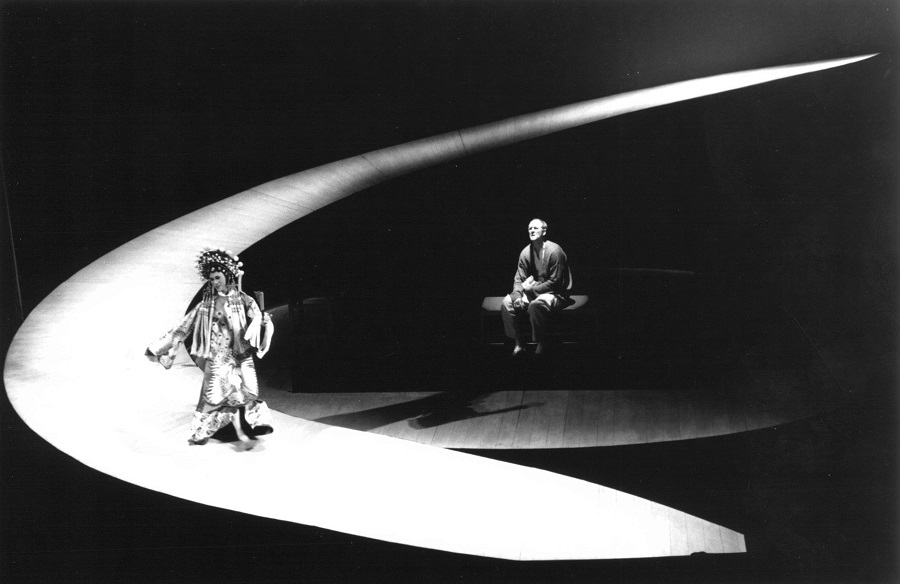
In David Henry Hwang’s Tony award-winning play, M. Butterfly, Broadway audiences encounter a dazzling spectacle, in which a tale of seemingly mistaken gender identities and delusions perpetuated over decades occasions a richly textured production moving in and around the spaces of global politics, gender and racial identities, and the power relations inevitably present in what we call love.
A close examination of M. Butterfly has profound implications for our assumptions about identity, including anthropological theories of the self or the person, the ways gender and race are mutually implicated in the construction of identity, and the pervasive insidiousness of gender and racial stereotypes.
The story intrigues through its sheer improbability. The playwright’s notes cite the New York Times, which in May of 1986 reported the trial of a “former French diplomat and a Chinese opera star” who were “sentenced to six years in jail for spying for China after a two-day trial that traced a story of clandestine love and mistaken sexual identity…. Mr. Bouriscot was accused of passing information to China after he fell in love with Mr. Shi, whom he believed for twenty years to be a woman.
In asking himself how such a delusion could be sustained for so long, Hwang takes us through the relations between France and Indochina, and most especially, through the terrain of written images of “the Orient” occupied most centrally by that cultural treasure, Madama Butterfly. These already written images-the narrative convention of “submissive Oriental woman and cruel white man”-are played out in many different arenas, including, perhaps most tellingly, the space of fantasy created and reproduced by the Frenchman himself.
An analysis of M. Butterfly suggests the ways Hwang challenges our very notions of words like “truth,” our assumptions about gender, and most of all, how M. Butterfly subverts and undermines a notion of unitary identity based on a space of inner truth and the plenitude of referential meaning.
Through its use of gender ambiguity present in its very title-is it Monsieur, Madame, Mr., Ms. Butterfly? – through power reversals, through constituting these identities within the vicissitudes of global politics, Hwang conceals, reveals, and then calls into question so-called “true” identity, pointing us toward a reconceptualization of the topography of “the self.” Rather than a bounded essence, filled with “inner truth,” separated from the world or “society” by an envelope of skin, M. Butterfly opens out the self to the world, softening or even dissolving those boundaries, where identity becomes spatialized as a series of shifting nodal points constructed in and through fields of power and meaning.
Finally, M. Butterfly intertwines geography and gender, where East/West and male/female become mobile positions in a field of power relations. It suggests that analyses of shifting gender identity must also take into account the ways gender is projected onto geography, and that international power relations and race are also, inevitably, inscribed in our figurations of gender.
Perhaps the creative subversiveness of Hwang’s play best emerges in contrast to the conventions of the opera Madama Butterfly, to which it provides ironic counterpoint. This cultural “classic”-music by Giacomo Puccini, libretto by Giuseppe Giacosa and Luigi Illica, based on a story by John Luther Longdebuted at La Scala in 1904.
It remains a staple of contemporary opera company repertoire, one of the ten most performed operas around the world. As we will see, Hwang reappropriates the conventional narrative of the pitiful Butterfly and the trope of the exotic, submissive Oriental woman, rupturing the seamless closure and the dramatic inevitability of the story line.
The conventional narrative, baldly stated, goes something like this. Lieutenant Benjamin Franklin Pinkerton is an American naval officer, stationed on the ship Abraham Lincoln in Nagasaki during the Meiji period, the tum of the century when Japan was “opened” to the West.
The opera begins with Pinkerton and Goro, a marriage broker, as they look over a house Pinkerton will rent for himself and his bride-to-be, a fifteen-year-old geisha named Cho-Cho-san (“butterfly” in Japanese). American consul Sharpless arrives, and Pinkerton sings of his hedonistic philosophy of life, characterizing himself as a vagabond Yankee who casts his anchor where he pleases.
“He doesn’t satisfy his life/if he doesn’t make his treasurelthe flowers of every region…the love of every beauty.,, Pinkerton toasts his upcoming marriage by extolling the virtues of his open-ended marriage contract: “So I’m marrying in the Japanese way/for ninehundred-ninety-nine yearslFree to release myself every month” (189).
Later, he toasts “the day when I’ll marry/ln a real wedding, a real American wife” (191). When Butterfly arrives with an entourage of friends and relatives, Pinkerton and Sharpless discover that among the treasures Butterfly carries with her into her new home is the knife her father used for his seppuku, or ritual suicide by disembowelment-and music foreshadows the repetition that will inevitably occur.
Friends and relatives sing their doubts about the marriage, and in a dramatic moment, Butterfly’s uncle, a Buddhist priest, enters to denounce her decision to abandon her ancestors and adopt the Christian religion. Rejected by her relatives, Butterfly turns to Pinkerton. The couple sing of their love, but Cho-chosan expresses her fear of foreign customs, where butterflies are “pierced with a pin” (215).
Pinkerton assures her that though there is some truth to the saying, it is to prevent the butterfly from flying away. They celebrate the beauty of the night. “All ecstatic with love, the sky is laughing” (215), says Butterfly as they enter the house and Act One closes. By the beginning of Act Two, Pinkerton has been gone for three years.
Though on the verge of destitution, Butterfly steadfastly awaits the return of her husband, who has promised to come back to her “when the robin makes his nest” (219). And, known only to her servant, Suzuki, Cho-cho-san has had a baby, a son with occhi azzurini, “azure eyes,” and i ricciolini d’oro schietto, “little curls of pure gold”-truly a stunning genetic feat.
The consul Sharpless comes to call, bearing a letter from Pinkerton, and he informs Butterfly that her waiting is in vain, that Pinkerton will not return and that she should accept the marriage proposal of the Prince Yamadori who has come to court her. Still sure of her husband, she will have none of it. In Cho-cho-san’s eyes, she is no longer Madame Butterfly, but Mrs. Pinkerton, bound by American custom.
In desperation, hoping the consul will persuade Pinkerton to return, Cho-Cho-san brings out her son. At that point Pinkerton is in fact already in Nagasaki with his American wife. Knowing that he is in port, Butterfly and Suzuki decorate the house with flowers, and Butterfly stays awake all night, awaiting Pinkerton’s arrival. In the morning, when Suzuki finally persuades her mistress to rest, Sharpless and Pinkelton arrive.
Pinkerton has decided to claim his son and raise the boy in America, and he persuades Suzuki to help him convince Butterfly that this is for the best. Later, Cho-cho-san sees Sharpless and an American woman in the garden. Now, realizing that Pinkerton has in fact married again, Cho-cho-san cries out with pain, “All is dead for mel/All is finished, ahl” (253) and she prepares for the inevitable. She tells Sharpless to come with Pinkerton for the child in half an hour.
Cho-cho-san unsheathes her father’s dagger, but then spies her son, whom Suzuki has pushed into the room. In her agony, the music forces her higher and higher, as her voice threatens to soar out of control and then sinks to an ominous low note. Cho-cho-san blindfolds her child, as if to play hide-and-seek, goes behind a screen to insert the knife and emerges, staggering toward the child.
The brass section accompanies her death agony, trumpeting vaguely Asiansounding music until finally, climactically, a gong signals her collapse. We hear Pinkerton’s cries of “Butterflyl” as Pinkerton and Sharpless run into the room. Butterfly points to the child as she dies, and the opera resolves in a swelling, tragic orchestral crescendo.
In Madama Butterfly Puccini draws on and recirculates familiar tropes: the narrative inevitability of a woman’s death in operas and most especially, the various markers of Japanese identity: Butterfly as geisha, that quintessential Western figuration of Japanese woman, the manner of Butterfly’s death, by the knife-the form of suicide conventionally associated in the West with Japan, the construction of the Japanese as a “people accustomed/to little things/humble and silent” (213).
And little is exactly what Butterfly gets. In Western eyes, Japanese women are meant to sacrifice, and Butterfly sacrifices her “husband,” her religion, her people, her son, and ultimately, her very life. The beautiful, moving tragedy propels us toward narrative closure, as Butterfly discovers the truth-that she is, indeed, condemned to die as her identity as a Japanese geisha demands-an exotic object, a “poor little thing,” as Kate Pinkerton calls her.
In Puccini’s opera, men, women, Japanese, Americans, are all defined by familiar narrative conventions. And the predictable happens: West wins over East, Man over Woman, White over Asian. The music, with its soaring arias and bombastic orchestral interludes, amplifies the points and draws us into further complicity with convention.
Butterfly is forced into tonal registers that edge into a realm beyond rational control, demanding a resolution which arrives, (porno)graphically, with the crash of the gong. Music and text collaborate, to render inevitable this tragic-but oh-so-satisfying denouement: Butterfly, the little Asian woman, crumpled on the floor. The perfect closure.
Identities, too, are unproblematic entities in Puccini’s opera; indeed, Puccini reinforces our own conventional assumptions about personhood. Butterfly’s attempts to blur the boundaries and to claim for herself a different identity-that of American-are doomed to failure. She is disowned by her people, and she cleaves to Pinkerton, reconstituting herself as American, at least in her own eyes.
But the opera refuses to allow her to “overcome” her essential Japanese womanhood. The librettists have Butterfly say things and do things that reinforce our stereotyped notions of the category “Japanese woman”: she is humble, exotic, a plaything. Pinkerton calls her a diminutive, delicate “flower,” whose “exotic perfume” (199) intoxicates him. His bride, this child woman with “long oval eyes” (213), makes her man her universe.
And like most Japanese created by Westerners, Butterfly is concerned with “honor” and must kill herself when that honor has been sullied. Death, too, comes in the stereotypical form. Her destiny is to die by the knife metaphorically, via sexual penetration, and finally, in her ritual suicide.
Butterfly is defined by these narrative conventions; she cannot escape them. Dorinne Kondo would suggest that this view of identity-a conventional view familiar to us in our everyday discourses and pervasive in the realm of aesthetic production-is based on a particular presupposition about the nature of identity, what philosophers call “substance metaphysics.”
Identities are viewed as fixed, bounded entities containing some essence or substance, expressed in distinctive attributes. Thus Butterfly is defined by attributes conventionally associated in Western culture with Asian–or even worse, “Oriental”-women.
Furthermore, Kondo argues that a similar view of identities underlies the burgeoning anthropological literature on what we call the self or the person. “The self” carries a highly culturally specific semantic load and presents apicture of unitary totality.
According to our linguistic and cultural conventions, “self’ calls up its opposing term, “society,” and presupposes a particular topography: a self, enclosed in a bodily shell, composed of an inner essence associated with truth and real feelings and identity, standing in opposition to a world that is spatially and ontologically distinct from the self. A self is closed, fixed, an essence defined by attributes. Typically, the many anthropological analyses of La notion de personne, the concept of self in this or that culture, abstract from specific contexts certain distinctive traits of the self among the Ilongot, the Ifaluk, the Tamils, the Samoans, the Americans.
And even those analyses which claim to transcend an essentialist notion of identity and a self/society distinction by arguing for the cultural constitution of that self tend to preserve the distinction in their rhetoric. That one can even talk of a concept of self divorced from specific historical, cultural, and political contexts privileges the notion of some abstract essence of selfhood we can describe by enumerating its distinctive features. This self/society, substance/attribute view of identity underlies anthropological narratives just as it informs aesthetic productions like Madama Butterfiy.
The self/society, subject/world tropes insidiously persist m a multiplicity of guises in the realms of theory and literature, but in anthropology, the literature on the self has transposed this opposition into another key: the distinction between a person-a human being as bearer of social roles-and self-the inner, reflective essence of psychological consciousness, recapitulating the binary between social and psychological, world and subject.
Yet anthropology deconstructs this binary even as it maintains its terms, for in demonstrating the historical and cultural specificity of definitions of the person or the self, we are led to a series of questions: Are the terms “self’ and “person” the creations of our own linguistic and cultural conventions? If “inner” processes are culturally conceived, their very existence mediated by cultural discourses, to what extent can we talk of “inner, reflective essence” or “outer, objective world” except as culturally meaningful, culturally specific constructs?
And how is the inner/outer distinction itself established as the terms within which we must inevitably speak and act? Early studies of the person, like the classic Marcel Mauss essay, take as a point of departure La notion de personne as an Aristotelian category, an example of one of the fundamental categories of the human mind.
Traversing space and time, Mauss draws our attention to different ways of defining persons and selves in different cultures in different historical moments, but posits the evolutionary superiority of Western notions of the same. In a key passage, Mauss discusses the notion of the self:
Far from existing as the primordial innate idea, clearly engraved since Adam in the innermost depths of our being, it continues here slowly, and almost right up to our own time, to be built upon, to be made clearer and more specific, becoming identified with self-knowledge and the psychological consciousness. Western conceptions of self as psychological consciousness and a reflexive selfawareness, based on a division between the inner space of selfhood and the outer world, are held up as the highest, most differentiated development of the self in human history.
Though Mauss’s insights have been elaborated in richly varied ways, most anthropological analyses leave in place the rhetoric of the self as psychological consciousness and self-knowledge, continuing to impart the impression of implicit ethnocentric superiority, essential unity, and referential solidity.