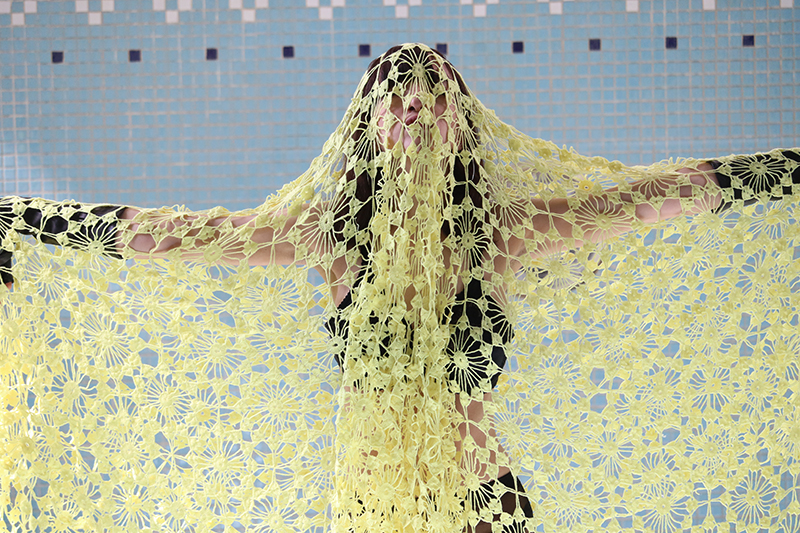
Fashion, in its myriad forms, is not merely a collection of textiles or transient trends but rather a profound language through which we articulate our inner lives and engage with the world. It serves as a living philosophy—a dialogue between the self and the ever-changing cosmos, a delicate interplay of art, thought, and lived experience. In conceptual fashion, every fabric, every cut, and every design element becomes an act of inquiry, a deliberate challenge to established conventions, and an invitation to examine the nature of beauty, identity, and truth. As Socrates once proclaimed, “The unexamined life is not worth living,” and so too does fashion demand that we look beyond superficial appearances to confront the essence of our existence.
At its core, fashion represents a conversation between the past and the future, between the visible and the ineffable. It is a medium in which the unspoken ideas of our inner world are given shape and form. Friedrich Nietzsche once said, “We have art in order not to die of the truth,” a sentiment that finds resonance in the realm of conceptual fashion where garments become more than mere adornments—they transform into vehicles for expressing the raw realities of our condition. Each creation is a testament to the transformative power of art; it is both a shield and a mirror, concealing as much as it reveals, a constant reminder that the boundaries between appearance and essence are not fixed but ever fluid.
Historically, the evolution of fashion has been intertwined with the evolution of human thought. In ancient times, clothing denoted status, power, and identity. Over centuries, as philosophical ideas evolved, so too did the meanings attached to what we wear. The Enlightenment ushered in an era that prized reason, individuality, and personal expression over rigid tradition. This shift echoes Jean-Paul Sartre’s observation that “Man is condemned to be free”—the freedom to choose one’s attire mirrors the broader existential quest for self-definition. In a society that often imposes predetermined roles and identities, the act of dressing is nothing short of revolutionary, a daily exercise in carving out one’s unique space in an ever-changing world.
In the modern era, technology and digital culture have further blurred the lines between the tangible and the abstract, inviting us to reconsider our very notions of reality. As Michel Foucault once noted, “Where there is power, there is resistance.” Within fashion, this resistance takes shape in the subversion of traditional norms, in bold experiments that disrupt conventional aesthetics, and in a celebration of difference that defies the pressures of conformity. Conceptual designers, often regarded as modern philosophers, create garments that provoke questions rather than offer easy answers. Their work is imbued with the belief that every choice—whether it is a daring cut, an unexpected texture, or an unconventional pairing of colors—is an act of defiance and a step toward articulating a more inclusive and honest narrative of self.
The dialogue between art and life is at the heart of conceptual fashion. Designers are no longer content to produce clothing solely for commercial success; they view their work as an exploration of ideas, a way to interrogate the world and invite viewers to join in that inquiry. As Simone de Beauvoir famously remarked, “One is not born, but rather becomes, a woman.” This notion, which has transcended gender to encompass the fluidity of identity in general, underscores the idea that our identities are not fixed entities but are continuously constructed and reconstructed through the choices we make, including the very choices of how we present ourselves. In conceptual fashion, this construction is made visible—a deliberate act of creation that challenges normative binaries and encourages us to question the nature of authenticity.
Art, in this context, becomes both a means of liberation and a form of resistance. Every garment is a statement—a carefully composed narrative that fuses the aesthetic with the political, the personal with the universal. The minimalist approaches seen in some contemporary designs evoke Zen philosophies that extol the virtues of simplicity and the beauty of emptiness. Lao Tzu’s teachings remind us that “Less is more,” a principle that transforms even the most understated garment into a profound meditation on the nature of existence. In stark contrast, the exuberant maximalism found in other designs reflects a celebration of multiplicity and the complexity of modern life. Bold colors, intricate patterns, and elaborate details create a tapestry of meaning that challenges the viewer to see beyond the superficial and engage with the deeper layers of symbolism embedded in each piece.
Yet, the aesthetic choices made by designers are not merely exercises in formal beauty; they are reflective of deeper philosophical inquiries into the nature of identity, memory, and temporality. Every piece of clothing is steeped in cultural resonance, drawing upon a rich heritage of symbols, rituals, and traditions. The integration of traditional motifs with modern design elements is not a nostalgic attempt to recapture the past but a deliberate act of synthesis—a way of bridging history with the present, of honoring what has been while simultaneously envisioning what could be. Hegel’s notion of history as a dialectical process, wherein conflicting ideas merge to form higher truths, finds a fitting analogue in the way fashion melds the old with the new, the conventional with the radical.
This interplay of tradition and innovation is a constant reminder that fashion, like life, is in a perpetual state of becoming. Heraclitus, the ancient philosopher, observed that “No man ever steps in the same river twice,” encapsulating the idea that change is the only constant. In the fast-paced world of fashion, where trends rise and fall with breathtaking speed, this idea becomes palpable—a daily reinvention of identity that reflects the transient yet transformative nature of our existence. The very act of dressing becomes a metaphor for life’s continual flux, a momentary pause in an ever-evolving journey where every choice is both a statement of who we are and a glimpse of who we might become.
The transformative potential of fashion is further amplified by its ethical dimensions. In today’s world, where the environmental and social impacts of consumption are more evident than ever, the fashion industry faces profound questions about responsibility, sustainability, and the true meaning of value. The fast fashion phenomenon, with its emphasis on rapid production and disposability, stands in stark opposition to the timeless ideals of thoughtful design and deliberate creation. Here, fashion becomes a canvas for ethical inquiry—a call to reimagine the entire process of production and consumption. Every choice, from the sourcing of raw materials to the techniques of fabrication, carries moral implications that extend far beyond the immediate realm of aesthetics. The existential perspective reminds us that meaning is not inherent but must be actively constructed through our actions, and in this way, each sustainable design is an act of rebellion against a system that prioritizes profit over planet. It is a testament to the belief that true beauty is not only seen but felt—a beauty that is ethical, responsible, and deeply resonant with the principles of justice and compassion.
The relationship between fashion and technology also invites a host of philosophical reflections. The digital revolution has redefined how we create, experience, and understand art in ways that were once unimaginable. Virtual runways, computer-generated garments, and augmented reality experiences are not mere novelties; they are harbingers of a new era in which the boundary between the physical and the digital is increasingly blurred. Marshall McLuhan’s adage, “The medium is the message,” acquires new depth in this context, for it is not only the design that matters but also the way it is experienced. As we navigate this brave new world, our perception of reality is constantly challenged by the interplay of virtual images and tangible objects. The result is a reimagining of what it means to be authentic in a world where the real and the simulated coexist in a delicate balance. Conceptual fashion, by embracing these technological innovations, becomes a powerful medium for interrogating the nature of reality, identity, and creativity itself.
Within this digital landscape, the role of social media has emerged as a democratizing force, breaking down traditional barriers and allowing voices from every corner of the globe to contribute to the global dialogue on style and aesthetics. This newfound inclusivity is not without its challenges; it raises profound questions about the nature of influence, the dynamics of power, and the ways in which cultural narratives are constructed and disseminated. Yet, it is also a celebration of the diversity and richness of human expression—a recognition that beauty is not the exclusive domain of the few but a universal language that speaks to us all. In this interconnected network, every post, every shared image, every comment becomes a small yet significant act of creative expression—a pixel in a vast mosaic of global culture that continuously evolves and redefines itself. It is a living, breathing manifestation of the idea that art, in its most democratic form, is a collaborative, ever-unfolding process.
The philosophical dimensions of fashion extend into the realm of personal identity, where the act of dressing is a form of self-creation and self-discovery. Every morning, as we choose the garments that will accompany us through the day, we engage in a subtle yet profound exercise of constructing our identities. This act is imbued with the spirit of existential freedom—an affirmation of our ability to define ourselves despite the pressures of societal norms. Judith Butler’s assertion that “gender is performative” underscores the notion that identity is not an inherent quality but a series of choices and performances that we continuously negotiate. In conceptual fashion, this idea is made explicit as designers create clothing that defies binary classifications, offering new ways to express the fluidity and multiplicity of identity. Each outfit is an act of self-determination—a personal manifesto that declares who we are, who we want to be, and how we choose to interact with the world around us.
The interplay between fashion and memory further enriches its philosophical tapestry. Every garment carries with it a story—a narrative woven from the threads of personal history, cultural heritage, and shared experience. The worn texture of a vintage piece, the faded color of a cherished scarf, or the intricate detailing of an heirloom garment can evoke memories that transcend time, connecting us to moments, places, and people that have shaped our lives. Marcel Proust once mused that “the real voyage of discovery consists not in seeking new landscapes but in having new eyes.” In fashion, this insight takes on a literal form: by looking at clothing not merely as objects but as repositories of memory and emotion, we are invited to see the world with renewed sensitivity, to appreciate the delicate interplay of past and present, and to recognize that every moment of beauty is a bridge between what was and what can be.
This dialogue between memory and innovation is a hallmark of conceptual fashion—a field in which the familiar is constantly reinterpreted in light of contemporary sensibilities. Designers draw upon historical references and cultural symbols to create works that are both rooted in tradition and boldly forward-looking. The result is a dynamic fusion of old and new, a testament to the idea that every act of creation is a dialogue between the finite and the infinite, between the ephemeral moment and the timeless continuum of human creativity. It is a reminder that while trends may come and go, the deeper truths that underpin art and beauty endure—echoing across generations, cultures, and epochs.
In parallel with these reflections on memory, technology, and identity, the ethics of fashion have become an increasingly urgent and central concern. In today’s world, where environmental degradation and social inequities are pressing challenges, the fashion industry is compelled to confront its own practices and to reimagine the relationship between production, consumption, and responsibility. The rise of sustainable and ethical fashion movements is a powerful manifestation of this philosophical shift—a recognition that beauty and creativity must be harmonized with care for the planet and its inhabitants. This ethical dimension calls for a reexamination of our values, urging us to consider not only the aesthetic appeal of a design but also its broader impact on society and the environment. It is an invitation to adopt a more mindful, reflective approach to creativity—one that acknowledges that every stitch, every dye, every choice of material is imbued with moral significance. In this light, conceptual fashion is not merely a celebration of style but a potent force for social and environmental transformation, a call to action that challenges us to create a future that is as sustainable as it is beautiful.
Beyond these practical considerations, the philosophical inquiry into fashion opens up profound questions about the nature of perception and the construction of reality. Our experience of beauty is deeply subjective, shaped by individual sensibilities, cultural contexts, and the interplay of light and shadow. Immanuel Kant argued that beauty is not an objective quality but a product of our aesthetic judgment—a harmony between the form of an object and the imaginative faculties of the observer. In conceptual fashion, this subjective experience is both embraced and celebrated, as designers deliberately create works that invite multiple interpretations and that resist definitive categorization. Every garment, every design, is a text—a layered narrative that speaks to different viewers in different ways, provoking a multitude of responses and emotions. This openness to interpretation is what makes conceptual fashion a living, breathing philosophy, one that continually challenges us to reconsider our assumptions and to find beauty in the unexpected.
As we traverse this vast landscape of ideas, we are also drawn to the transformative role of imagination—a force that lies at the very heart of both art and philosophy. Imagination is the wellspring of creativity; it is the power that enables us to envision possibilities beyond the confines of the present moment. In the realm of conceptual fashion, imagination takes on a concrete form, as designers harness it to create garments that are not only visually striking but also conceptually rich. Their work is a manifestation of the belief that art, in its truest form, is a way of accessing and expressing the ineffable—a way of capturing the fleeting moments of inspiration that define our human experience. As J.K. Rowling once observed, “Imagination is not only the uniquely human capacity to envision that which is not, and therefore the fount of all invention and innovation, but it is also the power that enables us to empathize with others.” In this sense, every act of creative expression in fashion is an act of empathy—a means of forging connections between disparate individuals, of speaking to the shared hopes and dreams that unite us all.
This empathy, this capacity to see the world through another’s eyes, is perhaps one of the most profound gifts of conceptual fashion. It is a reminder that art is inherently relational, that the beauty of a design is enhanced by the connections it inspires between people from all walks of life. In an era marked by fragmentation and division, fashion has the potential to serve as a bridge—a way of uniting us in our common humanity and of reminding us that, despite our many differences, we all share the same fundamental longing for beauty, meaning, and understanding. This vision of unity is not merely an ideal but a practical imperative—a call to embrace diversity and to create spaces where every voice, every perspective, is valued and heard.
The expansive realm of conceptual fashion is thus a microcosm of the broader philosophical inquiry into what it means to live a meaningful, authentic life. It is a discipline that continually challenges us to break free from the confines of convention, to question the established norms, and to embrace the fluid, ever-changing nature of our own identities. In every carefully constructed design, in every bold experiment with form and color, there is an invitation to explore the infinite possibilities of existence—a call to see beyond the surface and to recognize that the true power of art lies in its ability to transform our perceptions, to spark our imaginations, and to illuminate the path to a more inspired, compassionate world.
As we conclude this long and winding journey—a journey that is itself a reflection of the endless interplay between fashion and philosophy—we are left with the enduring realization that our creative endeavors are not isolated acts of self-expression but are integral components of a larger, collective narrative. A narrative that spans time and space, that draws upon the wisdom of ancient philosophers and the innovative visions of modern designers, and that continues to evolve with every new idea, every new creation, every new moment of inspired insight. In the grand tapestry of life, every garment is a thread, every design a stroke of genius, and every act of self-expression a testament to the boundless potential of the human spirit.
The philosophy of conceptual fashion is, therefore, a celebration of the eternal dance between art and life—a dance that invites us to explore, to question, and to dream. It is a reminder that beauty is not a static ideal but an ever-evolving process—a continuous unfolding of ideas, emotions, and experiences that defies easy definition. It is a call to live with passion, to embrace creativity in all its forms, and to recognize that every choice we make—no matter how small—is a part of a grand, unfolding narrative of human expression. In every garment we wear, every design we admire, and every creative act we undertake, there lies the potential to reshape our world, to inspire new ways of thinking, and to forge a future that is as compassionate as it is innovative.
In this unending dialogue between fashion and philosophy, we are reminded that the journey of creative expression is a journey without end—a journey that challenges us to continually rediscover ourselves, to reimagine our surroundings, and to embrace the limitless possibilities that lie within the realm of art. And as we carry these ideas forward into our everyday lives, we are invited to see the world not merely as a collection of objects or trends, but as a vibrant, ever-changing tapestry of meaning—a tapestry in which every thread is a testament to the power of human creativity and the enduring quest for beauty, truth, and connection.
Ultimately, what emerges from this extensive exploration is the profound truth that fashion, at its core, is not simply about what we wear but about the stories we tell, the identities we forge, and the dreams we dare to dream. It is a philosophy—a living, breathing form of art—that challenges us to embrace the unknown, to celebrate our differences, and to recognize that every moment of creative expression is a step towards a more enlightened, compassionate, and beautiful world. In the final analysis, the language of fashion is the language of life itself—a language that speaks to the heart of our humanity, that bridges the gap between the tangible and the abstract, and that continues to inspire us to create, to connect, and to transcend the limitations of our everyday existence.
May this journey into the philosophy of conceptual fashion serve as a reminder that every stitch, every fold, every daring design is an act of defiance against the mundane—a declaration of our infinite capacity for creativity, love, and transformation. And as we continue to explore and celebrate the boundless possibilities of this remarkable art form, let us do so with open hearts, curious minds, and a steadfast commitment to shaping a future where beauty and meaning are cherished, not as fleeting trends, but as timeless expressions of the human spirit.