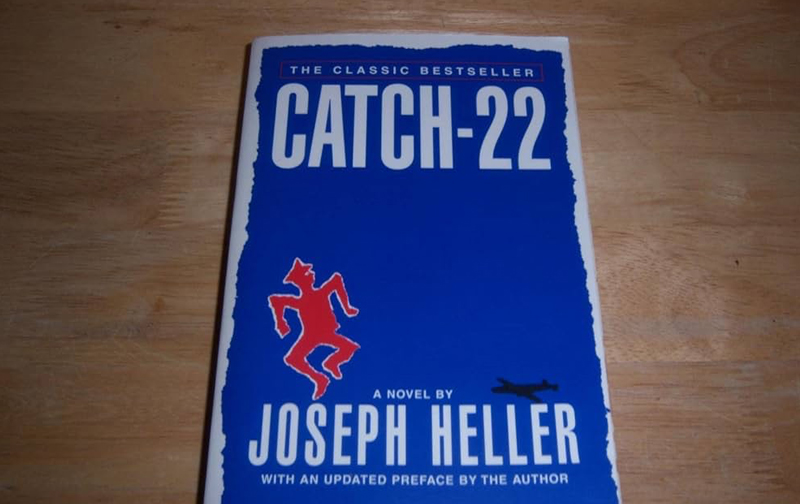
Catch-22, the satirical war novel by American author Joseph Heller, stands as a defining piece of postmodern literature, blending dark humor, absurdity, and biting social critique into a narrative that transcends the conventions of war fiction. Published in 1961, the novel captured the chaotic and illogical nature of war through a style as unconventional as the story it tells. Heller’s writing is marked by its disjointed chronology, circular logic, and sardonic tone, all of which work in concert to mirror the absurdity of the military bureaucracy and the existential crises of its characters. The fashion and style of Catch-22 extend beyond mere literary technique, shaping a broader cultural commentary that resonates with readers to this day. Examining the fashion of this novel requires exploring the multiple layers of its narrative, its distinct linguistic style, and the critical reception that has made it a cornerstone of modern literature.
The fashion in Catch-22 reflects the world it inhabits: disordered, fragmented, and steeped in paradox. Heller constructs a narrative that refuses to adhere to traditional storytelling norms, weaving together past and present, reality and illusion, logic and absurdity. The novel’s structure is nonlinear, with events unfolding in a chaotic, circular fashion that mimics the confusion and irrationality of war. This fragmented timeline forces readers to piece together the narrative, much like the characters themselves must navigate the bewildering military system. Heller’s use of repetition and recursion emphasizes the characters’ entrapment in a system designed to perpetuate itself, a system that offers no escape and no resolution.
The novel’s language further underscores its unique style. Heller’s prose is sharp, witty, and often paradoxical, filled with dark humor that lays bare the absurdity of the military machine. The titular “Catch-22” itself is a linguistic trap, a rule that negates itself while asserting its authority. According to the rule, a soldier can be declared insane if he willingly flies dangerous combat missions, but if he requests to be grounded on the basis of insanity, he proves his sanity by demonstrating concern for his own safety. This kind of circular reasoning permeates the novel, creating a sense of inescapable entanglement for the characters and the reader alike.
Heller’s characters are as absurd and multifaceted as the narrative itself. Yossarian, the novel’s protagonist, embodies the struggle for individuality and sanity in a world where logic has been turned on its head. His attempts to escape the madness of war are constantly thwarted by bureaucracy, absurd rules, and the unpredictable nature of those around him. The supporting cast is equally eccentric: Milo Minderbinder, the profit-driven mess officer who turns war into a business venture; Major Major Major Major, whose very name is a cruel joke; and the dead man in Yossarian’s tent, a grim reminder of the dehumanizing bureaucracy that reduces soldiers to mere paperwork. Each character serves as a satirical reflection of the institutions and ideologies that perpetuate war, highlighting the absurdity of a system that values procedure over human life.
The fashion of Catch-22 extends beyond its characters and narrative structure into its thematic core. The novel is a scathing critique of war, authority, and capitalism, exposing the ways in which these forces conspire to strip individuals of autonomy and meaning. Heller’s satire is relentless, dismantling the romanticized notions of heroism and sacrifice that often accompany war narratives. Instead, he presents a world where survival is an act of rebellion, and sanity is a liability. The soldiers are not noble warriors but pawns in a game played by distant bureaucrats and opportunistic profiteers. Through this lens, Catch-22 becomes a broader indictment of systems of power and control, resonating far beyond its World War II setting.
Critics have long debated the meaning and impact of Catch-22, with interpretations as varied and complex as the novel itself. Some see it as a profound anti-war statement, while others view it as a broader critique of bureaucracy, capitalism, and modernity. The novel’s humor, at once dark and absurd, has been praised for its ability to confront bleak realities without resorting to despair. At the same time, its fragmented structure and convoluted logic have led some readers to find it confusing or inaccessible. Yet, it is precisely this complexity that gives the novel its enduring power, challenging readers to confront the absurdities of their own world and question the systems that govern their lives.
The writing style of Catch-22 is as much a part of its message as its plot and characters. Heller’s use of irony, wordplay, and circular reasoning serves not only to entertain but to disorient, forcing readers to experience the same sense of confusion and powerlessness that plagues Yossarian and his fellow soldiers. The novel’s tone shifts seamlessly from comedy to tragedy, often within the same sentence, reflecting the unpredictable nature of war and the thin line between laughter and despair. This stylistic choice creates a unique reading experience, one that demands attention and rewards careful consideration.
In crafting Catch-22, Heller drew upon his own experiences as a bombardier in World War II, infusing the novel with a sense of authenticity that grounds its absurdity in reality. The bureaucratic incompetence, the senseless violence, and the pervasive fear all ring true, even as they are heightened to surreal extremes. This blending of personal experience and artistic exaggeration gives the novel its emotional weight, reminding readers that beneath the humor lies a profound meditation on the cost of war and the fragility of human life.
The legacy of Catch-22 is undeniable. It has inspired countless writers and artists, shaping the landscape of modern literature and popular culture. Its titular catch has entered the lexicon as shorthand for any no-win situation, a testament to the novel’s cultural impact. Yet, its true power lies in its ability to capture the contradictions of the human experience, to find humor in despair and meaning in madness. Heller’s masterpiece endures not because it offers easy answers, but because it dares to ask the hardest questions.
As a work of art, Catch-22 stands as a bold experiment in form and language, a novel that refuses to conform to expectations or provide comfort. Its style is a reflection of its content, a chaotic, disorienting journey that mirrors the absurdity of war and the struggle for meaning in an indifferent universe. In embracing the contradictions and complexities of its subject matter, Catch-22 transcends genre and convention, becoming a mirror for the absurdities of our own world. Through its unique fashion and style, both in storytelling and critique, the novel continues to captivate, challenge, and inspire generations of readers, cementing its place as a cornerstone of modern literature.