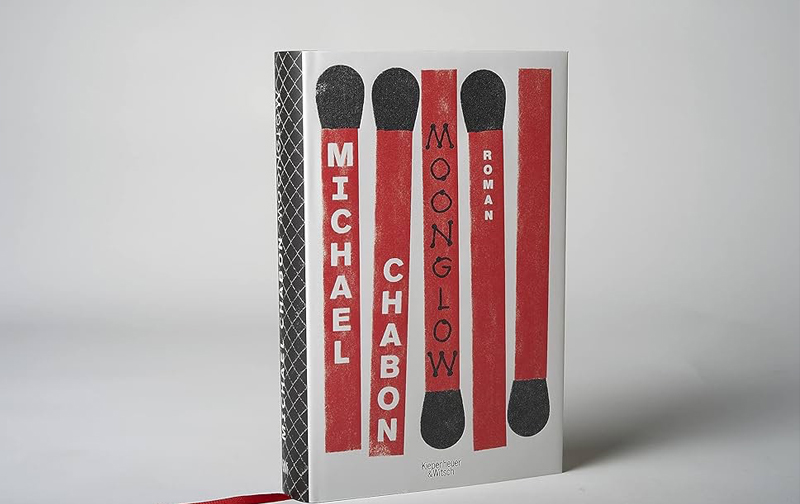
Michael Chabon’s novel Moonglow is an intricate tapestry of memory and myth that reveals as much about the art of storytelling as it does about the elusive nature of truth. In this work, Chabon deliberately blends the personal with the fantastical, crafting a narrative that oscillates between meticulous detail and exuberant flights of fancy, and in doing so, he creates a kind of literary fashion that is both timeless and unmistakably of its moment. The aesthetic choices embedded in Moonglow are not merely decorative; they reflect a deliberate approach to form that is at once playful, self-conscious, and steeped in the cultural motifs of mid‐century America. Through a carefully modulated voice and a non‐linear structure, Chabon fashions a narrative style that is imbued with a sense of grand storytelling and an almost theatrical panache, yet it is also riddled with the uncertainties and contradictions inherent in family memory.
At the heart of Moonglow lies a confession—a deathbed account delivered by an aging, enigmatic grandfather whose recollections blur the line between fact and fiction. In doing so, Chabon sets up a narrative that is simultaneously intimate and expansive. His writing style, marked by an exuberant use of language and an affinity for elaborate metaphors, dresses the story in a sumptuous layer of literary style. There is a deliberate tension between the precise, almost journalistic detail with which historical events are recounted and the lyrical, sometimes indulgently ornate turns of phrase that elevate the narrative into the realm of myth. The style of Moonglow is a fashion statement in itself: it is a novel that pays homage to the classic family saga and the art of memoir while simultaneously reinventing these genres with a postmodern wink. Chabon’s prose is at once elegant and playful—a sort of verbal haute couture that demands attention to the rhythm and cadence of every sentence.
One cannot help but notice that the aesthetic choices in Moonglow—the cadence of its sentences, the exuberance of its descriptions, the non‐chronological arrangement of its episodes—are reminiscent of a bygone era when literature was as much about style as it was about substance. The book’s narrative structure, which flits back and forth between different periods of the grandfather’s life, evokes the polychrome montage of old family albums, where each photograph is a story in itself, imbued with both nostalgia and a hint of unreliability. The fashion of the book, in this sense, is not about the material objects or the literal descriptions of clothing (as one might expect in a work concerned with style in the more conventional sense), but rather about the overall visual and emotional impression it creates—a layered, carefully curated collage of memory, history, and imaginative embellishment.
Chabon’s style is unmistakable. There is a sumptuousness in his description of even the most mundane details; he imbues ordinary objects and events with an almost mystical significance. His language is rich with imagery and metaphor, and he is never shy about indulging in what might be called “literary excess.” At times, this excess can border on the extravagant, with extended passages that revel in the sheer pleasure of descriptive language. Yet for many readers, this is precisely the point. Moonglow is a novel that invites you to luxuriate in its language, to appreciate the way its prose dances and shimmers with an almost tactile quality. The narrative is constructed like a fine garment, meticulously tailored and designed to evoke a particular mood—a mood that is both melancholic and celebratory, as if the act of remembering itself were an act of defiance against the passage of time.
There is, however, an undeniable tension in the way Chabon approaches the task of reconciling the factual with the fantastical. In his opening author’s note, he confesses that he has “stuck to facts except when facts refused to conform with memory, narrative purpose, or the truth as I prefer to understand it.” This admission is both an invitation and a challenge to the reader: it suggests that what we are about to read is less an objective memoir and more a carefully constructed narrative that uses truth as a canvas upon which to paint a more profound emotional reality. In doing so, Chabon’s style becomes a subject of critique in its own right. Some critics have argued that the novel’s discursive passages, its penchant for non-linearity, and its sometimes overindulgent prose can detract from the emotional core of the story. Others, however, see these same qualities as evidence of Chabon’s mastery of language and form—a deliberate choice to mirror the fragmented, often unreliable nature of memory itself.
This tension between rigor and play, between precise recollection and imaginative flourish, is at the very heart of what makes Moonglow so compelling—and so controversial among its readers. There are moments in the novel when Chabon’s language seems to overflow with the weight of history and the enormity of human experience. He conjures up images of war-torn landscapes, of ruined factories and desolate fields, and he does so with a kind of vividness that is almost cinematic. Yet, interwoven with these grand historical narratives are intimate moments of family life: the quiet sorrow of a woman haunted by memories of the Holocaust, the wistful, almost humorous recollections of a man who once attempted to blow up a bridge in an act of rebellious defiance. The effect is a narrative that is as multifaceted as the lives it depicts, combining the macrocosmic scale of historical forces with the microcosmic details of personal experience.
In this way, the style of Moonglow is both its greatest strength and its most frequent point of contention. The novel’s lavish prose and intricate structure are often cited as evidence of Chabon’s literary genius, but they can also be seen as a kind of overreach—a tendency to embellish and decorate at the expense of clarity and narrative drive. There are passages in which the sheer density of the language seems to slow the story down, trapping the reader in a web of adjectives and adverbs, metaphors and similes. For those who prefer a more straightforward, linear narrative, these moments can be frustrating, even exasperating. Yet for others, it is precisely this richly layered approach that transforms a simple story into a work of art—a piece of literary fashion that is as visually arresting as it is emotionally resonant.
At its core, Moonglow is a meditation on the power of storytelling and the ways in which our personal histories are constructed, deconstructed, and ultimately reimagined in the act of remembrance. Chabon does not merely tell a story; he creates an entire aesthetic world, one in which the boundaries between truth and fiction are blurred, and where every detail, no matter how trivial it might seem, is imbued with significance. This is the fashion of the book—a deliberate, almost sartorial attention to detail that is reminiscent of a master tailor meticulously choosing the finest fabrics and cutting them with precision. Every sentence, every turn of phrase, is a stitch in a larger, elaborate pattern, designed to evoke a specific mood and to transport the reader into a world where memory is as fluid and mutable as the light of the moon.
Critically speaking, Moonglow’s style invites both admiration and skepticism. Admirers point to the novel’s lyrical beauty and its ability to capture the ineffable qualities of human memory and emotion. They appreciate the way Chabon’s language transforms ordinary moments into something magical, and they celebrate the novel as a testament to the enduring power of family bonds and the art of storytelling. At the same time, detractors argue that the novel’s stylistic ambitions sometimes overshadow its narrative substance, that its elaborate prose can occasionally feel self-indulgent or overly ornate. They question whether the novel’s commitment to a kind of literary excess truly serves the story, or whether it is, in some places, a distraction—a kind of verbal showmanship that prioritizes style over substance.
These criticisms, however, can also be seen as a reflection of the broader debates about literary style in contemporary fiction. In an age when minimalist prose and streamlined narratives often dominate, Chabon’s luxuriant, allusive style stands out as a bold, if polarizing, counterpoint. Moonglow is not content to simply recount events in a straightforward manner; it is a novel that revels in the artifice of its own construction, that acknowledges its own embellishments and invites the reader to participate in the act of reimagining history. This self-conscious play with narrative form is, in many ways, a hallmark of Chabon’s oeuvre—a signature move that distinguishes his work from that of his contemporaries and that challenges the reader to look beyond the surface of the text to the deeper truths hidden within its elaborate folds.
Ultimately, the fashion and style of Moonglow are inseparable from its thematic concerns. The novel is a meditation on the nature of memory, the fallibility of truth, and the enduring power of storytelling to shape our understanding of the past. In crafting a narrative that is as richly textured and visually evocative as a carefully curated fashion collection, Chabon reminds us that our lives are not defined solely by the events that occur, but by the stories we tell about them. The novel’s non-linear structure, its playful yet poignant use of language, and its willingness to embrace both historical fact and imaginative invention all serve to reinforce this idea—that the act of remembering is as much about the art of storytelling as it is about the pursuit of objective truth.
For readers who relish a literary experience that is both aesthetically sumptuous and intellectually provocative, Moonglow offers a feast for the senses and the mind. It is a work that demands patience and attention, inviting us to linger over its intricate details and to savor the textures of its language. Even if some passages may at times feel overly elaborate or indulgent, they are integral to the overall effect—a testament to Chabon’s belief that every word, every image, can contribute to a larger narrative mosaic that captures the multifaceted nature of human experience.
In the end, Moonglow is a novel that, like the moon itself, casts a complex, sometimes elusive light on the dark corners of our personal histories. It is a work of art that challenges conventional notions of memoir and fiction, one that celebrates the beauty of language even as it grapples with the imperfections of memory. Whether one views its stylistic flourishes as moments of transcendent brilliance or as occasional lapses into self-indulgence, there is no denying that Michael Chabon has crafted a narrative that is as daring as it is distinctive. It is a novel that fashions its own identity—a richly embroidered garment of prose that both adorns and interrogates the fabric of our collective past.
Moonglow ultimately stands as an exemplar of literary fashion in the most profound sense: it is a work that not only tells a story but also displays the very process of storytelling as an art form, replete with all the embellishments, contradictions, and imaginative leaps that define our attempts to capture the elusive essence of life. Its style is a bold statement—a reminder that, in literature as in fashion, the choices we make about form and presentation can transform the ordinary into the extraordinary. And even as its richly woven tapestry sometimes strains under the weight of its own complexity, Moonglow remains a compelling, if challenging, invitation to look deeper into the interplay between memory, truth, and the art of narrative itself.