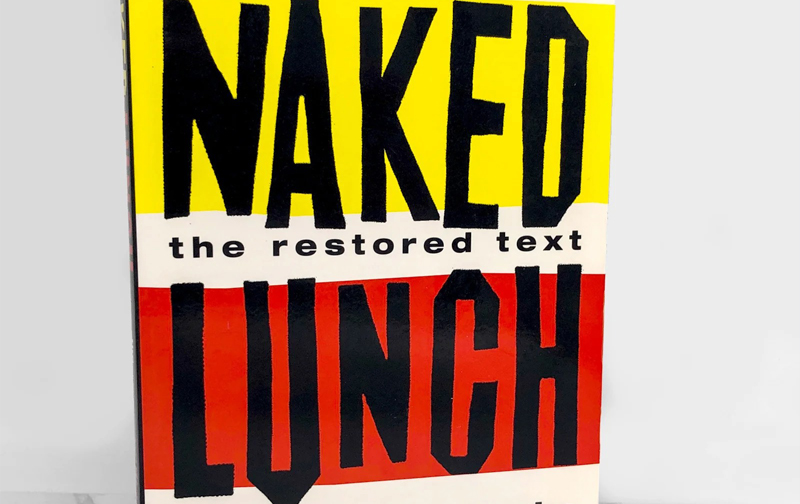
William S. Burroughs’ novel Naked Lunch stands as one of the most audacious and unconventional works in modern literature, challenging the reader not only with its narrative structure but also with its unique aesthetic, its fashion of writing, and a critique of the very notion of control and conformity that permeates both society and the art world. In Naked Lunch, Burroughs dismantles traditional storytelling, abandoning linear progression and clear causality in favor of a fragmented, non-linear narrative that mirrors the chaotic inner workings of the human psyche. The work’s experimental form and stylistic choices have generated both admiration and controversy over the decades, and its influence can be seen in various artistic fields, including fashion, where the ideas of subversion, dislocation, and the challenge of established norms resonate deeply.
The text of Naked Lunch is a labyrinth of disjointed episodes, surreal imagery, and a language that is at once clinical and visceral. Burroughs’ prose is deliberately abrasive, punctuated by abrupt shifts in tone and perspective. This style is akin to a deconstructed garment, where pieces are taken apart and reassembled in unexpected ways, challenging the conventional idea of a unified whole. In the realm of fashion, this approach can be seen as a precursor to many avant-garde movements, where the juxtaposition of disparate elements creates an aesthetic that is both unsettling and captivating. Just as a designer might combine fabrics and textures that traditionally do not belong together, Burroughs mixes language, ideas, and cultural references in a way that forces the reader to confront the fluidity of meaning and the instability of identity.
At the core of Naked Lunch’s stylistic innovation is its refusal to adhere to the conventions of narrative control. Burroughs famously stated that “control can never be a means to any practical end; control can never be a means to anything but more control.” This aphorism encapsulates not only a political and social commentary but also an artistic manifesto. In the novel, the structure of the text itself becomes a metaphor for the mechanisms of power and domination. The fragmented narrative resists a singular interpretation, much like an outfit that defies mainstream fashion by deliberately breaking the rules of dress. Each page of Naked Lunch can be seen as a canvas upon which Burroughs paints a picture of disintegration—a world where authority is subverted and the individual is left to navigate a landscape of chaos and desire.
The fashion of writing in Naked Lunch is intricately tied to the idea of liberation from societal constraints. Burroughs’ prose often employs what can be termed “cut-up” techniques, a method in which text is literally cut, rearranged, and reassembled to create new meanings and associations. This process mirrors the deconstruction techniques found in modern art and fashion design, where traditional forms are dissected and reinterpreted. The aesthetic of disjointedness, randomness, and even controlled anarchy in the text speaks directly to the postmodern sensibilities of the late twentieth century, where the very act of creation becomes an act of rebellion against established hierarchies.
In Naked Lunch, language is not merely a tool for communication but a material to be manipulated, much like fabric in the hands of a skilled couturier. Burroughs’ manipulation of language, with its sudden juxtapositions and unexpected turns of phrase, challenges the reader to think beyond the surface level of words and to question the very processes of meaning-making. The novel’s language is raw, sometimes vulgar, yet imbued with a poetic cadence that is both disorienting and beautiful. It is as if Burroughs is inviting his audience to step into a world where the familiar is rendered strange, where the act of reading becomes an exploration of the subconscious, a journey into the dark and sometimes absurd corridors of human thought.
The aesthetic choices in Naked Lunch also reflect a deep critique of the sanitized, regulated culture that seeks to control every aspect of human behavior. In fashion, similar critiques have emerged in the form of designs that deliberately eschew traditional beauty standards, opting instead for a look that is deliberately off-kilter or subversive. Burroughs’ text, with its explicit content and relentless questioning of authority, can be read as a rejection of the social norms that dictate what is acceptable, both in literature and in society at large. The novel’s portrayal of addiction, sexuality, and violence is unflinching, offering a mirror to a world that is often hidden behind layers of propriety and convention. This willingness to confront the uncomfortable and the taboo head-on is one of the qualities that have cemented Naked Lunch as a cult classic, a work that continues to inspire artists, writers, and designers who see beauty in the broken and the transgressive.
Burroughs’ writing style in Naked Lunch is also notable for its intertextuality—a constant dialogue with other texts, genres, and cultural artifacts. The novel is replete with references to music, film, and art, suggesting that creativity is not an isolated act but one that exists within a broader cultural ecosystem. This is reminiscent of the way contemporary fashion often borrows from various historical periods and cultural traditions, remixing them into something entirely new and unexpected. In Naked Lunch, the boundaries between high art and low culture, between the avant-garde and the everyday, are deliberately blurred. The text does not offer a clear hierarchy of values but instead presents a multiplicity of voices and perspectives, each contributing to a rich tapestry of ideas and images. This multiplicity challenges the reader to abandon the search for a singular, authoritative interpretation, much as modern fashion encourages the wearer to embrace an eclectic and personalized style.
A significant aspect of the novel’s critique of societal norms is its treatment of control and power. Burroughs’ dissection of control—as both a social construct and a personal struggle—is reflected in the very structure of Naked Lunch. The disjointed, episodic nature of the narrative serves as a metaphor for the fragmentation of modern identity in the face of overwhelming systems of authority. In a similar vein, contemporary fashion often seeks to disrupt established power dynamics by challenging the notions of gender, race, and class. The very act of dressing becomes an assertion of individuality and a rejection of conformity. In Naked Lunch, the subversion of control is not simply a thematic concern but is embedded in the language and structure of the text. The novel’s free-form style, with its abrupt shifts and seemingly random associations, mirrors the experience of living in a world where traditional power structures are in constant flux—a world where every attempt to impose order only leads to further chaos.
Critics of Naked Lunch have long debated its merits and its impact on literature and culture. Some have hailed the novel as a masterpiece of modernism, a work that shattered the boundaries of what literature could be. Others have decried it as a nihilistic exercise in self-indulgence, arguing that its lack of structure and its explicit content serve only to alienate the reader. However, it is precisely this polarizing quality that has ensured the novel’s lasting influence. By refusing to conform to the expectations of narrative coherence and aesthetic beauty, Naked Lunch forces its readers to confront their own assumptions about art, control, and identity. In doing so, it opens up a space for new forms of expression—both in literature and in the broader realm of artistic practice.
The fashion and style of Naked Lunch have, in many ways, paved the way for later experimental writers and designers who seek to break free from the constraints of traditional forms. The novel’s embrace of fragmentation, its use of non-linear narrative, and its willingness to delve into the darker recesses of the human mind resonate with the ethos of contemporary art and design. It is a work that rejects the tidy resolutions of conventional storytelling in favor of a more honest, if disconcerting, portrayal of reality. This commitment to authenticity, even at the cost of coherence, is a hallmark of Burroughs’ style—a style that has influenced countless artists, from filmmakers to fashion designers, who see in Naked Lunch a call to question, to rebel, and ultimately to create anew.
Moreover, Naked Lunch’s approach to language and structure can be viewed as a form of resistance against the commodification of art and literature. In an age when the market often dictates what is considered valuable or desirable, Burroughs’ work stands as a testament to the power of artistic freedom. His deliberate subversion of narrative norms challenges the idea that art must be packaged in a neat, consumable form. Instead, Naked Lunch offers a raw, unfiltered glimpse into the chaotic beauty of human existence—a beauty that is often found in the margins, in the rejected and the unconventional. This anti-establishment stance is one that has resonated with generations of readers and artists who find in Burroughs a kindred spirit, someone who dares to confront the status quo and to imagine a world beyond the confines of conventional morality and order.
In examining the fashion of writing that Burroughs employs, it is important to consider the broader cultural and historical context in which Naked Lunch was written. Emerging during a time of profound social and political upheaval, the novel reflects the disillusionment and fragmentation of a generation that had witnessed the horrors of war, the limitations of authority, and the collapse of traditional social structures. Burroughs’ work captures the zeitgeist of a world in transition—a world where old certainties were crumbling and new, uncertain possibilities were beginning to emerge. The radical aesthetics of Naked Lunch, with its fragmented narrative and its challenge to the dominant cultural paradigms, can be seen as both a product of and a reaction to this tumultuous period. In this sense, the novel is not only a work of art but also a historical document, a snapshot of a moment when the boundaries of art, literature, and society were being redrawn.
While Naked Lunch may continue to provoke controversy and elicit strong reactions from both supporters and detractors, its enduring legacy lies in its unapologetic embrace of the avant-garde and its fearless exploration of the limits of language and form. Burroughs’ willingness to deconstruct and reassemble the very fabric of narrative serves as an inspiration for anyone who has ever felt constrained by the demands of conventional expression. His work reminds us that art, in its purest form, is not meant to be controlled or contained but is instead a dynamic, ever-evolving force that defies categorization and resists easy interpretation.
Ultimately, Naked Lunch is a work that operates on multiple levels. It is a radical critique of the mechanisms of control and power, a pioneering exploration of experimental narrative techniques, and a bold statement about the nature of artistic freedom. Its fashion of writing—disruptive, fragmentary, and unapologetically raw—challenges us to reconsider what we expect from literature and art. It invites us to embrace the dissonance, to revel in the chaos, and to see beauty in the unexpected intersections of language and meaning. As such, Naked Lunch remains not only a cornerstone of postmodern literature but also a seminal influence on the aesthetics of contemporary art and design—a work that continues to inspire new generations to push the boundaries of creativity and to question the very foundations of artistic expression.
In the end, Naked Lunch endures because it refuses to be tamed. It is a relentless exploration of the interplay between control and liberation, order and chaos, tradition and innovation. Burroughs’ visionary approach to writing has left an indelible mark on the landscape of modern literature and continues to echo through the realms of fashion and art. His work challenges us to rethink our assumptions about beauty, form, and the nature of creativity itself. Through its uncompromising style and its bold aesthetic choices, Naked Lunch remains a testament to the power of art to disrupt, to transform, and ultimately, to liberate us from the confines of conventional thought.