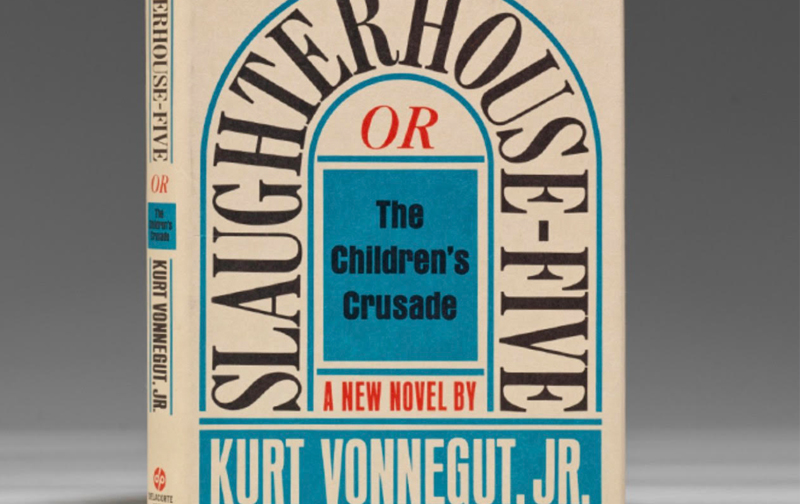
Kurt Vonnegut’s novel Slaughterhouse‐Five remains one of modern literature’s most distinctive and enigmatic works, not only for its unflinching portrayal of the absurdity of war but also for its remarkable fashion of writing—a style that itself has become a kind of literary couture. The novel’s narrative, oscillating between disjointed timeframes and surreal episodes, challenges traditional linear storytelling in a manner that is both playful and brutally honest. In this work, Vonnegut adopts a language that is at once simple and sardonic, stripping away the excesses of ornate literary convention to reveal a style that is lean, disarming, and steeped in dark humor. This “fashion” of writing is not merely a surface aesthetic; it is intricately tied to the novel’s thematic core, reflecting the chaotic and fragmented nature of human existence in a world ravaged by the mechanizations of war.
At its heart, Slaughterhouse‐Five is a meditation on the nature of time, memory, and the inescapable impact of historical trauma. Vonnegut’s protagonist, Billy Pilgrim, becomes “unstuck in time,” drifting through his life as though it were a patchwork quilt stitched together by the random, often incongruous events of his past, present, and future. This narrative technique, which might be seen as a literary analogue to the ever-shifting trends in fashion, disrupts our conventional understanding of cause and effect. Just as fashion designers challenge norms by mixing eras, textures, and silhouettes in innovative combinations, Vonnegut shuffles the chronology of his story to expose the absurdity inherent in trying to impose order on the chaos of human experience. The novel’s structure, fragmented and episodic, mirrors the transient nature of trends in high fashion—a reminder that what is considered stylish or acceptable at one moment can quickly fall out of favor, only to be recontextualized and reborn in another era.
The language of Slaughterhouse‐Five is spare, almost minimalist, yet it is loaded with irony and subtle critique. Vonnegut’s sentences often possess a rhythmic simplicity that belies the complex emotions and philosophical ideas they carry. This economical use of language is reminiscent of modernist aesthetics in visual art and design—clean lines, uncluttered forms, and an emphasis on the essential. In fashion, as in literature, minimalism can serve as a powerful counterpoint to the ostentatious; it strips away the superfluous, focusing on the beauty of raw expression and unadorned truth. Vonnegut’s prose does precisely this. It eschews elaborate descriptions and florid rhetoric in favor of a tone that is conversational and accessible, yet it never sacrifices depth. Each word is carefully chosen to contribute to the overall texture of the narrative, much like a well-tailored garment that balances form and function while making a bold statement about the wearer’s identity.
Moreover, the novel’s use of metafictional asides—Vonnegut’s frequent interruptions in the narrative to remind the reader that they are, indeed, reading a constructed story—adds another layer to its stylistic fashion. These self-referential moments invite readers to step back and consider not just the content of the story, but the very process of storytelling itself. It is as if Vonnegut is critiquing the traditional roles of both the author and the reader, challenging the passive consumption of narrative in the same way that avant-garde designers challenge the consumer’s expectations about beauty and form. By acknowledging the artifice of fiction, Vonnegut creates a dialogue about authenticity and representation, questioning whether there is any absolute truth in a world where everything is subject to reinterpretation. This playful yet pointed deconstruction of narrative authority is part of the novel’s enduring appeal—it is a literary garment that fits loosely, allowing for reinterpretation and re-styling with every new reading.
The novel’s thematic concerns also extend to a critique of the very systems that fashion our cultural and social identities. Slaughterhouse‐Five does not simply document the horrors of war; it interrogates the propaganda and sanitized narratives that governments craft to justify violence and repression. In this sense, Vonnegut’s writing style becomes a form of resistance—a way of subverting the official “uniform” of state-sanctioned history. His ironic tone and offhand delivery undermine the grandiose rhetoric often associated with military valor and patriotic sacrifice. Instead of glorifying conflict, he exposes its absurdity and moral bankruptcy. The anti-war message is embedded in the very fabric of his language, which is both irreverent and compassionate. This duality—combining levity with gravity—is one of the novel’s most striking features, much like a fashion collection that simultaneously pays homage to tradition while defiantly breaking its rules. In critiquing the fashionable narratives of war, Vonnegut forces his readers to confront the dissonance between the glorification of military might and the brutal realities of human suffering.
The aesthetic choices in Slaughterhouse‐Five can also be seen as a reflection of Vonnegut’s broader worldview. His fascination with fatalism and the inevitability of death, themes that recur throughout the novel, are expressed through a writing style that is as irreverent as it is resigned. The refrain “so it goes,” repeated throughout the text whenever death is mentioned, functions almost like a fashion slogan—short, memorable, and carrying layers of meaning. It encapsulates the novel’s paradoxical attitude toward mortality: a recognition of the profound tragedy of death, coupled with a wry acceptance of its inevitability. This refrain, much like a well-crafted accessory in a designer outfit, punctuates the narrative and reinforces its overarching mood. It is a constant reminder that while society may attempt to dress up and glamorize the harsh realities of life, beneath the surface lies an unyielding truth that defies artifice.
Vonnegut’s style is also notable for its use of satire, a tool he wields with precision to expose the follies of human nature and the absurdities of social conventions. His satirical approach is both a celebration of and a departure from the literary traditions that preceded him. In the way a fashion designer might remix classic silhouettes with contemporary trends to create something both timeless and strikingly modern, Vonnegut takes familiar narrative forms and twists them into something unexpected. His satire is not mean-spirited; it is a form of empathy, an acknowledgment of the ridiculousness of the human condition. Through humor, he invites readers to laugh at the horrors of war, to see the irony in the ritualistic repetition of violence and the cold bureaucracies that enable it. This critical distance is central to the novel’s power—it allows the reader to engage with difficult themes without being overwhelmed by despair. The humor in Slaughterhouse‐Five is as much a part of its fashion as any meticulously designed outfit; it is the unexpected pop of color in an otherwise monochrome tableau, a reminder that even in the darkest moments, there is room for irreverence and creativity.
In considering the broader impact of Slaughterhouse‐Five on literary culture, it is evident that Vonnegut’s approach to style has had a lasting influence on subsequent generations of writers. His blending of science fiction, autobiography, and historical narrative paved the way for a more fluid understanding of genre and narrative structure. The novel’s nontraditional format, its willingness to jump across time and space, and its use of metafictional commentary have all contributed to a rethinking of what it means to tell a story. In many ways, Vonnegut’s work can be seen as a precursor to the postmodern sensibilities that would come to dominate literature in the latter part of the twentieth century. His style is often imitated but never duplicated—an original design that continues to inspire and provoke discussion among critics and readers alike.
Critics have long debated the merits and limitations of Vonnegut’s stylistic choices. Some argue that his approach can be overly casual, that the flat, understated tone sometimes undermines the gravity of the subject matter. However, such critiques often miss the point: the casual tone is itself a deliberate counterpoint to the bombast and melodrama that often characterize war narratives. By choosing a style that is seemingly effortless and conversational, Vonnegut forces his audience to engage with the text on its own terms, without the distraction of conventional sentimentality. The disarmingly simple language is not a mark of indifference but a calculated strategy to strip away the layers of propaganda and ornamentation that obscure the true nature of war. In this light, the novel’s fashion of writing becomes an act of liberation—a way to reclaim language from the forces of conformity and censorship.
The interplay between style and content in Slaughterhouse‐Five also speaks to the broader cultural moment in which it was written. Emerging in the aftermath of World War II and during the turbulent years of the Cold War, the novel reflects a generation’s disillusionment with grand narratives of heroism and national destiny. The fashion of writing that Vonnegut employs—marked by its fragmentation, its ironic detachment, and its willingness to blend the surreal with the real—mirrors the disjointed, often contradictory experiences of those who lived through periods of intense political and social upheaval. It is a literary style born of crisis, a response to the failure of traditional forms to capture the complexity of modern existence. In this sense, the novel is as much a historical document as it is a work of art—a record of a time when the established order was being questioned, and when the very act of storytelling became a means of protest.
At the same time, Vonnegut’s novel has been celebrated for its accessibility. Its language, while innovative, is never esoteric; it speaks directly to the reader, inviting them to see the world through a lens that is both compassionate and unflinching. This accessibility is part of the novel’s enduring appeal—it is a work that can be read on many levels, offering insights that resonate with both casual readers and literary scholars. The straightforward, almost conversational tone belies the complexity of its ideas, much as a seemingly simple garment can embody profound cultural and artistic significance. Vonnegut’s style is democratic in its reach; it does not require an elaborate costume of academic credentials to be appreciated, only an open mind willing to confront the contradictions of existence.
In the realm of literary fashion, Slaughterhouse‐Five occupies a unique niche. It is a work that defies categorization, blurring the lines between genres and challenging the very conventions of storytelling. This resistance to neat classification is, in many ways, a reflection of its thematic preoccupations—the idea that life itself is a chaotic tapestry of moments that refuse to be neatly organized or defined. Vonnegut’s novel thus stands as a testament to the power of innovative style to both reflect and shape the human experience. Its impact on subsequent literary fashion is undeniable, influencing a wide range of writers who have sought to capture the fragmented, multifaceted nature of modern reality.
Ultimately, Slaughterhouse‐Five is not just a novel about war—it is a novel about the nature of storytelling, about the ways in which we construct our understanding of the world through language and narrative. Its fashion of writing, with all its quirks and idiosyncrasies, is a challenge to both the author and the reader to think differently about what it means to convey truth. Vonnegut’s work is a constant reminder that literature, like fashion, is an ever-evolving art form—one that must continually adapt to the changing contours of human experience. In his unorthodox approach to narrative and his incisive critique of the conventional modes of war storytelling, Vonnegut has not only created a work of enduring beauty but has also opened up new possibilities for the expression of dissent and the reimagining of history.
The novel’s influence can be seen in its continued relevance across generations and its capacity to inspire both admiration and critical debate. It is a work that challenges its readers to reconsider their assumptions about the past, the present, and the future, urging them to embrace a more nuanced, multifaceted view of history and humanity. The very fashion of Vonnegut’s writing—its bold, irreverent, and sometimes paradoxical nature—serves as a metaphor for the complexities of the human condition. It invites us to look beyond the surface, to appreciate the intricate interplay of form and content, and to recognize that true beauty often lies in the unexpected, in the imperfect, and in the rebellious spirit that dares to question authority.
In reflecting on Slaughterhouse‐Five, one cannot help but be struck by the enduring power of Vonnegut’s style—a style that continues to resonate in a world where the lines between reality and fiction, between order and chaos, are increasingly blurred. His work remains a shining example of how literature can serve as both mirror and mender, reflecting the fractured realities of modern life while offering a pathway to understanding and, perhaps, to healing. Through its distinctive fashion of writing, Slaughterhouse‐Five challenges us to confront the absurdities of our own existence, to laugh in the face of despair, and to find meaning in the midst of a seemingly indifferent universe.
Ultimately, the novel’s legacy is not solely defined by its anti-war message or its innovative narrative structure, but by its capacity to transform the act of reading into an experience that is as intellectually stimulating as it is emotionally cathartic. Vonnegut’s daring blend of satire, simplicity, and surrealism creates a literary garment that is as comfortable and familiar as it is groundbreaking—a style that continues to defy easy categorization and to inspire those who dare to dream of a world where truth, however fragmented, can still be expressed with clarity and wit.