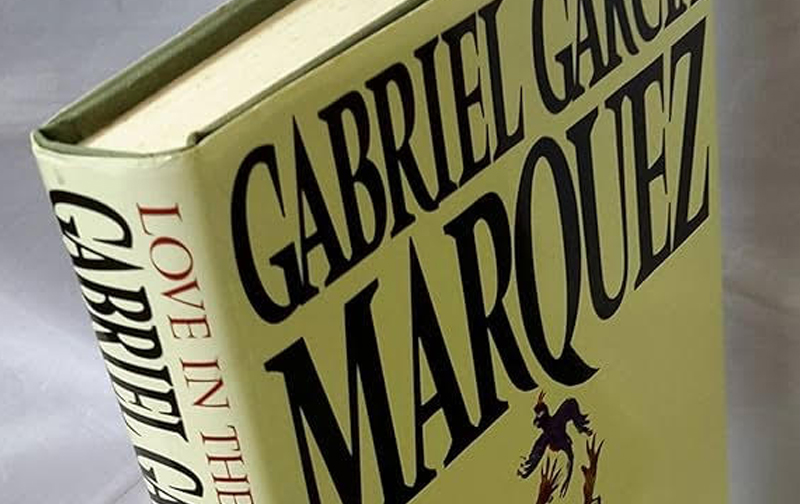
Gabriel García Márquez’s Love in the Time of Cholera is a novel that drapes itself in the elegance of longing, weaving a narrative as rich and intricate as the lace and silks of its characters’ world. It is a novel where love and time are intertwined, much like the layered textures of a carefully curated wardrobe. Márquez’s storytelling is known for its lush, almost hypnotic quality, where every sentence feels as if it has been embroidered with delicate precision. His prose, like high fashion, is both timeless and deeply evocative, capturing the essence of human experience with a style that is as grand as it is intimate. Just as a designer chooses fabrics to evoke emotions, Márquez selects his words to build a universe that feels at once distant and deeply familiar.
The fashion of Márquez’s writing is unmistakable. His work is often associated with magical realism, a genre that dresses the mundane in extraordinary embellishments, making the ordinary glisten with an almost surreal beauty. In Love in the Time of Cholera, this manifests in the way love is stretched across decades, its presence lingering in the lives of Florentino Ariza and Fermina Daza like the scent of perfume on fabric long after it has been worn. His descriptions have a tactile quality, immersing the reader in an era where romance unfolds in handwritten letters and stolen glances. The novel’s world is richly adorned with the textures of an old Caribbean town, its decaying beauty mirroring the slow erosion of time on the lovers’ affections.
Márquez’s literary style is deeply aware of aesthetics—not just in how he describes the physical world but in how he constructs his sentences. His writing is fluid yet meticulous, every phrase carrying the weight of poetry while remaining effortlessly readable. It is the kind of prose that does not simply tell a story but envelops the reader in an experience, much like how fashion is not merely about clothing but about the feeling it evokes when worn. His ability to balance lyrical beauty with the rawness of human emotion is what makes his style so unique. There is an opulence to his storytelling, a richness that does not overwhelm but rather seduces, much like a finely tailored garment that speaks volumes without needing embellishment.
The novel’s engagement with fashion is not just metaphorical but literal. Clothing in Love in the Time of Cholera is a symbol of social class, personal transformation, and the passage of time. Fermina Daza’s evolution is marked by the refinement of her wardrobe, her youthful romanticism giving way to a more measured elegance as she matures. Florentino Ariza, in contrast, clings to a certain nostalgia, his own appearance shaped by an almost performative dedication to his role as the eternal lover. The way characters dress reflects their internal landscapes—clothing becomes a language of its own, much like Márquez’s prose. Every silk dress, every starched collar, every fading uniform tells a story of where a character has been and where they hope to go.
The fashion of Love in the Time of Cholera extends beyond its characters and into its broader literary presence. Márquez’s style does not conform to the fast-moving trends of contemporary fiction; rather, it stands as a testament to the enduring appeal of deeply felt, elaborately crafted narratives. In an era where minimalism often dominates literary conversations, his work remains unapologetically lush, filled with long, winding sentences and descriptions that unfold like the petals of a flower. His writing does not rush—it lingers, allowing emotions to fully form, much like the way haute couture demands patience and appreciation for its intricate craftsmanship.
Criticism of Love in the Time of Cholera often reflects the same division that exists in the world of fashion—between those who admire extravagance and those who prefer restraint. Some literary critics have praised the novel for its ability to capture the aching persistence of love, its deep understanding of longing and time’s quiet cruelty. Others, however, have found its pacing indulgent, its exploration of obsessive love bordering on excess. The novel’s approach to romance—where passion does not fade but instead festers, grows, and transforms—has been both celebrated and questioned. Some view Florentino Ariza’s relentless pursuit of Fermina Daza as the ultimate testament to love’s endurance, while others see it as unsettling, an obsession disguised as devotion.
This divide in reception mirrors the cyclical nature of fashion, where what is seen as opulent and romantic in one era may be viewed as excessive in another. Márquez’s prose, like a lavishly designed gown, does not seek simplicity but rather embraces the beauty of intricacy. He is not interested in stripping things down to their bare essentials; instead, he layers meaning upon meaning, crafting stories that demand to be felt as much as they are read. His work resists the fleeting nature of trends, existing in a space where literature is not just about telling a story but about creating an atmosphere, a world that lingers long after the final page is turned.
The themes of Love in the Time of Cholera—time, longing, memory—are ones that resonate across generations, much like the classics of fashion that never truly go out of style. The novel, much like the works of Márquez as a whole, does not fit neatly into any one category. It is both deeply traditional and quietly subversive, questioning the very nature of love while simultaneously celebrating its endurance. This complexity is what makes it so compelling and why it continues to be discussed, admired, and debated.
Love in the Time of Cholera is a novel that embodies the idea that style—whether in writing, fashion, or love itself—is about more than just surface beauty. It is about the textures, the layers, the details that build over time. Márquez’s writing, like the most unforgettable fashion, is not about fleeting moments but about the way those moments are remembered, about the feelings they evoke long after they have passed. Whether seen as a grand love story or a meditation on the illusions we create around romance, the novel remains an enduring piece of literary artistry—one that, like the finest of garments, continues to captivate with its timeless elegance.