Fashion at its highest levels transcends mere garments to become a fusion of culture, psychology, and philosophy. High-end design has been called “idea fashion,” led by visionary “fashion conceptualists” whose work epitomizes innovation and personal expression. In this view, clothing is a system of symbols, not just material form. Anthropologists note that dress is a form of communication and identity formation , and indeed conceptual collections often draw on history, art or folklore as rich source material. Philosophically, fashion can be understood as a “complex system of signs and meanings” through which individuals express self and interact with society. High fashion especially functions like a laboratory of social ideas: designers manipulate aesthetics to express ideas about class, gender, or power – echoing Georg Simmel’s insight that fashion balances imitation and individuality. Psychologically, the design process itself becomes a journey of the mind: empirical studies show that fashion creativity follows thinking dispositions similar to those in art practice .
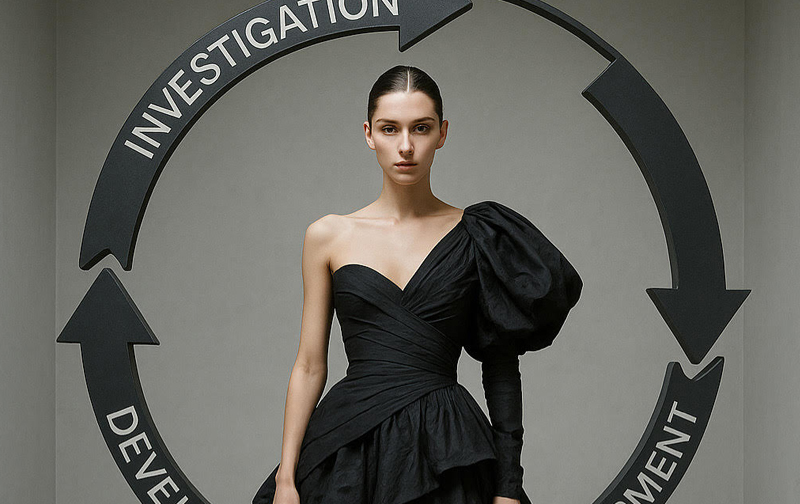
Surprisingly, despite its creative emphasis, conceptual fashion benefits from structure. The cited research argues that even “idea-driven” design can be aided by a systematic framework . Sau and Hau’s four-phase model – Investigation, Interaction, Development, Evaluation – bridges theory and hands-on making. In the Investigation phase, designers analyze the problem: they define the concept’s context at three nested levels (the outer “direction,” the mid “goal,” and the inner “inspiration”) . Here the anthropologist, sociologist and psychologist unite: designers survey cultural currents, set personal and social aims, and gather influences from art, history, or technology . For example, one project immersed in bohemian counterculture researched everything from ragtag textiles to music and literature (capturing culture and history) in order to form a conceptual goal . This phase recognizes that fashion “reflects art, history, culture, sociology, psychology and anthropology,” and that clothes project identity traits like class or personality . In effect, Investigation turns fashion design into ethnography and self-exploration: the garments are born of a coherent idea that resonates on intellectual, emotional and social dimensions.
The next Interaction phase is creative synthesis. The designer mingles ideas and inspiration, using visual and verbal tools. Common tactics include collages, mood-boards, sketches or even written narratives . As one case study explains, theme and mood boards (pictorial collages of imagery, text and color) are used to capture the evolving concept and “synchronize … distinctive ideas and thoughts into tangible information” . Here the process is associative: memories, emotions or stories are given form. A designer might, for instance, collect photos of historic bohemian artists alongside poetry and fabric samples, interweaving these into a conceptual collage. This interaction lets the intuitive mind roam: designers essentially brainstorm their theme. By making ideas visible (through drawings or prototypes), they test the coherence of the concept. As Sau and Hau note, this phase uses multi-modal expression – visual “pictorial” boards, written notes, remembered images and verbal storytelling – to flesh out what the theme “feels like” in fashion terms . It is a dialog between designer and idea, ensuring that the concept has fertile material to grow from.
Once the concept is crystallized, the Development phase realizes it in concrete design. Here theory meets handcraft. Designers draft silhouettes and select materials, transforming abstraction into artifactual form . Initial sketches (often rough and iterative) map out shapes and details; fabric swatches and color samples are chosen to embody the theme . In the bohemian project, for example, early pencil drawings gave way to collaged swatches evoking patchwork and frayed textures. The process is cyclic and increasingly focused: as one study notes, corrections and refinements become fewer as the design takes shape and the designer gains “a greater sense of direction” . Technical concerns arise here – pattern, fit, garment engineering – but always in service of the concept. This phase answers the designer’s goals with tangible solutions: couture techniques, experimental textiles or unusual draping are devised to carry the intended message. In other words, Development is where concept is engineered, turning the narrative of Investigation and Interaction into actual clothes.
Finally, the Evaluation phase critically examines the results. Designers check that every element aligns with the original idea and practical requirements. Evaluation is both creative and rigorous: it lists conceptual features and “deliverable messages,” then systematically judges whether each design output fulfills the vision . This might involve model trials, peer critiques, or checklists verifying that the conceptual keywords are manifested (for instance, “freedom” in silhouette, or “vagabond” in texture). Negative outcomes are as valuable as positive ones: as data from student and professional designers showed, fashion critiques frequently find flaws or unmet goals, prompting new iterations . Designers thereby cycle back through the process – tweaking a pattern here or reshuffling colors there – or even revisiting the original brief. Indeed, the research highlights that evaluation often “produces outcomes that enable informed correction and further development” and that only through this feedback can one know if a solution is truly good . Thus, the cycle is completed: evaluation outcomes feed into fresh investigation of the concept or refinement of the execution, continually enriching the creative system.
In practice, these four phases blend intuitively. One scholar notes that for high-fashion conceptualists, the analyses of requirements, goals and inspirations effectively comprise 90–100% of their process . They set out clear intentions before sketching any seams. Similarly, analysis (analysis of problem) and synthesis (generation of solutions) remain the cognitive backbone . Yet the model’s explicit sequencing helps even naturally brilliant designers to focus. By envisaging fashion design as “prescriptive” – prescribing possible futures rather than just reflecting the present – practitioners become like cultural “futurologists” . Each phase draws on a different discipline: Investigation calls for anthropological and philosophical insight, Interaction taps psychological and emotional exploration, Development demands technical craft and artistic sensibility, and Evaluation uses critical theory and social awareness.
To illustrate, in one applied project the Investigation phase drew on anthropology and sociology by researching 19th-century bohemians, their social status and clothing traditions . In Interaction, designers used mood boards and memories of childhood (psychology) to fuse those findings with personal narrative . During Development, traditional craft techniques (folk embroidery, patchwork) were innovatively applied using advanced textiles, reflecting both historical and technological influences . Finally, in Evaluation the collection was assessed against the goal of embodying “freedom” and marginality; critics judged whether each garment successfully told the intended bohemian story. Such concrete examples show how the model concretely marries theory (culture, symbolism) with making (sketch to prototype).
In sum, the four-phase model provides a deep scaffold for conceptual fashion design. It is not a rigid formula but a flexible lens: designers revisit phases in any order as needed. For instance, a failed prototype (negative evaluation) might trigger new inspiration (back to Investigation) or a redesigned pattern (back to Development). This echoes classic creativity research – from Poincaré’s incubation to Wallas’s illumination – which emphasizes that creative problem-solving is inherently iterative . Significantly, empirical coding of designer discourse confirmed the cyclical movement: goals, solutions, and evaluations constantly re-emerged to reshape the process .
Viewed through sociology and philosophy, the model also helps designers navigate fashion’s paradoxes. By consciously setting a “direction” (cultural context) and “goal” (social or personal message) early on, a designer can harness fashion’s double force of conformity and rebellion . The process ensures that avant-garde ideas remain grounded: as one reviewer noted, working within this framework allowed experimental pieces to still “retain basic bohemian values” rather than becoming arbitrarily bizarre . In terms of meaning, the Evaluation phase’s checklist approach is akin to semiotic analysis; it asks the designer to interrogate each symbol in their garment as Barthes might, checking that the assembled “text” truly conveys the intended narrative .
Meanwhile, psychologically the model supports the designer’s mindset. It legitimizes the messy early stages as part of a disciplined process. Educators contrast polished end-products with the value of “exploratory, messy processes” in art learning ; this framework acknowledges both, by including rough sketches and brainstorming as formal steps. It also echoes Amabile and others’ view that intrinsic motivation and personal meaning (the “inner qualities” McRobbie highlights) are central to breakthrough fashion design . In the bohemian example, the designer’s own life memories were treated as valid research data in the Investigation/Interaction phases – a psychological self-study that grounded the collection in authenticity.
The model thus synthesizes academic and practical wisdom. It draws from design science (analysis-synthesis-evaluation ), from craft pedagogy, and from cultural studies. The blending of theory and practice is explicit: each new idea is immediately tried out in material form, and each prototype is measured against intellectual criteria . This holistic approach is characteristic of conceptual fashion, where celebrated designers (Alexander McQueen, Rei Kawakubo, Viktor & Rolf, etc.) famously merge art installation with runway show . Those “geniuses” are well-known, but the framework is especially empowering for less heralded innovators too. By naming the stages of creativity, even an emerging or idiosyncratic designer gains a roadmap to develop an experimental collection.
In conclusion, a conceptual fashion design process model provides a comprehensive lens into how avant-garde fashion is made. It respects that design is at once an aesthetic craft and a humanistic inquiry. Anthropologists see culture, psychologists see mind, sociologists see society, and philosophers see meaning – all converging in how a visionary garment comes to life. By articulating Investigation, Interaction, Development, and Evaluation, this model unifies these perspectives into a coherent creative system. Through it, designers can structure their inspiration and interrogation in depth, producing collections that are not only wearable art but also culturally resonant theory rendered tangible . Whether in the studio of an acclaimed haute-couturier or an experimental textile lab, the process empowers the fusion of genius ideas with meticulous craft – ensuring that conceptual fashion continually advances fashion’s frontiers in a rigorous, informed way.