Fashion is often described as an evolving, living language – one that speaks to the present moment. When designers merely replicate traditional garments, fabrics, or techniques without a fresh twist, they risk creating clothes that look more like museum costumes than contemporary fashion. The core argument is that fashion, by its very nature, must continually renew itself to remain relevant. It is rooted in novelty, change, and the spirit of the times, whereas unaltered traditional motifs belong to a fixed past. As legendary designer Coco Chanel observed, “Fashion is not something that exists in dresses only. Fashion is in the sky, in the street… it has to do with ideas, the way we live, what is happening” . In other words, fashion draws inspiration from the world around us today – the “air” of current culture – rather than slavishly copying yesterday’s styles. This view is echoed by many sociologists, philosophers, and designers: to be truly fashionable, a design must engage with the now, not merely the then. Replicating a traditional garment stitch-for-stitch, or printing an age-old pattern on a modern silhouette without reinterpretation, misses the point of fashion’s forward-looking impulse. It produces attire that might be historically interesting but aesthetically stagnant – an outfit that speaks in a dead language, not the vibrant tongue of contemporary style.
From a sociological perspective, fashion simply cannot thrive in a society that never changes. Classical sociologist Georg Simmel noted over a century ago that “Fashion does not exist in tribal and classless societies” . In cultures where norms of dress are rigid and static, what people wear is dictated by tradition or caste, leaving no room for the capricious cycle of trend and change that defines fashion. In such *“static, unchanging” environments, “fashion in the modern sense can hardly be said to exist” . Fashion, Simmel argued, arises from a paradoxical mix of imitation and differentiation – people adopt a new style to fit in with a desired group, yet also to set themselves apart as unique . Once everyone has imitated it, the style loses its exclusivity and novelty, and so it dies, making way for a new fashion . Thus, constant renewal is built into fashion’s social dynamic. If a style remains the same for generations (as with a national costume or a traditional robe), it falls out of the realm of fashion and into that of custom or costume. Customary dress, tied to rituals or heritage, may be beautiful and meaningful, but it lacks fashion’s temporality – its drive to mark this season or this year as something distinct. As one fashion theorist neatly put it, “In a static, unchanging society… fashion in the modern sense can hardly be said to exist” . We can take this as a baseline: where tradition reigns unchallenged, fashion fades away.
By contrast, modern fashion was born by breaking away from tradition. Cultural philosopher Gilles Lipovetsky, in The Empire of Fashion, emphasizes that the rise of modern fashion in the West (from roughly the 14th century onward) was characterized by a preference for innovation over tradition . He argues that fashion introduced a mindset that values the new and the novel, encouraging individuals to reinvent themselves through dress rather than obey ancestral rules . In traditional societies, what one wears might be determined by religion, tribe, or caste, and those rules change slowly if at all. But in a fashion-driven society, change itself becomes a virtue. Lipovetsky’s analysis suggests that fashion liberated clothing from the strictures of heritage: instead of garments symbolizing a fixed cultural identity or status, they became a field for personal creativity and social dynamism. He writes that fashion “promotes innovation over tradition and individuality over conformity” – a telling phrase. It means that if designers cling too literally to tradition, they contradict fashion’s basic impulse. To simply reproduce an old garment with no alteration is to renounce the creative innovation that fashion demands.
Philosophers and thinkers have long recognized that fashion is essentially about the present, even when it borrows from the past. The 19th-century poet Charles Baudelaire, in defining modernity, spoke of “the ephemeral, the fugitive” as one half of art, including the art of fashion . He celebrated the beauty of “the transient, the fleeting” elements of life and style . Each era, Baudelaire argued, has its own gait, its own look – and capturing that is the task of the modern artist (or designer). In his famous essay “The Painter of Modern Life,” Baudelaire praised artists who depicted the fashion of their day, down to the cut of coats and the shapes of hats, rather than dressing all subjects in classical togas. In 1846, he even declared admiration for “the beauty of modern dress and manners”, urging painters to capture contemporary attire rather than idealizing the past . The message is clear: what is considered beautiful or stylish in one era will look dated in another; therefore, clinging to the costumes of yesteryear is a refusal to engage with the aesthetic needs of today. Baudelaire’s insight preludes a fundamental truth – fashion must represent its own time. If a designer today simply imitates, say, an 18th-century ball gown or a medieval tunic exactly, the result is an object out of time, like a fossil in the wrong era.
Even more explicitly, the semiotician Roland Barthes – a philosopher of signs – wrote about fashion’s relationship to time. Barthes noted that fashion almost invents its own temporality, erasing the immediate past in favor of the new. “Fashion postulates an achrony, a time which does not exist; here the past is shameful and the present is constantly ‘eaten up’ by the fashion being heralded,” he observed . In other words, the fashion industry operates as if only the now (and the imminent future) matters; last season is embarrassingly out-of-date, and anything truly historical is downright unfashionable unless reworked. Barthes went so far as to say, “Every new fashion is a refusal to inherit, a subversion against the oppression of the preceding fashion; Fashion…[is] the natural right of the present over the past.” . This powerful statement encapsulates the ethos of fashion as an art form: each new trend implicitly rejects what came before, insisting on its right to replace old with new. Fashion, in Barthes’s view, doesn’t just evolve – it revolts, albeit stylishly, against the very idea of being shackled by tradition. When designers treat traditional motifs or garments as inviolate, copying them without alteration, they essentially deny fashion’s “right of the present over the past.” Instead of a subversive refusal to inherit, they engage in a blind acceptance of inheritance. The result cannot be called fashion in Barthes’s sense; it would be more like preservation or archival reproduction.
This is not to say that fashion can never borrow from tradition. Indeed, designers constantly mine historical eras and indigenous cultures for inspiration – but the key is transformation. As the cultural critic Walter Benjamin wrote, “Fashion has a nose for the topical, no matter where it stirs in the thickets of long ago; it is the tiger’s leap into the past” . Benjamin’s poetic metaphor of the “tiger’s leap” implies that fashion can pounce on elements of the past and yank them into the present, giving them new life and relevance. He noted that during the French Revolution, for example, revolutionaries imitated ancient Roman dress and virtues as a way of aligning themselves with republican ideals . They cited Rome much as a designer might cite a bygone mode of dress – but importantly, they did so charged with what Benjamin called “now-time,” making the old new again . The lesson here is that drawing on tradition is most powerful when it is symbolically or conceptually updated, not copied verbatim. Fashion’s use of historical or cultural references works best when it feels like a dialogue between past and present, rather than a one-sided resurrection of bygone styles. If a designer takes a traditional motif – say, the ornate floral embroidery of a Victorian-era gown or the geometric patterns of a Persian carpet – and recontextualizes it in a modern silhouette or with futuristic materials, it can create a thrilling juxtaposition. The past is recognizable, but the overall statement is contemporary. Without that “tiger’s leap” into the now, however, a design that lifts an old motif wholesale may seem anachronistic or kitsch, as if wearing a story that no longer speaks to this era.
Consider the difference between fashion and costume. The term “costume” itself often implies clothing of another time or place, worn for a play, a historical reenactment, or a cultural ceremony. If someone today walks down the street in the full dress of a 16th-century aristocrat – brocade doublet, ruffled collar, hosiery and all – we would undoubtedly say they are wearing a costume. They might look like they’re headed to a period drama or a masquerade ball. In contrast, someone wearing an outfit that cleverly riffs on that style – perhaps a modern jacket with a subtle ruffle detail and brocade pattern, paired with contemporary trousers – could be making a fashion statement. The former outfit copies tradition literally; the latter interprets it. The line between fashion and costume is precisely in the element of contemporaneity. As one fashion writer quipped, if you saw a person dressed exactly in the style of 27 years ago, “you’d think them an actor in costume”, whereas a person dressed in last decade’s clothes today might simply seem unfashionable . The point here is how quickly fashion moves forward. In the 20th century, every few decades brought radically different silhouettes and norms (think of the contrast between the flapper dresses of the 1920s and the New Look of the 1950s, or between the mod minis of the 1960s and the power suits of the 1980s). Kurt Andersen, reflecting on this phenomenon, noted that if you looked at a photo from 27 years prior in the mid-20th century, the people’s attire would appear “unmistakably different,” even “laughably dated” – essentially costume-like . This is because fashion had changed so much in the interim that the old look had become foreign. Fashion constantly renders its own past obsolete or quaint. Therefore, a designer who resurrects a past style without modification ends up presenting something jarringly out of step – the runway turns into a stage set. Critics will often say an overly retro collection looks “costume-y.” In reviewing a collection by Selam Fessahaye that drew heavily (and literally) on traditional Asian garments, Vogue acknowledged the beauty of the pieces but remarked that “in its literalness, some of these homages to the East seemed a bit more costume than fashion” . That distinction – costume vs. fashion – is telling. The looks that were literal homages to traditional dress veered into costume territory, precisely because they lacked a strong modern interpretation. They might have been appropriate on a theater stage or a cultural festival, but as high fashion for modern life, they fell short.
Why is copying tradition wholesale so aesthetically problematic for fashion design? One reason is that it often signals conceptual stagnation. Creativity in fashion is about solving design challenges and expressing ideas through clothing. When a designer simply reiterates an existing traditional design, there is little creative problem-solving – it is design by rote, a kind of aesthetic Xerox. The result might evoke nostalgia, but it rarely provokes excitement about something new. It can feel safe, even pandering: wrapping a model in a famous print or folk costume can grab attention by virtue of recognition (the “oh, I know that pattern!” factor), but it doesn’t show the designer’s own vision. True fashion, on the other hand, typically contains a signature, a point of view. Great designers put their own fingerprint on any reference they use. Without that personal imprint or innovation, the work lacks a point of view and becomes mere reproduction. As designer Jonathan Anderson puts it, “I always try to design fashion that is interesting and innovative, and I like to break traditions and challenge people’s expectations.” . This ethos – of challenging expectations and traditions – is what propels fashion forward. If designers never broke away from what was expected, we’d have no evolution from season to season. Anderson’s remark highlights that interesting, innovative fashion inherently involves some rebellion against the customary. A collection that does nothing but pay obeisance to traditional motifs may be well-crafted, but conceptually it feels done. It leaves us where we started, offering no “next step” in the conversation of style.
Moreover, relying too much on traditional references can lead to an identity crisis in the design. Is the garment speaking for the designer, or is it speaking for the culture from which it’s borrowed – and if so, is it doing so accurately or meaningfully? There’s a risk of superficiality: lifting the visual aspect of a tradition (the surface pattern, the silhouette) without understanding the cultural context or without integrating it into a new context can come across as skin-deep pastiche. For example, simply adorning a dress with Persian carpet motifs because they look ornate might yield a pretty garment, but what does it say? It might only say, “Look, Persian carpets are pretty.” That’s not much of a fashion statement, especially if the shape of the dress, the styling, everything else remains generic. Now imagine instead a designer studies the carpet’s symbolic patterns and reworks them with futuristic fabric technology into a modern garment that plays with structure – suddenly, a dialogue opens up. The traditional element (carpet pattern) is now re-imagined through a contemporary lens (perhaps laser-cut neoprene mimicking carpet weaves, for instance), and the piece might comment on the contrast between old craft and new tech. In the second scenario, the designer has injected concept and personal creativity, avoiding stagnation. The first scenario (direct imitation) felt conceptually empty – essentially, creative plagiarism of one’s heritage or someone else’s.
Another crucial aspect is the use of modern materials and techniques. Fashion is not just about silhouette or pattern; it is also driven by what it’s made of and how. Throughout history, technological innovations have spurred fashion revolutions. The introduction of synthetic dyes in the 19th century allowed vivid colors never before seen; the invention of nylon and polyester in the 20th century gave us new textures and possibilities (think of the influence of stretch fabrics on sportswear and youth fashion, or how the “space age” designers of the 1960s like André Courrèges used new materials like PVC and acrylic for futuristic looks). In recent years, 3D printing, laser cutting, and smart textiles are pushing boundaries further. If a designer ignores all these advancements and sticks solely to traditional fabrics and methods (say, only heavy silk hand-embroidery exactly as done centuries ago), they may produce something exquisitely crafted – but again, it might lack the spirit of now. It could feel like a revival or conservation project rather than a fashion-forward creation. Modern reinterpretation often comes through updated fabrication. For instance, traditional Japanese kimono silk patterns reimagined in a synthetic mesh, or traditional handwoven textiles used in an unexpected way (like draping and bonding them with technical fabrics), can bring out fresh aesthetics. The late Alexander McQueen was a master of this kind of innovation: he often incorporated historical or traditional references – be it the Victorian gothic or Scottish tartans – but realized them with a twist (he paired fine wool tartan with latex or exaggerated the silhouettes to surreal extremes). McQueen believed in respecting tradition but never shied from modernizing it. “I like things to be modern and still have a bit of tradition,” he said , encapsulating the balance he struck in his collections. His quote, “I believe in history” , affirms that a designer can and should know their references – yet in practice, McQueen’s works were never mere history; they were fiercely contemporary, often shockingly so, because he injected personal narrative, edgy concepts (like his commentary on Highland history in the controversial Highland Rape collection), and innovative tailoring. The tradition in his work was always filtered through a modern, personal lens.
We see this principle affirmed repeatedly by top designers: the importance of imbuing designs with one’s own time and personal signature. Oscar de la Renta, who often drew inspiration from sumptuous historical costumes and ethnic garments, nonetheless asserted, “The great thing about fashion is that it always looks forward.” . Coming from a designer known for his classic elegance, this statement is telling – it reminds us that even the most classic glamour must adapt and anticipate the future to remain fashion (de la Renta himself evolved his silhouettes over decades to remain current). Similarly, Karl Lagerfeld, while reviving the traditions of the House of Chanel in the 1980s onward, never simply replicated Coco Chanel’s 1920s designs; he famously said, “Fashion is a language that creates itself in clothes to interpret reality.” . That reality is the contemporary world. So, when Lagerfeld took Chanel’s hallmark tweed suits (a very traditional item by then) he would reinterpret them in neon colors, or weave in plastic and metal threads, or crop the jackets and embellish them with contemporary logos – always adding a dose of “now”. In effect, he conversed with the tradition instead of parroting it. Fashion as a language, as Lagerfeld and others see it, has to be intelligible and interesting to today’s audience. A designer’s personal dialect in that language is what distinguishes their work. Miuccia Prada, known for her intellectual, forward-thinking approach to fashion (even when she plays with retro elements), succinctly said, “Fashion is instant language.” . The word “instant” underscores immediacy – fashion communicates in the moment. If you come to a modern conversation speaking exactly the language of a century ago, you will not be understood; at best you’ll be indulged as quaint, at worst you’ll be utterly irrelevant. Likewise, a garment that fails to translate its source material into the current fashion vernacular becomes a lost message.
To illustrate the difference further, let’s travel around the globe in concept. In India, there is a rich sartorial heritage of elaborate textiles, embroidery techniques like zardozi and chikankari, and iconic garments like the sari or sherwani. Indian fashion designers face the question: how to use this heritage in a way that speaks to both Indian youth and a global audience today? Many have answered by fusing traditional craftsmanship with modern cuts. One of India’s leading designers, Manish Malhotra, has said, “As a designer, it is my prerogative to preserve my heritage and create designs that reflect our contemporary India” . His view reflects a broader ethos in global fashion: honor tradition, but ensure it lives and breathes in a contemporary form. Malhotra’s successful ensembles often take traditional embroidery or fabric (for example, intricate hand-loomed Banarasi silks) but deploy them in modern gown silhouettes or cocktail dresses that today’s generation can wear beyond the wedding hall. The mix of craftsmanship, culture, and a touch of modernity is what ‘works’, as he puts it . Compare that to simply reproducing a 19th-century courtly sari in toto – the latter might be stunning, but it wouldn’t be considered “fashion” in 2025; it would be classified as a revival costume or bridal trousseau item. Another Indian designer, Sabyasachi Mukherjee, heavily references antique textiles and vintage styles, yet he deliberately styles them in edgy ways (pairing a traditional embroidered blouse with sunglasses and a belt, for instance) to make the old look cool again. The idea is that interpretation creates fashion, while replication creates costume.
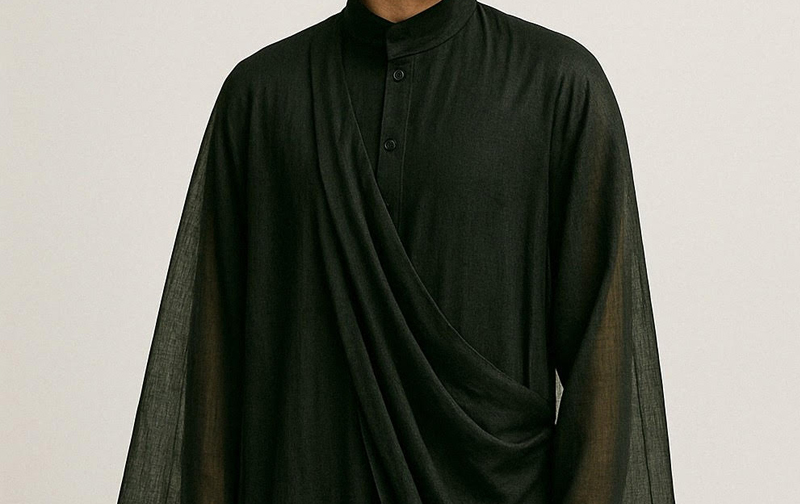
In East Asia, a parallel can be drawn. Traditional Japanese kimono, with its T-shape form and elaborate tied obi, is an exquisite garment but one bound by very strict rules of wear. Japanese designers like Yohji Yamamoto and Rei Kawakubo (of Comme des Garçons), when they emerged on the international scene in the 1980s, shocked Western audiences with designs that defied Western tailoring – in part inspired by the looseness and abstract shape of ethnic Asian clothing including kimono. Yet, they did not send geisha costumes down the Paris runways. Instead, they took elements (the wrap closure, the rectangular forms, the concept of layering) and radicalized them into avant-garde fashion that felt unprecedented. Kawakubo might take the idea of a kimono sleeve but stitch it in punk plaid and distort its proportions; Yamamoto might use a traditional indigo-dyed fabric but cut it into a deconstructed coat-dress. Their work shows how deep respect for one’s culture can manifest as reinvention. The kimono influence was clear to those who looked, but no one would mistake a Comme des Garçons creation for an actual Edo-period kimono – it was unmistakably a late 20th-century piece of fashion, speaking to issues of that time (gender, form, new beauty ideals). Indeed, Japanese designers’ penchant for black, unfinished hems and asymmetry was itself a comment on breaking from not only Western tradition but also their own country’s polished tradition – it was deliberately edgy and new. This edge is crucial: the user’s prompt uses the words “modern, edgy, and forward-looking” to describe what fashion must be. Edginess implies a cutting away from the safe and known. If a designer only stays within the edges of tradition’s template, they can hardly be called edgy. That’s why even designers working deeply with heritage must find a way to subvert or surprise.
Looking at the global fashion landscape, it’s apparent that fashion has increasingly become a conversation between cultures, eras, and technologies – but the successful dialogues always have an element of surprise or innovation. In Africa, for instance, contemporary designers are reimagining traditional prints and garments for a modern audience. A label like Nigeria’s Lisa Folawiyo takes the West African ankara prints (which have a long history and cultural significance) and cuts them into chic, globally appealing silhouettes like peplum tops and tailored trousers, embellishing them with sequins. The print – a traditional element – is still central, but it’s transformed by context and styling. If she instead simply produced the exact same garments her great-grandmother wore, would she have gained international acclaim? Unlikely – because the global fashion press and consumers respond to newness within recognizability. They love seeing the vibrant print (recognizable heritage) but also love the novel way it’s used (shorts, suits, etc., which are not “traditional” for that fabric). In the Middle East, designers like Elie Saab or Zuhair Murad incorporate Middle Eastern embellishments and a sense of regal opulence reminiscent of historical attire, but their actual designs – slinky red-carpet gowns with sheer panels and contemporary cuts – are utterly of this era. They aren’t dressing modern women as Ottoman princesses; they are infusing a whiff of that grandeur into dresses a 21st-century woman can wear to a gala. The difference lies in restraint and imagination: knowing what to take from tradition (perhaps a technique, an attitude, a color palette) and what to leave behind (the outdated shape, the context that no longer exists).
When fashion designers fail to apply that filter and simply transplant a traditional design into the present, the garment can feel conceptually orphaned. It doesn’t fully belong to the past (since it’s made now, often with some minor updates), but it also doesn’t belong to the present. It hovers in a no-man’s-land of meaning. Such designs often rely on the novelty or exoticism of the traditional reference to carry them. They may indeed catch eyes on a runway because they stand out amidst more genuinely innovative creations – but they often stand out as confusing or anachronistic. The audience wonders: Is this meant to be taken seriously as something I could wear (or aspire to wear) in daily life? Or is it intended as art or commentary? Unless the designer’s concept is to deliberately blur fashion and costume (which can be an artistic statement on its own, but that’s a rare, high-concept scenario), the lack of clarity usually weakens the collection’s impact. Critics might admire the craftsmanship or the cultural richness, but they will likely note that it doesn’t feel “fresh” or that it feels “too literal.” In design, literalness is often a criticism – it means the designer hasn’t abstracted or reimagined the source material enough. Great fashion tends to be interpretative rather than literal, suggestive rather than slavishly exact.
Beyond aesthetics and innovation, there’s also an argument about the progress of culture. Fashion is one arena in which society plays with new ideas of beauty, identity, and even politics (through what people choose to wear and what those choices signify). If fashion were to merely recycle traditional costumes, it would cease to serve its social function of reflecting and shaping contemporary identity. Sociologist Yuniya Kawamura describes fashion as a system that distinguishes “fashion” from mere clothing: part of that is the idea that fashion is validated by being new or different, endorsed by trendsetters, and adopted by followers until it diffuses and is replaced. It’s a cycle that drives the industry economically and culturally. Now imagine if all designers decided from next year onward that they would only reproduce historical garments – the cycle would stall; everyone would just pick an era or culture they fancy and dress up accordingly. It might be fun for a themed party, but as a societal practice it would mean the end of fashion as we know it, replaced by a static vintage archive. It would no longer be an industry of creative evolution but one of curation. This underscores that there is an inherent economic and creative necessity for fashion to avoid getting stuck in the past. The moment a traditional reference is used, the fashion mind asks: what’s the twist? how is it made relevant? Without satisfactory answers, the result is a dead end.
Let’s examine a concrete example to crystallize this: the Qipao (or Cheongsam) – the high-collared, slim Chinese dress – is a traditional garment that has seen waves of revival. In its pure form, the qipao is strongly associated with 1920s-40s Shanghai, and its cut and embroidered motifs carry that vintage charm. Many designers, both Chinese and Western, have been inspired by it. When someone simply reproduces a classic qipao in brocade with phoenix motifs, the wearer is immediately in a retro costume, evoking a bygone era. She might look elegant, but unmistakably old-fashioned – it’s essentially nostalgic costume (indeed, people often wear such dresses for Chinese New Year celebrations or weddings precisely to invoke tradition). However, contemporary Chinese designers like Guo Pei or Shanghai Tang (the brand) often rework the qipao – perhaps they make it in a modern printed fabric, or give it an unexpected bold color, or they cut it shorter, or combine its upper part with a different style skirt. These reworkings aim to translate the qipao for today’s context. A particularly innovative take might be to take the stand collar and side slits but attach them to an entirely different silhouette (say, a jumpsuit), creating a hybrid that acknowledges tradition but is novel. Such a design says “I remember this culture’s past, but I live in the present.” A straight replica says “I live in the past (or wish to).”
The aesthetic stagnation from over-reliance on tradition is not just hypothetical; it’s something the fashion industry grapples with regularly. Often, emerging designers from regions with strong cultural dress traditions have to learn how to incorporate their heritage without being pigeonholed as merely “ethnic designers.” If they stick too closely to tradition, international critics may dismiss their work as not truly contemporary or innovative. This can be frustrating, because of course one should be able to celebrate one’s culture. The solution many find is reinvention: for example, Indian-American designer Naeem Khan channels the glamour of Indian embroidery in his evening gowns, but the shapes of those gowns follow the trends of contemporary western couture (low backs, sleek mermaid cuts, etc.), making them competitive in the global market. Nigerian-British designer Duro Olowu uses Nigerian batik-like prints but in utterly modern, cosmopolitan ways (mixing prints, 70s-inspired silhouettes, etc.). In doing so, they both avoid stagnation. On the other hand, if a designer were to simply produce, say, the exact attire of a 19th-century Rajasthani royal court and try to market that as high fashion, it would likely be met with confusion or deemed costume – not because the garments aren’t beautiful, but because they do not align with current aesthetic dialogues. They ignore “the wind that blows in the new fashion,” to borrow Chanel’s imagery , and thus miss the lifeblood of fashion.
Innovation is the heartbeat of fashion. As soon as fashion loses innovation, it loses the excitement that draws people to it. This is why even brands known for heritage (like heritage luxury houses) constantly seek ways to reinvent their staples. A classic example is Christian Dior’s Bar jacket from 1947 – an iconic design (nipped waist, peplum) that is effectively a “traditional” piece within Dior’s history. But each successive creative director at Dior has interpreted that jacket anew – John Galliano made it in edgy materials and paired with everything from slinky slip dresses to distressed jeans; Maria Grazia Chiuri, in recent years, has reinterpreted it in denim or with embroidery, etc. If Dior had just been remaking the exact same Bar suit every year since 1947, Dior would have ceased to be a fashion leader and become a museum or a retro tailor. Instead, by riffing on that classic, they keep it alive and fashionable. The personal signature of each designer updates the tradition. This principle applies broadly: a designer’s unique perspective and the current cultural environment together act as a prism that refracts the beam of tradition into new colors.
It’s also worth noting that fashion is a collective, cumulative project of society. Each season’s trends react to and build on previous seasons, as well as cultural movements and technological changes. If one designer doesn’t push an idea forward, another will. When too many look backward without moving forward, there’s often a sense of ennui in fashion – critics will start lamenting, “This season feels tired” or “Where is the new direction?” For instance, in the late 1990s and early 2000s, there was a wave of vintage revival in fashion – a lot of recycling of 1960s and 1970s motifs. At first, it was refreshing (because those eras hadn’t been revisited in a while), but eventually some commentators started to complain that fashion was stuck in a “nostalgic gaze,” endlessly churning out retro styles and not inventing boldly new aesthetics. This periodic concern arises whenever designers lean too heavily on the past. As one journalist asked in a provocative article: “Are we in a decades-long design rut?”, pointing out how twenty years into the 21st century, people on the street didn’t look dramatically different from twenty years prior – unlike the rapid change seen in earlier decades . He linked it to a cultural moment where creators across fields were looking backward more than forward . While fashion still produces innovation, there is indeed a fine line: inspiration from tradition can enrich design, but imitation of tradition can stall it. The stagnation the user’s prompt refers to is essentially that rut – a situation where nothing truly new is happening because designers are too busy paying homage and not taking the next leap.
To avoid misunderstandings, it’s important to clarify that “modern” does not mean ignoring the past altogether. It means approaching it with a critical and creative eye. A purely avant-garde approach that disregards all history can result in fashion that is novel but meaningless, or too alien for people to embrace. The goal is not to reject heritage but to rework it imaginatively. Think of fashion as a form of storytelling: traditional garments and techniques are like classic stories that have been told for generations. A skilled designer is like a new storyteller who takes those familiar tales and retells them in a way that resonates with contemporary listeners – maybe by changing the point of view, updating the setting, or combining two old tales into an unexpected new one. The worst thing a storyteller could do (in terms of engaging an audience) is to simply recite an old story verbatim as if it were new. The listeners would recognize it and possibly tune out, unless they came specifically expecting a faithful retelling. But in fashion, unlike at a historical pageant, the audience (buyers, editors, enthusiasts) are expecting creativity. They delight in hints of the familiar, but what truly captivates them is the clever twist, the unforeseen element.
Additionally, edginess in fashion often comes from challenging norms – be they social norms, aesthetic norms, or technical norms. Traditional garments often carry with them a set of norms: they might be gender-specific (e.g., only women wear X, only men wear Y in a certain culture), occasion-specific (only for weddings, funerals, etc.), or restrictive in movement (corsets, foot-binding lotus shoes, etc.). When modern designers simply replicate these, they may inadvertently reinforce outdated norms or limitations. A forward-looking designer might instead subvert those: for example, taking an element of a women’s garment and using it in a men’s design, or taking something formal and turning it into streetwear. These subversions create that edgy feeling of surprise. If you don’t do that – if you just keep the tradition as-is – there’s no subversion, hence no edge. As a case in point, consider how the traditionally feminine art of embroidery has been reimagined in recent years by edgy designers on sportswear or unisex clothing, creating a tension between the old-fashioned delicate work and the new context of, say, a bomber jacket. If one were to just make a replica of a Victorian embroidered ladies’ tea gown, it might be gorgeous, but to today’s eye it’s likely more quaint than cutting-edge.
In sum, fashion must be a conversation between past and present, not a one-sided echo of the past. The strongest arguments against unthinkingly imitating traditional designs come down to the very definition of fashion. Fashion is contemporary expression; it lives in a state of flux and speaks to current aesthetics and societal moods. Imitating a traditional garment without alteration is akin to quoting an old text verbatim in the midst of a modern novel – it can be done sparingly for effect, but if the entire novel were just that quoted text, we wouldn’t call it a new novel at all. Likewise, a collection that is essentially a reproduction of historical or folk attire isn’t a new collection – it’s a curated exhibit. Sociologists remind us that fashion needs the churn of change to function ; philosophers remind us that fashion by definition privileges the present over the past ; and designers themselves, from Chanel to Prada to McQueen, insist that fashion must engage with the now (and the personal) to matter . Those who fail to heed this create work that may be technically dressmaking, but not fashion design in the fuller sense.
Ultimately, the reason fashion design should not simply imitate tradition without significant modern reinterpretation is that doing so betrays fashion’s creative mission and its temporal essence. Fashion is culture in motion. It is, as Miuccia Prada said, an “instant language” – and an instant language cannot freeze itself in an archaic form and still communicate vitality. When designers blend heritage with innovation, they pay respect to the past and contribute to the future of style, ensuring that traditional crafts and motifs live on in new forms. They avoid the trap of turning their runways into mere costume parades. Instead, they create garments that are alive in the present, garments that real people can wear to tell a story about who they are today. This is how fashion distinguishes itself from mere costume or replica: through a relentless, edgy pursuit of the new, even as it nods at what came before. As Barthes would have it, each new fashion asserts “the natural right of the present over the past” – and in doing so, fashion asserts its true identity as an art form of becoming, not of preserving. Fashion must push forward, reimagining tradition rather than simply reiterating it, to remain what it fundamentally is: the ever-evolving art of self-expression in time.