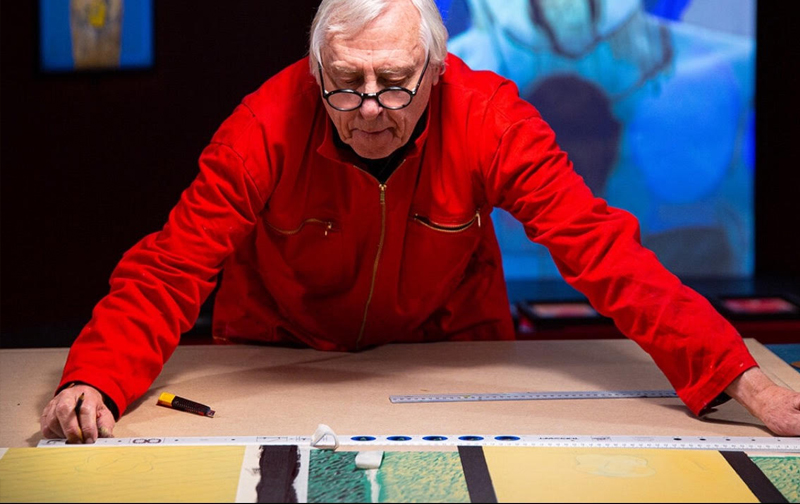
Peter Greenaway’s cinema is often described as a marriage of film and painting, a synthesis that yields an unmistakably opulent visual language. His work betrays a deep influence of Renaissance and Baroque art traditions – indeed, Greenaway began his career as a painter – which manifests in meticulously composed, tableau-like scenes and chiaroscuro lighting reminiscent of the Old Masters . Mannerist aesthetics also surface in his frames through exaggerated poses and artful distortions of reality . Common to nearly all Greenaway’s films is a series of stark visual polarities: sumptuous period costumes set against unabashed nudity, pastoral nature collided with grand architecture, and scenes of intense sensual pleasure juxtaposed with images of decay and death . These contrasts are not merely for show; they serve a narrative purpose by externalizing the films’ core tensions – between civilization and carnality, culture and carnage, life and its inevitable end – directly into the mise-en-scène. Greenaway’s approach positions the cinematic frame as a canvas where art history, theater, and cinema converge. Critics have frequently noted that each shot in his oeuvre “advances with the grace and precision” of a carefully wrought painting or novel , underscoring how visual composition in Greenaway’s films carries as much weight as dialogue or plot. Over a career spanning from the late 1960s to the 2020s, Greenaway’s art direction, set design, and costuming have continuously evolved, yet his dedication to a rich, symbolic visual language has remained a constant, serving as the structural backbone for narrative and character development in his films.
Greenaway’s earliest works were experimental films and pseudo-documentaries that already revealed his preoccupation with form, cataloguing, and visual allegory. The Falls (1980), an eccentric “mammoth, fantastical, absurdist encyclopaedia” of invented biographies , for example, is structured like an archive, with minimal dramatization. Though lacking elaborate set pieces, it introduced Greenaway’s fascination with exhaustive lists and classification – an interest that would later inform his approach to set decoration as a form of visual taxonomy. In these formative projects, he treated information itself as an artistic medium. This predisposition foreshadows how he would later use props, on-screen text, and architectural space within his films to create a dense network of symbols, effectively turning mise-en-scène into a kind of database. Media theorist Lev Manovich famously characterized Greenaway as a “database filmmaker,” noting that the database form – collections, lists, and visual catalogues – is key to Greenaway’s work, meeting his “demands for an anti-narrative cinema” and for film as Gesamtkunstwerk, a total work of art . Even before technology allowed him to literally layer information on screen, Greenaway’s early films hint at this mindset: each frame is arranged to be “read” for details, clues, and references, much like a museum display. While these 1970s works such as Vertical Features Remake (1978) and A Walk Through H (1978) were modest in production design, they laid the conceptual groundwork for Greenaway’s mature style – using visuals not just to complement storytelling but to be the storytelling.
Greenaway’s breakthrough came with The Draughtsman’s Contract (1982), a film that firmly established his reputation for painterly art direction and ornate period detail. Set on an English country estate in 1694, the film’s narrative centers on a Baroque-era illustrator hired to draw a series of landscapes, and Greenaway uses this premise to make the act of image-making itself a dramatic subject. The film’s visuals consciously evoke the very school of art that its protagonist practices. As Greenaway himself remarked, “90% of my films one way or another refer to paintings,” and The Draughtsman’s Contract “quite openly refers to Caravaggio, Georges de La Tour and other French and Italian artists” of the Baroque . Indeed, the “visual references for the film are paintings by Caravaggio, de La Tour, Rembrandt, Vermeer and other Baroque artists,” giving the film a decidedly “painterly quality.” Each composition is meticulously arranged with the balance and symmetry of a 17th-century canvas: verdant formal gardens and aristocratic interiors become theatrical stages where actors pose with the stillness and gravitas of figures in an oil painting. The scenic composition and illumination directly mimic Baroque techniques – dappled natural light and candlelit shadows sculpt each scene – and the costumes adhere to period authenticity with lavish wigs, frock coats, and gowns that could have stepped out of a Van Dyck portrait . Yet, Greenaway characteristically infuses deliberate anachronisms and modern art references into these settings. In one notable touch, he hung on the manor walls faux-Roy Lichtenstein paintings (in a 1690s setting!) as a sly wink, layering Pop Art within Baroque decor . Likewise, a character is seen using a “cordless phone” in the 17th century . These touches remind the viewer that this historical world is a constructed artifice, a postmodern play with time. Such set details serve the narrative by underscoring the film’s themes of deception, authorship, and interpretation; the audience, like the film’s draughtsman, must decipher what is “real” or significant in each image. Critics praised the film’s visual and intellectual richness. Roger Ebert lauded The Draughtsman’s Contract as “a tantalizing puzzle, wrapped in eroticism and presented with the utmost elegance,” noting how “all of the camera strategies are formal and mannered” in the film . The characters inhabit the screen like subjects of a lavish tableau vivant, and even their witty, baroque dialogue complements the visual opulence. This formal, mannered presentation – “the movie advances with the grace and precision of a well-behaved novel” , as Ebert observed – demonstrates how Greenaway’s elaborate art direction was integral to the storytelling: the stylized visuals create a controlled, almost artificial social world, mirroring the rigid contracts and schemes that drive the plot. Another reviewer, Jeremiah Kipp, remarked that in The Draughtsman’s Contract Greenaway still offered “some form of narrative…instead of the nonlinear, compulsive list-making and categorization” that would dominate his later films . In other words, while the film’s visual style was boldly unique, it remained grounded in a solvable mystery and period drama structure – a “fledgling attempt” at the bolder experiments Greenaway would later perfect . By the film’s haunting conclusion – a violent act staged with the composed elegance of a painting, shocking the viewer precisely because of its aesthetic detachment – Greenaway forces a reassessment of everything seen before, as one critic noted: the “ending is haunting; it makes you reassess all that went before”, revealing that beneath the beautiful surfaces, the supposed victims were “heartless predators” all along . This exemplifies Greenaway’s use of art direction and design to enrich narrative complexity: the splendor of the visuals lulls the audience into a sense of order and elegance that is ultimately subverted, deepening the film’s commentary on power, art, and duplicity.
Following The Draughtsman’s Contract, Greenaway continued to develop his distinctive visual language in a series of 1980s films that each pushed his design concepts in new directions. A Zed & Two Noughts (1985) shifts from the Baroque past to a modern setting – the film unfolds largely in and around a zoological research facility – yet it retains Greenaway’s hallmark compositional rigor and fine-art allusions. The film’s protagonists are twin biologists obsessed with death and decay after their wives die in a freak accident, and this morbid theme is brilliantly reflected in the production design. The sets are sleek, clinical spaces (laboratories, hospital rooms, the zoo itself) rendered with a stark symmetry that conveys the twins’ scientific mindset and their emotional repression. Greenaway and his key collaborators (production designer Ben van Os and cinematographer Sacha Vierny) compose many shots as perfectly balanced mirror images – an aesthetic echo of the twin characters and the orderly taxonomies of science. Within these frames, however, the content is often subversively grotesque or surreal: time-lapse montages of animal carcasses decomposing in glass tanks form the film’s most arresting visual motif. These sequences are meticulously arranged still lifes of death – reminiscent of vanitas paintings – where fruits, swans, and zebras rot in a blooming of color and texture under controlled lighting. Such imagery literalizes the theme of mortality, turning set props (dead animals) into narrative devices that chart the twins’ deepening fixation on life cycles. Yet alongside the clinical and the macabre, A Zed & Two Noughts also indulges in explicit homages to art history. One character, Alba (a woman who loses a leg in the same crash), becomes the subject of a mad surgeon’s aesthetic experiment: he surgically transforms her into a living recreation of Johannes Vermeer’s paintings . In an unforgettable sequence, Alba is posed and costumed precisely as Vermeer’s “Girl with a Pearl Earring,” complete with period dress and lighting, her amputated leg hidden to mimic the composition of the famous portrait . It is a striking example of Greenaway’s set and costume design serving as intertextual commentary – the film literally stages a classical painting within its narrative, blurring the boundary between cinema and canvas. The moment is beautiful yet disquieting, tying together the film’s exploration of artifice (turning life into art, at great physical cost) and decay (Alba’s body is as manipulated as the dying creatures the twins study). Critic Philip French noted that the “appearance of the film [is] consistently sleek and visually exciting,” praising the immense energy Greenaway poured into the visual presentation . Jonathan Rosenbaum went further, calling A Zed & Two Noughts “the boldest and arguably the best of Peter Greenaway’s fiction features” up to that time , largely due to its audacious imagery and thematic fearlessness. Not all were enamored: Vincent Canby of The New York Times famously lambasted the film as “pretentious, humorless and…more boring than a retrospective devoted to television weather forecasts” , a critique targeting what he saw as over-indulgence in style and insufficient human depth. Canby’s jab, however hyperbolic, underscores the polarizing quality of Greenaway’s approach – for some, the meticulous visual formalism and intellectual remove that make his films singular also make them emotionally distant. Nonetheless, in A Zed & Two Noughts, the art direction and costume elements (like Alba’s progressively elaborate outfits concealing her disability, or the stark black-and-white attire of the twins) all serve to externalize the characters’ inner worlds: their desire for symmetry, control, and understanding in a universe of entropy. The film thus functions as both an exquisite art installation – one replete with references to Vermeer and the naturalist painter Audubon – and a darkly comic narrative about mankind’s futile quest to catalogue life and conquer death. Greenaway’s visual language here had clearly evolved to handle modern settings without abandoning his painterly roots, and it proved that even a laboratory or a zoo, under his direction, could become as aesthetically fascinating as a Baroque palace.
Greenaway’s next major work, The Belly of an Architect (1987), continued this trend of embedding thematic content in visual design, this time focusing on architecture as the key motif. The film follows an American architect in Rome, Stourley Kracklite, who obsessively curates an exhibition on his hero, the 18th-century architect Étienne-Louis Boullée, even as he grapples with a fatal illness (a tumor in his belly). The production took full advantage of Rome’s grandeur: iconic sites like the Pantheon, the Roman Forum, and Fascist-era marble complexes become backdrops that dwarf the protagonist, visually reinforcing his insignificance in the face of history. Greenaway and production designer Luciano Tovoli treat these real locations almost like ready-made sets – Kracklite is often staged centrally in vast symmetries of classical columns and arches, akin to a figure in a Piranesi engraving. The set decoration for the Boullée exhibition itself is laden with architectural models, geometric plans, and neo-classical sculptures, all rendered in austere monochrome displays that mirror Kracklite’s idealization of order and permanence. Yet throughout the film, this ordered aesthetic is disrupted by imagery of physical decay: we see Kracklite clutching his abdomen in severe pain against the backdrop of pristine architecture. In one symbolic scene, a grand celebratory cake made to resemble one of Boullée’s domed designs is cut open and devoured – an edible building consumed from within, prefiguring Kracklite’s own bodily collapse at the exhibition’s opening. Here Greenaway uses a prop as both set decoration and narrative metaphor: the cake’s destruction visualizes the central drama of a man whose body (his “architectural” structure) is failing. Costume design complements these ideas; Kracklite’s costumes deteriorate from sharp, formal suits (signifying professional control) to disheveled, sweat-stained garments as his illness progresses, paralleling the tarnishing of his lofty project. Although The Belly of an Architect is one of Greenaway’s more somber and restrained films, it still bears his unmistakable visual stamp. The film’s pacing often allows the camera to linger on the arrangement of space and objects rather than on traditional dramatic action, inviting the audience to contemplate the meaning of the surroundings. In this way, architecture and set design become key characters in the film. While critical discussion of this work often highlights the powerful performance by Brian Dennehy as Kracklite, it is equally noted that the Rome locations and exhibition sets convey the “belly” of the film – its thematic core regarding legacy, erosion, and the quest for immortality through art. The cultural artifacts around Kracklite (ancient temples, Boullée’s visionary – but never built – drawings) constantly remind us of art’s enduring nature in contrast to the protagonist’s fleeting life, thus enriching the narrative without a word spoken. Greenaway’s art direction in this film underscores a philosophical query: can art (monuments, architecture) outlast the mortality of its creators? This question is physically manifest in every frame, making The Belly of an Architect a meditative visual experience where set and costume serve as windows into existential dread.
By the late 1980s, Greenaway had fully hit his stride in marrying visual extravagance with provocative storytelling. Drowning by Numbers (1988) offers a prime example of his penchant for structured visuals and symbolism. On the surface, the film presents a grimly comic narrative of three women (a grandmother, mother, and daughter, all named Cissie Colpitts) who sequentially drown their husbands – a dark tale of feminine revolt. But rather than approaching this as gritty crime drama, Greenaway filters it through a veil of stylization and game-like structure. The art direction introduces numbers literally into the scenery: the numbers 1 through 100 appear in order, slyly hidden in each scene as the story progresses . A viewer might notice, for instance, the number “7” painted on a gate as a character walks by, or “34” formed by two hanging objects – a playful visual puzzle that runs throughout the film. This numerical conceit turns the set decoration into a meta-game, echoing the characters’ own obsession with rules and counting (the film features recurring discussions of invented games). The landscapes of rural England are shot with a painter’s eye for composition and color: green meadows, a quiescent sea under pink dusk skies, and the twinkling lights of a country fair at night all appear as idyllic backdrops. Against this pastoral beauty, macabre elements are juxtaposed – a corpse floating among bright yellow apples in a tub, or the three women in black funeral dresses strolling calmly after committing murder. The costume design emphasizes a quaint, almost storybook quality: the women often wear old-fashioned floral dresses or solemn Victoriana, aligning with the film’s fable-like atmosphere, whereas the hapless men sport quirky, casual attire (one victim wears a comically garish suit in a bathtub scene, amplifying the absurdity). The overall effect is that of a morbid folk tale illustrated by an eccentric artist, full of easter-egg details and dark humor. These details serve the narrative by underlining its theme: life (and death) is a game with arbitrary rules. Even the local coroner in the story is more concerned with counting games and tallying stars in the sky than with dispensing justice, reflecting how structure and trivial order are given precedence over moral chaos. Critics largely appreciated the film’s imaginative design and structure – it holds a high approval rating among retrospectives – though some, like Roger Ebert, found it intriguing yet ultimately puzzling. Ebert admired that the landscapes were “beautifully photographed” but confessed “I was not sure why Greenaway made it” , suggesting that for some the aesthetic and structural ingenuity overshadowed clear purpose. Such a response speaks to Greenaway’s method: he is willing to let the audience drown (so to speak) in rich imagery and patterns, inviting them to find their own meaning in the visual and numerical riddles. In Drowning by Numbers, costume and set decoration actually carry significant storytelling weight. The recurring motif of the “Shepherdess” painting (an image frequently glimpsed in the background) and the constant numerical countdown both foreshadow the film’s climactic twist on fate and death. By the time the count reaches 100, the audience realizes they’ve been led, step by step, to an ending that feels both orchestrated by some dark game logic and inevitable in a mythic sense. Through its visuals, the film engages us in an interactive experience of sorts – we become players scanning each frame for the next number, just as we become accomplices in the Cissies’ deadly game. Such interactivity was unusual for cinema at the time and demonstrates Greenaway’s innovative use of art direction as a narrative engine in itself.
Greenaway’s international reputation was cemented with The Cook, the Thief, His Wife & Her Lover (1989), arguably his most famous and visually opulent film. Here, Greenaway’s long-time collaborators – cinematographer Sacha Vierny, production designers Ben van Os/Jan Roelfs, and composer Michael Nyman – combined with a bold new partner, fashion designer Jean-Paul Gaultier, to create a cinematic feast of image and sound. Set almost entirely in a lavish London restaurant named Le Hollandais, the film is structured as a series of contiguous spaces, each with its own dominant color scheme and mood, through which the camera (and characters) fluidly travel. The art direction is nothing short of theatrical. Each night, the brutish gangster Albert Spica (the Thief) holds court in the scarlet-red dining hall, a set draped in red velvet curtains, lit with a hellish glow, and adorned with Baroque still-life arrangements of meats and fruit that recall the sumptuous yet vaguely rotten banquet tables of a Frans Snyders painting. In stark contrast, the restaurant’s kitchen set is bathed in sickly green light: copper pots and molded jellies glimmer green, and even the steam has a greenish tinge. This is a world of raw ingredients and base bodily functions, the domain of the Cook. Meanwhile, the restrooms are antiseptic white, a neutral zone of secrecy where the Wife (Helen Mirren’s character, Georgina) and her Lover (Michael) carry out their affair hidden from Spica’s wrath. A loading dock of pale blue and the Lover’s book depository in warm sepia browns round out the film’s palette . Greenaway uses these color-coded environments to signify different emotional and thematic “worlds” – something he explicitly acknowledged, stating that the shifting colors represent how characters “inhabit each different world.” It’s as if the film’s architecture is partitioned into elemental zones: passion and violence (red), sustenance and lust (green), purity and secrecy (white), intellect and refuge (brown). The costume design, masterminded by Gaultier, is integrated brilliantly into this schema. As characters move from one location to another, their costumes magically change color to match the new setting . For instance, Georgina’s extravagant gown – designed with Gaultier’s signature blend of historical silhouette and provocative modern flair – shifts from deep crimson in the dining hall to verdant green in the kitchen, then to an angelic white in the restroom scenes . This astonishing effect was achieved through both lighting and multiple costume pieces, and it creates a visual continuity that binds character to environment. It is as though the very fabric of the characters’ identities is altered by the spaces they occupy – a cinematic embodiment of the idea that we all wear “masks” suited to our surroundings. Gaultier’s costumes are works of art in themselves: Georgina’s dresses feature lavish bustles and corsets, sensual and restrictive, signaling her role as the gilded possession of her husband, while also foreshadowing her own latent power and sexuality. Albert Spica, by contrast, is clad in outlandishly gaudy suits (brightly colored, with oversized patterns and food stains) that mirror his vulgar appetites and lack of refinement – he practically wears his grotesqueness on his sleeve. Michael, the lover, often appears in a bookish brown suit that helps him blend into the wood-paneled library where he hides; his costume renders him literally a background figure, “the lover as scholar,” almost camouflaged among books, which underscores his intellectual connection to Georgina in contrast to her husband’s coarse physicality. The coordination between set and costume in this film is so total that it approaches operatic Gesamtkunstwerk. Critics at the time were dazzled: the film’s “lavish cinematography and formalism” were widely noted , and its raw displays of violence and sex, set against such artful backdrops, sparked both admiration and controversy. Indeed, The Cook, the Thief, His Wife & Her Lover had to be released without an MPAA rating (to avoid the X rating) in the United States due to its graphic content, proving how far Greenaway was willing to go in marrying beauty and brutality. The narrative of the film – a tale of adultery and revenge culminating in an act of murderous cannibalism – is heightened and given allegorical weight by the production design. When Georgina finally exacts vengeance on her tyrannical husband by having him served a dish of her roasted lover, the scene plays out in the red dining hall as a twisted parody of the Eucharist or Last Supper. Georgina, now draped in regal black, forces Spica at gunpoint to dine on human flesh at the opulent table, proclaiming him finally a “cannibal” before pulling the trigger. The tableau at this climax is one of baroque horror: candles flicker over platters of grotesque cuisine, blood-red wine and sauces matching the room’s hue, as live musicians play somberly. It’s an image that critics and scholars have dissected for its art-historical echoes (from Rembrandt’s Belshazzar’s Feast to the satire of Hogarth) and its political metaphor (many saw Spica as a stand-in for Thatcher-era excess or for generalized fascistic gluttony). By presenting this gruesome finale in such a lavish, art-directed manner, Greenaway ensures it resonates as myth or cautionary fable rather than mere shock. Film scholar Amy Lawrence observed that the final scene’s composition confers a kind of perverse dignity and inevitability to the act – a death served as a banquet, aesthetically transfigured. Thus, art direction and costume design in The Cook, the Thief… do more than create an immersive world; they are the architecture of the film’s meaning. As one reviewer put it, the film is “audacious, powerful” – not only for its content but because of how that content is delivered through image and style . Roger Ebert, who championed the film, pointed out that its “raw emotion and violent interpersonal conflict” marked a departure from Greenaway’s typically more cerebral tone . That emotional impact, however, is undeniably magnified by the operatic staging – the audience feels the passion and anger viscerally precisely because the film’s visuals seduce and assault the senses at every turn. In sum, The Cook, the Thief, His Wife & Her Lover stands as a landmark in Greenaway’s career where his visual language reached an apex of complexity and boldness. It had a tangible cultural impact, demonstrating how a film could be extremely artistic and yet provoke mainstream debate about censorship and art. It also exemplified fruitful collaboration between a filmmaker and a fashion designer, bridging cinema and haute couture. The film’s enduring images – Helen Mirren in her massive collar and corset framed against the glowing red set, or the slow tracking shots that follow waiters carrying gleaming platters from the green kitchen to the red hall in a single, unbroken movement – have entered the pantheon of late-20th-century cinema iconography. They remind us that for Greenaway, the screen is a canvas and stage, where painting, theater, and even cuisine fuse into a singular, if often unsettling, vision.
As Greenaway entered the 1990s, he continued to push the envelope of visual form, increasingly incorporating emerging digital techniques into his art direction and storytelling. Prospero’s Books (1991), his adaptation of Shakespeare’s The Tempest, is perhaps the director’s most experimental foray into multimedia cinema and stands as a testament to his ever-evolving visual language. Rather than delivering a traditional literary adaptation, Greenaway transformed The Tempest into an audiovisual spectacle that treats Shakespeare’s text as one layer among many in a dense collage of image, calligraphy, dance, and music. The film features Sir John Gielgud as Prospero, and significantly, Gielgud at the time was in his late 80s – an esteemed actor at the end of his career. Greenaway built the film’s thematic and visual approach around this fact, turning Prospero’s Books into an exploration of an artist-magician (Prospero, and by extension Gielgud himself) contemplating his life’s creations. The set is essentially Prospero’s mind manifested: a vast dark soundstage of a world flooded with water (to reflect the island), upon which stand platforms and structures laden with books. Not just physical books, but imaginary books come to life – each of the 24 books that Prospero is said to own (as mentioned in Shakespeare’s play) is given a unique visual representation through animated illustrations, filmed vignettes, or superimposed text. For instance, “A Book of Water” shows cascades of water nymphs and droplets dancing across the screen, while “A Book of Mirrors” presents fragmented reflections of characters. Greenaway used then-cutting-edge digital effects to layer these elements, often having multiple images within the frame at once. In many scenes, the viewer sees a smaller frame inset in a corner showing text or drawings from a magical book, while the main action occurs elsewhere in the composition. This approach creates the impression of pages turning and illustrations animating as Prospero reads – the film is the book. It was an unprecedented level of visual layering, described by Roger Ebert as “a work of original art” that must be taken on its own terms . Indeed, Ebert noted that most critics “missed the point; this is not a narrative…It is simply a work of original art” that demands the viewer’s acceptance or rejection . The production design of Prospero’s Books thus largely consists of these symbolic objects and spaces rather than realistic locations. The costumes further delineate the film’s dual realities. Prospero himself wears a simple, flowing robe (or is often nude, as Gielgud was boldly willing to appear at times), emphasizing him as the pure source of imagination, unadorned like an ancient sage. In contrast, the spirits that he commands – notably Ariel and a host of nymphs and mythical creatures – are frequently portrayed nude or nearly nude, their bodies painted or gilded, effectively making the human form a canvas. Scholar Douglas Lanier observes that Greenaway uses nudity here as a “medium” to differentiate the film from the purely textual nature of Shakespeare’s work . The naked bodies, often moving in choreographed groups, serve as living set pieces that embody natural elements and ideas – innocence, freedom, and the raw material of life – which Prospero shapes with his art. By contrast, the members of Prospero’s court (like his daughter Miranda or her eventual lover Ferdinand) are arrayed in rich period costumes, linking them to Renaissance imagery and the more conventional aspect of narrative (Miranda and Ferdinand’s love and marriage plot is the closest the film comes to straightforward storytelling). The antagonists (Antonio, Alonso, etc.) wear stylized Elizabethan garb, but Greenaway often places them in tableau backgrounds or under surreal lighting, keeping them somewhat abstract. Throughout Prospero’s Books, water as a set element is omnipresent: reflective pools surround the stages, and characters splash or emerge from them, lending a constant fluid motion and literally mirroring the theme of reflection on art. The film’s audacious design and complex audiovisual layering divided critics and scholars. Many were astonished by its ambition – its “reliably daring” creativity for Greenaway’s fans, as the critical consensus later noted – while others felt it sacrificed emotional engagement and Shakespeare’s substance for visual opulence. Some Shakespearean scholars complained that Greenaway had “MTV-ed Shakespeare,” focusing on rapid, flashy visuals at the expense of the text’s depth . Greenaway, always unapologetic, summarized these criticisms as saying there was “too much Greenaway, not enough Shakespeare” – which, from his perspective, is precisely the point, as he intended to reinvent the play through his own artistic lens. Indeed, Prospero’s Books can be seen as Greenaway’s manifesto on the synergy of art forms: painting, calligraphy, theater, dance, and digital video all coexist. In one notable sequence, Prospero stages a grand masque for Miranda and Ferdinand – a Renaissance tradition of pageantry – which Greenaway explodes into a frenetic montage of Baroque costumes, operatic singing, and swirling images of classical gods blessing the union. It’s disorienting and mesmerizing, giving the sense of experiencing an artwork from within. The viewer, like Prospero, is immersed in the “brave new world” of pure imagination. The role of the set and costume design here directly serves the narrative concept that Prospero is the ultimate author: everything we see is literally coming from his books and his mind. The human performers become interchangeable with decor, the pages of books turn into moving projections on bodies and walls. This self-referential artistry did lead some to accuse Greenaway of indulging in style for style’s sake. However, as Ebert argued in the film’s defense, Prospero’s Books “need not make sense” in conventional terms because it “could not have been any less [difficult]” without betraying its nature; it is meant to be experienced rather than neatly understood . In academic discussions, Prospero’s Books is often hailed as a seminal example of early 90s postmodern cinema, illustrating how new digital tools enabled filmmakers to literally layer visual information and push cinema closer to the state of painting and collage. The film’s very existence expanded the notion of production design in cinema: no longer confined to static sets or practical locations, design could include dynamically changing textual and graphic elements superimposed on the action – a technique that anticipated later digital-heavy auteurs. In Prospero’s Books, Greenaway’s visual language reached an extreme of complexity and intertextuality, but it also pointed forward to the possibilities of merging traditional set and costume craft with digital art. For all its abstraction, the film has moments of poignant beauty, especially as it closes: Prospero/Gielgud, having relinquished his magic, walks naked into a soft light, the voluminous books scattered and silent. The artifice fades, leaving the frail human – a moving image of an artist at twilight, which Peter Conrad observed was Gielgud “simultaneously noble and naughty, a high priest and a joker, contemplating at the end of a long life the value of the art he practices.” This meta-commentary, delivered through performance and image, encapsulates how Greenaway’s design choices in Prospero’s Books ultimately serve a profound character and thematic development: the farewell of an artist to his creations, rendered in the very visual splendor that defined his power.
Greenaway followed Prospero’s Books with a project equally audacious in content, though more controversial in reception: The Baby of Mâcon (1993). Though not as well known to general audiences due to distribution issues, this film is crucial to consider in an analysis of Greenaway’s visual artistry because it represents his most Brechtian, self-reflexive use of set and costume. The Baby of Mâcon is structured as a play-within-a-film, set in a pseudo-medieval time and performed in front of a live audience (as depicted in the movie). The “story” concerns a miraculous baby born in a town of infertile women, and the horrific exploitation that follows, but Greenaway deliberately blurs the line between the enacted story and the act of its staging. The entire film takes place on the stage of a cavernous Baroque theater. The sets are overtly theatrical: painted backdrops of a rustic town, movable props like hay bales and livestock, and extravagant ecclesiastical ornaments for a cathedral scene. The camera does not hide the artifice – we frequently see the 17th-century audience watching from their seats or balconies, and at times the action on stage spills into the audience. By designing it this way, Greenaway forces the viewer to be conscious of performance and spectacle. The costume design in The Baby of Mâcon, by Dien van Straalen, is among Greenaway’s most lavish – ornate robes for the corrupt bishops and clergy, opulent jewel-toned gowns and wigs for the aristocrats observing the play, and earthy, tattered garments for peasants. Crucially, as the staged miracle tale descends into violence (with the Church figures committing heinous acts upon the Girl who claimed the baby, in retribution for her “heresy”), the beautiful pageantry is stripped away to reveal brutality. For example, a central sequence involves the public “deflowering” of the Girl by hundreds of soldiers as punishment – a scene extremely difficult to watch. Greenaway stages this atrocity in the midst of a formal court ceremony: the soldiers are dressed in identical ornate uniforms, moving in regimented formation amid flickering candlelight and before a silent, staring audience. The grotesque act is choreographed like a ritual. Here, the tension between the gorgeous ceremonial set/costumes and the rape’s horror makes a pointed statement on voyeurism and power – implicating not only the on-screen audience but the film’s audience as well. By the end, the stage is literally littered with the detritus of the performance (broken props, torn costumes, bloodstains), and the fantasy of the miracle has collapsed. The Baby of Mâcon uses its stylized design to meditate on the nature of spectacle and our complicity as spectators in scenes of suffering, echoing ideas from Brecht and Artaud. Because of its unflinching content, the film was seldom screened widely, but scholars have noted its daring use of form. The artificial stage sets serve to create a distance – “this is only a play” – even as the content forcibly breaks that distance, making us acutely aware of real cruelty. It’s a case where Greenaway’s visual choices directly engage a philosophical question: does aestheticizing violence numb us to it or expose its mechanisms? In The Baby of Mâcon, the simultaneous beauty and horror on stage compel a confrontation with that question. Though lacking wide critical discussion due to its limited release, the film remains a significant chapter in Greenaway’s filmography for how it pushes art direction into the realm of provocation and meta-commentary on the ethics of viewing.
After The Baby of Mâcon, Greenaway shifted gears. The Pillow Book (1996) marked a partial return to contemporary settings and a dialogue with non-Western artistic traditions, showing yet another evolution in his visual design. Set in Japan and later in Hong Kong, The Pillow Book is an erotic drama that draws inspiration from Sei Shonagon’s 10th-century Japanese text of the same name and explores the art of calligraphy on the human body. The film’s protagonist, Nagiko, is a Japanese model and writer who has an almost spiritual obsession with combining literature and the body – a passion stemming from childhood when her calligrapher father painted birthday greetings on her face. Visually, The Pillow Book is lush and cosmopolitan, blending traditional Japanese aesthetics with high fashion and modern urbanity. Production designer Hansjörg Mayer and cinematographer Sacha Vierny (in their final collaboration with Greenaway) crafted a style that allows image and text to merge on screen. Often, Nagiko’s handwritten diary entries in elegant Japanese characters scroll over the image, or a split-screen appears with calligraphic script on one side and narrative action on the other . These superimposed texts are not merely subtitles but part of the design – a dynamic graphic element that interacts with the actors’ bodies (sometimes literally written across their skin in ink) and with the film frame. This approach continues Greenaway’s integration of graphic design into cinema that we saw in Prospero’s Books, but here it is culturally and narratively grounded in the practice of East Asian calligraphy, giving it a thematic resonance (writing as an act of love and possession). The costumes in The Pillow Book oscillate between the traditional and the avant-garde. In Japan, Nagiko (played by Vivian Wu) is often seen in elegant contemporary clothing with subtle nods to traditional dress – for example, modern dresses with kimono-inspired patterns or sleek silk blouses in classical hues – signaling her role as a bridge between heritage and modern life. When she becomes involved with a European lover, Jerome (Ewan McGregor), and later enters the fashion and publishing world of Hong Kong, the attire shifts to haute couture and stylish Western suits, situating the characters in a glossy cosmopolitan milieu. Notably, at times Nagiko and Jerome wear nothing at all – their nude bodies becoming canvases for poems and prose. These scenes of body-writing are central set-pieces of the film: Nagiko’s lovers are chosen for the quality of their skin on which she will write or which she will have written upon by them, blurring the line between costume and character. Skin becomes a costume of text. For instance, in one visually striking sequence, Jerome lies nude as Nagiko covers him head-to-toe in elaborate Japanese characters in ink, effectively “dressing” him in literature. Later, in a grim twist, Nagiko has pages of Jerome’s skin (post-mortem) bound into a book for her publisher – an extreme literalization of the idea of the body as a text. Through these daring images, Greenaway examines sensuality and mortality entwined: the lover’s body is both a beautiful manuscript and ultimately a mortal coil turned macabre artwork. Critics responded to The Pillow Book with a mixture of admiration for its visuals and reservations about its storytelling. Many noted that it was “undeniably sensual and visually ravishing” . The film’s color palette is carefully controlled: scenes in Japan have a serene, pastel quality, while Hong Kong sequences are more frenetic, with neon lights and bold contrasts. Greenaway also employed a technique of changing film stock and aspect ratio to differentiate story layers – at times mimicking the look of silent cinema or monochrome when recalling the past, and vibrant color for the present – adding another textural layer to the visual narrative. Andrew Johnston commented that in The Pillow Book, Greenaway employs “most of [his] signature visual devices (elaborate title cards, superimposed images)” – by now recognized hallmarks of his style – “but accompanied by U2 songs and traditional Asian music, they seem fresher and more dynamic than before.” Indeed, the soundtrack’s unexpected blend of contemporary Western music and ancient Japanese court music paralleled the film’s fusion of fashion photography slickness with classical calligraphic art. Johnston’s observation highlights that by immersing himself in an Asian artistic context and a contemporary setting, Greenaway revitalized his approach; his familiar devices took on new life against the backdrop of 1990s Tokyo/Hong Kong. Still, reviews often felt that The Pillow Book’s narrative “lacks the hypnotic pull of its imagery” . In other words, while viewers were captivated by the beauty of its form – the erotic charge of watching human bodies turned into living calligraphy, the visual poetry of ink flowing on skin – some found the story of love, betrayal, and revenge (Nagiko’s quest to get back at a publisher by sending him body-written books culminating in one made of her lover’s skin) to be emotionally cold or structurally diffuse. This critique echoes a recurring theme in Greenaway’s reception: the question of whether sumptuous style overwhelms substance. However, in The Pillow Book, one can argue that style is substance. The film’s preoccupation with how words look and feel, how identity can be inscribed or erased, how art can be intensely personal and carnal – these are conveyed principally through its visuals. Greenaway once again uses design to deepen character: Nagiko’s transformation from a timid, calligraphy-adoring girl into a confident artist avenging her lover is mirrored in her visual presentation – from modest traditional clothes to high-fashion and finally to naked defiance. By the film’s end, she reclaims her late father’s practice of writing on her own skin (with her new lover), completing a personal and aesthetic journey. In doing so, The Pillow Book demonstrates Greenaway’s evolving interest in fashion and contemporary art; it is perhaps his most sensual film in terms of texture – one almost feels the glide of the calligrapher’s brush, the silk of garments, the cool concrete of modern architecture. It confirmed that even outside the period-piece context, Greenaway could maintain his baroque sensibilities, adapting them to modern settings without losing complexity.
Greenaway closed the 1990s with 8½ Women (1999), a film i watched more than hundred times, quite different in tone – a darkly droll homage to Fellini and the tropes of erotic cinema – which, while not as visually celebrated as his earlier works, still provides insight into his art direction choices and their narrative functions. The title itself references Fellini’s 8½, and like Fellini’s film, Greenaway’s 8½ Women deals with a wealthy man indulging in fantasies (in this case, starting a private harem of “half women”, or rather eight and a half concubines, to cope with grief). Set primarily in an opulent mansion in Geneva, the film’s production design is more minimalistic compared to the lush overload of Cook, Thief or Prospero’s Books. The mansion is sleek, marble-floored, and filled with expensive but cold modern art – an environment of privilege that initially appears emotionally hollow. Into this space, the protagonist Philip and his son Storey invite a series of women who each embody various erotic clichés (a nun, a kabuki actress, etc.), temporarily transforming the austere villa into a dreamscape of staged sexual tableaux. Greenaway’s set decoration for these sequences shows a playful, if sardonic, approach to costuming and space. Each woman brings her own microcosm of style: for instance, the Japanese “half woman” brings elements of a tatami room and wears a kimono; another, who fancies herself a film star, drapes the rooms in Hollywood Regency glamor. These ephemeral redesigns of the mansion reflect the film’s exploration of fantasy projection – the mansion becomes a canvas for Philip’s imagination, much as the women themselves become actors in his personal theater of desire. Costume design helps delineate each of the eponymous eight and a half women: from a sumptuously embroidered kimono to a riding habit, a burqa, and even a pig mask in one absurd encounter, the outfits are fetishistic caricatures, deliberately a touch tawdry or bizarre, signaling that these are constructed male fantasies rather than authentic identities. Greenaway’s palette in 8½ Women is notably monochromatic at times – characters often wear black, white, or gray when not in a fantasy scene – emphasizing a certain sterility in Philip’s real life. Only when fantasies are enacted do bursts of color or exotic costume enter, raising the question of whether Philip (and by extension, the film) finds genuine human connection or only a hollow pantomime of affection in these elaborate charades. Critics were not kind to 8½ Women overall; it received “generally unfavorable” reviews and is considered one of Greenaway’s less successful efforts . The consensus was that the film “exhibits his fondness for breaking taboos, but [its] ideas never come together into a satisfying whole.” Ebert, in a contrarian semi-defense, pointed out that Greenaway’s humor here “seems dour, and masks…a lot of hostility,” yet he detected a lineage from silent comic cinema in the film’s absurd premise . From a visual standpoint, 8½ Women might be seen as a deliberate anticlimax after the maximalism of Prospero’s Books and The Pillow Book – a film where Greenaway restrains his aesthetic to a degree, perhaps to satirize the very idea of the “male gaze” creating beauty. The irony, of course, is that Greenaway cannot help but still create carefully arranged visuals: each of the erotic scenarios in the mansion is shot with his trademark formality, often symmetrical or head-on like portraits of kinks, which itself becomes a source of dry comedy. The “half woman” of the title – an amputee – recalls the treatment of Alba in A Zed & Two Noughts, tying back to Greenaway’s fascination with bodily modification and symmetry/asymmetry as visual motifs. Ultimately, while 8½ Women did not achieve the critical or aesthetic heights of his prior films, it does cap the century by reiterating Greenaway’s unyielding commitment to visually representing the inner workings of his characters’ desires and psyche. If the film fell short, it may be because its central theme (male fantasy and grief) was arguably less potent or clear than earlier explorations of art and death; nonetheless, it presented another facet of Greenaway’s style – a slightly cooler, more sparse design sensibility – that would inform his shift into the 21st century. From my point of view it is a strong movie in his journey to enter the new century.
With the dawn of the 2000s, Greenaway plunged into even more experimental territory, embracing new media and expanding his visual canvas beyond the confines of a single film. His ambitious project The Tulse Luper Suitcases (2003–2004) – which comprises three feature films (The Moab Story, Vaux to the Sea, From Sark to the Finish), an abridged TV version, and an interactive web component – represents the culmination of his lifelong obsession with catalogues, lists, and the blending of film with installation art. In terms of style, The Tulse Luper Suitcases films are arguably “unorthodox, even compared to other Greenaway films.” They serve as a kind of grand audio-visual encyclopaedia of the 20th century, framed around the travels and imprisonments of the fictional Tulse Luper, a man who gathers 92 suitcases worth of eclectic artifacts (92 being a recurring number tied to the periodic table’s uranium, symbolizing the atomic age). This gargantuan narrative is reflected in an extremely layered visual presentation. Scenes often feature multiple images simultaneously: Greenaway employs split screens, inset boxes, and overlapping footage to present different angles or parallel events at once . Sometimes identical shots are delayed next to each other, so the action on the left of the screen is a few seconds ahead of the same action on the right, a temporal echo that challenges the viewer’s linear perception . Written text also scrolls across the screen – for example, typed captions listing the contents of a suitcase or identifying a historical context – while the dialogue continues. This frenetic collage approach essentially transforms the film frame into a dynamic canvas resembling a graphic designer’s workstation. The effect is similar to what Greenaway had done in The Pillow Book and Prospero’s Books, but turned up to full volume: Tulse Luper is “largely devoted to narrator-type characters, or to primary characters commenting on or responding to the action.” In other words, the film frequently shows characters in one corner narrating or providing documentary-like exposition while the main dramatization plays out elsewhere in the frame. The production design accordingly is flexible and self-referential. Some sets are historical (the story spans from 1928 to 1989 across Europe, America, and beyond, touching World War II and other events, so we see period train stations, bombed cities, 1950s hotel rooms, etc.), but Greenaway doesn’t aim for seamless realism. Instead, many scenes are staged in front of obvious green-screen composites or stylized backdrops, allowing maps, numbers, or film clips to intrude. The “suitcases” themselves are a key design element: each suitcase’s contents often introduce a mini-story or visual motif. One suitcase might open to unleash dozens of black umbrellas (prompting a surreal sequence of umbrella-filled skies), another contains old master paintings that then take over the frame, another holds film reels that set off archival footage on screen. The Tulse Luper project essentially turns set pieces into interactive exhibits – unsurprising given that Greenaway also mounted museum exhibitions alongside the films . In these gallery installations, actual suitcases and objects were displayed with accompanying film clips, reinforcing how integral the art direction is to the concept. The line between cinema and museum curation blurred: Greenaway treated the entire world of Tulse Luper as a vast collection of artifacts to be organized and experienced from multiple angles. Critics and academics viewed The Tulse Luper Suitcases as both fascinating and overwhelming. The films were not widely released commercially, but within scholarly circles, they ignited discussion about narrative in the digital age. As one analysis in the journal Image and Narrative put it, Greenaway in Tulse Luper adopts “the baroque’s art of exhaustion” through new media forms – indeed, there is a deliberate excess, an attempt to exhaustively catalogue 20th-century traumas and trivialities alike, through the lens of one man’s absurd life story. The style was likened to a “database” or a “multimedia encyclopedia” ; instead of a singular, linear tale, Tulse Luper offers an archive one can dip into. Greenaway’s visual language here fully embraced interactivity: by showing multiple sequences concurrently and flooding the viewer with data (visual and textual), he invites a non-linear consumption of the film. One might not catch every detail on first viewing, encouraging re-watches or even use of the complementary web materials to piece together the puzzle. In a way, Tulse Luper externalizes narrative structure as production design: the narrative is the set – a virtual, ever-shifting set comprised of maps, timelines, lists of elements, trains crisscrossing continents, prisons with transparent walls through which histories are projected. While this approach can be dizzying, it served Greenaway’s thematic purpose of illustrating how stories (and history itself) are constructed and compartmentalized. Within the swirling visual cacophony, Greenaway still finds moments of ironic clarity – for example, recurring animations of Uranium atoms or suitcase icons that act like visual punctuation marks, guiding the viewer. The costumes in Tulse Luper are less a focus than in previous works; many characters wear utilitarian 20th-century dress (suits, uniforms, modest period clothing), which often grounds the otherwise wildly experimental imagery in a recognizably human reality. Key collaborators on Tulse Luper, like art directors and digital artists, had to merge traditional set construction with digital compositing, marking a new collaboration between film crew and software technology in Greenaway’s process. Ultimately, The Tulse Luper Suitcases stands as a bridge between Greenaway’s cinema and his gallery installations, confirming that his conception of art direction had expanded beyond the proscenium of the film frame to an encompassing multi-platform experience. It also showed Greenaway staying current with technological evolution, harnessing it to further his lifelong aims: to challenge how stories can be told visually and to treat cinema not as mere filmed theater but as a fluid, malleable form of visual art.
In his later career, Greenaway returned to more narrative-driven films but continued to center them on art history and the lives of artists, allowing him to channel decades of visual expertise into lush period reconstructions and inventive biography. Nightwatching (2007) is a prime example, representing Greenaway’s deep engagement with the painter Rembrandt van Rijn. Ostensibly a biographical drama about Rembrandt (played by Martin Freeman) at the time he painted The Night Watch, the film is also a mystery positing a conspiracy hidden in that famous painting. This premise gives Greenaway ample opportunity to indulge in re-staging the world of 17th-century Dutch art – a milieu he had long referenced indirectly (as far back as Draughtsman’s Contract and the Vermeer homage in Zed & Two Noughts). The art direction in Nightwatching is rich with historical detail and painterly composition. Greenaway’s team reconstructed Rembrandt’s studio and the milieu of the Amsterdam civic guard with fastidious care: props include period-accurate brushes, pigments, and canvases, and costumes range from the humble work clothes of the artist to the elaborately decorated militia uniforms worn by the men in The Night Watch painting. James Willcock, the art director “known for his esoteric sets,” helped realize an Amsterdam that feels authentic yet also heightened in line with Greenaway’s style . Many scenes in Nightwatching are lit and arranged as direct emulations of Dutch Golden Age paintings. Interiors are bathed in that soft, directional window light Rembrandt is famous for, casting warm glows on oak tables and making crimson draperies luminous. Greenaway doesn’t miss the chance to insert tableaux vivants: at one point, he has Rembrandt orchestrate the positioning of his subjects for The Night Watch, and the film visually melts into a replica of the completed painting, with actors frozen in the exact poses and chiaroscuro lighting of the artwork, as the camera observes this “night watch” come alive (and later, literally, come to life with the suggestion of narrative subtext behind each figure’s pose). This technique demonstrates how Greenaway uses set and composition to interpret art – he is both recreating a painting and interpreting it as a coded scene of drama. A co-producer described Nightwatching as “a return to the Greenaway of The Draughtsman’s Contract,” and indeed the film features “trademark neoclassical compositions and graphic sexuality.” The neoclassical compositions are evident in the symmetry and balance of shots, as well as in scenes where Rembrandt’s wife and lovers appear as models for mythological or biblical scenes (visual references to paintings by Rembrandt’s contemporaries). The graphic sexuality surfaces in Greenaway’s frank depictions of Rembrandt’s intimate life – his marriage to Saskia, his affair with Geertje, and his later relationship with Hendrickje are all portrayed with an unvarnished physicality, including nude scenes that again juxtapose flesh against ruffled collars and lace. It reflects Greenaway’s consistent contrast of costume and nudity : Rembrandt’s personal life behind closed doors (naked truth, so to speak) vs. the clothed, armored formality of the public portraits he paints. By toggling between these modes, Nightwatching dramatizes the idea that art can hide as much as it reveals – a core theme of the film and its conspiracy narrative. Critics had mixed responses: some enjoyed the blend of art analysis and drama, while others found the mystery contrived. However, almost all agreed that Greenaway’s visual representation of Rembrandt’s world was compelling. David Denby of The New Yorker, for instance, appreciated how Nightwatching presented a vivid portrait of 17th-century life while also functioning as Greenaway’s personal essay on Rembrandt. It helped that Greenaway followed Nightwatching with a companion documentary, Rembrandt’s J’Accuse (2008), where he explicitly walks the audience through The Night Watch painting’s details and his theory of its embedded clues. Taken together, these works highlight Greenaway’s unique position straddling art history and cinema: he uses his flair for set and costume to teach the viewer to look – at a painting, at a composition, at subtext. In Nightwatching, the re-enactment of The Night Watch painting becomes the climactic set piece where all narrative threads converge in one iconic image; it’s a masterstroke of art direction that turns a famous static composition into a dynamic story vehicle. By the film’s end, Rembrandt is punished for the perceived insult of his painting (as Greenaway’s thesis suggests) – he’s bankrupt and painting in near-darkness. The final shot poignantly shows the aged Rembrandt alone in a shadowy studio, illuminated by a single flickering candle before one of his last self-portraits. The set has emptied of all grand props and costumes; only the artist and his canvas remain, a visual eulogy that mirrors the one at the end of Prospero’s Books. Thus, Nightwatching allowed Greenaway to not only recreate historical splendor but also to strip it away to reveal the solitary figure of the artist – his perennial interest.
Continuing with art-historical subjects, Greenaway directed Goltzius and the Pelican Company (2012), the second in what he called his “Dutch Masters” film series (following Nightwatching). Goltzius focuses on a lesser-known figure, Hendrik Goltzius, a 16th-century Dutch engraver and printmaker, and spins a tale about Goltzius attempting to persuade a noble patron to fund a printing press by having his troupe perform a series of live erotic vignettes based on Old Testament stories. In terms of art direction, Goltzius and the Pelican Company is a fascinating hybrid of historical pageant and modern theatricality. Much of the action takes place in the court of the Margrave of Alsace, which Greenaway and production designer Bernhard Henrich envisioned as a semi-empty, shape-shifting stage. Rather than realistic 1590s interiors, the film embraces an openly theatrical set: movable screens, painted scenery, and dramatic lighting transform the Margrave’s hall into various “stages” for the six erotic Biblical plays that Goltzius’ troupe enacts (stories of Lot’s incest, David and Bathsheba, etc., each chosen for their transgressive sexual themes). This recursive play-within-a-film structure harks back to The Baby of Mâcon, but here the tone is less grim – more a ribald, provocative commedia. The costume design is sumptuous and anachronistic in creative ways. Goltzius’ players don fantastical outfits for each Biblical tale: for example, in one scene depicting Adam and Eve, the actors wear nude body stockings adorned with strategic fig leaves – a cheeky visualization that echoes Renaissance engravings but with a wink. In another, portraying Lot and his daughters, the cast mixes period dress with deliberately out-of-period elements like stylized horned headdresses or metallic body paint, giving the proceedings a tableau vivant quality akin to performance art. The Margrave and his courtiers, as audience to these shows, are in rich late-Renaissance attire (ruffles, doublets, ornate gowns), but Greenaway sometimes uses modern elements (e.g., a neon frame around the stage or contemporary phrasing in Goltzius’ narration) to remind us of the constructed nature of the events. This interplay of accurate costuming with self-conscious artifice creates a unique visual experience: the viewer is always aware of the theatrical presentation, which actually reinforces the film’s themes of seduction, censorship, and patronage. Since Goltzius deals with the power of erotic imagery and the age-old conflict between art and moral authority, Greenaway makes the visual style part of this conversation. The “performances” are highly erotic but also highly formalized – the characters step in and out of painted lines on the floor that demarcate framing devices, illustrating how art both reveals and contains sexuality. The presence of printing presses, engravings, and sketches as props (Goltzius often shows preparatory drawings to the Margrave) further ties the film’s design to its exploration of image-making. Each scene could be paused and seen as an engraving or etching come to life. Critically, Goltzius and the Pelican Company was seen as intellectually intriguing but, like many late Greenaway films, reached only a niche audience. Its limited release (with only a handful of tickets sold in some regions, making it one of the least seen co-productions in its country of debut ) suggests that by 2012, Greenaway’s brand of provocative arthouse was out of step with mainstream cinema. Nevertheless, the film is a treasure trove for scholars of set and costume design, demonstrating how historical drama can be deconstructed visually. Greenaway effectively uses the 16th-century setting to comment on 21st-century issues of artistic freedom – and he does so by having the decor itself comment on the action (for example, backdrops illustrating the Catholic Church’s disapproval slide in as the Margrave’s clergy grow hostile, etc.). Goltzius also feels like a valedictory exercise in style for Greenaway: he revisits the idea of layered performance from Mâcon, the vibrant color-coding and nudity contrasts from Cook, Thief, and the direct classical art references that have been present since Draughtsman’s Contract. The result is a film that, while challenging in content, is visually lavish and conceptually coherent, tying Greenaway’s career-long motifs into the literal subject of an artist navigating the thin line between artistic expression and provocation.
In 2015, Greenaway surprised audiences with Eisenstein in Guanajuato, a film that, while still unmistakably his, brought his visual preoccupations to the biography of another filmmaker: the legendary Sergei Eisenstein. This move was telling – it’s a film about cinema itself, or rather about the meeting of different cinematic sensibilities. The film focuses on Eisenstein’s 1931 trip to Mexico to film his (never-completed) Que Viva Mexico! and imagines the passionate love affair and personal awakening Eisenstein experiences there. On the surface, one might expect Greenaway to emulate Eisenstein’s famed montage style or black-and-white starkness, but instead he does almost the opposite: Eisenstein in Guanajuato is bold, colorful, and unabashedly graphic in its sexual depictions, which created a jarring yet fascinating interplay between content and form. The production design places Eisenstein (played with exuberant energy by Elmer Bäck) in vibrant Mexican settings: colonial-era churches, bustling markets, and, most significantly, the exquisite Hotel Hacienda where he stays. The hotel room set is drenched in hues of terracotta, blue, and sunlit gold, filled with local crafts, ornate tiles, and Catholic iconography – an environment sensuously foreign to the pallid, intellectual Russian. As Eisenstein explores Guanajuato and wrestles with new experiences (including his first sexual relationship with a man, his guide Palomino Cañedo), Greenaway integrates occasional Eisensteinian touches: a rapid montage of Mexican skulls, faces, and landscapes here; a sudden intertitle or exaggerated camera angle there. But mostly, Greenaway’s own style dominates: he employs split screens at times (e.g., showing Eisenstein’s frenzied intellectual commentary on one side and the object of his observation on the other), and he stages erotic scenes with uninhibited frankness under bright light – a far cry from Eisenstein’s implicit, coded approach. The costume design highlights Eisenstein’s alien status: he is almost always in a crumpled linen suit, bow tie, and with his shock of wild hair – effectively a monochrome figure – while locals wear richly colored fabrics, embroidery, and, during festival scenes, fantastical costumes of deathly skeletons or folkloric characters. This stark contrast reinforces how Eisenstein, initially a fish out of water, gradually “absorbs” the vitality of Mexico (both culturally and sexually). As he falls in love with Palomino, there’s a visual motif of Eisenstein shedding layers – quite literally, in the explicit bedroom scenes, but also metaphorically, as his rigorous Soviet persona melts into a more liberated self amid the warmth of Guanajuato. David Robinson, a noted film historian, commented on Greenaway’s approach here, praising that Greenaway’s “post-modern pictorialism [was] still as ingenious, flashy and painstakingly wrought in his seventies” as ever . Indeed, at age 72, Greenaway filled Eisenstein in Guanajuato with youthful verve: swirling camerawork through candy-colored streets, playful graphics (at one point a spinning spiral overlay signifies dizzying intellectual orgasm), and fearless juxtaposition of high and low (philosophical debates on art one minute, farcical bedroom comedy the next). However, Robinson and other critics also pointed out the film’s historical liberties and provocations – some accusing Greenaway of caricaturing Eisenstein, reducing the pioneer to a “randy tourist” figure. Robinson specifically noted the “many historical inaccuracies” and that no one who knew the real Eisenstein “would recognize” him in Greenaway’s portrayal . Such critique underscores Greenaway’s central method: his goal was not a factual biopic but an impressionistic, interpretive one. He used the art direction and design to draw parallels between Eisenstein’s situation and his own recurring themes. For example, Greenaway has long proclaimed that “cinema is dead” unless it reinvents itself; in Eisenstein in Guanajuato, we see Eisenstein hitting a wall with his film project – he cannot edit Que Viva Mexico! to his satisfaction, implying that perhaps conventional film approaches were failing him. In response, the film’s visual extravagance (Greenaway’s own cinematic language) stands in for the breakthrough that Eisenstein’s time in Mexico provided – not in finishing a film, but in personally transforming him, which the movie suggests was necessary for his later masterpieces. The set piece that perhaps best encapsulates Greenaway’s intent is a surreal interlude where Eisenstein visits the mummies of Guanajuato (a famous ossuary). In a circular charnel house, dozens of desiccated corpses stand behind glass. Eisenstein, wearing a Day-of-the-Dead skeleton costume (an unhistorical but symbolically potent flourish), dances and philosophizes among the dead. The scene is macabre yet darkly funny, as Eisenstein confronts mortality in a carnivalesque manner. For Greenaway, this is a direct nod to the recurring marriage of sensuality and mortality in his own oeuvre (back to that contrast of “sexual pleasure and painful death” ). The mummies sequence visually marries the Mexican fascination with death art to Eisenstein’s internal crisis – all through set decoration and costume. In the end, Eisenstein in Guanajuato stands as evidence that Greenaway’s visual imagination, even this late in his career, remained as “bold” and idiosyncratic as ever . The film’s provocations (“certainly bold,” as consensus put it ) may not have entirely coalesced into broad appeal – some saw a “lack of depth and clear narrative purpose” amid the provocation – but they offered a fresh lens on a cinematic icon and allowed Greenaway to effectively converse with a fellow film theorist across time. By designing Eisenstein’s Mexican sojourn as a colourful fever dream of enlightenment, Greenaway paid tribute to the way place and design can shape a filmmaker’s vision – something he, as an artist who often relocated his own life (eventually settling in Amsterdam), deeply understood.
As of the mid-2020s, Greenaway’s most recent feature films (such as Walking to Paris (2023), reportedly a chronicle of the young sculptor Constantin Brâncuși’s trek across Europe) continue this pattern of using richly crafted visual worlds to explore artists’ lives and the nature of art itself. Though details on Walking to Paris are sparse as it emerges, one can expect Greenaway to apply his decades-honed visual dialect – which speaks in the language of paintings, installations, and operatic staging – to the story of a sculptor engaging with landscapes and cities. It is telling that Greenaway has gravitated toward historical artists and their journeys; it provides the perfect canvas for him to deploy period costumes, architectural set pieces, and intermedial references while reflecting on the act of creation. In interviews, Greenaway has hinted at projects involving classical composers or painters like Hieronymus Bosch, signaling that his muse remains the intersection of art forms.
Surveying Peter Greenaway’s entire filmography, from the avant-garde shorts of the 1960s to the historical epics of the 2000s, one discerns a remarkable evolution in art direction and design that nevertheless adheres to a coherent artistic philosophy. Greenaway treats every frame as a curated exhibition. In his films, costume and set are not background elements; they are active textual layers, as vital to conveying meaning as the script or performances. His visual language, densely packed with allusions to Baroque painting, theater, and literature, has grown ever more intricate with technological advances – moving from static tableau compositions to dynamic multi-screen collages – yet it has always served the narrative and thematic aims of his work. Those aims consistently orbit the exploration of art, sexuality, power, and mortality. Whether it is a 17th-century draughtsman drawing a murder scene, a modern wife conducting an affair under her husband’s nose in a gaudy restaurant, or a legendary Soviet director losing his inhibitions under the Mexican sun, Greenaway finds ways to externalize their psychological and thematic worlds through design. He invites critical commentary by layering his films with intertextual clues – so much so that one could say he builds critique into the set. It is no surprise that philosophers and art historians have been drawn to his work. Many, like Marsha Kinder and Susan Felleman, have written about Greenaway’s mise-en-scène as a form of postmodern baroque, noting how he re-invents Mannerist style for the screen to expose cinema’s artifice and interrogate representation . Others have likened his encyclopedic projects to the works of Borges or the concept of the Wunderkammer (cabinet of curiosities), aligning him with a tradition of artist-collectors. Greenaway’s key collaborators have been instrumental in realizing his visions: the late Sacha Vierny’s cinematography gave a luminous, museum-quality sheen to films up through Pillow Book, production designers like Ben van Os, Jan Roelfs, and others crafted the elaborate sets that often earned the description “painterly” from critics , and composers like Michael Nyman provided aural architectures that paralleled the visual rhythm (for example, the pulsing waltz that scores Drowning by Numbers, itself structured around numerical counts, or the baroque motifs in Draughtsman’s Contract’s music that mirror the period setting). Even fashion designers, most notably Jean-Paul Gaultier, brought haute couture sensibility to the costuming, proving how porous Greenaway’s cinema is to other art domains . Through these collaborations, Greenaway has consistently blurred the boundaries between film and the other arts, often literally turning his productions into art exhibitions (as with Tulse Luper and various installation pieces in galleries).
In the end i think i made you tired if this article but Peter Greenaway’s contribution to cinema is a testament to the power of art direction, set decoration, and costume design in cinematic storytelling. He has created a body of work where visuals carry complex narrative information and scholarly commentary without ever losing their sumptuous appeal. His films function as moving paintings and kinetic sculptures – as much experiences for the gallery-goer as for the traditional film viewer. Over the decades, Greenaway’s visual language has certainly evolved: early works experimented with form and editing structures, the 1980s and 1990s brought a flowering of baroque excess and integrated multimedia, and the 2000s onward saw digital techniques amplifying his collage-like approach. Yet, throughout, there is a clear through-line of intent. The role of costume and set in his films is to build layered worlds that reflect and refract the characters’ inner lives and the films’ themes. Greenaway’s cinema asks the audience to read the image – to treat every costume change, every piece of furniture or architectural backdrop, every color shift or superimposed text as part of a grand design of meaning. This aligns perfectly with his recurring investigations of how art (be it a painting, a drawing, a play, or a film) encodes truth and lies. Critics like Roger Ebert recognized this early on, calling Greenaway’s work “elegant, formal and mannered” and acknowledging its puzzle-like nature . Philosophers and theorists have since connected his oeuvre to ideas of the simulacrum, the death of cinema (Greenaway often provocatively lectures that cinema died with the invention of the remote control), and the liberation of the image from narrative tyranny. In practice, Greenaway has indeed liberated the image: in his films, images don’t just support the story – they are the story, in all their sumptuous, cryptic glory. His cultural impact is perhaps most evident in how he opened up possibilities for hybridizing film with visual art; filmmakers and visual artists cite his work as an inspiration for breaking narrative rules and embracing artifice. Now in his 80s, Greenaway remains, like Prospero, a magician of the cinematic image. His filmography stands as a comprehensive exhibition of what can be achieved when set and costume design are elevated from the decorative to the expressive – when fashion, architecture, painting, and cinema converge. In Greenaway’s hands, the screen becomes a canvas of infinite depth, one where each frame invites us to dive in, decipher, and delight in the sensual interplay of art and life, beauty and horror, the clothed and the naked, the living and the dead . It is a visual and intellectual banquet that continues to feed scholars and cinephiles, proving that Greenaway’s unique brand of cinematic artistry – part painter, part poet, part provocateur – has carved its own chapter in the history of film.