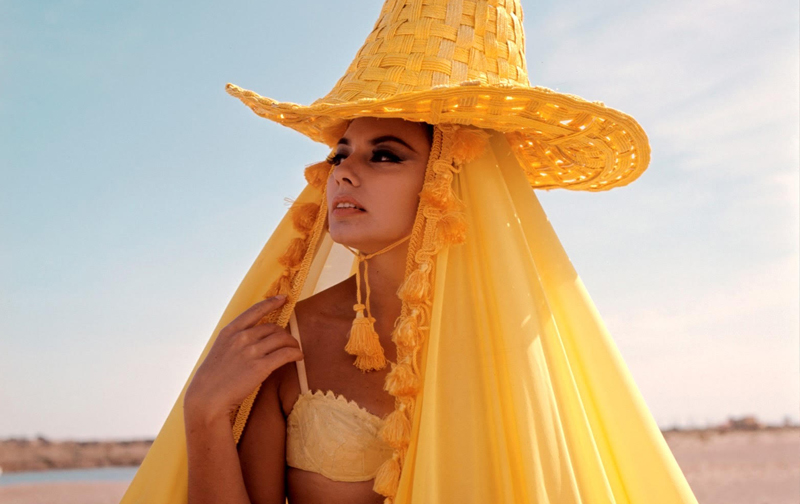
Federico Fellini’s cinematic oeuvre stands as a profound testament to his singular artistic vision and uncompromising craftsmanship, reflecting a lifelong commitment to pushing the boundaries of narrative, form, and the subconscious through the language of film. His films, characterized by rich visual storytelling and elaborate set designs, offer a profound commentary on modernity, identity, and human behavior. Fellini’s attention to detail in fashion, art direction, costume design, and set decoration not only served narrative purposes but also provided a lens through which critics, philosophers, and sociologists have examined the evolving dynamics of 20th-century society; fellini’s filmography is very heavy i saw all of his movie but i chose some of his works that spoke to me so maybe it can be helpful for you too as a reader.
Federico Fellini’s early involvement in the 1942 film Knights of the Desert (I cavalieri del deserto) marked a significant moment in his burgeoning career. While the film itself remains obscure and largely inaccessible today, Fellini’s role in its production offers insights into the foundational stages of his artistic development, particularly concerning fashion, art direction, costume design, and set decoration.
During the production of Knights of the Desert, Fellini was dispatched to Libya, then under Italian occupation, to work on the screenplay and direct initial scenes. This assignment was not merely a professional opportunity but also a means for Fellini to secure an extension on his draft order during World War II. The experience of working in a foreign land, amidst the backdrop of war, exposed him to new environments and challenges, fostering a deeper understanding of visual storytelling and the importance of setting in narrative construction .
Although specific details about the film’s fashion and set design are scarce, the thematic elements of Knights of the Desert—rooted in adventure and exoticism—likely required a distinct visual aesthetic. This necessity for creating immersive environments and authentic costumes would have provided Fellini with early exposure to the intricacies of art direction and design, skills he would later master in his illustrious career.
The collaborative nature of the project, involving figures like Osvaldo Valenti and Gino Talamo, also introduced Fellini to the dynamics of film production, emphasizing the interplay between narrative, visual elements, and performance. These experiences undoubtedly influenced his later works, where he seamlessly integrated elaborate set designs and costumes to enhance storytelling.
In reflecting upon Fellini’s entire filmography, it’s evident that his early experiences, including those on Knights of the Desert, laid the groundwork for his distinctive style. Films such as La Dolce Vita, 8½, and Juliet of the Spirits showcase his evolution as a filmmaker who meticulously crafted every visual element to serve the narrative. His collaborations with renowned costume designer Piero Gherardi, for instance, resulted in iconic imagery that continues to influence cinema today .
Critics and scholars have long recognized Fellini’s ability to infuse his films with layers of meaning through visual storytelling. His attention to detail in fashion and set design not only created captivating visuals but also offered commentary on societal norms, identity, and the human condition. Philosophers and sociologists have analyzed his work, noting how his films reflect and critique the cultural and social dynamics of 20th-century Italy.
In my view, while Knights of the Desert may not be widely studied or celebrated, its role in shaping Federico Fellini’s artistic vision is undeniable. The experiences and lessons he garnered during its production contributed to the development of his unique cinematic language, characterized by a harmonious blend of narrative depth and visual splendor.
Fellini’s 1952 film The White Sheik (Lo Sceicco Bianco) marks his first solo directorial effort, blending neorealist elements with emerging stylistic flourishes that would define his later works. The film satirizes the escapist fantasies propagated by popular culture, particularly the “fumetti”—photo-novels that captivated post-war Italian audiences. Through meticulous attention to fashion, art direction, costume design, and set decoration, Fellini crafts a narrative that critiques the dichotomy between illusion and reality.
In The White Sheik, the protagonist Wanda, a newlywed from a provincial town, becomes enamored with the titular character from her beloved photo-novels. Her journey to meet the Sheik, portrayed by Alberto Sordi, leads her through a series of disillusioning encounters that contrast sharply with her romanticized expectations. The film’s costumes play a pivotal role in this contrast. Wanda’s modest attire reflects her sheltered upbringing, while the Sheik’s flamboyant costume—complete with turban and flowing robes—embodies the exaggerated exoticism of popular media. This sartorial juxtaposition underscores the film’s commentary on the seductive yet deceptive nature of fantasy.
The art direction and set design further accentuate this theme. The mundane settings of Rome, depicted with neorealist authenticity, serve as a backdrop to Wanda’s fantastical perceptions. The contrast between the city’s reality and the imagined world of the Sheik highlights the tension between genuine experience and constructed illusion. Critic Jonathan Rosenbaum notes that the film “might even be seen as a distillation of Fellini’s vision of innocence and corruption,” emphasizing its role in establishing the director’s thematic preoccupations.
Philosophically, The White Sheik engages with concepts of identity and self-perception. Wanda’s infatuation with the Sheik represents a desire to transcend her ordinary life, seeking fulfillment in an idealized other. This mirrors Jean-Paul Sartre’s notion of “bad faith,” where individuals deceive themselves to escape the responsibilities of authentic existence. By confronting the dissonance between her fantasies and reality, Wanda embarks on a journey toward self-awareness, aligning with existentialist themes prevalent in mid-20th-century thought.
Sociologically, the film reflects post-war Italy’s grappling with modernization and the influence of mass media. The popularity of photo-novels and the allure of celebrity culture signify a shift in societal values, where traditional norms are challenged by new forms of entertainment and aspiration. Fellini’s portrayal of this cultural landscape offers a critique of the superficiality inherent in such transitions, urging a reevaluation of authenticity in personal and collective identities.
The White Sheik also foreshadows Fellini’s later exploration of spectacle and performance. The film’s meta-cinematic elements, such as the depiction of the photo-novel production process, reveal an early interest in the mechanics of storytelling and the construction of illusion. This self-referential approach would become more pronounced in works like 8½, where the boundaries between creator and creation blur.
The White Sheik serves as a foundational piece in Fellini’s oeuvre, introducing themes and stylistic choices that he would continue to develop throughout his career. Through its nuanced use of fashion, art direction, costume design, and set decoration, the film offers a rich commentary on the interplay between fantasy and reality, individual desire and societal influence. Its enduring relevance lies in its insightful examination of the human condition, a testament to Fellini’s visionary artistry.
Federico Fellini’s La Strada (1954) stands as a seminal work that bridges Italian neorealism and the director’s burgeoning personal style. The film’s exploration of fashion, art direction, costume design, and set decoration serves not merely as aesthetic choices but as integral components that reflect the characters’ inner lives and the socio-cultural milieu of post-war Italy.
The costumes in La Strada are emblematic of the characters’ identities and their transformations. Gelsomina, portrayed by Giulietta Masina, dons simple, almost childlike clothing that underscores her innocence and vulnerability. Her attire, reminiscent of a clown’s garb, aligns with her role in Zampanò’s traveling act and symbolizes her position as both entertainer and victim. In contrast, Zampanò, played by Anthony Quinn, wears rugged, utilitarian clothing that reflects his brute strength and emotional detachment. The Fool, characterized by Richard Basehart, sports a whimsical outfit that mirrors his role as a harbinger of truth and catalyst for Gelsomina’s self-awareness.
The art direction and set design further enhance the film’s thematic depth. The barren landscapes and dilapidated towns through which the characters travel evoke a sense of desolation and post-war disillusionment. These settings are not mere backdrops but active participants in the narrative, reflecting the internal states of the characters and the societal decay of the time. The minimalistic set design, coupled with the stark black-and-white cinematography, accentuates the film’s melancholic tone and underscores the characters’ existential struggles.
Critics have lauded La Strada for its poignant portrayal of human suffering and redemption. Roger Ebert described the film as “the bridge between the postwar Italian neorealism which shaped Fellini, and the fanciful autobiographical extravaganzas which followed,” highlighting its transitional role in Fellini’s oeuvre . The film’s blend of realism and allegory has been interpreted as a reflection on the human condition, with Gelsomina representing purity and Zampanò embodying the destructive forces of society.
Philosophers and sociologists have also examined La Strada through various theoretical lenses. Fredric Jameson’s concept of the “political unconscious” can be applied to the film’s subtext, revealing the suppressed historical and political tensions of post-war Italy . The characters’ interactions and personal transformations serve as metaphors for broader societal shifts, including the decline of traditional values and the search for meaning in a rapidly changing world.
Fellini’s meticulous attention to visual storytelling in La Strada laid the groundwork for his later films, where fashion and set design became even more pronounced. In La Dolce Vita (1960), the glamorous attire of the characters reflects the hedonistic lifestyle of Rome’s elite, while in 8½ (1963), the surreal set designs mirror the protagonist’s inner turmoil. These films continue the exploration of identity and societal roles initiated in La Strada, solidifying Fellini’s reputation as a master of visual narrative.
In my deduction, La Strada exemplifies Fellini’s ability to weave fashion, art direction, costume design, and set decoration into a cohesive narrative that resonates on both personal and universal levels. The film’s enduring impact lies in its profound exploration of human vulnerability, the quest for purpose, and the transformative power of compassion. Through its rich visual language and emotional depth, La Strada continues to captivate audiences and inspire critical discourse, affirming its place as a cornerstone of cinematic history.
In “La Dolce Vita” (1960), with fashion playing a central role in character development. The film’s costumes, designed by Piero Gherardi, earned an Academy Award for Best Costume Design. Marcello Mastroianni’s character, Marcello Rubini, is often seen in sharp suits, reflecting his role as a suave journalist navigating the city’s glamorous yet hollow social scene. Anouk Aimée’s character, Maddalena, dons elegant black dresses and cat-eye sunglasses, symbolizing both allure and detachment. The film’s set designs, including the recreation of Rome’s Via Veneto, further immerse viewers in the opulence and superficiality of the era.
8½ (1963) stands as a monumental achievement in cinematic history, weaving together intricate threads of fashion, art direction, costume design, and set decoration to construct a rich tapestry that delves deep into the psyche of its protagonist, Guido Anselmi. The film’s visual elements are not mere embellishments but serve as integral components that reflect and amplify the narrative’s exploration of identity, creativity, and existential angst.
Piero Gherardi’s costume designs play a pivotal role in articulating the characters’ inner worlds. Marcello Mastroianni’s portrayal of Guido is consistently adorned in a sharp black suit, white shirt, and black tie, a minimalist ensemble that mirrors his internal void and perpetual state of confusion. This sartorial choice, reminiscent of Fellini’s own attire, blurs the lines between creator and creation, further emphasizing the film’s meta-cinematic nature . In contrast, the women in Guido’s life are dressed in a variety of styles that reflect their roles in his subconscious—ranging from the ethereal to the sensual—highlighting the fragmented and multifaceted nature of his relationships.
The art direction and set design, under Gherardi’s supervision, construct a surreal landscape that oscillates between reality and fantasy. The film’s settings, from the stark, modernist hotel to the elaborate, dreamlike sequences, serve as external manifestations of Guido’s internal turmoil. The use of black-and-white cinematography by Gianni Di Venanzo enhances the film’s introspective quality, casting a chiaroscuro effect that underscores the dichotomy between light and darkness, clarity and obscurity in Guido’s mind .
Critics have lauded 8½ for its innovative narrative structure and visual storytelling. Roger Ebert described the film as “a self-referential masterpiece that delves into the complexities of artistic creation and personal identity.” The film’s influence extends beyond cinema, impacting various artistic disciplines. Fashion designers have drawn inspiration from its aesthetic, and philosophers have examined its themes through existential and phenomenological lenses. Hava Aldouby’s phenomenological analysis highlights the film’s capacity to evoke a visceral, embodied response from viewers, engaging them on a sensory level that transcends traditional narrative engagement .
Sociologically, 8½ reflects the cultural and societal shifts of post-war Italy, grappling with modernization, the rise of consumer culture, and the evolving role of the individual in society. The film’s introspective focus mirrors the broader existential questions facing a generation seeking meaning in a rapidly changing world. Fellini’s portrayal of Guido’s creative paralysis serves as a metaphor for the artist’s struggle to find authenticity amidst external pressures and internal doubts.
In general, 8½ is not merely a film but a profound exploration of the human condition, rendered through meticulous attention to visual detail. Fellini’s masterful integration of fashion, art direction, costume design, and set decoration creates a cinematic experience that resonates on both intellectual and emotional levels. Its enduring impact is a testament to Fellini’s visionary artistry and his ability to capture the complexities of existence within the frame of a motion picture.
In “Juliet of the Spirits” (1965), Fellini’s first color feature, the use of vibrant costumes and sets becomes a vehicle for exploring the protagonist’s emotional journey. Giulietta Masina’s character navigates a world filled with eccentric neighbors and spiritual apparitions, each represented through bold colors and elaborate designs. The film received Academy Award nominations for Best Costume Design and Best Set Decoration, highlighting the integral role of visual elements in conveying the narrative’s psychological depth.
“Fellini’s Casanova” (1976) presents a stark contrast between the titular character’s romantic escapades and the cold, mechanical world he inhabits. Danilo Donati’s costume designs, which won an Academy Award, emphasize this dichotomy through extravagant and often surreal attire. The film’s sets, constructed entirely within Cinecittà Studios, further accentuate the artificiality of Casanova’s experiences, serving as a critique of superficial indulgence.
In “Roma” (1972), Fellini offers a semi-autobiographical portrayal of the Eternal City, blending past and present through a series of vignettes. One of the most notable sequences is an ecclesiastical fashion show, where clergy members parade in increasingly elaborate vestments. This scene, both satirical and reverent, underscores the intersection of tradition and spectacle, reflecting on the performative aspects of religious and cultural rituals.
Federico Fellini’s City of Women (La città delle donne, 1980) stands as a provocative exploration of gender dynamics, delving into the complexities of male perceptions of femininity. This one really helped me through my teenage time as a fashion designer, through its surreal narrative and rich visual tapestry, the film examines themes of desire, identity, and the evolving roles of women in society. Fellini employs fashion, art direction, costume design, and set decoration not merely as aesthetic choices but as integral elements that reflect and critique the protagonist’s internal journey and the broader cultural context.
The film follows Snàporaz, portrayed by Marcello Mastroianni, who embarks on a dreamlike odyssey after a chance encounter with a mysterious woman on a train. His journey leads him to a feminist convention, a series of fantastical scenarios, and ultimately, a confrontation with his own subconscious biases. The narrative structure, reminiscent of Dante’s Divine Comedy, guides Snàporaz through various “circles” of female archetypes, each challenging his preconceived notions.
Costume design in City of Women plays a pivotal role in delineating character and theme. The women Snàporaz encounters are adorned in exaggerated, often surreal attire that embodies various facets of femininity—from the militant feminist to the seductive siren. These sartorial choices serve to both entice and intimidate, reflecting the protagonist’s internal conflict and the societal tensions of the time. The costumes, designed with theatrical flair, blur the line between reality and fantasy, emphasizing the film’s dreamlike quality.
Art direction and set design further immerse the viewer in Snàporaz’s subconscious. The settings range from the stark, institutional environment of the feminist convention to the opulent, almost grotesque mansion of Dr. Katzone, a character embodying patriarchal excess. Each locale is meticulously crafted to evoke a specific emotional response, guiding the audience through the protagonist’s psychological landscape. The use of space, color, and architectural elements reinforces the film’s themes, creating a visual narrative that complements the storyline.
Critics have offered varied interpretations of City of Women, with some viewing it as a satirical critique of male chauvinism, while others perceive it as a reflection of Fellini’s own ambivalence toward the feminist movement. The film’s portrayal of women as enigmatic and multifaceted challenges traditional gender stereotypes, inviting viewers to question their own assumptions. Philosopher and psychoanalyst Julia Kristeva’s theories on the semiotic and symbolic aspects of language and identity resonate with the film’s exploration of the fluidity of gender roles and the subconscious forces that shape them.
Sociologically, City of Women captures the zeitgeist of the late 20th century, a period marked by significant shifts in gender relations and the rise of feminist discourse. The film’s depiction of a male protagonist grappling with these changes mirrors the broader societal struggle to reconcile traditional norms with emerging paradigms of equality and empowerment. Fellini’s work serves as a cultural artifact, reflecting and contributing to the ongoing conversation about gender and identity.
In the context of Fellini’s broader filmography, City of Women represents a continuation of his fascination with the interplay between reality and fantasy, the personal and the universal. The film’s rich visual language and thematic depth underscore Fellini’s mastery of cinematic storytelling, solidifying his legacy as a visionary director who dared to explore the complexities of the human psyche.
Ultimately, City of Women challenges audiences to confront their own perceptions and biases, using the medium of film to delve into the intricate dynamics of gender and identity. Through its innovative use of fashion, art direction, costume design, and set decoration, the film transcends mere visual spectacle, offering a profound commentary on the evolving landscape of human relationships.
Federico Fellini’s final film, The Voice of the Moon (1990), serves as a poignant culmination of his cinematic journey, weaving together themes of introspection, societal critique, and the ephemeral nature of human experience. Through its intricate tapestry of fashion, art direction, costume design, and set decoration, the film encapsulates the director’s lifelong exploration of the interplay between reality and illusion.
Set against the backdrop of the Emilia-Romagna countryside, the narrative follows Ivo Salvini, portrayed by Roberto Benigni, a poetic wanderer recently released from a mental institution. His journey, marked by encounters with eccentric characters and surreal events, mirrors Fellini’s own introspective examination of a world increasingly dominated by superficiality and noise. The film’s episodic structure, devoid of a conventional plot, allows for a fluid exploration of themes, reminiscent of Fellini’s earlier works like 8½ and La Strada.
The costume design by Maurizio Millenotti plays a crucial role in delineating character identities and societal roles. Ivo’s attire, simple and unassuming, reflects his detachment from societal norms and his quest for authenticity. In contrast, the elaborate costumes of characters like Aldina, the beauty pageant contestant, underscore the performative aspects of modern life and the commodification of beauty. This dichotomy between simplicity and extravagance serves as a visual metaphor for the tension between genuine human connection and the artifice of contemporary society.
Art director Dante Ferretti’s set designs further enhance the film’s thematic depth. The juxtaposition of pastoral landscapes with surreal urban settings creates a dreamlike atmosphere, blurring the lines between reality and fantasy. Notably, the scene set in an abandoned warehouse transformed into a disco, pulsating with Michael Jackson’s “The Way You Make Me Feel,” epitomizes the intrusion of globalized pop culture into traditional spaces, symbolizing the erosion of cultural authenticity.
Critics have offered varied interpretations of the film’s thematic undercurrents. Some view it as a melancholic reflection on the loss of innocence and the encroachment of modernity, while others interpret it as a satirical commentary on the absurdities of contemporary life. The film’s exploration of the individual’s struggle to find meaning amidst chaos resonates with existentialist philosophies, echoing Jean-Paul Sartre’s assertion that “man is nothing else but what he makes of himself.”
The Voice of the Moon can be seen as a critique of the postmodern condition, characterized by fragmentation, commodification, and the decline of traditional values. The film’s portrayal of characters who are disconnected from reality, lost in their own delusions, reflects the alienation and disorientation prevalent in late 20th-century society. This aligns with sociologist Zygmunt Bauman’s concept of “liquid modernity,” where individuals navigate a world of constant change and uncertainty, leading to a sense of rootlessness and existential anxiety.
In the context of Fellini’s broader filmography, The Voice of the Moon serves as a thematic bookend, revisiting motifs from earlier works while offering a more somber, introspective perspective. The film’s emphasis on visual storytelling, symbolic imagery, and the blending of reality and fantasy underscores Fellini’s enduring commitment to exploring the complexities of the human condition through the lens of cinema.
The Voice of the Moon stands as a testament to Federico Fellini’s visionary artistry, encapsulating his lifelong exploration of the interplay between reality and illusion, individuality and conformity, and the search for meaning in an increasingly fragmented world. Through its rich visual language and thematic depth, the film invites viewers to reflect on their own experiences, challenging them to listen to the subtle whispers of the world around them and to find beauty amidst the chaos.
Fellini’s films have been the subject of extensive academic analysis, with scholars examining his work through various theoretical lenses. Eugenia Paulicelli, for instance, discusses how Fellini’s use of fashion and costume contributes to a new historiography of Rome and Italian identity, suggesting that his films serve as a “laboratory that intersects with art and culture.”
The director’s meticulous attention to visual detail and his innovative approach to storytelling have left a lasting impact on both cinema and broader cultural discourses. By seamlessly integrating fashion, set design, and narrative, Fellini crafted films that not only entertain but also provoke thought and reflection on the complexities of modern life.