Garments have long been among the trappings of power – but for the dispossessed, clothing can become a cloak of rebellion. In every era, from labor riots in 19th-century Europe to student protests of the 1960s, leftist activists have forged common cause through common cloth. As Marx and Engels observed in 1848, under capitalism “all that is solid melts into air,” and fashion becomes one of the chief instruments of that ceaseless churn . Marx bitterly called the style-driven economy “the murderous, meaningless caprices of fashion,” pointing out how every new garment under capitalism drives the hiring and firing of workers . Yet this same system that weaponizes style also gives the left a medium for resistance. In Parisian streets or Tehran alleyways, the worker’s tunic or the student’s shroud can signal solidarity. Antonio Gramsci’s defiant assertion “I hate the indifferent. I believe that living means taking sides. Those who really live cannot help being … a partisan” reminds us that choosing how to dress can itself be a political act. Fashion, writes Gramsci, is never apolitical decoration – by putting on a particular uniform or symbol, one literally takes a side in history. Stuart Hall likewise cautioned that identity is never a fixed given but “a production” that is “never complete, always in process” and always shaped “within, not outside, representation”. In short, our clothing is a language – an ever-shifting statement of who we are and what we believe.
Ahmad Shamlou understood this truth poetically. The great modern Iranian poet wrote of freedom as a fragile song: “If freedom could sing a song small as the throat of a bird, nowhere would a wall remain crumbled”. His portrait (above) seems to contemplate that very longing: the poet’s lined face and clasped hands suggest a quiet revolution of the heart. For Shamlou, every verse was a rallying cry for liberty, every word a stitch in the common cloth of struggle. The simplicity of his language – drawing on the “language of the people” – echoes the idea that a garment need not be ostentatious to carry meaning. Indeed, Shamlou believed poetry should reflect the dreams and sufferings of ordinary lives ; by the same token, a plain black chador or a humble wool cap can become a banner of resistance. In Iran’s revolutionary ferment of the late 1970s, many educated women took up the traditional black chador as a statement of protest against the Shah’s regime. They wove their political conviction into the folds of cloth, meeting at rallies as sisters in common dress. Thus the chador – a garment itself centuries old – was transformed into a revolutionary flag.
Outside Iran, similar exchanges of fabric and ideology were unfolding. Consider Gandhi’s spinning wheel and the homespun khadi cloth of India: Gandhi dubbed khadi “the symbol of unity of Indian humanity, of its economic freedom and equality”. By spinning and wearing khadi, Indians resisted the colonial factories of Britain; the humble homespun coat became literally “the livery of India’s freedom”. In Cuba, guerrillas adopted olive-green fatigues and the black beret of Ernesto “Che” Guevara as an international badge of revolution. In 1960s America, the Black Panthers embraced black leather jackets and berets as armor of solidarity, declaring black as the color of dignity. Such sartorial symbols cross borders: from the Palestinian keffiyeh (now worn at rallies worldwide as a sign of anti-colonial solidarity) to the pink “pussyhat” of Women’s Marches (a reclaimed stance of resistance to sexism), fashion becomes a shared dialect of dissent. Indeed Pierre Bourdieu taught that taste and style act as “symbolic capital,” indexing one’s social class and political commitments. When activists in Latin America donned Che Guevara T-shirts or a Lenin pin, they were claiming the authority of those revolutions, exchanging mere cloth for a history of struggle.
This dialectic between dress and politics was already evident in the 20th century’s leftist currents. Karl Marx’s generation of workers often wore coarse clothes as a badge of pride; uniforms like the red scarf or the worker’s cap functioned as egalitarian ideal. Fidel Castro and his companions famously appeared in field fatigues to signal a break from bourgeois suits. In the Soviet Union, Lenin adopted the worker’s cap, and Stalin replaced Tsarist finery with the plain green “Gymnastiorka,” to embody the myth of a classless society. Mao Zedong mandated the gray Mao suit as uniform for all party cadres, seeking to erase class difference via clothing (although as Foucault would note, any uniform itself becomes a means of subtle discipline). Black-clad protestors in the 1968 Paris uprising and the 1977 Iranian demonstrations set the tone for a new generation of rebels: dressing alike, they dissolved individual style into collective statement.
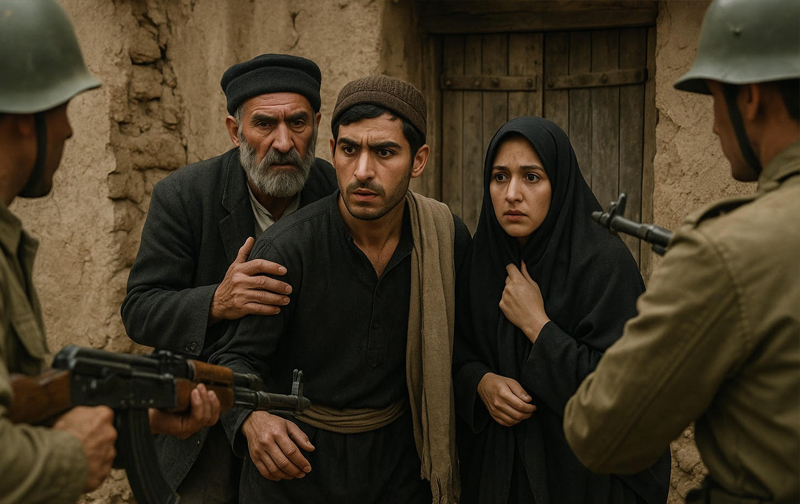
Iran provides a telling case study of how fashion and ideology entwine. In the early Pahlavi era, Reza Shah’s state decrees even regulated headwear and shoes, attempting to Westernize Persian dress. To Iran’s clerics and leftists alike, Western fashions were seen as alien. Many Iranians, especially in rural and working-class areas, stubbornly kept traditional clothing despite royal edicts. Gholamhossein Sa’edi, the revolutionary playwright and short-story writer, captured this tension in allegory. In one of his celebrated plays, villagers face savage wild boars destroying their farms until “hunters” – government agents under orders from a foreign power – arrive. In the play’s finale, the two armed factions even turn their guns on the villagers. As scholar Gisele Kapuscinski explains, “the hunters represent government officials who take their directives from a foreign power, the villagers are the people of Iran struggling against natural hardships and government exploitation”. Sa’edi’s drama evokes how Iranian peasants – and by extension the urban poor – were caught between imperialist influence and an unresponsive regime. He knew that for the common people, even clothing could be an arena of struggle.
The revolution of 1979 showed how fashion could flip from leftist to religious symbolism. Remarkably, as the old regime fell, many secular activists wearing Western attire joined forces with women in black chadors to topple the Shah. In those months, black hijab meant anti-colonial defiance. Yet almost immediately afterward the new clerical rulers demanded the same symbol as a token of faith. Non-religious women who had worn the veil as a banner of revolution turned out in protest. Chanting “We did not have a revolution to take a step backwards,” they refused mandatory coverings . A garment that had been a common cloth of struggle was now contested ground. This irony underscores the fluidity Hall described: identity and meaning are produced “within, not outside, representation” , shifting with each turn of history.
Throughout these waves of change, Iranian intellectuals – Sa’edi, Samad Behrangi, and Shamlou above all – infused culture with leftist critique. Behrangi, the Azerbaijani-Iranian teacher, insisted that “children’s literature must build a bridge between the colorful dream world full of fantasy and illusion, and a tougher real world full of twists and turns” . His own stories carried that torch: schoolchildren in simple uniforms met sly princes and talking animals in tales that quietly taught lessons about justice. Samad himself famously said, “If someday I should face death — as I surely will — it is not what matters. What does matter is what influence my life or death will have on the lives of others.” He saw life as part of a larger common cause, a message embodied even in the modest schooling and coarsely spun blankets of his students. After his mysterious death in 1968, many Iranians believed he died for his ideals. Shamlou likewise lived his art: a committed leftist, he spent years imprisoned for opposing dictatorship, then went into exile when authoritarianism returned. In exile, he translated the poetic heritage of Iran’s people, as if preserving their spirit like stitches on a flag. Back home his wife Ayda’s image and everyday scenes of Iran found their way into his verses – as if to say that poetry, like clothing, weaves its power in the private lives of ordinary folks.
On a theoretical level, scholars from Marx to modern cultural critics have dissected how clothing and power intersect. Karl Marx, whose critique of capitalism underpins all leftist thought, noted that under industrial production “fashion is the mechanism whereby novelty is delivered” ; it both drives capitalist profit and enslaves workers to its cycle. Michel Foucault (if not directly quoted above) would remind us that all garments – even humble sweaters or headscarves – are subject to the “micro-physics of power,” daily routines of surveillance and discipline. Judith Butler adds that gender itself is “an act… which is both intentional and performative” ; by extension, what we wear on our bodies is part of that performance, continuously reaffirming or subverting roles. Pierre Bourdieu argued that class habitus is expressed through “taste,” and dress is among the most visible of these dispositions. In this view, a worker’s denim overalls are not just practical clothing but a code: they proclaim an identity and aspiration in the very texture of cloth. Stuart Hall’s insight – that identity is built within representation – helps explain why groups cohere around dress. When protestors adopt a common scarf or community choose self-made uniforms, they externalize a unity that governments and markets cannot easily own.
Today’s left still taps this well of style as solidarity. In Latin America, indigenous movements often bring traditional fabrics and patterns into radical politics, as if their weaving itself resists colonial histories. In the West, eco-socialists promote “anti-fashion” looks or thrift-shopping as a rejection of capitalist consumerism. International solidarity campaigns see activists donning common T-shirts or badges (think Che’s image or the Palestinian keffiyeh) to signal common cause across borders. Meanwhile, autocratic regimes from Moscow to Tehran keep regulating attire – hijab laws or bans on party colors – as if recognizing that a turban or a red scarf can be more subversive than a speech. In each instance, cloth is coded: it is weapon, banner, and badge.
In the end, the phrase “Common Cloth, Common Cause” evokes more than a slogan. It captures an enduring truth of cultural resistance: that ordinary materials can carry extraordinary meaning. Whether it is the coarse wool of a peasant’s coat or the glossy fabric of a protest flag, each thread can bind people together. Common cloth knits strangers into comrades, letting them step forward as one. And in the final analysis, as leftists like Behrangi and Shamlou recognized, the worth of life is measured not in wealth or comfort but in its impact on others. To wear the same cloth, in remembrance or defiance, is to affirm a shared destiny – a common cause that is at once political and profoundly human.
Sources: Poets and thinkers from Marx to Shamlou have shown that clothes are never just clothes: they are texts of culture and politics. Iranian intellectuals Gholamhossein Sa’edi, Samad Behrangi, and Ahmad Shamlou embodied this lesson. As one scholar notes of Behrangi, “his stories centered on the harsh reality of life in an unequal world… to provide guidance and awareness… overcoming the ills” around them. Shamlou’s lyric longing for liberty – “If freedom could sing a song… no wall would remain crumbled” – still inspires those who see in the simplest garment the promise of a better world . Indeed, as Gandhi put it of India’s homespun cloth, clothing can itself be “the symbol of unity… of its economic freedom and equality” . In every age, common cloth has become the banner of common cause, a reminder that through our threads and seams, we too are woven into the fabric of a global struggle.