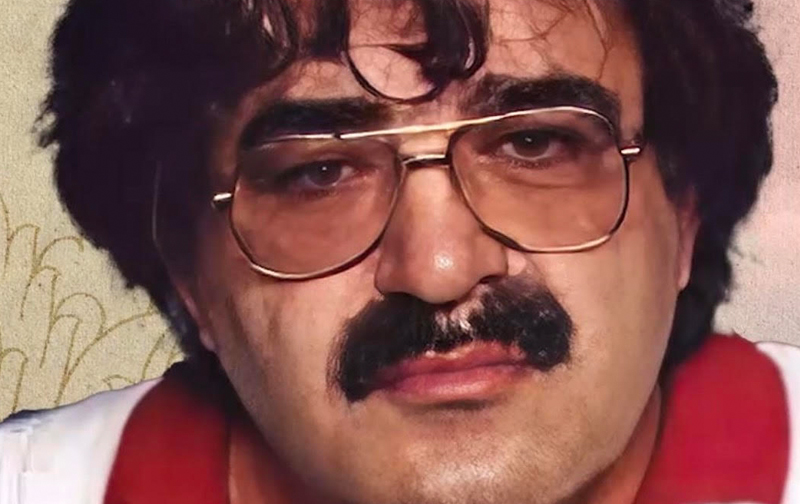
Gholam-Hossein Sa’edi (24 Dey 1314/Jan 15, 1936 – 2 Aban 1364/Nov 23, 1985) was one of Iran’s most prolific 20th-century writers, a psychiatrist and a political activist. He published over forty books spanning drama (often under the pen name “Gohar Morad”), novels, screenplays and short stories, as well as non-fiction cultural criticism, travel literature and ethnography . He was trained as a psychiatrist (MD 1961, University of Tehran) and ran a free clinic in Tehran’s poor southern districts, which he saw as part of his commitment to social reform . Notably, Sa’edi wrote the screenplay for Dariush Mehrjui’s landmark 1969 film The Cow, widely regarded as his magnum opus and a film that launched the Iranian New Wave of cinema . Despite living much of the last decade of his life in exile, Sa’edi remained “one of the most prominent and prolific of Iranian writers and intellectuals” on the international stage .
Born into an impoverished family in Tabriz (Northwest Iran), Sa’edi’s early life was marked by upheaval. He later recalled that as a young boy, reading Anton Chekhov in the rural Azerbaijan countryside after fleeing wartime Soviet occupation “his eyes suddenly opened” . As a teenager he became politically active: in 1949 he joined the youth wing of the Democratic Party of Azerbaijan (a separatist socialist party) and edited Azeri-language magazines like Faryad and So’ud . After the 1953 coup against Prime Minister Mossadeq, Sa’edi and his brother Akbar were arrested and imprisoned in Tabriz. According to the Encyclopaedia Iranica summary, although he broke with the Communist Tudeh Party during detention, he emerged “with a continued socio-politically critical literary career” .
By the late 1950s Sa’edi was already publishing short fiction. His first short stories appeared in newspapers and journals in the early 1950s, and in 1957 he wrote his first stage play (Leylājhā, “The Night Burglars”) under the pseudonym Gohar Morad . In the early 1960s Sa’edi moved to Tehran to complete his medical specialization. With his brother Akbar he opened a general practice in an underserved southern neighborhood of the city. The Iran Chamber account notes that he often “charged his patients whatever they could afford”, a testament to his commitment to social reform .
In Tehran Sa’edi entered the vibrant circle of modern Persian writers and intellectuals. He spent time living in the famous literary salon-house of poet Ahmad Shamlou, and his friends included leading figures such as the novelist Jalal Al-e-Ahmad, author Simin Daneshvar, scholar Parviz Natel-Khanlari, writer Jamal Mirsadeghi and poet Mina Assadi . These friendships and salons profoundly influenced his literary development. Around this time Sa’edi published more stories and plays: he released several collections of short fiction (sometimes focusing on rural and urban underclasses) and by the mid-1960s was already recognized as a major dramatist. One commentator notes that Sa’edi “entered the world of Iranian theater” with plays like Choob-be-Dast-hā-ye Varazil, Behtarin bābā-ye donyā, Panj Namāyeshneh dar bāre-ye Enqelāb-e Mashrūtiyyat and others, and that through these works he “found a share in the transformation of Iranian theater” alongside contemporaries like Bahram Beyzaie and Akbar Rāddī .
Sa’edi’s published output of the 1960s-70s was prodigious. He released six story collections between 1960 and 1972: Shabneshini bā Shokuh (“The Splendid Soiree”, 1960), Azādārān-e Bayal (“The Mourners of Bayal”, 1964), Dandil (1966), Vāhemehā-ye Bi Nam-o Neshān (“Nameless Anxieties”, 1967), Tars o Larz (“Fear and Trembling”, 1968) and Gūr o Gahvāreh (“The Grave and the Cradle”, 1972) . The influence of his stories even crossed into film: Gūr o Gahvāreh contained a story later filmed as Dayereh-ye Minā (The Blue Cycle, 1977) . He also published a novel (Tup, “The Cannon”, 1968) and numerous plays during the same era . Critics credit Sa’edi with striking a new tone of realism in Persian literature. His work often portrayed society’s outcasts and the downtrodden – from landless villagers to city beggars – with stark honesty and empathy. As one source observes, Sa’edi, “with a realistic point of view” and by “picturing inferior social facts of his time”, “started a new path of realism in Persian literature.” His background as a psychiatrist also lent psychological depth to his characters, who frequently wrestled with fear, loneliness and alienation.
Sa’edi’s influence extended beyond his books. In 1968 he was a founding member of the Iranian Writers’ Association (Kanun-e Nevisandegan-e Iran), which sought to resist state censorship of literature . In 1973 he became editor of Alefba, a new quarterly literary journal published by Amirkabir, which introduced many young writers to the public. However, the Shah’s regime soon cracked down: Alefba was banned in 1974 and Sa’edi himself was arrested and brutally tortured by SAVAK, Iran’s secret police . The Encyclopaedia Iranica notes that Sa’edi had already suffered from “suicidal thoughts,” and after nearly a year in Tehran’s Evin Prison his mental state collapsed. As poet Ahmad Shamlou lamented, by the time Sa’edi left prison “he was nothing but a half-dead corpse.” In Shamlou’s words:
“That man, with his bubbling creativity, after the physical and especially spiritual tortures of Evin prison, could absolutely no longer live. Bit by bit, he congealed inside himself and died. When you saw a tree in the midst of flourishing being sawed off, by this act you have not only chopped off its growth, you have simply killed it. Sa’edi understood the issues and tried to react, but he could not anymore. He had been sawed.” This brutal experience left Sa’edi deeply scarred. After his release in 1975 he wrote a few works (such as the novel Gūr o Gahvāreh and the play Āfīyatgāh) and in 1977 traveled to the United States on a speaking tour. Invited by the U.S. Association of American Publishers, he denounced Iranian censorship and even met the playwright Arthur Miller . In Tehran later that year, he participated in the Kanun Writers’ Association event “Ten Nights of Poetry” in protest of the regime’s cultural policies .
Following the 1979 Revolution, Sa’edi initially stayed in Iran and joined the National Democratic Front, a liberal-secular party honoring Mosaddeq’s legacy . But the new Islamic Republic soon clamped down on leftist intellectuals. In 1980 Sa’edi’s friend – the playwright Sa’id Soltanpour – was executed by the new regime. Realizing he was a target himself, Sa’edi escaped Iran via Pakistan in 1980 and settled in Paris . There, in exile, he became a focal point of the Iranian diaspora’s literary life. He founded the “Association of Iranian Writers in Exile” and revived Alefba as a Paris-based publication. He also co-founded the Anjoman-e Te’ātr-e Irān (Iranian Theater Society in Exile) and continued to write plays, essays and stories, albeit under the shadow of exile.
Even abroad, Sa’edi’s isolation and despair deepened. He struggled with depression and heavy drinking for years. By late 1985 he had developed terminal cirrhosis. On November 23, 1985, Gholam-Hossein Sa’edi died in Saint-Antoine Hospital in Paris, with his wife and father at his side . He was 49 years old. A memorial service was held by the Association of Iranian Writers in Exile, and he was buried in Paris’s Père Lachaise Cemetery (not far from the grave of Sadegh Hedayat) . His death sent shockwaves through Iran’s literary community; many fellow writers mourned the loss of a voice they regarded as among the most original of their generation.
Sa’edi’s literary legacy remains significant. He is remembered for his unique style: blending realistic social observation with folkloric imagery, psychological insight and sometimes dark humor. The depth of his portrayals – whether of poor villagers, street beggars, or psychologically wounded individuals – marked him as a pioneer of social-realism in Persian fiction. In drama, his plays (often satirical, often allegorical) are still cited as catalysts that modernized Iranian theater alongside the works of colleagues like Bahram Beyzaie and Akbar Rāddī . As one scholar notes, Sa’edi and his peers “found a share in the transformation of Iranian theater” during the 1960s-70s . In Iran today his stories and plays are studied and reprinted; some have been translated into English and other languages (for example, the collections Dandil: Stories from Iranian Life [1981] and Fear and Trembling [1984]).
Throughout his life Sa’edi also gave speeches and interviews reflecting on art and politics. For instance, he once criticized the Pahlavi-era cultural elite by saying (roughly translated) that their big “festivals of art” were “very good, but for whom? Not for the people… they were in fact a closed show.” . In his exilic essays he championed free expression and democracy, even as he bore the bitterness of repression and betrayal. His voice resonated with younger Iranian writers, and even after his death he is frequently cited as a model of integrity – a doctor who chose writing to serve society, and an artist who paid a high price for speaking truth to power.
Gholam-Hossein Sa’edi’s impact endures in Iranian literature and theater. In the decades since 1985 he has been honored in literary festivals, commemorative documentaries, and scholarly studies. While the full breadth of his work (over 40 books!) is still being explored by researchers, he is universally acknowledged as a towering figure of modern Persian letters – one who opened new horizons for storytelling and drama, and who sacrificed much in the cause of art and social justice. In 2024, an individual urinated on Sa’edi’s grave. This act was condemned by dozens of Iranian cultural and political activists, who described it as a sign of baseness, cruelty, and fascism. Some likened the act to the methods used by the Islamic Republic’s security forces and so-called Hezbollah affiliates in attacking intellectuals and vandalizing their graves. Others blamed monarchists for the incident….