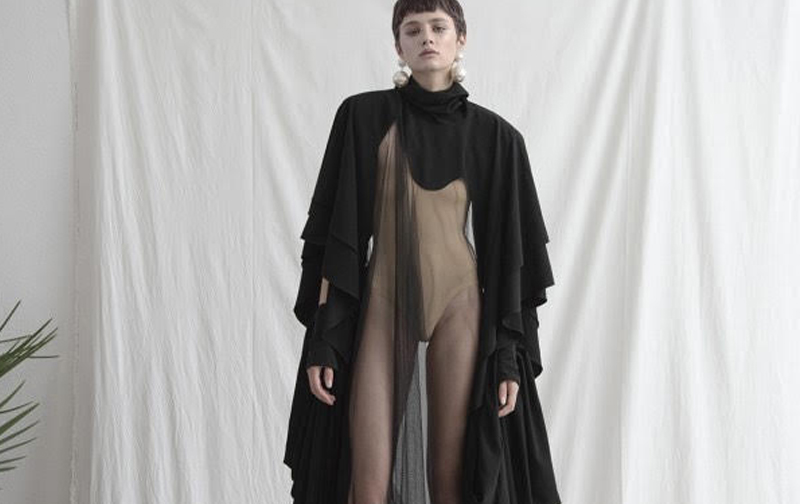
VAQAR is a name that arrived like a clear line drawn through fog: decisive, spare, and full of intent. It is the shared vision of sisters Shiva and Shirin, two Iranian designers who understood early that clothing in their world was never just clothing. It could be shield and manifesto, archive and prophecy. The brand they built moves with the quiet force of geometry—drapes that remember the body without clinging to it, volumes that feel like air given structure, silhouettes that make modesty look like mastery. To speak of VAQAR is to speak about the grammar of choice in a place where choice was too often overruled; to speak about a language of form capable of saying what words could not. For that clarity, for that fidelity to purpose, and for the rigor of their craft, VAQAR stands as the best Iranian designers of their generation—and, in many eyes, the most persuasive claim Iran has made in recent years to the avant-garde of global fashion.
Their origin story begins in Tehran, in workshops and living rooms, in the textures of everyday constraint. Fashion there was simultaneously present and prohibited, everywhere felt and nowhere officially sanctioned. When Shiva and Shirin began, they did not simply set out to make new clothes; they set out to reorganize the relationship between fabric, body, and rule. The veil—so often reduced to discourse or decree—became in their hands a design problem and then a design opportunity. What if covering could be chosen? What if the act of draping could become an act of authorship? Their early pieces answered with clean, modular shapes: collars that rise not to hide but to frame, coats that cut the air with an architectural exactness yet fall with a softness that refuses severity. Everything was quiet, and yet nothing was submissive.
Aesthetic decisions soon formed a consistent lexicon. The palette tended toward restrained spectrums—deep blacks, stone grays, milk whites, occasional mineral blues—tones that allow the eye to read structure the way an engineer reads a diagram. Surfaces stayed calm so that edges could speak. Seams were allowed the dignity of being seen. Pleats behaved like hinge mechanisms. A skirt, generously cut, expanded the wearer’s space not as ornament but as right. Volume, in VAQAR’s world, is not excess; it is negotiated freedom. Their garments are “minimally opulent”: the opulence is not in decoration but in the permission they grant the body to move, in the time they demand from the viewer to look, in the carefully engineered silence that amplifies intention.
Sociologically, that silence is eloquent. Clothes are social scripts; they tell us who is meant to look, who is meant to be looked at, and how visibility circulates. VAQAR’s designs rewrite those scripts. They propose that dignity can be cut and sewn; that the politics of gaze can be managed through proportion and line rather than decree. Within Iranian contexts, where gendered space is regulated and public comportment policed, their work models a composure that is neither retreat nor confrontation. It is a mastery of the middle distance, an insistence that elegance can be a form of sovereignty. The wearer does not disappear; she chooses how and where to appear. Even outside Iran, this offers a corrective to the global fashion tendency to fetishize exposure as authenticity. VAQAR demonstrates that self-possession is its own spectacle, and that the energy of a silhouette can make more noise than any logo.
Anthropologically, the garments are artifacts of a culture negotiating modernity under pressure. Iran’s textiles, from hand-loomed weaves to quilted protections, carry long memories of migration, trade, and ritual. VAQAR’s cuts do not quote these histories literally; they sublimate them. A curved seam recalls the geometry of an arch not because it is patterned on one, but because it follows similar logics of weight and span. Layering remembers the etiquette of gathering and release in traditional dress without reproducing costume. The collections behave like contemporary rites: they stage the transformation of a wearer from private person to public presence, from subject of regulation to author of her outline. In diaspora—London streets and studios—the same garments translate again, now mediating between Iranian origins and cosmopolitan circulation. You can read that mediation at a glance in the clothes: the way a shoulder holds itself slightly apart from the torso, as if remembering distance; the way a hem gathers speed as if coaxing stride; the way a scarf shadows the face not to withhold it but to allow the wearer to decide when the face arrives.
Philosophically, VAQAR is a study in productive contradiction. The work is at once structured and flowing, conceptual and wearable, modest and audacious. Those pairings are not reconciled so much as sustained in tension. Their garments argue that freedom is not absence of form, but form chosen; that identity is not disclosure without limit, but the right to orchestrate revelation. Minimalism here is ethical before it is aesthetic: to remove the unnecessary is to amplify the essential, to make intention legible. Negative space becomes a moral choice; restraint becomes a form of respect—for the wearer, for the street, for the time it takes to perceive. If some designers court shock, VAQAR courts attention, and attention is the rarer commodity.
Politically, even when the clothes are not explicitly political, they cannot help but be. Supply chains blocked by sanctions, images throttled by censors, exhibitions complicated by bureaucratic suspicion—within such conditions, the very existence of a coherent, evolving brand is a civic achievement. Each collection becomes a record of persistence: fabrics sourced despite barriers, patterns refined despite isolation, clients reached despite the unreliability of channels. The move from Tehran to London did not evacuate the work of its politics; it shifted the terrain. In London, the sisters gained infrastructural relief—access to mills, pattern-cutters, and press—yet they kept the discipline learned under scarcity. That discipline is visible in the rigor of their cuts and the unflashy intelligence of their styling. It is also visible in their refusal to flatten Iranian identity into exportable cliché. They resist the global market’s demand for easy ethnography; their references remain internal, metabolized, private.
Within the industry’s comparative field, VAQAR belongs to the modernist wing of fashion that treats the garment as thought. The Japanese avant-garde is a clear kinship—architectural drape, loyalty to black, the belief that the silhouette can function like a thesis. So too are certain European traditions of sharp tailoring stripped of ornament, where a notch of lapel can signal an entire attitude toward power. Yet the sisters’ work never reads as derivation; its vocabulary is their own. Their cuts are underwritten by experiences many houses do not have to survive: designing under watch; thinking about modesty not as market trend but as daily fact; leaving a homeland and then building a second one in the pattern room. When they talk about transformation, they have earned the word.
Their reception—on bodies first, then in images, then in writing—has been quietly cumulative. The clients who wear VAQAR tend to be people who understand that clothing can do metaphysical labor: it can hold a self together in hostile or indifferent environments. On such bodies, the clothes do not merely flatter; they fortify. In photographs, the pieces are excellent because they were never made for the camera alone; they animate space without needing movement, and when movement arrives, they expand to meet it. Critics who write about them often reach for architectural metaphors and end up speaking about ethics. That too is telling. If architecture asks how humans shall live together in space, VAQAR asks how a person shall live with herself in public.
Calling VAQAR the best Iranian designers is not a chauvinistic flourish; it is a description of a standard. They have given the term “Iranian fashion” something it rarely receives in global discourse: precision. Precision of cut, of argument, of cultural address. They do not represent; they specify. That specificity matters because it liberates younger designers from the pressure to stand in for a nation. After VAQAR, an Iranian collection can simply be itself—serious, funny, austere, florid—without being interrogated for authenticity. This is a political service to culture disguised as a creative practice. The sisters carved out, by consistency rather than noise, a space where Iranian ideas about body and world can circulate as equals among other ideas. They normalize excellence.
The sisters’ partnership is itself a method. Collaboration, in their studio, looks like the way two lines find each other to form a plane. One brings a sense of commercial scale, the other an artist’s restlessness; together they prevent the work from drifting into compromise or solipsism. Siblinghood adds stakes. It is more difficult to speak lazily when your interlocutor knows the exact history of your taste, when shared childhood textures—wool coats, tiled courtyards, shaded alleys after heat—are available as references without translation. You can see this intimacy in fittings that resolve into ease, in shapes that seem inevitable only after they have been argued into being.
If one listens across their collections, certain themes recur like leitmotifs. There is the motif of shelter: a collar becomes a roofline, a cape proposes a room. There is the motif of propulsion: slits and pleats that suggest a future written as gait. There is the motif of discretion: pockets engineered to hold the essential, closures that hide the mechanics of care. And there is the motif of threshold: garments that feel designed for doorways, the moment of passing from one regime of being to another—street to studio, private to public, Iran to elsewhere. Clothes for crossings are the great modern need; theirs meet it with unusual intelligence.
Global comparison clarifies the force of their contribution. Much of contemporary fashion oscillates between spectacle and streetwear, between runway moments built for virality and basics optimized for distribution. VAQAR occupies a rarer middle ground where thought and use cohabit. They are not anti-spectacle—theirs is a quiet spectacle—but they are uninterested in the churn of novelty. Their iterations are patient. A sleeve will be reconsidered across seasons until it carries exactly the right amount of volume for the function intended—privacy, gesture, velocity. In a marketplace that rewards speed, such patience is insurgent.
To speak finally to the wearer is to complete the circuit. A VAQAR coat teaches posture; a VAQAR dress teaches time. Posture, because the garment asks the spine to remember itself and gives the shoulders a horizon to measure against. Time, because it refuses to be consumed at the pace of the feed; it asks to be walked in, lived in, wrongly folded and carefully hung, taken to work and to witness. These clothes are not ceremonial in the sense of rare; they are ceremonial in the sense that they dignify the ordinary. You put them on and experience that old, precious feeling that the body can be a place of decision rather than a site of compliance.
No label can stand on rhetoric alone. The reason VAQAR’s claims—to resilience, to freedom, to transformation—ring true is that the garments are good. The cutting is disciplined. The materials are chosen without sentimentality. The construction holds. It is tempting to read the story first and the clothing second, but in the end quality is the subtlest politics. Good clothes make good arguments because they remain persuasive under use. In Tehran, in London, on winter pavements and in summer corridors, their pieces continue to perform the same service: they make their wearers more legible to themselves.
What does it mean, then, to call them the best? It is to recognize the unshowy heroism of coherence. Across contexts, constraints, and continents, the work has held its line. It has matured without abandoning its original wager—that a woman’s outline could be a manifesto of her choosing—and it has broadened without scattering into influence for its own sake. In their hands, fashion becomes a social technology for redistributing attention and a philosophical instrument for clarifying selfhood. Their success is not a triumph over Iran or a capitulation to the West; it is the proof that form, rigorously pursued, can carry a life between worlds.
Some designers leave you with images. VAQAR leaves you with capacities. You find yourself standing differently, deciding when to be seen and when to reserve yourself, discovering that freedom can be cut on the bias and hemmed against fray. You realize that elegance is not an accident of taste but a practice of care. And you understand, if you did not before, why great fashion is always about more than clothes: because it furnishes the everyday with the structures that let people move through it as themselves. By that measure—by any serious measure—the sisters Shiva and Shirin have given us not only a distinctive body of work but a way to hold our own. That is what the best do.