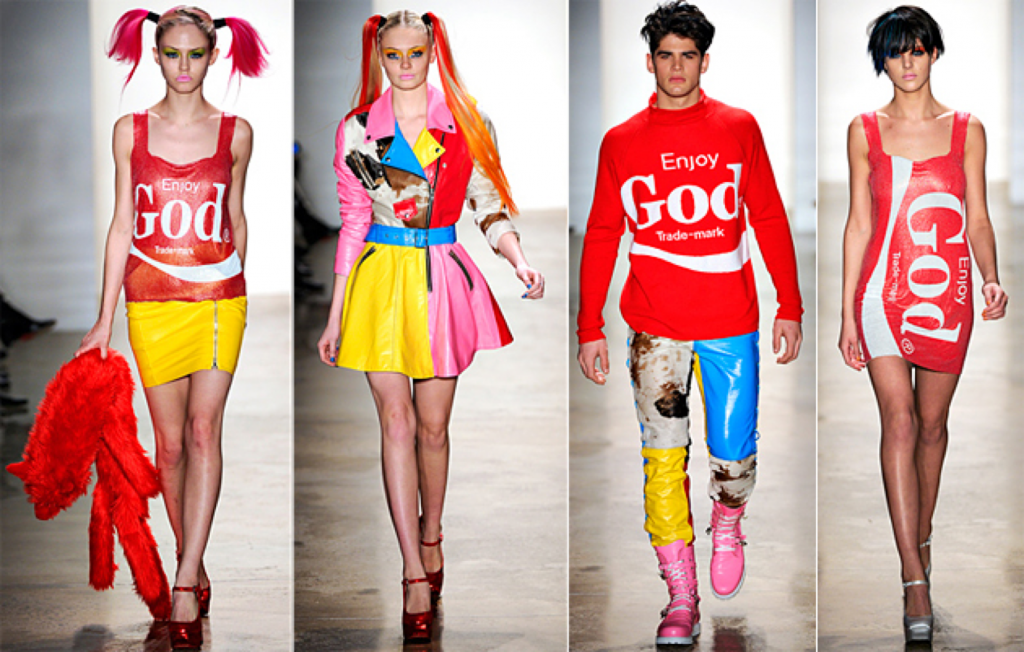
One of my concerns in the collections I have worked on has been popular culture and the impact of elite culture on it. A clear example I can give is my collection, “Golha” (flowers), which is actually inspired by the Radio Golha. Radio Golha was a radio program in which we could listen to the popular culture of Iran. Memorable songs from that period are also known as Ranga-rang. But what I think is most interesting about Radio Golha is how the media shapes people’s tastes.
But what is popular culture? Perhaps popular culture can be considered a set of customs, scientific and literary works of a nation, or perhaps a set of common beliefs and feelings among members of society could be a popular culture that has characteristics similar to spirituality, materiality, and having thoughts and feelings. Popular culture is also a lifestyle that has its own acts and thoughts and can be found in everyday life.
In Western culture, popular culture took shape in the second half of the twentieth century, and artists such as Andy Warhol became its main representative. Popular culture has many critics, including Adorno, who considered popular culture to be fundamentally banal. But some have defended popular culture and turned it into a trend that has also affected the fashion industry.
But “Golha” suggests the problem of the taste of popular culture in Iran that has deteriorated sharply and sometimes goes beyond vulgarity. For this reason, in the following, I will examine the taste of popular culture and how it is formed.
Popular culture in the latter half of the twentieth century precipitated a decisive change in style and body image. Postwar film, television, radio shows, pulp fiction, and comics placed heroic types firmly within public consciousness.
Thus the type and the icon are inextricable with the birth of fashion itself. But their full realization only arrives fully with the eruption of mass popular culture after the Second World War. While it has always been commonplace for humans to follow, or emulate a particular image, fictional or otherwise, popular culture in the latter half of the twentieth century precipitated a decisive change in style and body image.
Post-war film, the growing pervasiveness of television, radio shows, the proliferation of pulp fiction and comics placed heroic types firmly within public consciousness. Formerly, for men the aspirational uniformed type was largely limited to the military man, but with modern popular fantasy and mythology this tradition, persistent since ancient times, changed abruptly.
Society’s guardian and saviour were no longer associated with the soldier, but also the superhero. Embodiments of the authentic land warrior found its corollary in the cowboy, while the sinister but sensual outsider was the vampire.
History had had their heroes—Jessie James, Ned Kelly, Buffalo Bill, General Custer—but what is striking about the hero of popular culture is that it is wholly or partly imaginary, and having a codified set of attributes that are copied or reinterpreted by people in the everyday life.
Gay culture, with its love of artifice and play, deployed a number of types as forms of queer expression, many of them formerly associated with archetypal heterosexuality, such as the cowboy and the policeman. Indeed, it was at this time that gay male culture, which had always struggled with the stereotype of effeminacy, began to embrace hyper-masculinity, as in the clone and in the hyperbolic male forms in the gay comic by Tom of Finland.
Ironically enough, this new face of gay men’s style occurred at the same time as the bodybuilding’s entry into mainstream culture during the early ‘80s. Western culture had always valued the Hellenic physique, in life as in artistic representation, but to recreate it with one’s body and in proportions well exceeding those of GrecoRoman sculpture, is still a relatively new idea.
A critical watershed for bodybuilding occurred in 1977, with the documentary Pumping Iron of Arnold Schwarzenegger and his friends (such as Lou Ferrigno, who would later play the Hulk in the television series) preparing for the Mr Olympia bodybuilding contest.
In addition to those found in classical sculpture, muscular physiques were also a staple of superhero comics, but in the 1980s it became an increasing commonplace of masculine identity, embraced by both hetero- and homosexuals.
Shifts in body ideals are not only regulated to women, masculine ideals have also shifted across periods from the slim Victorian and Edwardian silhouette to the muscular shaped body of the 1950s and 1960s epitomised by Hollywood icons James Dean, Marlon Brando, and French actor Alain Delon, and made popular through magazines such as Playboy and Hustler.
The über-masculine male portrayed in the Solo and Marlboro Man advertisement campaigns in the 1970s and 1980s depicted the ideal man as rugged, hirsute, and in the company of other men or alone in the wild. Ideal masculinity was represented as synonymous with nature, wild and untamed.
From the 1970s onward, gay men began fashioning clothing styles that allowed them to ‘blend in’ to mainstream culture. It was the birth of the hyper-masculine ‘clone’ with a standardised dress style consisting of flannel shirt, baseball hat, jeans, army fatigues, and hiking boots. The 1980s gave rise to the commercialization of masculinity that was made popular by the ‘New Man’ and the increase of male retail outlets and style magazines such as Arena. The metrosexual of the 1990s gave way to the ‘lumber sexual’ of the new millennium and its latest incarnation, the contemporary hipster.
The new millennium sees the presence of various types that are the symptoms of post-industrialisation and the age of technology. But there is also a radical turn to a specially modified and mythologised past: the sheer preponderance of vampire books, films, and television series suggests an interest in the vampire that outweighs the basic liking of horror film, and rather suggests that the vampire is a symbolic figure in the era of what Slavoj Zizek refers to as ‘end times’: ecological degradation, overpopulation, fiscal volatility. The vampire is one who lives on after destruction and in spite of it.
For the Western male image, and one that filtered to the rest of the world, the 1980s was very much that of the slim and fashion forward ‘New Man’ represented in the fashion style press; or, the muscle-clad, hypertrophied body of cinema’s he-men.
The kind of musculature body made popular in cinema is not achievable to all body types and is potentially dangerous (injuries, steroid abuse). It is also not necessarily always desirable, and, in the end, is simply difficult to sustain, as the demands of life limit the many hours in the gym required for it.
As a backlash and as an alternative, the ‘New Man’ emerged only a small time later, followed by the ‘New Lad’ and the metrosexual in the 1990s. The metrosexual was a yuppie with a particular accent on appearance and manner that was a kind of urbanised glamour.
The explosion of male fragrances in the 1990s and the growing industry of male cosmetics proved congenial to the new male subject, one that appeared to take pleasure in beauty regimes desired by both men and women.
The hypermasculine body that was so much part of the Reagan era was in many respects the somatic climax of the Cold War era, an era that conveniently divided the world into a simple binary structure: the Western Bloc, which included America and its allies, and the Eastern Bloc comprising of Russia and the communist states of Central and Eastern Europe.
The fluctuating uncertainties of politics after the post-Perostroika era became noticeable on innumerable levels, including, male identities, which became a great deal more fluid and its orientations diverse.
In many respects, the hipster is to the twentieth and twenty-first century what the bohemian was to the nineteenth. He descended from the jazz culture of the 1940s and is synonymous with the invention of ‘cool’, a word that began to be used more widely in the 1950s.
Adapted from the slang “‘hep cat”’, as the name suggests, a hipster is into what is “‘hip’, and what is hip is what is what is slightly awry of ‘square’ middle class norms. A modernised dandy but without the dandy’s aristocratic pretentions, the hipster is laconic, relaxed, and ‘smooth’ in his choice of clothing, is unafraid of risqué language, employs a sense of humour, is imbued with an air of insouciant impertinence, and has a penchant for mild recreational drugs—because they’re taboo and also because they keep him ‘cool’.
Unlike the dandy, the hipster affects a rarified form of impoverishment, irrespective of his actual impecuniousness, in order to express affinity with the itinerant, gypsy order of society, the socially unencumbered and unrepressed.
Writing in 1948 in the Partisan Review, Anatole Broyard’s ‘A Portrait of Hipster’ called him a ‘keeper of enigmas, ironical pedagogue, a self-appointed exegete’. He was someone whose rebellion was in the interests of not being easily defined and irreducible to a function, or manipulable to a foreign agenda.
The Beat hipster was a product of the cataclysm of the Second World War, and embodied the need for dissent but without any sense of destiny—James Dean, the ‘rebel without a cause’, was very much a hipster. Hipsters confessed a deep affinity with mid-century jazz and popular culture, which meant that race played a central role. The sympathy with Afro-Americans and Negro culture would be varied and fraught—it was often criticised for being superficial—but it was fundamentally rooted in being subcultural outcast by default, or design. In its still dominant incarnation, the white hipster reinterpreted popular Negro culture, especially with regard to its rebarbative behaviour as a form of social resistance, and the aesthetics of cool.
The hipsters were a literary movement that was associated with a prominent group of American writers known as The Beats: Jack Kerouac, William Burroughs, and the poet Allen Ginsberg that became known as the Beat Generation. (Purists at the time would see the hipster and the Beat as different, something which we will deal with below, but by and large the differences boil down to tribalism, especially since the two were almost impossible to tell apart.)
Essentially, the Beats admired and were influenced by the Negro hipster and often forged intimate relationships that were accepted by the subculture without prejudice. They even adopted extensive vocabulary derived from 1940s jive talk, women were ‘chicks’ and men were ‘cats’ and people were either ‘hip’ or ‘square’.
The Beats were anti-materialists, read French existentialist philosophy, listened to bebop jazz, favoured the Theatre of the Absurd, and nonobjective gestural abstraction. Although no particular subcultural style is associated with the early hipsters, they often wore baggy chino pants, red and white gingham shirts, polo neck sweaters, and desert boots.
By the 1950s berets, black and white Breton sailor tops, and tight-fitting jeans became popular, as well as ‘goatee’ beards that became associated with French intellectualism. Nearly 50 years later, on August 8, 1994, Time magazine declared that, ‘Everybody’s Hip’ and ‘Hipness is bigger than General Motors’.
By the end of the 1990s, Zeynep Arsel and Craig J. Thompson write, ‘leading business media such as Brandweek, Fortune and the Wall Street Journal were all discussing the hipster as a commercially significant cultural category’.
The hipster is the figure of uncertainty and anxiety, yet attractive either because of the bold values he represents, or appears to represent. This ambiguity and the role of appearances are key. For the hipster is so often the dreamy man with one foot permanently in adolescence who affects a bewilderment at the frenetic modern world, a bewilderment that stalls him from action.
At best, the hipster is about disillusion at the depersonalization and complexities of the world, at worst it is lassitude and intransigence justified by what it sees is the implacability of the world, a world with too many secrets and vested interests.
While some of other male figures have a set of easily perceptible identifiers—the gaunt lizard-like dandy, or the muscle-clad brute, or the playboy in his suit or designer clothes—the hipster is much more elusive on the level of material culture.
‘Hip’, it may be argued, is the equivalent of ‘chic’ for late twentieth century countercultural discourse, both in terms of outward style and progressive personal ethics. Or alternatively it has been defined as a portmanteau term for post-war subcultures in general, and it is also very much a state of mind that opposes the numbing and exploitative of forces of late capitalism.
Norman Mailer’s paean to the hipster in his influential essay ‘The White Negro’ (1957), a reply to Albert Camus’s The Myth of Sisyphus (1942, translated two years before Mailer’s essay in 1955), is inflected with Nietzschean bombast. One commentator believes that it sits ‘on the border of sociological observation and aesthetic manifesto’.
Mailer’s essay is full of infuriating speculation and unsubstantiated assertions, but nonetheless is an unforgettable document. It is a wordy essay that unpacks the hipsters’ disenchantment with mainstream conformist culture and the adoption of African American jazz culture as their own.