Wearing a pork pie hat, baggy trousers, brogue shoes that were more often than not duo-tone black and white, the most noticeable and lasting feature of their appearance was the zoot suit, a long, flared coat gathered at the waist.
The female counterpart was the pachuca, who has received relatively little attention, for the main reason that the pachuco was not irreducible to a suit, but rather participated in acts of social subversion that were either reactions to victimisation or just plain crime.
In the war years of the 1940s, the suit ceased to be linked to a person or character, but rather assumed a universal status for those who wore them. In days of austerity following the First World War and then the Depression, to wear an excessive amount of cloth was to make a very recognizable comment about one’s own entitlement and the position toward authority.
The zoot suit, as Eduardo Deanagán remarks, ‘was a fad that pushed at the edges of social convention, playing on fashion mores by mixing gender styles and flaunting consumption beyond the unspoken. Like all subcultures, hip-hop and its subgenre, gangsta rap, entails the assemblages of body adornment, including accessories, hairstyles, and garments (as well as shared music, ideologies, and argot) to create an identifiable style.
The relation between these elements of styling practices produces a system of signs that creates meaning, what Carol Tulluch calls ‘style narratives’. Although the relationship between the objects (sign) and its meaning (signified) is arbitrary, motivated only by social convention, the meaning produced (in this case the gangsta rapper) is embedded with knowledge and power.
The style practices of the African diaspora, writes Tulloch, are a form of agency that are ‘part of the process of self-telling, that is to expand an aspect of autobiography through the clothing choices an individual makes’.
In her study of the style narratives of the African diaspora, Tulloch creates an analytical frame that she calls ‘style-fashion-dress’ to interpret the system of concepts that signifies the meanings and frameworks that are implicit in dress studies methodologies.
Tulloch uses the term ‘style’ in her matrix to denote agency. When applied to the groups of people that were formed outside of Africa (due to the effect of imperialism and colonialism), a consideration of transnational spaces needs to be accommodated in order to understand the formation of new identities.
Such an approach, argues Tulloch, ‘can lead to a more balanced understanding of the stylefashion-dress practices of black people as a comment on a sense of self in contested situations and contested spaces’.
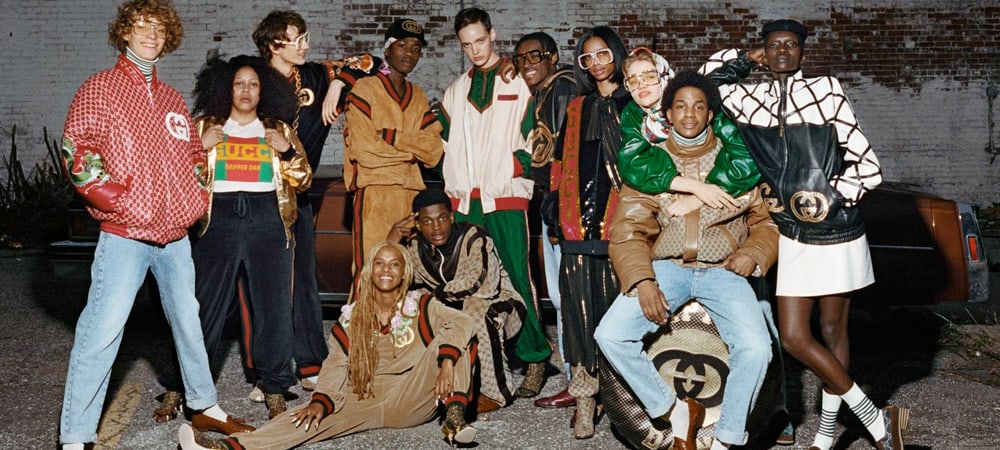
Using Tulloch’s analytical framework, hip-hop extends on African and Latino precursors of stylefashion-dress by engaging in the appropriation of everyday garments and accessories (sports-wear and high end fashion brands) to produce meanings of group affiliation, visibility, and territoriality.
In the same vein, Chandler and Chandler-Smith argue that African idiomatic style maintains cultural continuities through the concept of bricolage and black fashion imagination, what they call ‘things African’.
They argue that ‘contemporary hip-hop recirculates its own internal ethnic traditions in a wider black fashion system’ to produce continuity of memory and a sense of shared space and belonging.
Gangsta attire signals affiliation and territoriality across Afro-Latino imaginary spaces, particularly spaces of poverty and neglect, such as the ghetto, what Chandler and Chandler-Smith call ‘the underworld womb of hip-hop’.
This transgressive space of transcultural urban identities uses music, language, and dress codes to articulate social resistance by producing new meanings of style (read agency here) whilst maintaining links to African prototypes of costume and performance, what Chandler and Chandler Smith describe as ‘ghettocentricity’. Ghettocentricity and pachuco culture ‘got into the dress codes of white male status and normality, playing with the images of an Anglo popular culture’s own masculine ‘outsiders’ – the Southern dandy, the Western gambler, the modern urban gangster…. and ruptured their structures of Otherness’.
Since the establishment of cable television and MTV (music television) in the 1980s, hip-hop subculture has been co-opted by the media, fashion, and marketing industries to mass produce the violent and negative aspects of ghetto life: poverty, drugs, crime, and institutional incarceration.
Hip-hop performers such 50 Cent, Snoop Dog, Eminem, and the promotion of their dress code as ‘players’—oversized white T-shirts and baseball jerseys, baggy pants, reversed baseball caps, and coloured bandannas—have come to represent a visual language that is bound up with notions of ‘street cred’.
Stereotyped masculine roles including the ‘player’ or the ‘pimp’ are promoted through stylised dressing and sexualised body language, ‘in which Armani and Gucci suits, alligator shoes and custom-designed hats and jewelry’ come to signify conspicuous consumption, status, and affluence. It represents a call to leisure and lubricious hedonism that is an outward fillip to austere, white Protestant values.
It is a sad and well-known fact that racial hatred is most ruinous and hard to curtail when it is exacted from within. As Coolio said in his greatest hit, ‘Gangster’s Paradise’ (1995), ‘Why don’t we just try to see that the ones we hurt are you and me’.
For the assertion of masculinity amongst gangsta cultures is as much an effect of pride as it is of self-hatred and disrespect—hence the common use from one African American to another of ‘nigga’ and ‘black motherfucker’. (The more innocuous appellation is ‘homie or ‘homeboy’, whose origins are not derogatory but rather relates to underprivileged or victimised social groups whose families are forced to regroup and migrate.)
It is because of this duality that the common use in contemporary culture of what is now called ‘the n word’ among African American men is hard to situate from an ethico-historical point of view. In his study of youth culture in schools, Edward Morris reflects that ‘the n word, along with other social mechanisms, defined boundaries and provided pathways for the localized constructions of race.
In addition to expressing racial solidarity, it was meant to make white people feel uncomfortable’. It is therefore a linguistic tactic to show fealty and to facilitate what he calls ‘the achievement of blackness’.
In this campaign of socialization, it is important for African American youths of certain (usually underprivileged) schools and communities to achieve gangsta status and to avoid being ‘lame’.
To be lame is show signs of vulnerability, not to have the right dress, or to have conflicting attitudes of the group, especially as it applies to the combative male culture.
As opposed to the gangsta, which appropriated for itself the realities and the myths of black criminality, to be lame was to comply with rules and, by extension, to affiliate with the oppressive status quo.
As Morris notices, ‘boys in particular felt a pull to enact this hard streetwise image’. The gangsta image is a powerful and seductive concept as it is far from confined to an urban condition, but is caught up in the fantasies circulated by representation and narrative.