This said, Bourdieu points out the common strategies required of challengers to the established couturiers: they must promote themselves as subverting the old order without wholly problematizing the field of fashion itself.
Indeed, they cannot do so without calling into question their own raison d’etre-after all, their ultimate goal is not to deconstruct the field, but to succeed in it. Similarly, Baudrillard argues that the only significant intervention possible in the commoditized regime of fashion is to throw into question its foundational logic, which again no designer can completely afford to do. Do we say, given these inevitably compromised and complicit interventions, that all contestatory potential is therefore vitiated?
I have argued that one of the key interventions made in the clothing of “the Japanese avant-garde” designers lies in their figurations of gender. Inevitably, however, these interventions are animated by multiple, constitutive contradictions. First, the high-fashion industry and by extension the work of Kawakubo, Yamamoto, and Miyake at one level participate enthusiastically in the relentless reproduction of the gender binary.
The industry itself is predicated on the division of markets between men’s and women’s clothing (though of course there can be crossover in the practices of consumption), reflected in the showing of the collections (men’s and women’s collections are shown separately, according to entirely different schedules), in the organization of retailing (departments or boutiques specialize in either men’s or women’s clothes), and in fashion journalism (women’s magazines and trade papers are often separate from the men’s, e.g., Women~ Wear Daily and Daily News Record, Ryiiko Tsiihin and Ryiiko Tsiihin Homme).
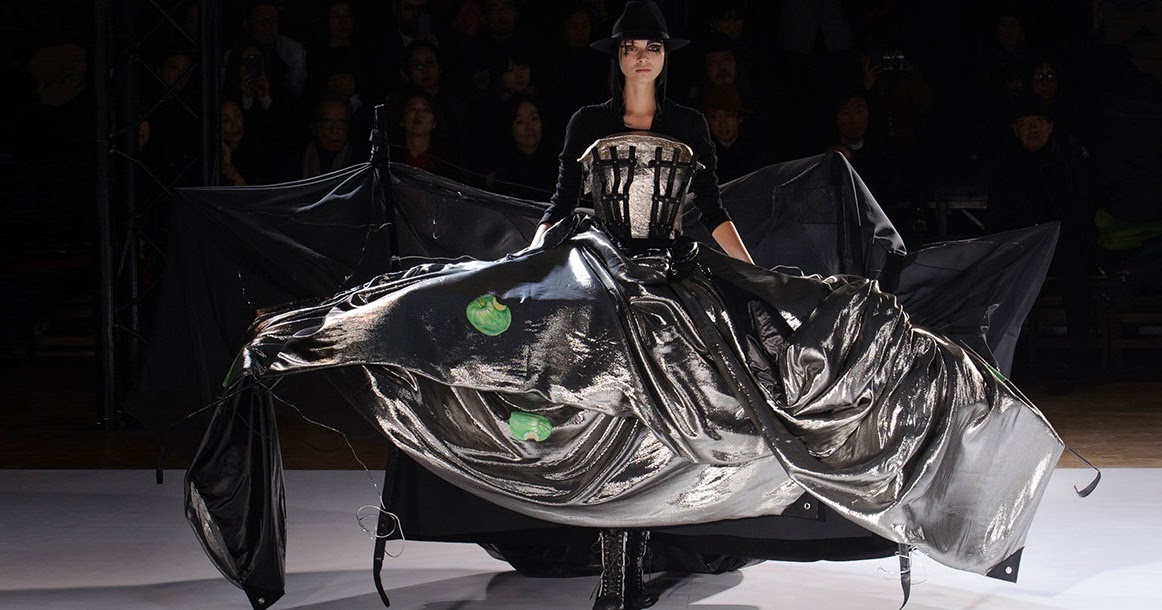
Even within the binary organizational strictures of the fashion industry, the work of avant-garde designers in Japan offers a different way of crafting gender, based on the presumed relationship between clothing and bodies. Certainly, especially in the 1980s, Miyake, Yamamoto, and Kawakubo made strong statements about a different aesthetic of shape, where the garments do not follow the body’s outlines, but define a space around the body.
This inevitably refigures the clothing-body relationship and the construction of gender based on womanly curves or masculine linearity. For example, Kawakubo claims she begins with an abstract shape, and her concern is first for the clothing itself.
In an interview, Kawakubo spoke of her point of departure as a “concept,” not pattern or tailoring techniques. She further emphasized the spontaneity of her sources of inspiration: “It’s not on the basis of the pattern.
The sensation of having experienced the feel of the material. .. . It’s purely the sensation of the moment. Right now, I like warm things or heavy things…. It’s just that sensation.” This conceptual and tactile aesthetic takes on marked contrast to the “body conscious” fashion of the West: I don’t understand the term “body-conscious” very well…. I enter the process from interest in the shape of the clothing and from the feeling of volume you get from the clothing, which is probably a little different from the pleasure Western women take in showing the shapes of their bodies.
It bothers Japanese women, doesn’t it, … to reveal their bodies. I myself understand that feeling very well, so I take that into account, adding more material, or whatever. It feels like one would get bored with ‘body-conscious’ clothing (1987, 92).
Here Kawakubo links different principles of clothing construction to differences in gender construction, sexuality, race, and nationality; Western “bodyconscious” clothing depends upon Western figurations of gender and sexual display, while Kawakubo’s clothing and aesthetic sensibility articulate a sensuality enjoyed by Japanese women.
Kawakubo thus discursively constructs racialized gender differences as a principle shaping her work. Yamamoto and Kawakubo have spoken specifically of a blurring of gender categories, where the wearer they envision is not bound by familiar gender conventions. Even the name of Kawakubo’s company, Comme des Garçons (“like the boys”) gestures toward these gender contestations, enshrining a kind of boyish (manisshu, “mannish,” as it is sometimes called in the Japanese press), troublemaking image.
Paradoxically, early on this was articulated in a highly Western mode: before it became known in the West, Comme des Garçons clothing was often photographed in ways that were very garçonne, illustrative of the company name: hat tilted to the side, a cigarette dangling from the mouths of the very French-looking models.
It is precisely this ambiguous gender imagery that has puzzled many a Western observer. A male editor at a well-known fashion magazine told of his bewilderment in the face of the “shapeless” clothing designed by the Japanese, which fails to reveal a woman’s body.
He said that he would never want his girlfriend to wear Japanese fashions; rather, his taste ran tothe form-fitting styles of Azzedine Alaia, whose clothing has curves, even if there is no one in them, and Thierry Mugler, famous for his parodically sadomasochistic, femme-fatale designs.
Amanda Stinchecum, a commentator on Japanese aesthetics, has this to say about Kawakubo’s work and its challenge to conventional gendered images: As a woman, she is aware of the expectations of not only men, but women as well, that women look and act pretty, and that this prettiness conform to accepted norms.
The lips should be red, the eyelids blue, the waist narrow, the hips curved, and so on. To be appealing, clothing, too, is supposed to meet certain expectations: symmetry, neatness, sexiness (suggesting if not revealing Kawakubo’s clothes do neither). Her designs express both a reaction against these expectations, and an interest in pure fonn…. Kawakubo’s clothes are the most extreme because she, more than the others, refuses to meet the expectations we have of clothing and of women (76).
Kawakubo concurs, restating emphatically to me, “I’ve never once thought about a woman’s ‘beauty.'” (“Yappari, onna no utsukushisa ni kangaeta koto ga nai. “) In some interviews, Kawakubo expresses the expectation that her ideal consumer would be someone like herself: an independent career woman (1987, 90).
A Comme des Carçons representative explained, “The goal for all women should be to make her own living and to support herself, to be self-sufficient. That is the philosophy of her clothes. They are working for modem women. Women who do not need to assure their happiness by looking sexy to men, by emphasizing their figures, but who attract them with their minds” (Coleridge 1988,89).
Indeed, Kawakubo insisted fiercely on that independence: “I don’t have the slightest conception of depending on someone, of saying, ‘Help me.'” She elaborates elsewherethat she does not design with a particular kind of person in mind; rather, the concern is with the feeling the clothing imparts:
“To put it in extreme terms, I want to value the feeling of freedom that comes when someone wears the clothes, something psychological and spiritual rather than the actual feel and fit of the clothing” (1988). The refrain of newness, of freedom emerges strongly in Kawakubo’s discourse.
At one level, such statements could be taken as typical strategies mounted by new designers, for Bourdieu perceptively argues that the necessity to assert marketable difference often takes the form of dynamism, modernity, and subverting convention.
Moreover, the reference to independent women as consumers is surely a marker of the accession of women to the professional and managerial classes in advanced capitalist societies. Kawakubo, Miyake, and Yamamoto clearly design with professional and creative women in mind. The late designer Tokio Kumagai links clothing to these dramatic socialchanges: Men and women are crossing over.
There’s no longer a notion that because you’re a man, you have to do this, or because you’re a woman you have to do this…. Even husbands wake up in the middle of the night to take care of the kids; even wives are working, earning money, so from the point of view of everyday life, differences are disappearing. The obstructive view that because you are a woman you have to wear a slim skirt no longer exists.
Bourdieu might simply see these developments as expanding the reach of the professional and managerial classes, this time in a female guise. Certainly this is at one level unassailable. Yet can we say that considerations of gender and race might nuance a narrative of class reproduction?
To address such questions will require a closer examination of how this difference is embodied and enacted in the designer’s own creative vision. How, if at all, has it shifted over the years? I want here to make an argument that the initial, extremely radical shock has been gradually modified, though not necessarily in a linear progression.
Comme des Garçons is establishment now, although it is still considered experimental and avant-garde; indeed, experimentation has been institutionalized as the distinctive feature and the trademark of the work of Kawakubo, Miyake, and Yamamoto.
Their aesthetic moves have been incorporated into mainstream fashion. After the 1991 fall/winter collection, a Comme des Garçons employee commented to me that that even a well-known conservative fashion reporter seemed at last to have understood the clothing and gave the collection excellent reviews.
“We’re wondering whether someone slipped something into her drink,” she said wryly. A closer examination of four women’s collections—early, middle, late periods, if you will-allow us to consider more specifically the nature of the gender contestations Comme des Garçons clothing might foster.
Inevitably, such an analysis is partial and located; let’s include, for example, those collections in Paris and Tokyo. Because I was interested primarily in decoding the aesthetic/capitalist logic by which the collections operate over time, the focus remains on the women’s collections.
A thorough analysis of gender production must also take into account the contemporaneous men’s collections and, ultimately, processes of consumption and resignification. I will argue that through changes observable in the women’s collections, we can see gradual modifications in the radical silhouettes as well as critically important aesthetic continuities and the possibilities for continuing opposition and difference.
Though partial, these stagings of wish-images will also be suggestive, allowing us more concretely to examine provisionally questions of gender contestation and recuperation, foregrounding the contradictions animating Kawakubo’s work and by extension the work of all avant-gardes in the fashion industry.
The focus of my analysis here is the presentation of Comme des Garçons highfashion ready-to-wear in the Paris runway shows, which must be set within the context of Comme des Garçons’s history and more generally, within the landscape of the Paris collections, or defiles.
Comme des Garçons had been in existence for over ten years by the time they showed in Paris. The firm was established in 1973, and Kawakubo opened her first boutique in the fashionable Minami Aoyama section of Tokyo in 1976. She added a men’s line in 1978, and in 1981 presented her first women’s collection in Paris-not in one of the large tents at the Louvre, where established designers show, but in the Hotel Intercontinental.
This early 1981 collection forms a reference point for Western analysts, even though Kawakubo had been designing clothing for a decade or more. This is one telling indicator of racial marking: for racialized, non-Western subjects, existence commences from the time of introduction to the West.
The defile is a v ery particular event, and an equally particular yet revealing object of study. It is a climactic moment in a designer’s work on a collection, an opening night for the world’s fashion critics and buyers. It presents designers with an opportunity to showcase their clothing and to stage their aesthetic and corporate image, for shows ideally unify the meanings of individual clothing pieces in ways difficult to achieve were the garments simply hanging in a showroom.
The collections allow designers the opportunity to thematize the significant difference(s) that will ideally bolster their reputation as creators and stimulate consumer desire. In fact, the ways things are shown on the runway are not necessarily exactly the ways they will be sold, and designers usually showcase a few image pieces that embody the spirit of the house or the collection; these are not expected to sell on a large scale.
Fashion shows are thought to enact creative visions, and they have the feeling of festival, of reunion with colleagues, of performance. What made the early Comme des Garçons shows so radical? Holly Brubach, style editor for The New York Times, once classified designers in terms of two approaches to fashion.
One, exemplified in the work of the Japanese and most of the British avant-garde designers, makes an intellectual and aesthetic challenge, calling attention to the troubles in the world. The other views fashion as simply one of life’s exquisite pleasures, where clothing is meant “for eating lunch at a French restaurant where the walls are painted some flattering shade of pink” (92).
I myself had not appreciated the degree of this difference until I reasearched on Paris fashion of 1990 and found out the collections and shows mounted by establishment high- fashion designers such as Hanae Mori, the only Japanese designer of haute couture. Like her peers at Chanel, Ungaro, and S1. Laurent, Mori is known for upper-class, classically feminine looks.
Her clothing tends to be tailored, soigne, close to the body. The defile performs this version of femininity. At the Mori ready-to-wear show, carefully coiffed and painted models sashayed out in high heels to the latest Top-40 hits-that year, Paula Abdul and Soul II Soul. Tossing their hair, they flirted with the audience and the video cameras at the end of the runway in an almost parodically feminine style.
This conventional gender performance characterizes many fashion shows. Staging, then, is crucial. The models’ makeup and gestures, the way they walk, the music, the lighting, all shape representations of gender. With this in mind, let us tum our attention to four Comme des Garçons women’s collections shown over a period of eleven years.
Fall/Winter 1984-5 collection extended themes from the first Paris showings in 1981, but still presented a dramatic alternative to the exaggerated padded shoulders and the sexy styles that characterized the fashion of the period.
Staging of this and other early Comme des Garçons shows was considered highly unconventional at the time. The antifashion tone to this Comme des Garçons defile begins with the music: initially, there is none, a feature that attracted much commentary in the fashion press. Generally, shows begin when the lights go down and the music starts; when the lights rise, the models emerge.
The 1984-5 show is brightly lit from the outset, and the models stride out to silence. When music does begin-at an unpredictable moment-it is relentless percussion, rather than the usual Top-40 or latest house hits. The models walk briskly, energetically, wearing heavy, flat shoes and sandals. There is no flirting or simpering here: the women are unsmiling, sullen, sober, sometimes defiant, and they seem oblivious, even hostile, to the onlooker’s gaze.
The women wear little makeup, and hair is arranged to appear messy, standing out from the head. Occasionally, the models wear tricornered hats, like soldiers from the Revolutionary War, or crushed caps reminiscent of a medieval burgher, heightening the impression of gender transgression or cross-gender impersonation-except, perhaps, for the long hair that protrudes from underneath the hats.
Indeed, the models look unkempt, rather than conventionally pretty or elegant. Unlike celebrations of conventional femininity in most fashion shows, the atmosphere here indicates that the world is a troubled place, and that fashion is not outside or above that trouble. Women are not meant to be pretty, but tough and defiant. These are women with a major attitude.
This collection was known for its use of indigo and sumi-ink dye processes; many garments allude to recognizably Japanese motifs, and they are representative of Comme des Garçons in their looseness, volume, and asymmetry. For example, some pieces resemble large, flowing caftans that are shirred, unevenly cut, or hang asymmetrically.
The series featuring aizome, or indigo dye, recalls traditional Japanese patterns. A series dyed with sumi ink explores the gray scale, using traditional techniques to make garments that push the cutting edge of style.
Despite the invocation of Japanese techniques and dyes, however, the overall impression is of displacement in space and time, for the clothing refers to garments from various cultures and various historical periods, unifying the ages: monkish garb, peasant clothing, medieval attire, academic robes, kimono, Japanese work clothing, street style and bag ladies.
In making these allusions, the garments also escape easy encompassment into any single category. Recognizable shapes and motifs occur in this collection and are reprised in later work. Long, loose, layered, asymmetrical pieces dominate this particular season. Kawakubo has often designed jumpers; a typical shape is the jumper with one bare shoulder, held up by a single asymmetrical piece or strap.
In this collection, the shape is wide and loose; in later collections, the jumper is far more conventionally elegant and close to the body. Another Kawakubo trademark is layering, appearing here in long knit dresses made from loose, sometimes differently colored, layers.
The effect this time is bulky, though the overall shape is relatively close to the body. Staging elements heighten the importance of this segment: lights go down and relentless, atonal music commences, echoing the percussion in the beginning segments.
By this time, Comme des Garçons’s work is sufficiently well-known for the designer to play with her own image. In this case, the innovation occurs with the appearance of color. A series of pale wheat, beige and ivory knits, including slim asymmetrical sweaters, pants created from draped and folded fabric, and loose caftan-like dresses and coats, garners applause.
A later series stages its difference: the lights dim, then rise, as models silently stride onto the runway in garments of warmly hued burnt orange, gold, salmon pink, rust, and burgundy. Again, the audience breaks into enthusiastic applause.
By 1984, Comme des Garçons and Yohji Yamamoto had attained international prominence. The aesthetic conventions of this collection-wrapping, tortured shirring, voluminous layers and folds, the absolute rejection of symmetry-had become familiar themes in their work and disseminated outward.
Chunky, flat shoes and voluminous shapes were beginning to take hold in other designers’ collections. The loose, black clothing first shown on the runways by the Japanese could be seen on the streets, even worn by the fashion pack in the Cour Carree of the Louvre, where the major collections are shown. Bernadine Morris of the New York Times, reporting on this 1984 show, wrote: “While the Japanese clothes provide an original approach to the art of dressing, they no longer inspire panic. The world still seems safe for Western dress” (ClO).
The invocations of panic and safety for Western dress demonstrate in what threatening and revolutionary terms Japanese designers were initially perceived. This collection should impart a sense of why “the Japanese” and Comme des Garçons caused such a sensation and inspired such strong international reactions.
Still, at this point the gender images and subversions of staging conventions were clearly occurring within a highly comprehensible frame. The long, loose, primarily black or navy garments were by now no longer surprising; rather, they presented an alternative to “sexy” styles that could, in 1984, be subsumed within the realm of the intelligible.
Indeed, one could argue that by this time there had been some modification in the garments themselves; for example, Kawakubo showed some narrow shapes that fit the body closely, even though the body is wrapped in multiple layers or swathed in fabric.
Shirring and smocking in these pieces simultaneously obscure and reveal “feminine curves.” Moreover, though Comme des Garçons had used innovative staging devices and gender performances-sullen models in a silent parade, for example-the convention of the fashion show itself is clearly still fully in place.
In short, the work of Comme des Garçons contested certain fashion conventions, presenting particular wish-images for gender that highlighted independence, rejection of stereotypical femininity, dynamism, movement, and loose, architectural shapes that had a unisex look, problematizing conventional notions of sexiness.
Yet these contestations occurred fully within a frame of intelligibility that does not-cannot-fundamentally call into question the rules of the game. During the mid-80s, Kawakubo concentrated on slimmer silhouettes, saying she had grown tired of wrapping and enormous volume, and she often chose to play with Western tailoring in forms like the suit.
However, in this movement toward tailoring, there was always a recognizable Comme des Garçons difference: for example, combining cutting and tailoring with draping. The distinctive Comme des Garçons aesthetic preoccupations with wrapping, asymmetry, and folding never disappear, but occur along with drafting techniques associated with Western clothing traditions.
To illustrate more recent strategies, I analyze here the two collections that I attended: the first in Paris, the second in Tokyo. They carry through recognizable Comme des Garçons drafting themes and aesthetic motifs, yet differ markedly from the 1984-5 collection in staging, silhouette, and figurations of gender.
Staging and music of Fall/Winter 1990 show set the tone for this gender performance. The theme for the collection is “modern sweetness,” a message carried out in the selection of urbane pop/jazz by female vocalists: Dionne Warwick, Eartha Kitt, Sarah Vaughan, Astrud Gilberto, among others.
The music accompanies a gender performance that emphasizes the gamine; the women here are energetic, but retain a touch of sweetness and naivete. The model who opens and closes the show displays a gangly, slightly embarrassed awkwardness.
On the one hand, this injects a note of artlessness refreshing in the face of the supermodel sophistication typical of many fashion shows, but such charm remains recognizably, even stereotypically, feminine. The jaunty, fast-paced music provides accompaniment as the models walk out briskly (again, no sashaying here); most smile engagingly at the audience.
Makeup appears conventionally feminine; hairstyles tend toward the short and gamine, while longer hair is tied up in irregular, spiky strands. Sometimes, the models wear whimsical caps shaped like a Hershey’s kiss. This collection features a number of themes connected to drafting and to fabrication. One was the L-shape; many garments display an L-shaped piece that dangles from the garment like an extra appendage.
A second is the use of strings. In Paris and New York, this is the year of the anorak: a parka gathered at the waist, sometimes hooded, and closed at the hem by a string. Comme des Garçons not only plays with the anorak shape, but uses string closures for skirts and pants as well as jackets. A third theme is nonwoven fabric, including synthetics that resembled insulation batting, for example, or tubular nylon jersey woven into updated versions of fishermen’s sweaters.
In this collection Kawakubo deconstructs Western clothing conventions. She cites Western garments-anorak, jacket, jumper, schoolgirl dress, middy blouse-so that each retains distinctive features that make it recognizable, yet each is thrown off balance.
For example, anorak shapes are cut with voluminous amounts of fabric; one displays a ballooning L-shaped appendage, like a huge extra sleeve or pouch, dangling from the back. Baseball jackets appear with the typical knit collar, but the sleeves are closed with string, and the jacket is cut so that the back is split and gathered, making an inverted “V” that extends above the waist.
Sometimes the fabrication is unusual, another characteristic Comme des Garçons move: for example, long versions of baseball jackets made of nylon tricot over bonded fabric-a 2 X 1 polyester where two threads to one are knitted together.
Generally, such material appears inside the garment, as interfacing. Kawakubo also appropriates schoolgirl uniforms and girlish dresses in the form of Peter Pan collars and middy blouses. These look demure, yet feature unusual drafting techniques that create an off-kilter, sometimes even tortured, impression.
For example, a dress with a Peter Pan collar is asymmetrically skewed and has a large pouch-like protrusion of extra fabric in the front; the middy blouses display characteristic shirring, asymmetries, and unexpected appendages of fabric.
Among Kawakubo’s strong points are her jackets, where innovations appear in both fabrication and drafting. A major series features jackets and trousers of soft, synthetic fabric reminiscent of insulation batting, in shades of celadon, gold, rust, and gray.
A jacket from this collection has a shawl collar that can be worn conventionally, displaying an open slit at the base of the neck. Alternatively, the head fits through the opening, making the “collar” a decorative piece that floats horizontally across the collarbone.
Some jackets and trousers feature L-shaped pieces that hang like extra arms or droopy pockets. Transparent blouses appear with banks of ruffles cascading down the model’s back instead of the bodice. Another jacket series pairs brightly colored plaids with solids. These garments are formed from pieces of fabric sewn together, so that they can expand or contract depending on the shape of the wearer’s body.
Sometimes, the drafting innovations are scarcely visible. The Noir, or evening, collection exemplifies the economy of expression for which the Japanese are famous. For example, armholes are cut as slits on the bias of the fabric, rather than cutting a round hole in the fabric or setting in a sleeve. A fairly straightforward pair of pull-on slacks and a tube skirt have an L-shaped waistband, visible only to the wearer.
Occasionally, the drafting is more apparent. One series combines rust and blue stripes in a series of tops and garments that are both shorts and skirts. Stripes reveal the direction of the grain of the fabric, so the ensemble inevitably reveals the complexities of its construction in its vertical, slanted, and horizontal stripes.
Quon’s commentary is eloquent here: “There is tension in all the garments, yet they are made for comfort.” The Noir, or evening series, as well as the show’s finale, accent soft fabrics and feminine, gamine images. The long dresses in Noir use velvets of polyester/rayon/chambray; two colors are woven together and the fabric cut as close to the surface as possible in order to produce an iridescent effect and a soft, luxurious surface texture.
The dresses are long, relatively simple shapes; some feature scarves, capelets, and trains, others have armholes in a halter or racerback style, or open under the arms, like a kimono. The finale is unprecedented for Comme des Garçons: a bride, who traditionally ends the shows of the established couturiers.
She appears in a wedding gown with short sleeves, a fitted bodice, and a skirt made of multiple layers of fabric in the material reminiscent of insulation batting. Her veil is a white cap with a huge visor. As the bride clearly shows, the clothing itself combines with staging to produce recognizable gender performances. Baseball jackets, parkas, pants, capris, and culottes produce a young, sweetly boyish effect when worn by the short-haired, gamine models.
The schoolgirl look defines another important series: however deconstructed and unusual, this is a gender image of naivete and innocence. Here, the hair, pulled up in topknots that end in spiky tendrils, adds an air of youth with an edge of unruliness.
Suits and jackets are more sophisticated, yet the staging-the smiling, gamine models, the jaunty, urbane music-imparts the impression of “modern sweetness” otherwise absent from the garments themselves. Finally, one can only note the ironic, yet unmistakable gender recuperation in the finale, marked by the appearance of a bride— no matter how unusual her garment.
Gamine, at once girlish and boyish, heterosexually coupled, the women in this Comme des Garçons show may be brisk, energetic, and cheery, wearing clothes that cite and deconstruct Western clothing conventions, but they are indisputably feminine.
Spring/Summer 1991 collection was seen as a real departure for the company, the first really “pretty” show in Comme des Garçons history. Kawakubo used “feminine” fabrics, including diaphanous chiffon, jerseys, taffetas, hand-crocheted lace, and a range of colors, from soft pastels and chiffon hand-dyed with sumi ink to brilliant reds.
Wrapping and folding were carried to new heights with this collection. One theme was a rolled hem, in which hems were not cut and stitched; rather, the fabric was folded over on itself, imparting a softer look. Each chiffon piece was constructed of multiple layers, or chiffon was layered over lace or stretch fabrics.
The drafting theme for this collection was the circle. Accordingly, the Noir section featured Grecian-inspired ball gowns with circular sleeves, and taffeta gowns with layers of circularly draped material, first stiffly protruding in front, like a pouch, then in the finale to the collection, dipping low in the back. Characteristic Comme des Garçons preoccupations with asymmetry-blouses and dresses with one sleeve, scarves dangling to one side, notches cut under the arms at odd angles-recur here.
The theme of this collection is “mature elegance,” a marked staging contrast to the young, jaunty collection preceding it. Again, music is telling: the show begins with quiet, ambient sounds of birds chirping, a shimmery New Age score followed by soft solo piano reminiscent of Satie.
The models walk out slowly, in stately fashion, mostly unsmiling; their (usually long) hair is pinned up loosely and powdered to give it a subdued, gray cast. Faces, too, are powdered to a matte finish. Retro elegance is a theme: the hairstyles evoke the turn-of-thecentury, while the accessories-hats with veils, cloches, large flowers pinned to the head-recall the 1920s and 1940s. According to Kawakubo, the atmosphere of the collection is meant to symbolize beauty in a troubled world.
This collection approaches conventional Western clothing, but we also see striking continuity in the Comme des Garçons aesthetic/corporate image of avant-garde artistry. Kawakubo claims to have become tired of volume, wanting to work with slimmer (and more commercial, more accessible) shapes and different materials.
Nonetheless, she retains the distinctive features that enable Comme des Garçons to set itself apart from the mainstream. For example, the rolled hems are at first glance barely discernible, but they give the garments an unfinished softness and constitute a patterning innovation.
The use of folding emerges even in very simple-looking garments: a double-layered chiffon T-shirt I have from the collection is a single, continuous piece with two sleeves and a hole for the neck at either end. To wear the T-shirt, one must fold it up inside itself. Such distinctive features are both drafting innovations and effective commercial strategies that distinguish a Comme des Garçons product.
Themes from previous collections recur, yet are refigured in distinctive ways. For example, the show begins with a series of garments dyed with sumi ink, reminiscent of the sumi-dyed garments in the 1984/5 show. This time, however, the fabric is chiffon, and the gender presentation is ladylike, feminine, stately. Models appear in flowing chiffon jumpsuits and dresses, some with diaphanous vests that float as the women walk slowly down the runway.
Layers occur in many guises: a long, diaphanous dress with an open bodice that reveals the breasts is worn over another transparent dress, so that the breasts are covered, yet visible through the fabric. Some chiffon dresses end in a triple hem.
One characteristic print for this collection is a stained-glass pattern that appears on dresses and jumpsuits; many of these are worn underneath transparent chiffon. Another distinctive feature is a series of coats, jumpsuits, and dresses made of lace in a daisy pattern; these are often shown with a translucent chiffon overgarment.
The drafting theme, the circle, appears primarily in two forms. One is a circular sleeve made of a continuous piece of fabric joined in the back. It appears most strikingly in a series of long jersey dresses with a Grecian air. All are of pale gray or white, with slightly flared skirts and a train; sometimes the train resembles a scarf tied at the waist, draping to the floor from the hip, while another trails from the waist at the back of the garment.
Smocking positions the skirt asymmetrically on the hips. A second circle motif is a pouch. As waltzes set the tone, the Noir or evening collection culminates in two brilliantly red ballgowns. One is a jumper style in which the stiff fabric creates a huge, circular pouch in front, revealing a diaphanous red blouse underneath.
The finale is a short ballgown of bonded fabric rising to the knees in front, dipping almost to the floor in back. The circle motif here appears in a back that curves low, displaying bare skin almost to the waist. What of the gender images presented here? Mature elegance is indeed an apt characterization.
The stately manner of the models’ walks, their hair and makeup, the contemplative music, the historical resonances to the tum of the twentieth century, the ’20s and the ’40s, the soft, recognizable femininity of the fabrics (lace, chiffon, taffeta, jersey), the gentle colors (gray, white, apricot, pale green), the soft prints (stained glass and mineral patterns) all seemed recognizably feminine, elegant, pretty.
The brilliant reds and characteristic navy and black also appeared; these, too, were used in garments that often emphasized softness and revealed the body even as they often retained a characteristic Comme des Garçons sense of complex, tense construction.