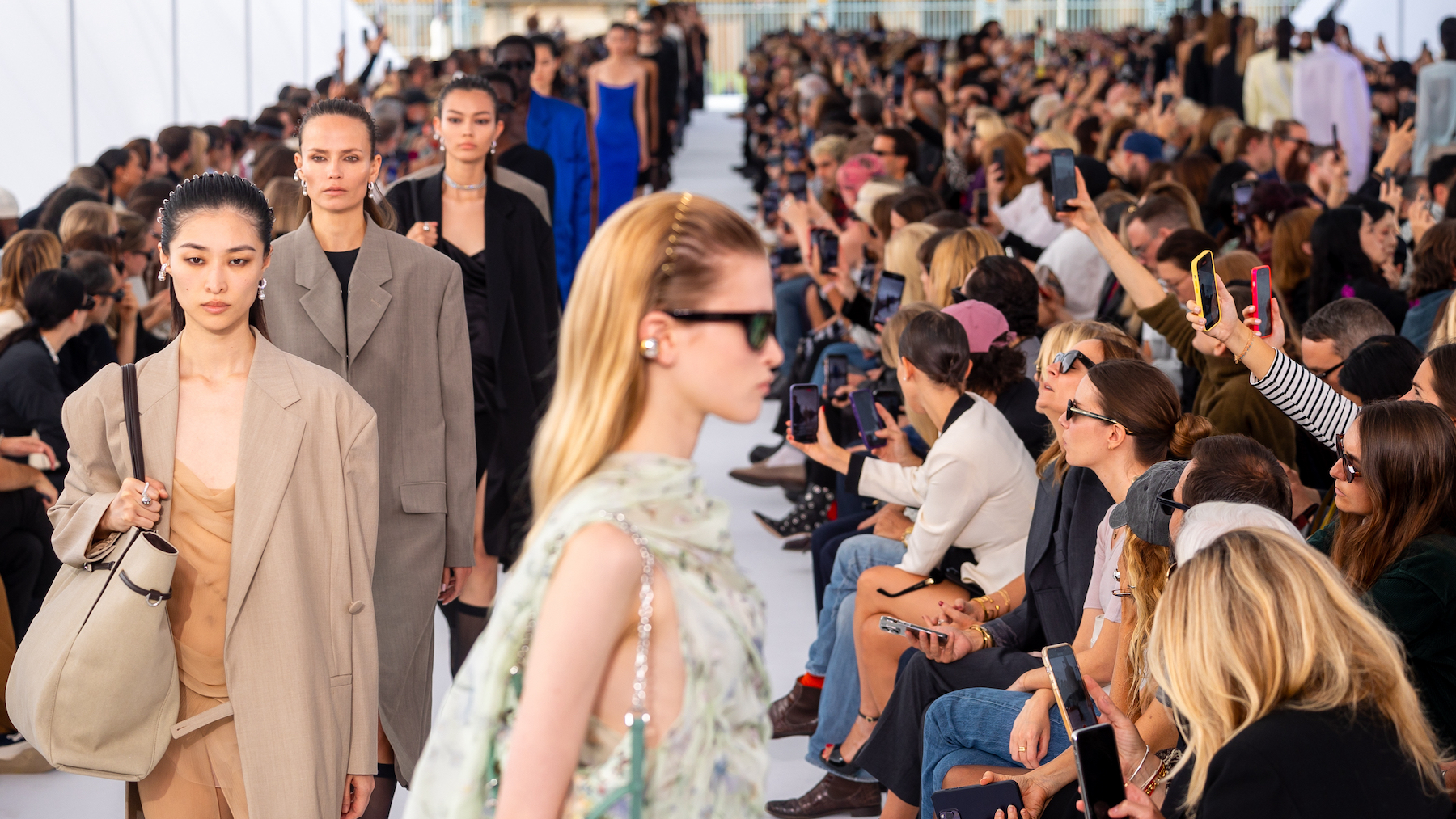
Given Wilson’s comment that ‘fashion is the child of capitalism’ (2003: 13), this essay shows how Marx’s rich conceptual framework can produce a deeper critical understanding of the origins and dynamics of fashion, socially, culturally and materially. For just like the capitalist system which spawned it, fashion is ‘double faced’ (Wilson, 2003: 13), a source of both pleasure and pain, expression and exploitation.
In contrast to the grinding poverty which scarred his later life, Marx was born into the relative comfort of a middle class home in the German cathedral town of Trier in the Rhineland in 1818. The son of a Jewish lawyer who converted to Protestantism to escape anti-Semitism, Marx studied law at Bonn in 1835 and philosophy at Berlin University a year later.
Despite completing his doctoral thesis on classical Greek philosophy in 1841, aged only 23, Marx dropped his plans to follow an academic career. Instead, he dedicated his life to studying capitalism and to providing the theoretical underpinnings for a grand project: the emancipation of society by ridding it of the suffering caused by the class inequalities and exploitation which prevail under capitalism (Callinicos, 1983).
Under this system, or ‘mode of production’ (Marx, 1976: 3), goods are produced to be sold as commodities to create profit for capitalists, that is, those who own the ‘means of production’ (the raw materials and manufacturing machinery). For Marx, then, capitalism does not primarily seek to meet the needs of the workers who make these goods.
Rather, their ‘labor power’ is sold to, controlled, and exploited by these same capitalists in return for the wages necessary to subsist. Meanwhile, workers themselves are transformed into consumers forced to buy back the things they make at a premium. This exploitative system of production characterizes capitalism and is central to the development of fashion. Casual journalism, Marx’s main source of income after leaving university, was poorly and erratically paid, forcing him to regularly pawn his overcoat to buy food and other essentials for himself and his family.
Frequent trips to the pawnbrokers meant he ‘knew the value of his coat’ as a commodity or means of exchange. However, giving up his coat for cash also brought him face-to-face with one of the most important aspects of fashion: its capacity to signify social status, real or otherwise, ‘actual or contrived’ (Finkelstein, 1991: 128). Without his coat Marx was unable to study, since ‘the reading room [of the British Library] did not accept just anyone off the streets, and a man without an overcoat […] was just anyone. Without it, Marx was […] not fit to be seen’ (Stallybrass, 1998: 187).
Thus, Marx experienced first-hand the symbolic power of dress as a means to create an image or impression of social identity and to ‘individuate oneself amid society’ (Marx and Engels, 1973: 84). What made Marx such an exceptional thinker within the history of western thought was his frustration with the cerebral fixation of many of his contemporaries. As he writes, ‘philosophers have only interpreted the world in various ways – the point is to change it’ (Marx, 1974: 123).
As a student Marx was drawn into a bohemian circle of radical thinkers who were heavily influenced by, yet increasingly critical of, the work of Hegel, the most important philosopher of the day. The ‘Young Hegelians’, as they were known, still basked in the intellectual glow of the eighteenth-century Enlightenment, which stressed that ideas, reason, and thought – as opposed to God, nature, and supernatural forces – were decisive in understanding history and transforming society.
They gathered to drink and discuss ideas at the Berlin Doctors’ Club (Gonzalez, 2006), attacking the oppressiveness of the Prussian (now German) society of which they were part. In Hegel’s work Marx found the seeds of his own theory of history: ‘historical materialism’. Hegel (1975) had argued that the development of society and the ideas that shaped it, went through distinct stages. Any change from one type of society to another did not come about gradually, but through ruptures and antagonisms rooted in conflicting ideas about how people understood the world.
Thus, for Hegel, progress could only come about if this contradiction in ideas was resolved by a move to a new revolutionary way of thinking, a synthesis which provided a more complete and higher level of understanding of the world. He argued that the Prussian state had emerged from such a struggle between those who believed God or supernatural forces shaped history, and enlightenment thinkers for whom everything could be explained rationally.
However, Marx’s ‘historical materialism’ saw social change as arising not from contradictions in the ideas in society, but in its material conditions of life and the way in which labour was organised. Marx argued that the conflict over ownership, control of production and its product was the central contradiction in capitalist society. It created distinct groups or, in his terms, classes, and resulted in a struggle between them for control of labour power.
As he famously put it: ‘the history of all hitherto existing society is the history of class struggles. Freeman and slave, patrician and plebeian, lord and serf, guild-master and journeymen, [and worker or proletarian and capitalist], in a word oppressor and oppressed.’ (Marx and Engels, 1998: 3). Here he was also influenced by the work of Hegel’s biggest critic, Feuerbach, who insisted material life shaped consciousness.
Feuerbach’s ideas offered an alternative to Hegel’s, whose concept of labour as only of the mental kind made him succumb to ‘the illusion of conceiving the real as the product of thought’ (Marx, 1993: 101). For Marx, who was above all interested in change and how to get it, Feuerbach’s materialism was problematic in that it conceived of human nature, thought and behaviour as an unalterable essence.
Thus, it was by both drawing on and critiquing the ideas of these thinkers that Marx developed his ‘historical materialist’ perspective. He argued that human nature did not remain static, because labour and its effects distinguished our ‘species being’ from other animals. For Marx, labour changes human nature itself because our active interaction with the material world through labour reshapes our consciousness.
At the same time, through our ‘material production and intercourse we alter along with the actual world our thinking and its products’ (Marx and Engels, 1975: 37). According to Marx, then, it was the contradictions of class relations, the control over labour and its products by a small group or class under capitalism, which prevented the full realisation of our ‘species being’ or creative labouring powers. This loss of control over our labour is what he termed ‘alienation’ (1844).
The control by the dominant class over labour precluded the establishment of communism, which for Marx and his friend and collaborator Engels was the highest form of society. Under Communism, the production process would be transparent. Labour would be democratically controlled and organized on the basis of social need instead of private profit. In establishing such possibilities, Marx, supported by Engels, became the primary theorist of revolutionary socialism.
Via seminal texts like The Communist Manifesto (1848) he espoused the belief that only when the working class takes power by destroying the existing capitalist state, will the whole of society be freed from the inequality and suffering caused by class relations, ‘alienation’, and the exploitation of labour.
Wilson (2003) links fashion’s emergence from tentative beginnings in court society (Elias, 1978) to the rise of capitalism about four or five hundred years ago. She argues that the symbolic use of adornment to indicate group belonging or social identification – be it to a tribe or subculture, gender or class, whether through clothing, jewellery, body paint (make-up) and piercing – is found in all cultures. But that is dress, not fashion. Rather, fashion ‘is dress in which the key feature is rapid and continual changing of styles’ (Wilson, 2003: 4–5).
Though it does not discuss dress or fashion specifically, Marx’s Manifesto documents the social milieu in which fashion developed as a wider social practice. It paints a picture of a world in which change and impermanence or ephemerality, continually trump continuity, stability and tradition. This meant, as The Manifesto also vividly demonstrates, a transformation from a society in which social life characterised by ‘fixed, frozen relations, with their train of ancient and venerable prejudices’ was ‘swept away’ and replaced by capitalism and a modern urban society where, as Marx famously put it, ‘all that is solid melts into air’ (Marx and Engels, 1998: 38).
Amongst The Manifesto’s many memorable vignettes is its portrayal of the collapse of the old certainties derived from a divinely ordained social order, whose social or class relations were determined by a fixed hierarchy from king to noble to peasant. Marx and Engels wrote: The bourgeoisie has put an end to all feudal, patriarchal, idyllic relations.
It has pitilessly torn asunder the motley feudal ties that bound man to his ‘natural superiors’, and has left remaining no other nexus between man and man than naked self-interest, than callous ‘cash payment’. It has drowned [all of this] in the icy waters of egotistical calculation. (1998: 37)
The Manifesto thus dramatically depicts ‘the shock of the new’ (Hughes, 1991) and the impact of modernity; a new form of society in which the possibility of social mobility and the concept of the self and individual identity were ascendant. Moreover, the disturbance of class relations that created the conditions for this mobility was amplified by the fact that the bourgeois class, as Marx and Engels argued, ‘subjected the country to the rule of the towns’ (Marx and Engels, 1998: 40).
Possessed of a surplus income – the profits of labour exploitation – some of which was spent on consumption, the bourgeois class competed on their favoured public urban terrain with the old rural aristocratic noble class. Class leadership was then contested sartorially, as well as economically and politically.
As Slater puts it, ‘new money buys landed estates, wears the clothes of court and “society”, it can indulge in the leisure pursuits of the aristocracy’ (1997: 70). According to both Wilson (2003) and Entwistle (2000), a lack of certainty ensued about who was who in class terms. This was felt most keenly as strangers passed strangers on the streets.
Such ambiguity about identity in class terms especially fed a heightened sense of the importance of dress as social currency, a means of expressing, and playing with, revealing and concealing, social identity – hence the symbolic weight of Marx’s coat. Unsurprisingly, therefore, the early capitalist city was for Wilson the ‘crucible of contradiction’ (2003: 13), the space where the fashioning of individual identity emerged in a maelstrom of urban encounters set in motion by capitalism’s disruption of older social relations.
Only in this new competitive social context could dress become the fashion. Its change or endless mutability developed through what has become known as ‘trickle down’ diffusion, or the spread of fashion from ‘superior’ to ‘inferior’ classes (Veblen, 1899).
In place of the relative permanence of feudal dress codes established by occupation – whether one was a ‘biscuit, knife or stationery seller’ (Wilson, 2003: 24–25) and policed by ‘sumptuary laws’ governing who wore what in terms of fabric and colors (Craik, 2009) – a competitive cycle of fashionable emulation and symbolic ‘distinction’ developed (Bourdieu, 1984).
Entwistle argues that the struggle for dominance between subordinate and superior classes ‘was fought out obliquely less with swords than through symbols of which dress was one of the most significant’ (2000: 106). Just as the aristocracy attempted to maintain their identity against the new bourgeois class, whose consumption at first mimicked their own, the bourgeoisie, in turn, developed a more restrained style of dress (for men at least): the sober frock coat and dark colored suit, which attempted to distinguish them both from the aristocracy and the working class (Breward, 1999).
Without understanding the transformation from feudalism to capitalism it is difficult to explain this sartorial class struggle and why both fashion’s dynamic of change and the tension between the individual self and the social emerged. Fashion, in class terms especially, as Simmel argues, became the means to subjectively negotiate contradictory impulses to fit in and stand out, enabling both ‘social adaptation’ and ‘differentiation’ (1971: 296).
If we switch our focus to the material dimensions of fashion under capitalism, and more specifically to how clothes came to be produced and consumed under it, the overall picture is one of a significant but uneven and contradictory shift away from a feudal mode of production.
Under that slow-moving system, self- and small-scale artisanal provisioning of goods predominated. Cloth and garment manufacture were ‘cottage industries’ involving shop-based tailors and journeymen and seamstresses or dress makers (Rouse, 1989; Tarrant, 1994; Lemire, 1997). The contrast between this and today’s large scale production of fashion as retail commodities – garments which are ‘ready to wear’ and available off-the-peg in global fashion chains – is both striking and yet, in important respects, misleading.
The era of rapidly changing ‘fast fashion’ means seductive images of the latest celebrity or catwalk styles, spread virally through the internet and social media sites, soon to be picked up by global fashion multiples who quickly turn them into readymade garments for sale to today’s consumer. Zara’s use of digital technology in design, stock control, buying, and logistics has cut the lead time between identifying a fashion and getting it into shops to just a few weeks (Edwards, 2011).
However, as recently as the mid-1950s, ‘it was still normal to make your clothes or have them made for you’ (Rouse, 1989: 244). Surprisingly, then, despite the spread of fashion at first to the bourgeoisie and then to the middle class at the end of the nineteenth and the beginning of the twentieth centuries (Rouse, 1989; Entwistle, 2000; Wilson, 2003), for much of the population, a pattern of non-fashionable consumption remained long after the wider demise of feudalism.
Unlike today’s ecologically damaging culture of throwaway fashion, clothes in the eighteenth and nineteenth centuries were kept for as long as possible, repaired, unpicked, cleaned and reused not just as second hand but as third, fourth, fifth, sixth hand and more (Lemire, 1997). Moreover, right up to the early twentieth century the second hand trade provided the main point of access for readymade clothing for all but the middle, bourgeois and aristocratic classes (Rouse, 1989; Tarrant, 1994).
There was then a contradiction between the emergence and spread of a culture of fashion in the early capitalist period, and the exclusion of the majority of the working class from fashionable ready to wear until the second half of the twentieth century, when fashion genuinely became ‘fashion for all’ (Rouse, 1989: 278).
This was fundamentally an issue of the cost of new readymade garments. A typist who earned ‘about £66 per annum in 1910’ and had a budget for clothing of about ‘£5 per annum’ could not afford to be fashionably dressed, only ‘respectably’ so (Rouse, 1989: 278). Marx and Engels argue in The Manifesto that the potential productivity of the ‘forces of production’ was limited or ‘fettered’ by the class based social relations of capitalism, which created conditions of scarcity in what should have been an era of plenty.
This argument is powerfully apposite in the case of fashion. Until the rise of trade unions at the end of the nineteenth and the beginning of the twentieth century forced increases in pay in the developed countries, fashion was simply beyond most working class people’s pockets.
Fashion is here understood in Barthes’ sense of a rapid cycle of stylistic obsolescence where the rate of ‘replacement exceeds dilapidation’ (Barthes, 1998: 297–298; for more on Barthes). This exclusive history of consumption is mirrored by the reality of fashion production, which has not shaken off its pre-industrial origins because it remains centred on an archaic assembly process known as CMT (Cut, Make and Trim). Indeed, CMT uses technology and techniques that have scarcely changed since the invention of the sewing machine one hundred and seventy years ago.
Marx argued that capitalism was a system based on the exploitation of workers by capitalists. Understanding how this exploitation works to extract what he called ‘surplus value’ can help us to comprehend the contradictions between fashion production and consumption. More specifically, it can explain why fashion in the twenty-first century continues to heavily exploit the labour of the garment workers who produce the clothes most of us wear today.
Such toil, little different to the horrific sweated conditions endured by garment workers in Marx’s day, persists because if fashion is to continue as a mass consumer phenomenon it must be made and sold cheaply. Marx’s concept of labour as ‘species being’ is vital to understanding fashion. To take one example, without the social labour involved in each of the 40-plus manufacturing processes from cotton harvest to retail display, off-the-peg cotton chinos – a menswear fashion staple – could not exist (Jarnow and Dickerson, 1997).
Some writers have seen Marx’s focus on labour as crudely materialistic (Sahlins, 1976; Baudrillard, 1981, 1988), narrowly focused on production, regardless of the quality and aesthetic dimensions of what was produced so long as it had some functionality. This misperception has been reinforced by the fact that ‘Communism’ produced the infamous Trabant car in East Germany, and the homogenizing uniform of the Mao suit in China.
The reasons why these states turned out such ‘wonders’ are too complex to go into here, except to say they evidence the alienation or lack of democracy and control by workers in both countries, and each state’s behaviour was ‘state capitalist’ rather than communist (Cliff, 1988). As such they would have been anathema to Marx, who argued not for state ownership and the drive for profit, but for workers’ democratic control of labour to serve peoples’ wants and needs.
At the heart of Marx’s work is his richly capacious concept of labour as our active creative ‘species being’; the thing which distinguishes human nature from all other species. Though he praises capitalism for developing this productive potential, Marx and Engels attack ‘the bourgeois epoch’ (1998: 38) as a world in which a fantastic wealth of commodities is created by exploiting the many, whilst their enjoyment is restricted to the few.
For Marx, then, consumption is always marred by the fact that under capitalist social relations markets determine access to commodities on the basis of access to money or credit (Fine and Leopold, 1993). For Marx, this contradiction, along with ‘alienation’ or ‘estrangement’ (Marx, 1844) from our creative labouring powers, could only be overcome when the limited or ‘fettering’ role of class relations and the private ownership and control of production was swept away.
Marx’s appreciation of the enormous potential of labour to create all manner of stunning things, including dress, emerges strongly across his writing. It is at its clearest when in Capital Volume One (1867) he writes: ‘spiders conduct operations which resemble weavers’, and bees construct honeycomb cells, ‘but what distinguishes the worst of architects from the best of bees is that the architect builds the cell in their mind before constructing it in wax’ (Marx, 1990: 284).
Elsewhere, he writes that unlike animals, who ‘produce one-sidedly’ to meet ‘immediate needs’, humans ‘produce universally … even when we are free from physical need and truly produce only in freedom from need’ (Marx, 1844: n.p.). For Marx, then, labour as our ‘species being’ involves conscious design and aesthetic creation beyond necessity.
It is this quality of the things we create that makes our production uniquely cultural, since, as he puts it, human beings alone ‘form objects in accordance with the laws of beauty’ (Marx, 1844: n.p.). Whilst these words jar with assessments of Marx as a crude materialist or ‘productivist’, they suggest that the very quality of fashion, the thing which makes it such a powerful cultural force, is the duality of adornment.
In Capital Volume One he defines commodities as things that engage both wants of the ‘stomach’, that is, bodily or practical needs, and wants of the ‘fancy’ or the imagination (Marx, 1990: 125). Fashion, then, is a play of form with and over function: we do not just wear shoes for their utility or for protection, but we wear specific styles of shoes, whether loafers, brogues, boots or trainers, for social, symbolic and aesthetic reasons.
Unlike so much writing on fashion, barring a few exceptions (see Braham, 1997; Entwistle, 2000, 2011; Fine and Leopold, 1993; Phizacklea, 1990), Marx’s focus was not just on the creative, aesthetic and playful possibilities of things in the abstract. He was resolutely interested in examining how human labour was systematically exploited to produce commodities.
He wanted to understand the contradictions this created, especially under capitalism. In the case of fashion, Marx could see its contradictions not just in his personal experience and tribulations with his coat. He focused on something far worse: the question of why the production of fashion took such a cruel, inhuman form.
In Capital Volume One he examines the textile industry, tailoring and other forms of garment manufacture, to bring home the realities of the exploitation of labour needed to produce fashion’s finery. Here, as elsewhere, he argues that ‘alienation’ meant labour produced what he called ‘marvels and beauty beyond necessity’, but always at the price of ‘deformity’ and suffering for the worker (Marx, 1963 cited in Molyneux, 2012: 12–13).
Similarly, Engels, whose father owned a textile mill in Manchester, had already documented the poverty and misery that arose from the production of all kinds of commodities in England’s industrial cities in the 1840s. Pointing to the ‘15,000 mostly young, women seamstresses’ who worked, slept and ate in their workshop premises, labouring for 15 to 18 hour days, he wrote: ‘it is a curious fact that the production of precisely those articles which serve the personal adornment of the ladies of the bourgeoisie involves the saddest consequences for the health of the workers’ (2009: 12).
Outraged by the human cost of fashion’s cycle of stylistic change, Marx attacked its ‘murderous caprices’, highlighting the tragedy of Walkley, a 20-year-old milliner who ‘worked uninterruptedly for 26.5 hours’ and died of overwork (Marx, 1990: 365). Understandably, given these circumstances, Marx hoped that the invention of the ‘decisively revolutionary’ sewing machine would transform the production of garments through the use of modern industrial methods (Marx, 1990: 443).
But Marx’s hopes were not fulfilled and the sewing machine intensified the exploitative pressure on garment workers rather than alleviating it. Understanding why this was so, and why no other major advances have been made in the technology used to make clothes in the CMT process, is the key to understanding fashion’s contradictory or ambivalent status.
Today, we still need a Marxist perspective to understand the Jekyll and Hyde tendency of the fashion industry.
To explain how ‘surplus value’ or profit is created through the social relations between capitalist and worker, Marx developed a basic formula for capitalism, or more precisely capitalist exchange: M-C-M (1990: 248–57).
It explains how the capitalist or bourgeoisie as the class who owned the means of production made money from the workers, how this dominant class sold them their ‘labour power’ in exchange for the wages they needed to live. Taking this process step by step, Marx argued that the capitalist advances value in the form of money, M, to purchase the value of ‘labour power’, C, as a commodity from the worker in the form of wages.
But crucially the value created by the worker’s total labour in any given time – the second ‘M’ of the equation – always exceeds that invested or paid out by the capitalist. Thus, the workers receive only a portion of the total value they create, a wage based on what Marx argued was ‘socially necessary labour time’ or SNLT. For Marx, labour, or more precisely the SNLT taken to make things, is the basis of the value of all commodities.
It represents the time needed on average, given socially typical levels of tools and techniques, for workers to create enough value to be paid the wages necessary to live and to return to work fed, rested, clothed and entertained. For Marx, then, the core value of any commodity comes from the amount or measure of SNLT taken to make it.
His ‘labour theory of value’ means that if a worker produces enough value to pay for their subsistence in four hours, for the rest of an eight hour day they worked for nothing, creating four hours ‘surplus value’ for the capitalist for whom they worked. ‘Surplus value’, then, is the excess value which the worker creates and the capitalist receives over and above the value of the worker’s wages.
In money terms this value is realised as profit for the capitalist when the commodity is sold. This is the general picture. When we turn to examine fashion production in particular, it has specific characteristics ensuring that the amount of wages paid to the garment worker – the value of their SNLT – was and is very low. Historically, the first ready to wear clothes were manufactured using a continuation of the old feudal ‘cottage industry’ system mentioned above.
Known as ‘the putting-out system’ (Hobsbawm cited in Lemire, 1997: 55), this pre-industrial system of manufacture involved merchants or other middlemen supplying fibres to spinners, thread to weavers or cloth to seamstresses and tailors. They worked these materials respectively up into thread, cloth or garments, for which they were paid a set amount. In this system workers initially had some power, because they sold the product of their labour, not their ‘labour power’ as a commodity.
In the case of artisan hand loom weavers in the late eighteenth and early nineteenth centuries, the control of their labour was lost as large scale mechanization cut the time taken to make cloth. As a result, the value of the ‘labour power’ which went into textile manufacture quickly collapsed, destroying the livelihood of these weavers who could no longer compete by selling the products of their labour and were forced instead to sell their ‘labour power’ itself, cheaply.
In the case of garments, Marx argued that the need to raise profitability by cutting the time taken to make clothes so as to reduce the value of ‘labour power’ took a different form. In Capital Volume One Marx quotes ‘The Children’s Employment Commission’ (1864), who reported: ‘when work passes through several hands, each takes its share of profits […], so the pay which reaches the workwoman is miserably disproportioned’ (1990: 695).