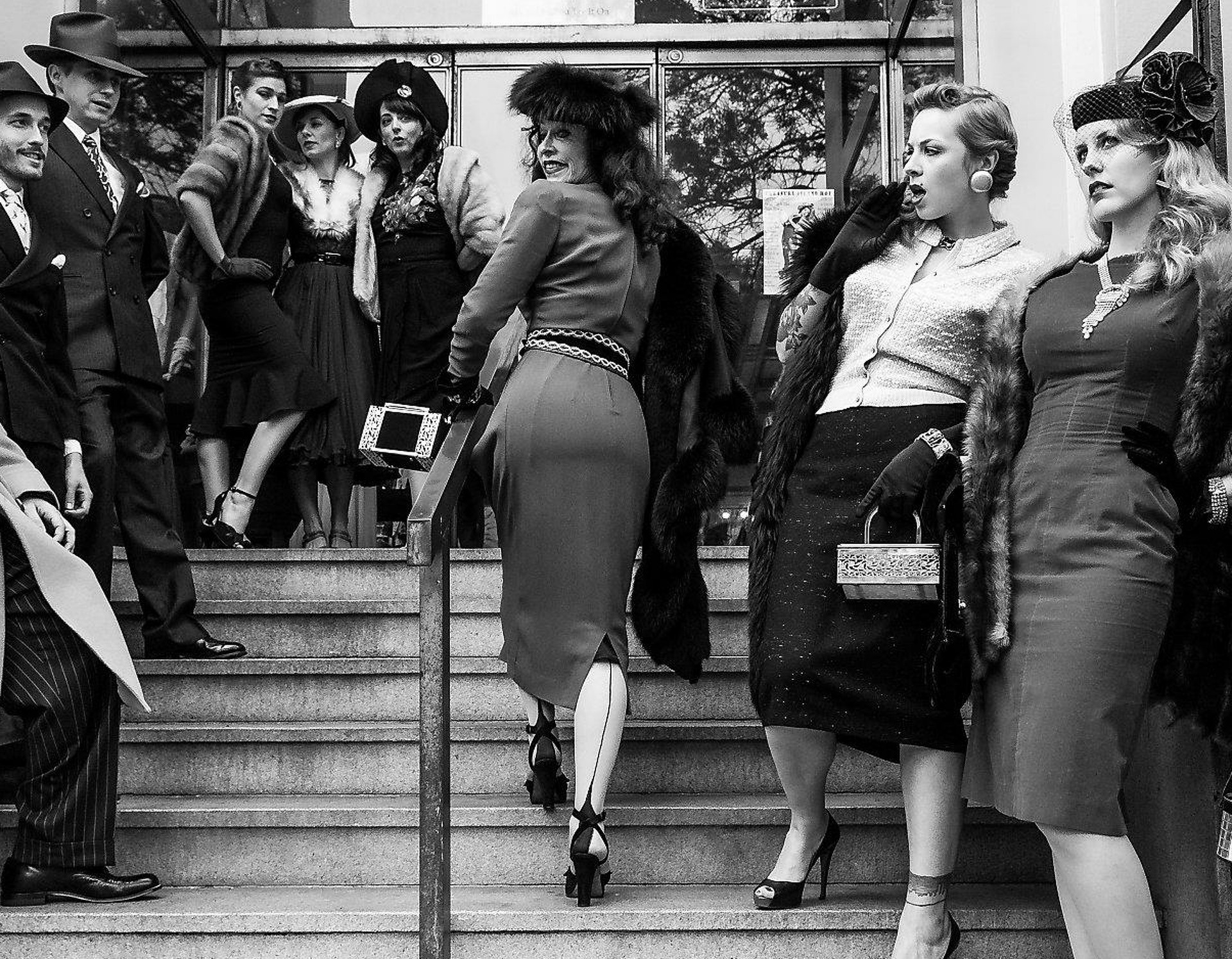
“I am so happy, thank you so much,” a tearful Julia Roberts sniffled when receiving her Academy Award for Best Actress in 2001. In the press coverage of the show, the actress was acclaimed for her professional achievement but also for her choice of outfit.
Because what she was wearing was not the latest or newest designer garment but a dress from the Valentino archive. Had a celebrity worn a dress that was clearly not new to an award show decades earlier, it may have been considered dated.
But in 2001, it was vintage. Fashion has often been associated with its craving for the new, what Lipovetsky (1994: 4) has described as the “frenzied modern passion for novelty.” The rise of vintage highlights the nature of novelty in fashion as erratic. What is old may therefore paradoxically be considered new because it is the collective, situated perception that determines the status of the garment.
While wearing old or pre-owned clothes was nothing new in 2001, the event was still described as a watershed moment in fashion because the old had overruled the new (Goodyear 2007). While Julia Roberts has been quoted for saying: “I just thought it was a pretty dress” (Cosgrave 2006: 253), she was still credited for endorsing vintage fashion and pushing old clothes from the style cemetery to the fashion forefront even in the mainstream.
Although secondhand fashion has been a recurring phenomenon in fashion throughout the twentieth century, it was not on the highly commercialized mass-scale of the early twenty-first century. This flirt with the past was strong already in the early 1990s. In an article aptly titled “The Shock of the Old,” fashion writer Suzy Menkes (1993) stated: “What’s new in fashion? You should be asking, ‘What’s old?’ For the hottest trend on and off the international runways is thrift-shop chic.”
The turn of the millennium seemed to hold the promise of ending this focus on retrospection, giving room for what anthropologist Ted Polhemus (1996: 126) predicted would be something “new and fresh.” However, as Julia Roberts’ famous vintage dress illustrates, this was far from the case. As argued by Heike Jenß: “Memory is in fashion” (2015).
This article explores issues of memory, ambiguous present, and imagined futures in fashion production and consumption, and how shifts in perceptions of novelty are used as social currency in identity management.
This approach rests on the argument proposed by Fred Davis (1994: 65) that “appropriating and inverting status symbols” lie at the core of fashioning identity. This is demonstrated in the celebration of the explicitly used and outdated as fashionably new in the example of style revivals and vintage.
While there are a number of factors also relevant when studying what makes fashion happen, such as the creative process of the designers and the commercial agenda of the fashion industry, the main focus here is on how social strategies of distinction have become increasingly ambiguous on a mass scale.
This ambiguity takes on a variety of visual expressions. Common for all the cases is that the inversion of status symbols, in the present example of novelty, is engaged in the symbolic identity construction through the deliberate act of confusing the sartorial message through what Fred Davis (1994: 66) refers to a “resorting to some other form of vestmental imperfection for the purpose of enhancing status.” Wearing a conspicuously dated dress may be seen as an example of this deliberate fashion flaw.
Early reports dated the black-and-white Valentino couture gown to the 1980s. As it turned out, the Valentino dress was from the AW1992 collections and therefore only nine years old when Julia Roberts wore it as vintage to the Oscars, which seems to complicate the conception of novelty in fashion.
The fashionable present has been viewed as an imagined moment especially since the fashion system became more formalized in the mid-1800s. As argued by Georg Simmel (1957: 547) more than a century ago: “Fashion always occupies the dividing-line between the past and the future.”
The designers were and still are among the key projectors of this ambiguous present operating as they do in a creative time warp. Designers, in collaboration with design teams, conglomerates, media, and an eye to consumer tastes, are instrumental in shaping the fashion future when they visualize what will be considered chic six to twelve months before the actual clothes will be retailed as “current.”
So notions of novelty have long been ambiguous in fashion. The passing of fashion time has traditionally been measured out by seasonal installments presented at fashion weeks and fairs marking a regular rhythm, at least within the framework of the fashion industry. Each new season is framed as “on time” materializing as it does the latest conception of the new. By implication, what came before is considered out-of-date, transforming the new to old in an instant.
The social adoption process has traditionally mirrored this strategy of planned obsolescence institutionalized with the fashion seasons. The first movers pioneer novelty that is then gradually copied by fashion followers until a point of saturation is reached and the process starts over in step with the fashion industry trajectory.
Within the traditional hierarchy of price as the key parameter of prestige, the flow has moved vertically from high to low. However, the disruption of time in fashion as represented by revivals is an example of how these flows may also move horizontally within social groups where the social currency is understood to be equal not to price but to more ambiguous significance such as recasting the old as new.
At the same time, the thrift aesthetic described by Suzy Menkes suggests a trickle-up from the sartorial practices on street level. In this sense, the ambiguous now displayed through fashion revivals points to the scattered flows of contemporary fashion, and fashioning identity involves navigating this multi-temporality.
This process has been complicated with the increased pace of production cycles. The prospect of seasonless cycles and only a few weeks to produce premium collections have been suggested as part of the reason that high-profile designers such as Raf Simmons (2015) and Alber Elbaz (2015) have left their positions at major fashion brands, Dior and Lanvin. The fashion industry has been diagnosed with possible burnout and it could be argued that time is literally running out, pushed not just by the demand for new products in stores every week but also by the rise of instant fashion.
In the early twenty-first century, live-streaming, online forecasting, and front row blogging have stimulated a conception of real-time that tampers with the basic temporal structure of fashion. Intensifying this development is the “See-Now-Buy-Now Revolution” (Bowles 2016) where clothes from brands such as Burberry are available for purchase in stores and online the same day as they are presented on the runway.
Perhaps as a counterstrike against this increased velocity, time seems to be inverted to still greater degrees in fashion in step with the intensified interest in secondhand and retro styles. Fashion has a long-term love affair with past styles, and the history of secondhand clothing is as old as fashion itself. In the twentieth century, the retro fascination appeared to be a realization of a postmodern vision that the end of innovation was near.
Jean Baudrillard (1992) described postmodern culture as a dance of the fossils in which chronological history has collapsed into a perpetual present. In a similar vein, Fredric Jameson (1983: 115–116) declared that “all that is left is to imitate dead styles, to speak through the masks and with the voices of the styles in the imaginary museum . . . the failure of the new, the imprisonment in the past.”
Both perspectives are fitting here to describe vintage as a resurrection of historic debris; however, the social effect seems to be an ambiguous redefinition of novelty rather than an elimination. Julia Roberts’ Oscars-dress attests to the postmodern complication of time that is “neither past nor forgetting” (Baudrillard 1992: 73) but celebrates it as a relative and therefore ambiguous present.
The possible consequence of this temporal trap is that fashion no longer automatically holds the seed to its own destruction because the parameters of novelty and time lag are reorganized. This points to shifts not only in the rhythm of the fashion industry but also in fashioning identity which has traditionally relied on the tension between new and old.
While the postmodern vision of creative poverty was intended as a cultural critique, the focus within the framework of this article is how retrospection is part of an ambiguous strategy of distinction through variations on what may be termed discontinued chic.
This approach reframes what could previously have been considered dated, and therefore undesirable, by placing these qualities beyond the nihilistic vision implied in the dance of the fossils. The focus is on reconsidering the properties of novelty through shifting definitions of social currency.
An example is the discovery of a discarded item of clothing, for instance, at a thrift store, which to the new owner is desirable not just as a material object but also as a visual style story reappearing from the past. Novelty in this sense is not necessarily newly produced but rather informed by social and cultural values of a given time and place.
Novelty, then, is not necessarily an inherent quality but a socially negotiated one. As argued by Everett Rogers (2003: 11): “If the idea seems new to the individual, it is an innovation.” This marks a move from the chronological time of fashion seasons toward a more creative staging of time as both a visual expression and symbolic quality.