In the early 1980s, Japanese fashion exploded onto the international scene. The work of designers such as Issey Miyake, Yohji Yamamoto, and Rei Kawakubo of Comme des Garçons was predicated on a revolutionary aesthetic vision-loose, architectural shapes, asymmetry, unusual textures and somber colors, “lace” made of holes and rips in fabric.
To a Western public, these garments embodied unfamiliar notions of what counts as clothing and how clothing relates to human bodies. The fashion world reacted passionately. Detractors labelled it the “Hiroshima bag-lady look,” while enthusiasts welcomed it as pathbreaking and subversive.
Many dismissed it as destined only for shock value, a passing fad. Yet Japanese fashion and its influence have been pervasive at all levels of the industry. The continuing success of designers such as Issey Miyake, Rei Kawakubo, and Yohji Yamamoto, among others, has forced Paris and New York to take notice, if sometimes grudgingly, and to recognize Tokyo and Asia more generally as sites of creation in the fashion industry, not merely asproducers of designs conceived in the West.
Fashion provides us with an exemplary site for examining the constitutive contradictions of Japanese identity at a moment when Japan had assumed an acknowledged place as a global economic superpower. An advanced capitalist nation-state with an imperialist history and, arguably, imperial ambitions, it is nonetheless racially marked.
Constitutive contradictions similarly animate the fashion industry: quintessentially transnational in its dispersal and reach, it is simultaneously rife with essentializing gestures that refabricate national boundaries. Consequently, for Japanese designers and others, what counts as Japanese is always a problematic issue.
On the one hand, the entry of the Japanese into high fashion ready-to-wear indexes Japan’s status as an advanced capitalist power and a cultural leader, for fashion is a global industry in which developed nations, and more specifically, major urban centers in those developed nations, assert hegemony as the sites of creation.
Yet, Japan’s subordinate status as a late developer, forcibly compelled to modernize in Western terms, continues. Competition is still on someone else’s ground, within an idiom and a tradition developed elsewhere. This history is materialized in the very designation of the medium in which Japanese designers work: yofuku, “Western clothing,” rather than wafuku, “Japanese clothing.”
Inevitably, the work of Japanese designers rearticulates a problematic of “Japanese” and “Western” identities. At stake in these questions is a politics in a broad sense—economic power, cultural authority, world recognition, place in a world order-at an historical moment when national boundaries are contested, problematic, and highly charged. Referentially unstable, defined through lack and difference as are all identities, “Japan” has been unthinkable historically outside its relations with the West and with other Asian nations.
An overly schematic narrative of relations with the West would mark a legacy of inferiority symbolized in the “opening” of Japan to Commodore Perry and the defeat in World War II, followed by a postwar economic boom and an increasing sense of Japanese political confidence as equal or, some might say, even superior to the West.
At issue here are interimperial rivalries among advanced capitalist nation-states. Yet, because the Japanese are racially marked, the rivalry is laced with familiar Orientalist discourses whose tropes circulate in the fashion world as they do in the realms of politics.
Even when some Japanese designers see themselves as part of a larger, transnational narrative field, the sedimented histories of nation-states and various essentializing practices resituate them in terms of their national, and often racial, identities.
On the other hand, in its relations with other parts of Asia, Japan’s mobilization as a nation-state in the late nineteenth century meant taking on the colonizing imperatives of the nation; specifically, projects of imperialist ambition and aggression manifested in the colonizations of Korea and Taiwan, wartime militarism, aggressions in China, as well as continuing economic imperialism in Southeast Asia. Western Orientalizing, counter-Orientalisms, self-Orientalizing, Orientalisms directed at other Asian countries: the interweavings of such constitutive contradictions produce “Japan”.
This article examines the fashioning of a Japanese national essence in a variety of sites in the garment industry. First, the industry’s transnational complexity and the challenging of old forms of dominance emerge in the question of what counts as Paris, where Parisian hegemony in the fashion industry is simultaneously undermined and reasserted.
This provides a broad context for the analysis of multiple Orientalisms. International fashion commentary tends to group Japanese designers on the basis of national essence rather than on individual design achievement, as is the usual case for European and American designers.
“The Japanese” are termed “avant-garde” or “experimental,” and the distinctive features of their work are often traced to origins in culture, such as a Japanese aesthetic, Zen, or regional costume. Such essentializing gestures are for these designers centrally implicated in geopolitical power relations and in discourses of Orientalism, and the final section examines the reinscriptions and contestations of Orientalist discourses in three sites.
The first is a moment of Western Orientalizing. Wim Wenders’s documentary about designer Yohji Yamamoto, despite its celebration of postmodern identities, reinvokes a high modernist discourse of filmmaker as creator deity and recirculates familiar Orientalist tropes: Japan as miniature, aesthetic, feminized, exotic.
A second moment examines processes of what Marta Savigliano (1995) calls “autoexoticizing,” through the appropriation of Western gazes. Here I focus upon a 1989 feature entitled, “Kyoto snob resort” in a leading Japanese fashion magazine, Ryilko Tsilshin (Fashion News).
The series of photographs and articles initiates a nostalgic search for the essence of Japaneseness as it simultaneously claims a strongly cosmopolitan identity through adopting/undermining a Western-usually French-gaze. It offers an exemplary instance of nostalgic essence fabrication, the provocation of consumer desire through commodity fetishism, and the construction of a feminine consumer-subject.
The third moment enacts Japanese positioning as an imperialist, advanced capitalist nation-state in a position to Orientalize others. Ryilko Tsilshin Homme, the men’s issue of the same fashion magazine from the same month, provides a revealing point of entry into this colonizing male gaze, as its articles and fashion spreads perform Japanese male dominance over a feminized, Orientalized Thailand and an exoticized, mysterious Bali.
Through an examination of these disparate sites, the contradictions and mutually constitutive dialectics of nationalismltransnationalism and Japanese identity emerge in their ambivalent complexity. Questions of cosmopolitan and national identities are articulated in paradigmatic form in the fashion world’s complex relationship to Paris as the world fashion capital.
Strong contending sites of fashion design have arisen in recent years in New York, Milan, and to a lesser extent, London and Tokyo. Yet even as the fashion world proliferates and disperses, a strong centripetal force draws designers to Paris. Compelling them is a sense that, after all is said and done, only those designers who have made it in Paris have really made it.
Certainly, of the Japanese designers only the handful who regularly show in Paris can besaid to have achieved worldwide recognition: Hanae Mori, Issey Miyake, Rei Kawakubo of Comme des Garçons, and Yohji Yamamoto notable among them.
To address the question of Parisian hegemony, however, one must also problematize what counts as French. Multinational financing, licensing, and the hiring of foreign designers have wrought dramatic changes in the classic French design houses, refiguring the boundaries of Paris. Chanel has been for years the domain of German Karl Lagerfeld, who also designs for labels Chloe and Lagerfeld and for the Milan design house Fendi.
In 1989 Milanese Gianfranco Ferre took over the House of Dior from the long regnant Marc Bohan. Last season, Ferre’s successor, British designer John Galliano, showed his first hautecouture collection for Dior. The venerable House of Gres was purchased by the Japanese textile and apparel company Yagi Tsusho in 1988.
Yagi then hired Takashi Sasaki, a Japanese who had worked for 15 years at Pierre Cardin, to replace the ailing Madame Alix Gres. Sasaki presented his first collection for Gres, 80 pieces for the spring and summer of 1990. In the same year Cacharel, symbol of soft French femininity, hired a new head designer, Atsuro Tayama, head of the Japanese fashion atelier A.T.
In 1995, hip London designer John Galliano succeeded Hubert de Givenchy at the House of Givenchy, marking an important shift in the traditions of haute couture. When Galliano moved to Dior, Alexander McQueen took over the helm at Givenchy. Moreover, France’s “Others”-designers from former colonial territories and denigrated European nations-have also made inroads into Paris, including the highly successful Azzedine Alaia, of North African descent, the House of Xuly Bet, of Senegalese origin, and Belgian deconstructivist Martin Margiela.
To complicate matters, a designer of one national origin may have an organization financed by one or more multi- or transnational corporations, and employees in the boutiques, the showrooms, and the production lines may be scattered across the globe. Certainly, Paris is the site for increasing numbers of international alliances in which Japanese capital plays a key role.
For example, Romeo Gigli, the sensation of the late 1980s, opened a Paris boutique owned by Japanese department store Takashimaya-which also owns the exclusive on the production and marketing of Gigli in Japan. Onward Kashiyama, a Japanese firm, distributes Jean-Paul Gaultier in Asia and the U.S. and owns Gaultier’s Italian production facilities. In 1995 they inaugurated their own house line designed by American Michael Kors.
Production is also globally dispersed; for example, Comme des Garcons and Yohji Yamamoto manufacture some of their simple garments in their intermediately priced, or bridge lines, in France and Italy. One can only guess what the origins of these workers might be: Turkish Gastarbeiter? North African immigrants? If Paris is hegemonic, it is no longer the Paris reigned exclusively by the French. Indeed, French fashion, itself emblematic of French nationhood, is created by Germans, Italians, Japanese, and North and West Africans, among many others.
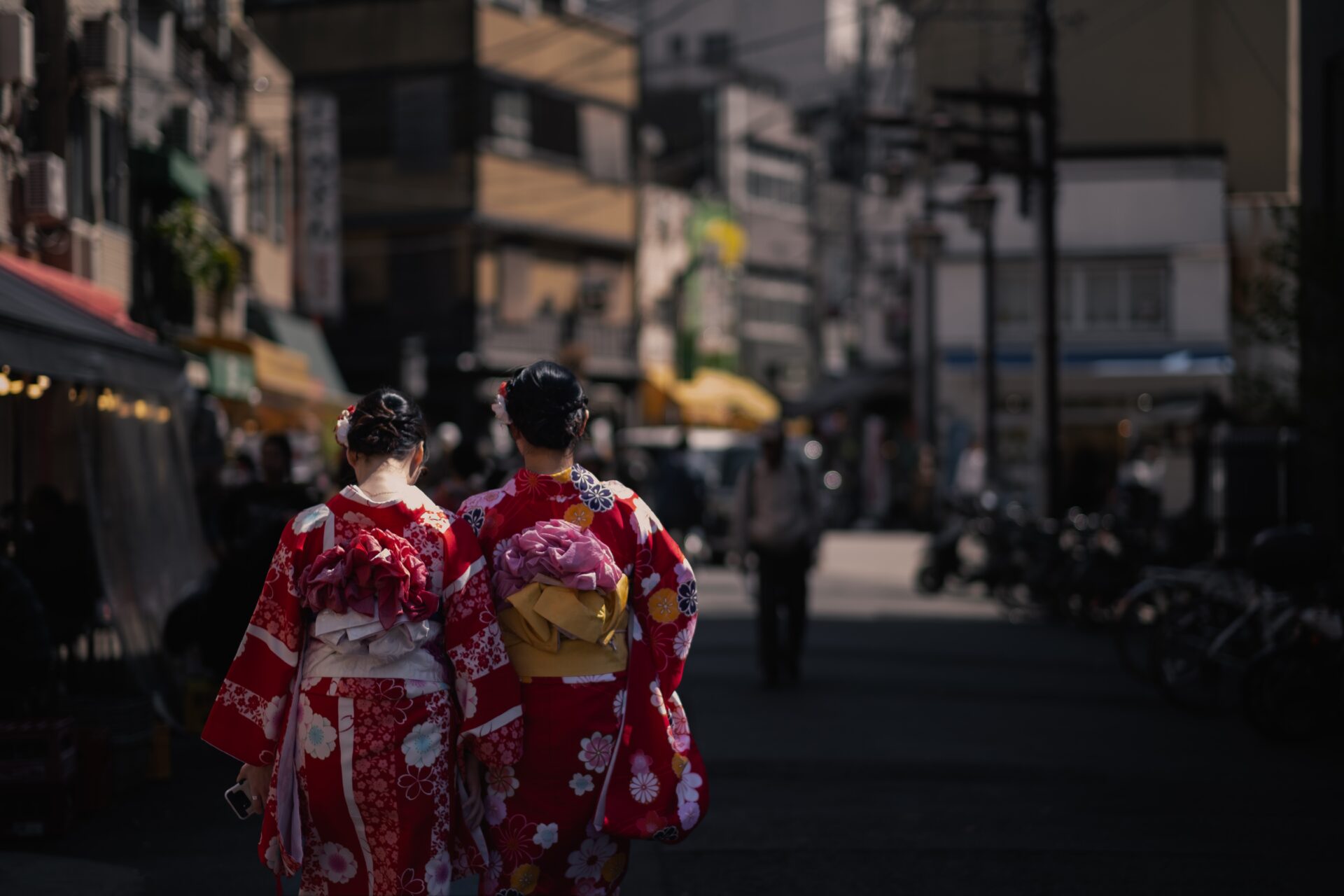
On the Japanese side, the relation to the West is a complex mixture of “mimicry” (Bhabha 1987), appropriation, synthesis, and “domestication” (Tobin 1992). Western clothing has become the normative standard in Japan after its introduction in the Meiji period (1868-1912), so that kimono either mark special occasions or signify traditionalism. On the level of fashion design, the 1990 Tokyo collections I attended were instructive. Mostly, designers showed what I call “just clothes,” garments indistinguishable from what you might see on the streets of Paris, New York, or even middle America.
The mimetic reproduction of the West was further symbolized by the overwhelming use of white models. One or two Asian models appeared in the shows of most Japanese designers; only those from abroad, such as the recently deceased Bill Robinson, featured numerous Asian models.
In the Tokyo collections, when Black models were used, they added “exotic” color, reproducing Western industry practice. The predominance of white models and the just-clothes quality of most of the collections can be thought of in multiple ways: one, as poignant and racially marked.
Another level might see in the collections a thorough domestication of Western clothing, so that the garments Japanese designers produce for the domestic market are no longer merely reproductions, but thorough appropriations of Western clothing conventions.
Another, taking a cue from Bhabha’s analysis of mimicry, would see the complex combination of “not quite”-the almost realized reproduction of Western clothing-and “not white,” the racial marking that makes the notion of the Japanese entering the domain of Western clothing slightly disturbing, even ominous.
Indeed, Japanese designers in their very entry into the domain of Western clothing destabilize the East-West binary even as, at another level, they reinscribe it through mimesis. Given this aesthetic/political history and the context of an industry defined by cosmopolitanism, global dispersion, a contested European cultural hegemony, and mimetic/appropriative tendencies in the domestic fashion industry, what counts as “Japanese” is, for Japanese designers-a label many themselves eschew-a highly vexed issue.
Many desire not to be lumped together, nor to be seen as designing out of a culture. Fashion, they say, should transcend nationality {mukokuseki}. Perhaps Issey Miyake’s well-documented career and his thoughtful disquisitions on the subject most eloquently illustrate these complexities and ambivalences. After graduating from Tama Art University in 1964, he went to Paris to work at the houses of Lanvin and Givenchy for four years.
In an address at the Japan Today Conference, he describes his awakening to possibilities for synthesis of Japanese and Western forms in his creations: Away from the home country, living and working in Paris, I looked at myself very hard and asked, ‘What could do as a Japanese fashion designer?’ Then I realized that my very disadvantage, lack of Western heritage, would also be my advantage.
I was free of Western tradition or convention. I thought, ‘I can try anything new. I cannot go back to the past because there is no past in me as far as Western clothing is concerned. There was no other way for me but to go forward.’ The lack of Western tradition was the very thing I needed to create contemporary and universal fashion. But as a Japanese I come from the heritage rich in tradition …
I realized these two wonderful advantages I enjoy, and that was when I started to experiment creating a new genre of clothing, neither Western nor Japanese but beyond nationality. I hoped to create a new universal clothing which is challenging to our time (Miyake 1984). Predictably, Miyake feels uncomfortable with the label “Japanese designer” precisely because it enforces stereotyped limits to his vision of a design with universal appeal.
He fears that his association with Japonaiserie will make the interest in his clothing simply a fad. Miyake wryly stated, “I have been trying to create something more than Japanese or Western for over ten years and, ironically, I find myself as one of the leaders of the new Japanese craze. I hope I will be around a lot longer than this sudden interest” (1984).
Miyake’s claim on universality reproduces the contradictions animating Japanese identity formation from the 1970s. On the one hand, his appeal for universality fuels the forces of consumer capitalism. “Universality” means clothing that will sell anywhere in the world, and more specifically, in Europe and the United States.
Claims for universality reveal desires for parity with the West as a nation-state, as a capitalist power and as a cultural producer. On the other hand, “universality” reaches for recognition outside essentialized Japanese identity. Here, the salient feature is racial marking, which preserves the unmarked category of universality for “white”. Who, after all, is allowed the designation “designer,” not “Japanese designer?” Miyake’s move toward universality on this level is a common, if problematic, move to escape ghettoization.
This dilemma, how to play on someone else’s field as a racially marked, artistic, capitalist, geopolitical rival, faces all Japanese designers who have international reputations, and each deals with the dilemma somewhat differently. According to Harold Koda (1989), former curator at the Fashion Institute of Technology and currently costume curator at the Metropolitan Museum of Art, the arrival of the Japanese in Paris can be conceived in generational terms.
The trailblazer in the field of international fashion design and a highly powerful force in the industry is Hanae Mori. She first went to Paris in 1961, showed for the first time overseas in New York in 1965, and in 1977 became the first Asian to be admitted to the Chambre Syndicale de la Haute Couture: the exclusive ranks of those who are allowed to design haute couture, garments made-to-order for the world elites.
Mori is known for her feminine, classic garments, clothing for the elegant, well-heeled, mature woman. The shapes of her clothing draw from classic draping and tailoring as much as from regional costume. The garment in the photograph exemplifies these influences. The coat echoes kimono in its flowing shape, but the sweater dress it covers is slim, recognizable in terms of Western clothing conventions as feminine, sexy, soigne.
The Japanese elements in her work often lie in the patterns of the fabrics she uses: her well-known butterfly motif, for instance, in clothing and accessories in the late ’70s and early ’80s, or patterns on her luxurious evening gowns that evoke motifs from kimono.
Kansai Yamamoto’s Japan draws on the stylishness of Edo townsman culture. Understated aestheticism has no place here; instead, Kansai boldly appropriates Edo stripes and Edo firemen’s gear, among other motifs, to create wildly patterned tops, electric bright, multicolored sweaters with padded shoulders reminiscent of samurai armor, and dramatic combinations of strong colors and bold graphics in his space-age/Edo-retro look.
Kenzo Takada has been resident in France since 1965 and showed his first Paris collection in 1970 (Sainderichin). Kenzo’s bright, folkloric styles, his recreations of boxy kimono shapes in quilted and flowered fabrics in the 70s, his continued sporadic references to kimono in later collections allude to regional costume even as they modify it.
Mitsuhiro Matsuda and to some extent Takeo Kikuchi of Bigi claim for Japan a different version of Japanese-ness that alludes to the Japanese appropriation of Western clothing in earlier parts of this century. One of Bigi’s labels, Moga, explicitly invokes the heritage of the flapper, the mo(dan) ga(aru) (modem girl) of the 1920s.
Matsuda stresses the romantic aspects of fashion in his work, through nostalgic evocations of prewar elegance in beautifully tailored suits, rich patterns and colors, embroidery, and passementerie. All these designers tend to use Western tailoring techniques or adaptations of regional costume for their work. This tendency to group Japanese designers together proves understandably frustrating to people who pride themselves on their distincti veness and creativity.