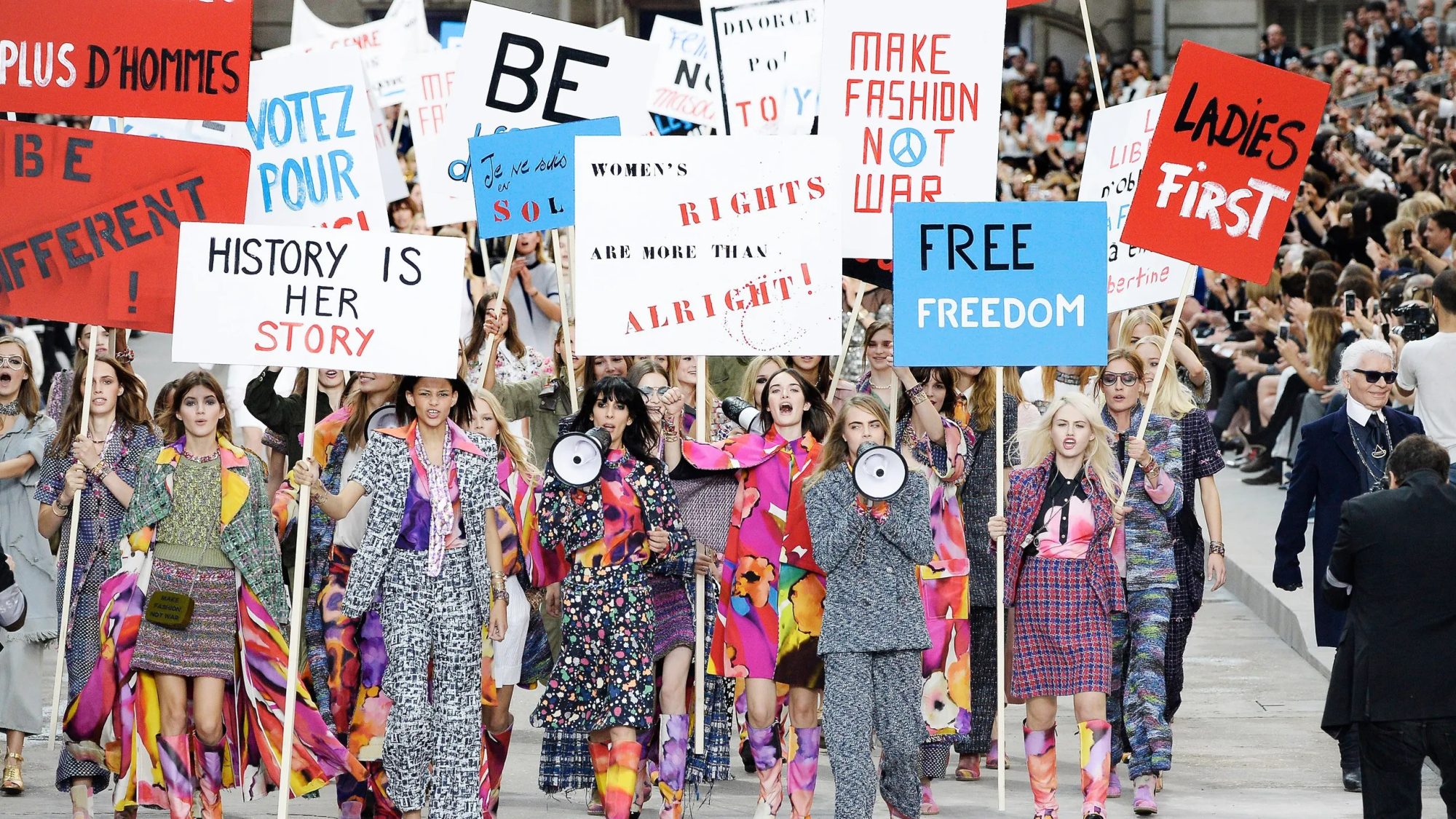
Clothing and dress are strongly gendered fields. As a result, much of the writing on dress has been heavily influenced by feminism. Feminists of the second wave, however, tended to be critical of fashion and its impact on the lives of women. Fashion was seen as imposing oppressive forms of gender identity, embodying practices designed to objectify and limit women, locking them into defensive and inauthentic forms of presentation (Friedan 1963; Greer 1971; Daly 1979; Evans and Thornton 1989; Bartky 1990; Jeffries 2005).
It distorted the natural body through subordinating practices like high heels and corsets, reducing women to objects of a sexualizing gaze, rendering them unable to act effectively in the world. It diverted women’s energies into trivial questions of appearance and reinforced negative stereotypes of women as ever-changing, inconstant and narcissistic.
More recently, feminists influenced by postmodernism have taken a less negative view, recognizing the inescapability of matters of style and cultural formation in relation to the body and appearance. They have also been more willing to see fashion as part of a distinctive women’s culture, an area of pleasure and expressivity that goes beyond the reproduction of patriarchy and capitalism (E. Wilson 1985).
It remains the case, however, that dress is closely implicated in the reproduction of gender. For many theorists (E. Wilson 1985; Davis 1992; Tseëlon 1995; Entwistle 2000) gender is indeed the central preoccupation of fashion; and it forms one of the most clearly marked aspects of dress across most cultures. As Kidwell and Steele (1989) show, the complex interplay of gender is at the heart of many clothing styles.
Clothes reflect the body at the same time as they obscure it, being widely used to hide sexual difference in the strongly biological sense, while pointing up and signalling it through assumptions concerning gender in clothing codes. Clothing thus acts to deliver gender as self-evident or natural, when it is in reality a cultural construct, reproducing gender as a form of body style and reinforcing the complex interplay between sexed bodies and gendered identities.
Fashion thus plays a critical part in the way femininities (and masculinities) are rendered, played out, resisted and understood (Holland 2004), contributing to a set of gendered behaviours and practices that are themselves fluid, shifting and contextual. A range of earlier work has explored the ways the female body is unfinished business, regarded as deficient in its natural form, unsatisfactory, requiring constant vigilance and repeated beauty work for it to be made acceptable and feminine.
For Bartky (1990, 1999) and others, fashion and beauty practices are modes of body discipline, producing self-regulating female subjects through the demonstration of control over the physical body. Body management becomes a means of normalizing and disciplining the female body, ensuring its innate unruliness is tamed and made acceptable.
In terms of dress, Davis (1992) points to the dual character of such disciplinary processes through the example of the modern bra, which both conceals and enhances the female sexual form, constituting the female body in a directly erotic form at the same time as controlling and obscuring it.
This moulding of the female body into acceptable social forms is also found in relation to age. Beauty practices, especially anti-ageing ones, are part of the process of producing an acceptable form of woman in later years—still feminine, still displaying engagement with the disciplinary practices of femininity, yet in a toned-down way that accepts the lesser claims to attention and regard.
In relation to clothing this means still wearing feminine or fashionable dress, showing that the individual is still involved, still trying to present a good appearance, and not falling into the dangers of neglect and potential dereliction. It can involve showing a continuing commitment to fashion in the form of the trends of the high street, but without straying into overly youthful dress.
As Hurd Clarke and colleagues comment in their study of older Canadian women: By clothing their bodies deliberately and in accordance with socially sanctioned prescriptions, the women effectively managed the impressions of others through the projection of a happy, healthy and cogitatively intact self. (2009: 724)
Acceptable dress was thus a means of maintaining status in the context of its erosion. The empirical study on which it draws was confined to older women. This reflects the reality of the older population, which is predominantly female. (Ironically it is older men who have been somewhat neglected in academic studies of age recently.)
Primarily, however, it reflects the way fashion is constituted as a feminized field, whose discourses are differentially embodied in the lives of women: women shop for clothes more frequently and spend more (on average half again compared with men); they engage more fully with the subject through the popular media; and, most significant, they are associated culturally with the ideas of fashion and appearance.
Most writing on fashion and dress, whether popular or academic, centres on women. Taking women as the focus also provides a link across to the extensive body of work influenced by feminism concerning the body, appearance and gender. Men have traditionally been excluded from the territory of fashion. Within modern Western hegemonic masculinity, fashion is seen as a somewhat uneasy, even dangerous territory.
Active interest in it is traditionally regarded as effeminate, associating men with the triviality or narcissism of women. Masculine identity, Crane (2000) suggests, is traditionally constituted as fixed and innate, and conscious attempts to construct identity through clothing are thus viewed as suspect, implying something lightweight or insubstantial.
This is despite the rich history of men’s use of dress (notably in uniforms and formal dress) to denote identity and signal status. Indeed until the period of the Great Renunciation from the second half of the eighteenth century when men renounced brightly coloured and embroidered silks for sober woollen garments (Flugel 1930), the dress of elite men was as flamboyant and splendid as women’s (McNeil and Karaminas 2009).
These strictures have eased somewhat recently with the emergence of metrosexual man; and younger men are now more openly engaged with fashion and appearance. However, it remains the case that older men are largely disengaged from fashion as a cultural field. This is not to say that clothing and dress are irrelevant to their lives.
Indeed from an anthropological or material culture perspective, they cannot be. Older men also get dressed, make choices about their appearance, present their bodies in culturally distinctive ways and express consumption choices in the market. Men’s dress is at least as culturally coded as that of women; indeed in many ways the codes are stricter and more closely defined, the range within which they operate narrower, so that a slight adjustment of cut or detail, of tone or texture, can signal right or wrong dress for a particular person or social group.
Men’s clothes, however, are less governed by fashion and its volatility. There is a slower fashion cycle, with more garments falling into the category of slowly evolving staples rather than fashion goods. There is a lesser aspiration to look fashionable, indeed doing so can carry negative connotations.
This closer coding and slower evolution of styles means that it is in some ways easier to observe certain dynamics in relation to clothing and age, in particular the significance of age as a replacement for class in the dynamic of fashion and the diffusion of styles.
Men are, however, subject to many of the same norms in regard to dress and age that women are, though in milder form. Older men too learn to avoid styles deemed too youthful by virtue of their fashionability, showiness or exposure of flesh, though the dominant codes for men’s dress mean that these elements are more muted than is the case for women.
They thus share in some of the negative evaluations of the body and age encoded in dress for older women. Men’s status, however, is less tied to their appearance than is the case with women. There is not the same requirement that they present themselves in their dress in terms of heterosexual appeal, an aspect that remains a powerful element in women’s dress.
Men by contrast, particularly middle-class men, dress to exhibit power and status. (Though the latter is not absent from women’s clothing, it is expressed differently.) This means that dress and age are differently constituted for men and women. Older men still can (to some extent) draw on forms of dress that express embodied status, for example the suit; whereas for older women there is greater discordance between their presentation and the youthful ideal that dominates dress codes and that is a crucial part of the constitution of femininity in the modern West.
Normative femininity is youthful, and this means that the changes in appearance that occur with age erode the status of women in a much more direct way. Dress, as Entwistle (2000) notes, plays an important part in the mundane business of reproducing social order, and there is a long-established link in dress studies between clothing and social identity. Clothes are indeed, as Breward (2000) notes, one of the ways social difference is made concrete and visible.
From the time of Veblen (1899) and Simmel (1904/1971) onwards, sociologists have explored the way clothing operates as part of class identity, with fashions diffusing down the social hierarchy as they are successively adopted and abandoned by elites and as lower groups take them up. Competitive class emulation is thus the engine of fashion, understood here as institutionalized, systematic change.
Bourdieu (1984) offered a more nuanced account of these processes of class distinction and diffusion in which dress is seen as an aspect of cultural capital, part of how elites establish, maintain and reproduce their positions of power, reinforcing relations of dominance and subordination through their capacity to define what is fashionable or correct and to abandon it once it becomes mainstream and commonplace.
More recently, the democratization of fashion and the rise of street styles have challenged the dominance of class in sociological accounts of fashion, introducing more plural sources of style and allowing for bottom-up accounts of meaning and value in dress, as well as diffusion of styles (Davis 1992; Crane 2000). The coterminosity of social and cultural elites has also been questioned. As a result, other dimensions of social identity are increasingly emphasized. There is a growing sense that different meanings in relation to dress are significant and other dynamics are in play in the diffusion of styles.
The emphasis on street styles and bottom-up sources has sometimes led to fashion and identity being theorized in subcultural terms, in which clothing and body styling acts as markers of the boundaries of the group, or, in Polhemus’s term, ‘tribe’, a means of stabilizing identity and registering belonging (Polhemus 1994; Evans 1997). Hebdige (1979) indeed regarded consumption as central to subcultural identity. Such approaches focus on youth culture, street styles and transgressive, countercultural modes; and they are rarely applied to conventional or dominant groups, though York’s account of Sloane Ranger (York 1980; York and Barr 1982) and Le Wita’s analysis (1994) of the French haute bourgeoisie is a notable exception. Older people do not fit easily or well into such subgroup analysis, which classically focusses on groups that can be regarded as deviant or in some degree oppositional. Though attempts have been made to interpret age as a form of deviant identity, the analogy remains strained. Though perhaps deviant in their marginalization from the mainstream, older people are not oppositional in culture, and it is not helpful to regard older styles as adopted for countercultural effect or to assert a deviant identity.