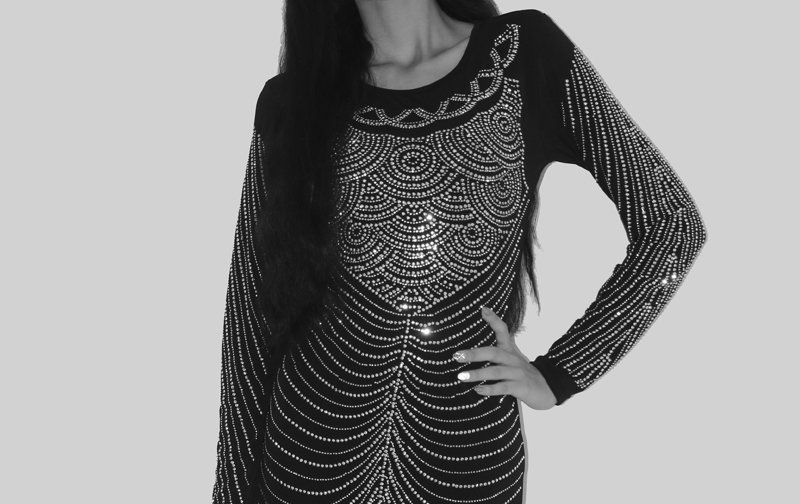
The art of adorning clothing with beads is as old as civilization itself. From the moment early humans discovered the allure of shimmering shells and stones, they began stitching these treasures onto their garments. In ancient times, long before written history, people were already crafting beads from seashells, seeds, stones, and bone, and using crude needles to sew them onto animal skins or woven textiles . By around 2500 BCE, in the city-state of Ur in Mesopotamia, artisans were embellishing clothing with precious lapis lazuli beads sewn onto fabric—a striking early example of luxury beadwork on a garment . This find from the tombs of Ur, where rich blue lapis beads were stitched into a royal cloak or headdress base, reveals that even the Sumerian elite prized the sparkle of beads as a status symbol. Across the ancient world, many cultures independently developed bead embellishment techniques, using whatever materials nature provided. Beads of shell, stone, bone, and clay have been excavated from Neolithic graves across Europe and Asia, often found near the remains of garments, suggesting they were once sewn on as decoration or ritual adornment. By the Bronze Age, the craft had grown increasingly sophisticated: archeologists have uncovered gold beads and semi-precious stone inlays on ancient garments, indicating that the idea of wearing one’s wealth quite literally on one’s sleeve has deep roots in human history.
No ancient civilization embraced bead-ornamented dress more conspicuously than the Egyptians. As early as the Old Kingdom (c. 2500–2400 BCE), Egyptian women of high rank wore the famed bead-net dresses, garments entirely constructed of thousands of glazed ceramic faience beads strung in intricate lozenge patterns . One surviving example, reconstructed from a pile of beads found in a Giza tomb, consists of blue and green faience cylinder beads linked into a netted sheath that would have been worn over a simple linen dress . These bead-net sheaths clung to the body and glittered in the desert sun, the colors imitating precious gemstones like turquoise and jade. Some bead-net dresses even incorporated tiny shells at the fringe, each plugged with a stone to rattle as the wearer moved, adding a musical jingle to the visual sparkle . Egyptian tomb paintings and sculptures vividly depict such dresses, showing women clad in shimmering beaded overlays. A famous story from the Middle Kingdom describes Pharaoh Sneferu ordering twenty oarswomen to row a boat wearing only fishnet-like garments of beads, so that their movements would delight him . This anecdote, whether apocryphal or not, highlights the dual function of Egypt’s beaded dress: it was both sensuously aesthetic and symbolic. The patterned bead nets likely held meaning in Egyptian culture, possibly evoking protective nets of divine magic or representing a wealthy woman’s high status. Beyond dresses, the Egyptians also adorned ritual items with beads; for instance, mummy wrappings and funerary masks were often covered in beadwork, reflecting a belief that these shiny, unaging materials had protective and ritual power . The extensive Egyptian use of beads—whether faience, jasper, carnelian, or even imported pearls and lapis lazuli—firmly established the idea of beaded garments as a sign of sacred beauty and earthly opulence.
Meanwhile, ancient Mesopotamia and its neighboring regions were developing their own traditions of beaded attire. Sumerian royals like Queen Pu-abi of Ur (c. 2600 BCE) went to their graves literally draped in beads. When Pu-abi’s tomb was discovered, her skeleton was “adorned with an elaborate golden headdress, a beaded top, and a belt made of gold and precious stones,” according to archaeologists . Her burial ensemble included thousands of beads of gold, lapis lazuli, and carnelian that once formed a glittering bodice and girdle . These stones had traveled from far lands (the lapis from Afghanistan, the carnelians likely from the Indus Valley) and were laboriously drilled and sewn onto her garments as affirmations of power. In life, Mesopotamian elites wore garments heavy with such embellishments: diadems strung with rows of lapis and gold beads, cloaks spangled with imported jewels, and even bead-trimmed ceremonial armor. Visual records and excavated artifacts suggest that by the Akkadian and Babylonian eras, royals commonly had robes embroidered with studs of precious stones. The ancient Persians too developed a flair for encrusting their clothing with gems and pearls. In Achaemenid Persia (550–330 BCE), robes, tunics and even trousers of the nobility were richly embroidered not just with gold thread but with actual jewels. One account notes that Persian shawls and trousers “bore the weight of pearls and gemstones, shimmering like stars caught in fabric,” with each stitch showcasing exceptional craftsmanship . Such descriptions are corroborated by surviving fragments of textiles and the famous Oxus Treasure, which includes gold clothing appliqués that likely held inlays of turquoise or garnet. For the Persians, as for many ancient peoples, the sparkle of crystals or pearls on attire was not mere ornament—it symbolized divine favor and earthly authority. Every pearl sewn onto a Median court robe or every lapis lazuli disk on a priestly vestment was a statement of status and a talisman of protection.
Far to the east, early civilizations in the Indus Valley and China were also integrating beads into clothing in meaningful ways. The Indus Valley (circa 2000–1500 BCE) became one of the earliest centers of bead production; its craftsmen made and exported stone beads—agate, carnelian, jasper—across the ancient world . While most Indus beads have been found as loose strands or jewelry, some were likely appliquéd to textiles for ritual or status display. Terracotta female figurines from the Indus culture are depicted wearing elaborate grids of beads on their torso—possibly representing beaded shawls or ornamental breastplates worn by real women. In ancient China, by the Zhou and Han dynasties (1st millennium BCE), nobles adorned ceremonial garments with jade pieces and pearls. Chinese records speak of “pearl jackets” – robes said to be embroidered with strings of pearls reserved for aristocracy. Indeed, one of the Chinese characters for elegant attire combines the radicals for “jade” and “clothing,” reflecting how intertwined gem adornment was with the concept of fine dress. Pearls in particular held a special place in Chinese culture as symbols of purity and prosperity; they were harvested from coastal waters and often presented as tribute to emperors. By the later Han period, high-ranking Chinese wore court hats and belts decorated with rows of freshwater pearls, and legends tell of emperors’ robes sewn with so many pearls and jade pieces that the garments were almost armor-like in weight. Even if some of these accounts verge on myth, archaeological finds have confirmed that Chinese royalty incorporated precious beads into their regalia. For example, ancient embroidery pieces and burial garments have revealed couched gold threads interspersed with tiny seed pearls to create shimmering patterns . This practice would reach its zenith much later in the imperial era, but its roots are visible in antiquity.
Across the ancient world, then, whether in Egypt, Mesopotamia, Persia, India or China, we see a common impulse: using natural “jewels” – crystals, gems, and pearls – as embellishments on clothing. These early experiments in bead embroidery were painstaking. Every bead was individually drilled (if stone or pearl) and then sewn by hand onto cloth or leather using sinew or thread. The results must have been breathtaking under sunlight or firelight: imagine a Sumerian king stepping into a courtyard with his lapis-and-gold cape catching the light, or an Egyptian dancer spinning so that her bead-net dress flashed and clattered. Such sights would imprint themselves in cultural memory. Over time, the techniques grew in complexity and the symbolism deepened. Beaded patterns in these early cultures often took the form of geometric grids, zigzags, or floral motifs. These patterns were not arbitrary; they conveyed meaning. For example, the Egyptians arranged beads in lozenge motifs that might symbolize the cosmic order or protective nets; the Mesopotamians favored rosette and star motifs with lapis and gold, echoing their goddess Ishtar’s symbols; the Chinese often formed their couched pearl patterns into dragons and clouds, emblematic of imperial authority and heavenly mandate . Thus, even at the dawn of fashion history, pattern design with beads was a form of storytelling – a way to literally weave culture, belief, and status into the fabric of attire.
As we move into the classical era (roughly 500 BCE – 500 CE), bead embellishments continued to play significant roles, though the extent varied by culture. The Greeks and Romans, for instance, were masters of jewelry but generally conservative about attaching jewels directly to clothing. The flowing robes and togas of classical fashion did not lend themselves to heavy bead embroidery in the way oriental court costumes did. Instead, the Greco-Roman elite wore their gems on brooches, diadems, and necklaces. Nevertheless, there were exceptions where clothing itself was gem-enriched. Hellenistic Greek ladies occasionally had pearls sewn onto their veils or hems, an import from Eastern luxury trends after Alexander’s conquests. The Roman love affair with pearls is well documented: writers like Pliny remark on Roman matrons who adorned not just their necks and ears but even the braids in their hair and the trim of their stolas with pearls. One particularly extravagant Roman woman, Lollia Paulina, famously arrived at a banquet wearing a dress encrusted with pearls and emeralds, head to toe, an ensemble worth a fortune and meant to rival the splendor of any triumph parade . The Romans also pioneered the use of glass beads in dress decoration. By the 1st century CE, artisans in Alexandria and Rome could produce glass beads in vibrant colors, sometimes silver-foiled on the inside for extra sparkle (a precursor to later rhinestones). Roman fashion embraced these in moderatio: a noblewoman’s gown might feature a decorative clavus band (vertical stripe) at the front made not just of dyed thread but inset with tiny glass beads or pearls forming a repeating pattern. Sumptuary laws in the Roman Empire, however, attempted to regulate such excess. Pearls were so highly valued (Caesar once limited their wear to the ruling classes) that stitching them onto clothing was an ostentation reserved for the wealthiest—and indeed, emperors rewarded generals with robes studded with pearls and gold as tokens of honor. One enduring legend is that of Cleopatra and her pearls: the Egyptian queen, living in the same era, was said to own the two largest pearls in the world. During a lavish feast with Marc Antony, she purportedly crushed one pearl into a cup of vinegar and drank it, to demonstrate Egypt’s incomparable wealth. While this story highlights extravagance in jewelry, Cleopatra also wore pearls woven into her hairstyles and likely on her garments as well. Contemporary accounts and art indicate Cleopatra and other Ptolemaic queens dressed in Hellenistic-style gowns heavily ornamented along the edges with precious stones including pearls. Thus, by the dawn of the common era, the idea of a “beaded dress” had transcended geographic boundaries: from the Mediterranean to East Asia, to embellish a textile with pearl or crystal was the ultimate sartorial luxury.
In parallel with these Eurasian developments, rich traditions of bead adornment were taking shape in other parts of the world. In Africa and the Americas, where written records are scarce, archaeology and oral histories reveal that bead-ornamented attire had deep cultural importance. Long before European contact, indigenous peoples in Africa were making and using beads from natural materials—ostrich eggshell beads in prehistoric Sahara, clay and stone beads in West African villages, and coral and cowrie shells in coastal communities—to decorate both body and clothing . For instance, in ancient Nubia (the Kushite kingdoms south of Egypt), rulers were buried with garments adorned by rows of faience and carnelian beads, reflecting Egyptian influence and indigenous styles. In West Africa, the Kingdom of Igbo-Ukwu (9th century CE in present-day Nigeria) left behind evidence of heavily beaded regalia: archaeologists found garments and headpieces densely covered in thousands of glass beads imported from Egypt or the Middle East, indicating a taste for beaded splendor. Beads in Africa often carried currency-like value and symbolic weight. Among the early Yoruba, for example, certain blue stones and later glass beads were reserved for kings and religious leaders. A vivid case is the tradition of the Yoruba ade (beaded crown): by the second millennium CE, Yoruba kings wore towering cone-shaped crowns completely covered in tiny colorful beads, with beaded veils that obscured their face. Each pattern on these crown veils – zigzags, faces, geometric forms – conveyed spiritual and political messages. One mid-19th-century Yoruba crown (commissioned by King Oba Edun of Okuku) is described as being made of beads, cloth, and wood, “fully exhibiting the talent and creative response of the artist working with beads to embellish the conical crown worn by the king on ritual occasions” . The very laboriousness of stitching tens of thousands of minute beads onto a single crown or tunic was a statement of the king’s power to command artisanal skill. Similarly, in the Grassfields kingdoms of Cameroon, by around 1000–1500 CE and later, royalty sat on beaded thrones and wore beaded garments: multi-layered aprons, caps, and even elephant masks covered in blue, white, and red beads forming symbols of leopards or geometric patterns. One artifact from Cameroon, the beaded throne of King Fon Njouteu (19th century), incorporates up to eight different types of beads into a wooden seat covered with fabric and then entirely encrusted with bead-mosaic designs . If a piece of furniture could be so richly beaded, it is easy to imagine how opulent a king’s ceremonial robes would have been in the same aesthetic tradition. African beadwork in dress was never merely decorative; it spoke the language of community and belief. Many societies assigned specific bead colors and patterns to stages of life or achievements. Beaded aprons known as cache-sexes among certain Central African groups (like the Kirdi or related peoples) were worn to indicate a girl’s maturity or a bride’s fertility, the intricate geometric bead patterns and fringed cowries on these aprons communicating sexuality and societal role . The very asymmetry in some designs carried meaning – a deliberate “mistake” in pattern could ward off evil or signify that perfection belongs only to the divine.
In the Americas, indigenous cultures likewise had ancient bead traditions that later became integral to clothing decoration. Prior to European contact, beads in the Americas were made of shell, bone, stone, pearls, and brightly dyed porcupine quills. For example, the mound-building cultures of the Mississippi Valley (c. 1000 CE) prized freshwater pearls from river mussels: thousands of pearls have been found in excavations of the Spiro Mounds in Oklahoma and other sites, suggesting they were sewn onto high-status garments or accessories as glittering ornamentation (one Spanish chronicler in the 16th century marveled that the Indigenous people of Florida possessed “fabulous amounts of pearls” stored in temples) . In Mesoamerica, the Maya and Aztecs used jade beads and gold discs to adorn ceremonial costumes; a remarkable Maya textile fragment from Calakmul shows jade beads carefully stitched onto a belt around 700 CE . Farther north, the First Nations of the Pacific Northwest carved shell beads (notably the white dentalium shells) that were strung on fringes of ceremonial dance shawls to produce both visual and auditory embellishment. However, it was in the period after European contact (post-1500 CE) that Native American beadwork on clothing truly flourished, due to the introduction of small glass seed beads via trade. European traders in the 17th and 18th centuries brought vast quantities of glass beads (manufactured in Venice, Bohemia, and later France) to the Americas, and these quickly supplanted quills and native-made beads as the favored material for adornment . Indigenous artisans adapted the new medium with astonishing creativity, essentially inventing new artistic traditions that married Old World materials with New World sensibilities. By the 19th century, virtually every Native American nation had developed a distinctive style of bead-embellished dress or regalia. On the Great Plains, for instance, Lakota and Cheyenne women excelled at appliqué beadwork on tanned buckskin dresses: they covered yokes and sleeves with geometric blocks of color, each shape holding meaning (the “tipi” triangle shape might symbolize home, a cross might symbolize the four directions, etc.). As one Smithsonian summary notes, Plains dresses “express tribal identity, family values, and creativity” and “often mark events, display family pride, and honor accomplishments, often with beadwork” – each dress telling a story in pattern and color . In the Great Lakes and Woodlands regions, nations like the Anishinaabe (Ojibwe) developed a floral beadwork style, translating their ancient bark and quill designs into luxuriant patterns of glass beads on dark cloth. These floral motifs often held medicinal or spiritual significance – a vine with six leaves might represent a particular clan or a prayer for longevity. Every stitch thus had an expressive purpose. Native beaders also innovated technically: by the mid-1800s they had mastered several stitches. The “lazy stitch” involved sewing beads in parallel rows, perfect for bold geometric designs on Sioux men’s shirts or Crow women’s blankets . The “overlay stitch” or appliqué allowed curved motifs and was favored for pictorial floral work. They even learned bead weaving on looms to make delicate beaded sashes and belts. All of this was part of a broader cultural imperative: beadwork became a “language of symbols and stories, a spiritual practice, and a way to connect generations,” as one account of Native traditions explains . Elders taught the young not only how to bead but the meaning of the motifs, ensuring that bead-embroidered garments functioned as wearable history books and cosmologies. A Cheyenne woman’s beaded wedding dress, for example, might incorporate her family’s sacred colors and emblems of significant events, so that putting on the dress is akin to wrapping oneself in ancestral narrative. In short, by the time the modern era dawned, the indigenous bead-embellished dress was among the most eloquent forms of artistic cultural expression, with pattern design directly reflecting cultural storytelling and identity .
Returning to Eurasia in the medieval period (roughly 5th–15th centuries), we find bead embroidery evolving in tandem with changes in fashion and the availability of materials. During the early Middle Ages in Europe, after the fall of Rome, luxuries like pearls and colored glass beads were still traded but relatively scarce. The primary patrons of beaded garments were kings, queens, and the Church. Ecclesiastical vestments of the Byzantine Empire and Latin Christendom provide some of the best examples of early medieval bead artistry. In Byzantium (Eastern Roman Empire), the imperial court in Constantinople continued the Roman tradition of jewel-encrusted attire on a grander scale. Mosaics from the 6th century (in Ravenna, Italy) famously depict Emperor Justinian and Empress Theodora wearing robes and accessories laden with pearls. Empress Theodora’s depicted costume includes a massive jeweled collar decorated with hanging pearls, and her crown is edged with rows of pearls with pear-shaped pearl pendants dripping from it . These pearls were not merely aesthetic flourishes; in Byzantine symbolism pearls represented divine light and imperial purity. Only the emperor, empress, and certain saints in art are shown so richly endowed with pearls, underscoring their semi-divine status. Byzantine court regulations (the Klētotēs) strictly controlled who could wear what: one edict in the 9th century forbade ordinary people from wearing clothes with any precious stones or pearls, reserving such decoration for the aristocracy just as the exclusive imperial purple dye was reserved for them . The Church also took inspiration from this bejeweled splendor. Medieval church vestments – chalice veils, altar frontals, and bishops’ robes – were often embroidered with pearls and gems to create images of the celestial Jerusalem. By the 12th–14th centuries, a technique called opus Anglicanum (“English work”) had become renowned: these were lavish embroideries for ecclesiastic use, integrating gold threads and pearls into complex figurative designs. A surviving example is the Syon Cope (c. 1300, England), a processional cloak covered in golden embroidery of saints and scrollwork, heavily accented with seed pearls. Europe’s nobility soon adopted similar ornamentation for their secular finery. In the High Middle Ages, queens and kings wore mantles and girdles encrusted with pearls and gemstones. The medieval love of symbolism meant that every element on a garment could carry meaning: a mantle embroidered with gemmed lions and eagles, for example, broadcast heraldic or biblical connotations. Pearls, above all, became the preeminent royal gem sewn into attire, due in part to their association with purity (especially important as a visual metaphor for Christian rulers). By the 15th century, the lust for pearls in European fashion had reached remarkable heights. In England, King Henry VIII (1509–1547) was “legendary” for his love of personal splendor and he “ordered massive amounts of pearls to be sewn onto his robes, coats, hats, and even his shoes” . A portrait by Holbein of Henry VIII shows each knot of the king’s collar laden with clusters of large pearls, and even his hat is dotted with them . This lavish use of pearls on clothing was emulated by his courtiers and especially by his daughter, Queen Elizabeth I. Reigning in the late Renaissance (1558–1603), Elizabeth I effectively made the pearl-encrusted gown her imperial signature. Contemporary accounts and her portraits attest that she was scarcely seen without yards of pearls. One 16th-century observer wrote that literally “thousands of pearls were sewn onto her gowns in a crisscross fashion,” so many that each time the gowns were cleaned all the pearls had to be meticulously removed and reattached . In one of her famous portraits (the Rainbow Portrait, c.1600), her robe is dotted with pearls and her hair is adorned with them; in another (the Armada Portrait, 1588) she wears a black dress embroidered with an angular grid of pearls and gold that covers the entire fabric surface. Elizabeth used these pearls as symbols of chastity, wealth, and divine right, consciously projecting an image of almost otherworldly magnificence . The idea that a ruler’s clothing told a story – in her case, of power, purity, and even “virgin queen” mystique – was clearly understood. The pearls themselves, sourced through burgeoning global trade (including from the new American colonies where Spanish fleets harvested Venezuelan pearls by the ton), were a tangible link between fashion and international power politics. Monarchs like Elizabeth wore the world’s riches on their dresses to impress upon all viewers the reach of their influence.
In the late medieval and Renaissance eras, other parts of the world had parallel developments in bead-embellished dress. The Islamic world, for instance, maintained and refined the traditions of jeweled garments inherited from the Persians and Byzantines. Ottoman Turkish sultans of the 16th century wore kaftans with gold embroidery but generally not a lot of sewn-on gems, preferring turbans ornamented with standout jewels. However, in the Mughal Empire of India (16th–18th centuries), emperors and empresses reveled in heavily beaded and gem-encrusted attire. The Mughals, with their vast resources, had access to diamonds, rubies, emeralds, and Basra pearls, and they did not confine these to jewelry alone. Court paintings from Jahangir’s and Shah Jahan’s reigns show robes embroidered in gold with clusters of pearls and precious stones sewn onto the cloth in floral motifs. One Mughal invention was the pearl-fringed turban ornament: a turban cloth might have a thick tikka of pearls draped along its edge, creating a curtain of pearls across the wearer’s forehead. Mughal royal coats (jama) were sometimes described as being literally stiff with gold and heavy with pearls – garments so lavish they were almost impractical except for ceremonial use. It was in India that the embroidery art of zardozi (gold wire embroidery often studded with pearls and gems) truly flourished during this time . Palatial workshops in Delhi, Agra, and Lahore turned out spectacular canopies, tent hangings, and garments where each motif (perhaps a blooming lotus or a cypress tree) was outlined in seed pearls and filled with gold coils and precious stones. These techniques and aesthetics spread beyond the Mughal centers to regional courts and even to Europe as exports. A fascinating cross-cultural example is the so-called Peacock Dress of 1903: a magnificent gown made in India by local craftsmen for Mary Curzon, the wife of the British Viceroy, to wear at the Delhi Durbar. Though a bit later historically, it encapsulates the tradition of Eastern beading meeting Western fashion. The Peacock Dress was constructed of cloth-of-gold and embroidered with hundreds of iridescent beetle wing cases to resemble peacock feathers, and it was further embellished with thousands of small diamonds, sapphires, and pearls. It looked for all the world like a Mughal emperor’s robes adapted into an Edwardian ball gown. Such garments highlight how beaded and bejeweled embellishment was understood by all cultures as a universal language of opulence and artistry.
By the 17th and 18th centuries, beads and jewels on clothing had become an integral part of haute couture for Europe’s elite. Baroque-era gowns for queens and noblewomen featured extensive embroidery. Often this took the form of metallic threads and spangles (sequins made of flattened metal), but pearls and faux pearls were commonly incorporated as well. An example is the wedding suit of Gustav III of Sweden (1766): his coat and waistcoat are embroidered with silver threads and adorned with hundreds of small paste gems and pearls forming floral patterns. It is recorded that many such suits and gowns from the Baroque and Rococo periods had to be dismantled after use to reclaim the gems and pearls, as they were too valuable to bury or leave unused. The development of paste gems (glass imitations of gems) in the 18th century by jewellers like Georges Strass made it possible to have the look of diamonds on dresses without the exorbitant cost. Starting around 1775, techniques for backing glass stones with metal foil to make them sparkle were perfected . As a result, “false” diamonds known as rhinestones or strass entered ladies’ fashion. Marie Antoinette, known for her extravagance, certainly had gowns with sewn-on paste brilliants and pearls complementing her real diamond necklaces. In fact, the era’s penchant for sparkle in candlelit ballrooms encouraged decoration that would catch the light. A twirl on the dance floor in 1760 might reveal a pattern of twinkling points on a lady’s overskirt, each one a tiny faceted glass sewn on with a gilt thread. However, these adornments were typically used sparingly and artfully – a scrolling vine down a sleeve outlined in seed pearls, or a stomacher (ornamental bodice front) covered in an arabesque of simulated gems. Men’s court fashion also embraced such embellishment, especially in military or ceremonial costumes. The uniforms of some 18th-century royal guards, for example, had decorative knots and epaulettes with embedded glass “jewels” to impress onlookers. Even in the colonies, we see attempts to display status through bead-ornamented dress. In the Americas during the 18th century, wealthy colonial officials sometimes adopted native-inspired bead decorations for their own attire – albeit in limited ways, such as beaded garters or hatbands given as gifts by indigenous allies. Conversely, Native American leaders of this time, like the famous Mohawk leader Thayendanegea (Joseph Brant), took to wearing European-style military jackets but had them adorned with their own traditional beadwork motifs, thus creating an early fusion of styles that presaged later trends of cultural crossover in fashion.
It was in the 19th century, however, that the use of beads, crystals, and pearls on dresses truly proliferated globally, aided by industrialization and the changing social role of fashion. The Victorian era (1837–1901) in particular is often called the “heyday” of beadwork . Several factors contributed to this: mass production of beads (especially tiny seed beads and steel beads), the rise of a wealthy middle class eager for ornamentation, and new technologies in lighting that made sparkle more appreciable. By the mid-19th century, factories in Bohemia and France were churning out millions of uniform glass beads in all colors. For the first time, beaded embellishment was not limited to the ultra-rich; even a middle-class lady could buy embroidered trims or appliqués studded with beads to adorn her gowns. Fashion journals of the 1850s and 1860s frequently mention evening dresses “richly ornamented with bugles” (bugle beads are slim glass tubes) or with “jet trimmings.” Jet, a fossilized coal, became extremely popular after 1861 when Queen Victoria entered deep mourning for Prince Albert and set off a trend for black mourning attire. Since glittery diamonds or colored stones were considered inappropriate for mourning, black glass beads and jet beads took their place, providing a subdued sparkle on black gowns. Dresses of mourning, and even later half-mourning, featured elaborate patterns of black beading—flowers, scrolls, and scallops—made from thousands of shiny jet beads. These could catch the gaslight in a dim parlor and give the wearer an elegant shimmer without straying from the somber color. Outside of mourning wear, the Victorians loved bead embellishment in day-to-day accessories as well: beaded handbags, parasols with bead fringes, gloves with small bead monograms, and even beaded boots were fashionable . By the 1870s–1880s, the evening gowns of the Belle Époque (late Victorian and Edwardian periods) took bead embroidery to new heights of complexity. It was said that a society lady’s ball gown might be so heavily ornamented with beads, sequins, and lace that it weighed more than the lady herself. Indeed, Queen Victoria’s own gowns (when not in mourning) were sometimes decked in a froth of crystal and pearl beading.
One reason these embellishments thrived in the late 19th century was the advent of better artificial lighting. Fashion historians note that the switch from candlelight to gaslight in venues inspired designers to incorporate more sparkle, such as jet beads or crystals, into garments . Gas lighting, introduced in the early 1800s and common by mid-century, burned brighter and steadier than flickering candles, thus revealing the glint of glass and crystal far more effectively. By the 1880s, many theaters and ballrooms even had electric arc lighting or early incandescent bulbs. Under these, a gown embroidered with clear crystals or silver-lined beads would gleam impressively. Period commentary indeed attributes the vogue for beaded ball gowns to the new illumination: “the embellishment of late nineteenth-century clothing with jet beads or crystals was inspired by the replacement of candles with gas lighting” , as one historian succinctly put it. Women’s evening attire from this era survives in museum collections showing exquisite beadwork. For example, an ivory silk ball gown from the 1880s by Charles Worth (the era’s premier couturier) is embroidered with a sunburst pattern of silver sequins and beads across the bodice and train. Another, an American-made 1890s evening dress, has dense bead-and-sequin encrustation forming patterns of paisleys and flowers from neckline to hem. The surfaces of these dresses are almost like pavé jewelry, completely covered in sparkle. Yet, despite the heavy ornamentation, the best designers arranged beads artfully to enhance the lines of the garment, not obscure them. In these designs we see the continuation of using pattern for storytelling and symbolism: a motif like the peacock (popular in late 19th-century design due to the Aesthetic Movement) might be rendered on a dress in glittering blue-green beads and sequins, implying a sense of exotic beauty and pride.
Victorian beadwork was not limited to women’s fashion. Men’s formal wear remained relatively somber in color (black and white), but military and ceremonial uniforms incorporated bullion embroidery and occasionally bead embellishments. The officers of certain regiments had dress uniforms with badges and aiguillettes (shoulder cords) that included sequins and beads in the embroidery for extra richness. The famous Yeoman Warders of the Tower of London, for example, have tunics embroidered with the Tudor rose and the monarch’s ciphers in gold and silver thread, and some historic uniforms included pearls or pastes set into the larger designs for texture. Beyond uniforms, one idiosyncratic area of male fashion involving beads was the phenomenon of the Pearlies in London’s East End: working-class men (and women) in the late 19th century who decorated entire suits with patterns of mother-of-pearl buttons (a type of “bead”) as a form of charity costume and pride in street-trade culture. A Pearly King’s suit, covered shoulder to toe in glinting pearl buttons forming hearts, clubs, moons, and slogans, is a striking folk expression of the same impulse that put pearls on a queen’s gown – democratized and made into cultural identity. While not crystal or pearl beads in the strict sense, the Pearly tradition underscores how the idea of telling one’s story through patterns on clothing had permeated all social strata by this time, from monarch to costermonger.
The 19th century also saw the increased globalization of beadwork techniques. As European imperialism reached its height, there was intense cross-cultural exchange in decorative arts. Indian and Asian bead embroidery were brought to the attention of European audiences and vice versa. Colonial exhibitions displayed Indian zardozi and Chinese court gowns; these inspired Western designers to incorporate Eastern motifs and techniques. Conversely, colonized nations picked up European fashion elements, blending them with traditional bead craftsmanship. In Africa, by late 19th century, imported European glass beads were ubiquitous and local artisans used them in new ways. Zulu and Ndebele women in southern Africa developed incredibly intricate beadwork for their wedding bodices, hats, and blankets around this time . The Ndebele in particular became known for large panels of geometric bead patterns worn on garments to indicate the wearer’s marital status and wealth. Each color combination in these patterns conveyed a specific message understood within the culture – for instance, among Zulu bead artisans, placing black and white beads next to each other signifies marriage, while red next to black can mean an aching heart or longing . These so-called “Zulu love letters” were beaded pieces given as tokens of courtship, where the pattern and color code sent a secret message from a young woman to her beloved . It is fascinating that at the very same time in Victorian England a gentleman might send a coded message with flowers (the language of flowers was popular in the 1870s), a Zulu girl could send her message in beads. Such parallel uses of decorative arts for storytelling show a common human thread (literally and figuratively).
The turn of the 20th century (1900s) brought dramatic shifts in fashion, but beaded embellishments continued to reign supreme in certain arenas – particularly in eveningwear and performance costumes. The Edwardian era (circa 1900–1910) saw lavish formal gowns often draped in multiple layers of sheer fabric, each layer delicately embroidered with beads or sequins to create a shimmering effect as the wearer moved. Couturiers like House of Worth and Callot Soeurs excelled in these touches. One popular style was the “robe tunique”: a columnar underdress with a shorter overdress or tunic on top, the tunic usually made of gauze or tulle densely beaded at its bottom edge so that it caught the light and added weight for an elegant drape. Many surviving Belle Époque dresses have hemlines encrusted with cut steel or crystal beads. Cut steel beads (minute faceted metal beads) were a specifically 19th-century innovation that carried into early 20th-century fashion, prized for a diamond-like sparkle; they were famously used by the designer Charles Worth to create a glimmering embroidery on an ivory velvet evening cape in 1897 that resembled a starry night.
In 1907, an innovation in dress design by Mariano Fortuny would quietly revolutionize the use of beads in fashion by combining aesthetic and function. Fortuny’s iconic Delphos gown, a slender column of finely pleated silk inspired by ancient Greece, was notably weighted with strings of Murano glass beads along the side seams . These small Venetian glass beads, often in beautiful colors, served to pull the light silk gown down and create a clinging, statuesque drape on the body, while also providing a subtle decorative accent down the sides . Each Delphos dress thus had a built-in “bead curtain” that was both utilitarian (preventing the lightweight silk from floating away and helping it fall in graceful folds) and ornamental. The simplicity of this design – a single type of bead used repetitively as a design element – was radically modern for its time, especially when contrasted with the heavy all-over beadwork of most Edwardian evening gowns. Fortuny’s concept presaged the later modernist approach to embellishment, where materials and structure merge creatively. It also underscored how technology (in this case, the machine-made uniform glass beads of Murano and Fortuny’s secret pleating process) could yield new artistic outcomes in fashion. His Delphos gowns, although originally intended as informal “tea gowns,” became coveted art pieces, showing that bead embellishment could be integral to a garment’s very construction and not just surface enrichment .
The 1910s and 1920s saw one of the most exuberant flowerings of beaded dresses in history, propelled by social change and advances in bead manufacturing. After World War I, women’s fashion changed drastically: corsets were abandoned, hemlines rose, and the straight “flapper” silhouette became the mode. To compensate for the relative simplicity of cut, designers lavished these new shorter, shift-like dresses with intricate beadwork. The quintessential 1920s flapper dress was typically a sleeveless shift covered front to back in beads and sequins, often in Art Deco geometric patterns. An example in the Royal School of Needlework’s collection is an archetypal flapper dress “adorned in glass beads, sequins, and gold thread embroidery” with an eye-catching geometric spiderweb design in beads . These bead patterns were often bold and abstract, reflecting the Jazz Age’s spirit of modernity and liberation. It was not unusual for a single dress to boast tens of thousands of beads. Indeed, many women’s magazines of the late 1920s offered patterns for beading one’s own dresses, and they warned it could take 100+ hours and over 50,000 beads to complete a simple design. Why were beads so synonymous with the 1920s? Part of the reason lies in nightlife and lighting, much as in the Victorian gaslight era but now amplified by electricity. By the 1920s, dance halls, jazz clubs, and theaters were illuminated by bright electric lights, and the sparkle of beads under these lights became emblematic of the glamour and decadence of the age. One fashion historian notes that the rise of electric lighting “converged to redefine fashion and nightlife,” with the brilliance of electric bulbs complementing the glitter of the beaded flapper style . In essence, the fast rhythms of jazz music found a visual echo in the flicker of light on a mass of beads as a dancer shimmied. Flappers often wore fringe on their dresses as well; many of those fringes were made of strings of beads that would sway rhythmically (this trend peaked around 1925–1926). The bead fringe not only created visual drama but audible tinkling, adding to the multisensory experience of the dance.
Beyond the dance floor, the 1920s also saw bead embellishments becoming more thematic. Designers took inspiration from global art and history: Egyptian motifs were hugely popular after the 1922 discovery of Tutankhamun’s tomb (resulting in Egyptian-inspired bead patterns with lotus flowers and pharaoh’s heads on dresses), and Asian influences led to dresses with beaded Oriental dragon and wave motifs. An outstanding couture example is the work of French designer Jeanne Lanvin, who created robe de style ball gowns with wide panniered skirts in the mid-1920s that were often heavily beaded in patterns influenced by 18th-century art or folklore. Meanwhile, Gabrielle “Coco” Chanel, though famous for her minimalist knits, in the 1920s also produced evening chemises embroidered with crystals and black jet beads in sleek linear patterns, matching the restrained chic of her aesthetic but still delivering sparkle. It was in this era too that crystal beads achieved new heights of quality and popularity thanks to companies like Swarovski. Daniel Swarovski had invented in 1892 a machine for precision-cutting leaded crystal, and by the 1910s–20s his Austrian firm was producing brilliant rhinestones and beads at scale . These high-quality crystals, more refractive and consistent than earlier paste jewels, became a staple for designers wanting affordable dazzle. In 1924, Parisian embroiderer Albert Lesage purchased the famed Michonet embroidery house and established Maison Lesage, which would soon become renowned for its beaded embroideries on couture garments . Lesage worked closely with all the great designers of Paris, supplying hand-beaded panels for their gowns. The 1920s were thus a golden age for couture beadwork: Lesage and other ateliers employed teams of embroiderers working with tambour hooks (the Luneville crochet technique) to quickly apply beads and sequins in fabulous designs for clients like Vionnet, Patou, and Molyneux. The use of the tambour beading technique—where beads are pre-strung on a thread and a tiny hook from underneath the fabric creates a chain stitch, attaching each bead in one swift movement—greatly sped up production and allowed for extremely uniform, tightly spaced bead placement . Europe learned this method partly from Indian Aari embroidery, and by the 1920s it was standard in French haute couture . As noted in a reference, tambour (Luneville) embroidery was commonly used to bead haute couture garments in Europe, while in India the analogous Aari work achieved similar effects on sumptuous textiles . The artistry of these petite mains (skilled craftswomen) resulted in masterpieces of bead embellishment: shimmering dresses that looked as if made of liquid mercury or star-strewn skies, depending on the design. Each garment told a subtle story; for instance, an evening dress by Callot Soeurs circa 1925 might feature delicate vine motifs in pearls and crystal on silk tulle, evoking an enchanted garden at midnight – a fusion of natural inspiration and modern glamor.
While women’s dresses were grabbing attention, the world of performance costumes in the early 20th century also embraced beads and crystals with gusto, foreshadowing styles to come. The famous Ziegfeld Follies revues (1907–1931) in New York set new standards for opulent stage costumes. Designer Erté and others created fantastical outfits for the showgirls, often weighing 20–30 pounds from the sheer quantity of beads, sequins, and jewels on them. One Erté design for the Ziegfeld Follies, titled “Le État-Unis,” incorporated a star-spangled motif: the costume was basically a nude mesh body stocking completely covered in thousands of silver beads and rhinestones forming stars and stripes, topped with a gigantic star-shaped headdress also dripping with beads . Under the spotlight, costumes like this turned the performers into living, moving chandeliers. Such extravagance was not purely for visual impact; it was also symbolic. Florenz Ziegfeld wanted to present his chorus girls as the epitome of American beauty and excess – each a “glorified girl” – and the lavish beadwork was crucial to that illusion of unattainable glitter. In Europe, the Ballets Russes (active 1909–1929) also had a major influence. Their costumes, designed by Léon Bakst and others, often used bold color and rich ornament, including pseudo-oriental beadwork, which then influenced fashion (Paul Poiret’s Orientalist collections, for example, featured beaded tunics and harem pants echoing Bakst’s Scheherazade costumes).
The interruption of World War I briefly made extravagant beadwork seem frivolous, but by the late 1920s and into the 1930s, Hollywood took up the torch. In Hollywood’s early Golden Age, costume designers like Adrian and Travis Banton outfitted starlets in beaded gowns that became legendary. Who can forget the bias-cut, body-hugging satin gowns worn by actresses like Jean Harlow, often so richly embellished with crystal beads that they sparkled on black-and-white film as if lit from within? One famous example is Marlene Dietrich’s dress in the film Shanghai Express (1932): a sleek cheongsam-inspired gown covered in black sequins and jet beads that glisten with every subtle move. These cinematic costumes brought the allure of the beaded dress to a mass audience, further cementing it as a symbol of glamour. Even in the depths of the Great Depression, movies provided visions of sequin-and-crystal-encrusted luxury. It was a form of escapism, but it also reinforced the idea that beads and shimmer equaled sophistication and magic.
Mid-century couture (1940s–1950s) initially pulled back from the heavy ornamentation of the 1920s, embracing a more subdued elegance during and immediately after WWII due to rationing. However, with the war’s end, there was a quick resurgence of lavish embellishment, particularly in Paris. Christian Dior’s “New Look” collection of 1947, which reintroduced full skirts and an ultra-feminine silhouette, also welcomed back ornate surface decoration. Dior worked extensively with Maison Lesage and other embroiderers to adorn his evening dresses with crystals, sequins, and pearls. A notable creation is the 1949 “Junon” gown by Dior, whose skirt is composed of cascading petal-shaped panels embroidered with iridescent sequins to resemble the tail of a peacock – a direct throwback to the pre-war love of nature motifs, now executed in a modern way. Simultaneously, American and European stars once again embraced dazzling gowns: when the future Queen Elizabeth II married in 1947, her bridal gown (designed by Norman Hartnell) was itself a masterpiece of beadwork, embroidered with some 10,000 seed pearls and thousands of crystal beads in a pattern of orange blossoms and starflowers, symbolizing fertility and love. Hartnell would again achieve a triumph of pearl and crystal embroidery with Elizabeth’s Coronation gown in 1953, perhaps one of the most important beaded dresses of the 20th century. That dress, of white satin, was embroidered with the floral emblems of the United Kingdom and Commonwealth in an elaborate lattice design “decorated with seed pearls, sequins, and crystals” and bordered by scalloped bands of gold beads, diamantés and yet more pearls . It positively glittered under the television cameras and the gothic lighting of Westminster Abbey. With a weight of 30 pounds due to the heavy embellishment and gold threads, the coronation gown was a literal burden of splendor – a visual narrative of empire and unity, each motif (shamrock, rose, maple leaf, wheat sheaf) picked out in its own palette of pearls and colored beads . Hartnell even included a secret lucky four-leaf clover on the skirt, sewn in green silk and studded with a few extra beads for emphasis . This gown shows how, in modern times, pattern design on a beaded dress can still carry rich meaning: it was a deliberate piece of storytelling, an emblematic map of a realm wrought in crystals and pearls, just as medieval coronation robes bore heraldic symbols and Byzantine robes bore religious icons.
The 1950s and 1960s continued to feature remarkable bead-embellished couture. Hartnell, who became known for such work, also made state banquet gowns for the Queen strewn with beads in shapes like maple leaves (for a Canadian state visit gown) . In Paris, designers like Hubert de Givenchy and Pierre Balmain frequently accented their elegant evening dresses with tasteful bead embroideries – perhaps a scattering of pearls on a satin column or an ornate bodice on a tulle ballgown. Balenciaga, known for restraint, would occasionally surprise with a gown completely crusted in black jet beading, creating a play of matte and shine. The 1960s, an era of experimentation, saw beading adapt to new trends. While the youth-driven street fashions of the ’60s leaned toward bold prints and plastic paillettes (large sequins) rather than traditional beadwork, high fashion and costume design still used beads in novel ways. The late ’60s “space age” style inspired garments with silver and transparent beads to suggest futurism – Paco Rabanne’s famous mini-dresses made of linked plastic and metal pieces often incorporated clear lucite beads and discs, giving a crystalline look that was literally space-age material. The hippie and mod influences also brought beads back to everyday wear in a different sense: love beads (long strings of colorful beads) were worn as accessories by youths, echoing on a humble scale the impulse to adorn oneself with beads as a statement (in this case, of bohemian identity or worldliness). At the same time, pop culture icons on stage maintained the tradition of high-wattage sparkle: for instance, during the 1960s, entertainer Josephine Baker, by then in her 60s, performed in Paris wearing body-hugging costumes fully covered in rhinestones and beads, a throwback to her 1920s glory and a bridge to the coming era of Las Vegas showgirl extravagance.
The period from the 1970s through the 1990s saw the use of crystal and pearl embellishment diverge into two parallel streams: the rarefied world of haute couture, where artisans kept alive the meticulous hand-beading traditions, and the flamboyant realm of entertainment and subculture, where beads and crystals grew ever more unapologetically opulent. In haute couture, houses like Chanel, Dior, and Valentino consistently featured exquisitely beaded gowns in their collections. The Maison Lesage atelier, now under François Lesage (son of Albert), was producing embroidery for dozens of designers, preserving old techniques and innovating new ones. Lesage’s samples from the ’70s and ’80s show both traditional motifs (lush roses in seed beads and sequins) and modern abstract designs (bold geometric beadwork for a ’80s Claude Montana jacket, for example). During this era, couture beadwork benefited from technological advances quietly: better synthetic threads that could bear more weight, improved glass beads from Japan and Czechoslovakia that were colorfast and uniform, and new types of plastic sequins. But the core techniques remained those handed down – petit point stitching with beads, tambour hooking, and so on. Designers often used beading to evoke nostalgia or exoticism. In 1976, Yves Saint Laurent’s famed “Ballet Russes” collection reimagined Russian traditional costumes; he sent models down the runway in richly colored peasant-inspired dresses smothered in embroidery and beads, including pearls, to capture that folkloric opulence. His rival Karl Lagerfeld at Chanel in the 1980s revived Chanel’s eveningwear with brilliant sequined and beaded black dresses that glittered like the Paris night. Valentino became known for his red gowns often touched with tonal bead embroidery to give depth to his signature hue. Fashion in the ’80s had a “more is more” philosophy, and nothing exemplified this like the evening dresses of the decade, replete with sequins, crystals, and yes, shoulder pads. It was common for the most expensive cocktail dresses to be entirely covered in beads, essentially transforming the fabric into a malleable mosaic of shine. Meanwhile, across the Atlantic, American designer Bob Mackie became the king of beaded extravaganza in Hollywood. Dressing stars like Cher, Diana Ross, and Liza Minnelli, Mackie’s creations often blurred the line between “gown” and “jewel.” Cher’s infamous 1988 Oscars ensemble – a sheer mesh dress that appeared nearly nude except for strategic swirls of black beads and sequins with a spiky beaded headpiece – exemplified how far the idea of the beaded dress could go in evoking shock and awe. Every bead on that outfit was hand-placed to create the illusion of swirling black “smoke” on her body; it was both garment and body art. In Mackie’s designs for Las Vegas shows and television variety specials, he routinely used tens of thousands of Swarovski crystals and pearls, fully embracing their glamour. These outfits were no doubt influenced by (and themselves influenced) the costumes of Las Vegas showgirls, whose feather-and-crystal ensembles evolved from the Ziegfeld/Broadway legacy and became ever more glittering by the 1970s.
Crucially, the 1970s also saw the mainstreaming of rhinestone-studded attire for men in entertainment, particularly in country music and Elvis-era rock and roll. Ukrainian-American tailor Nudie Cohn famously created the “Nudie suits” for country stars: flamboyant tailored suits in bright colors, densely embroidered and appliquéd with themed imagery (horses, cacti, musical notes, etc.) and then liberally festooned with rhinestones. Elvis Presley’s iconic 1973 “Aloha from Hawaii” white jumpsuit with eagle motifs is a prime example, featuring eagle designs rendered in gold studs and multicolored rhinestones, with sparkling rhinestone-studded cape to match. It was reported that Elvis’s gold lamé suit designed by Nudie in 1957 was so heavily embellished (with real gold sequins) that it was physically taxing to wear . These Western and rock costumes earned the nickname “rhinestone cowboy” style (after the Glen Campbell song), highlighting how thoroughly crystals had become identified with performance bravado. Such costumes carried on the showbiz tradition that started with vaudeville and the Follies – using light-catching materials to ensure the performer is a beacon on stage – but they also entered everyday fashion in more modest forms. By the 1980s, one could find denim jackets with rhinestone fringe, or T-shirts with iron-on crystal motifs, reflecting a trickle-down of the high-wattage glamour into pop fashion. This period also saw a noteworthy technological milestone: in 1956 Swarovski, in collaboration with Dior, had introduced the Aurora Borealis (AB) coating that gives crystals an iridescent rainbow sheen . By the ’70s and ’80s, AB crystals were everywhere in fashion and costume, adding an extra dimension of color sparkle (for instance, AB-coated crystals were popular for figure skating costumes, which by the ’80s were fully studded with beads and rhinestones to catch the ice arena lights). The AB innovation shows how a technological tweak – a chemical coating – can create a whole new visual effect and become a trend; it secured rhinestones’ place in haute couture and costume design as truly versatile embellishments .
As we approach the 21st century, the use of crystal and pearl bead embellishments in fashion remains as significant as ever, though it continually transforms with new trends and values. The late 1990s and 2000s saw a resurgence of high-glamour red carpet fashion, which meant an abundance of glittering gowns for celebrities. Designers like Elie Saab, Zuhair Murad, and Naeem Khan became internationally acclaimed specifically for their mastery of ornate beaded and sequined gowns. Elie Saab (from Lebanon) in particular has often delivered collections that are essentially a fantasia of crystals, sequins, and pearls on sheer tulle, creating the effect of “gowns made of light.” His dresses often feature dense crystal embroidery that fades ombré-like into transparency, forming patterns of foliage or stars – a technique that is both contemporary and reminiscent of the 1920s’ fascination with illusion dresses. One of Saab’s notable pieces was the champagne-colored gown worn by Halle Berry at the 2002 Oscars, which had a sheer bodice richly embroidered with floral motifs in crimson thread and beads, and a full satin skirt. While that gown’s impact came partly from its daring sheer top, it was the embroidery and beading on the bodice that truly gave it artistic merit and made it one of the most remembered Oscar dresses. Another modern designer, Indian-born Naeem Khan, has built a brand in New York around exquisitely beaded deco-style dresses, dressing First Lady Michelle Obama and many Hollywood stars in his sparkling creations that often use geometric bead patterns reminiscent of Art Deco or traditional Indian designs. Indeed, many of these 21st-century designers rely on the skilled labor of Indian embroidery workshops; there is a vibrant exchange wherein Western design houses outsource embroidery to India, where artisans continue the tradition of aari and zardozi work for modern designs, effectively using ancient techniques to realize cutting-edge fashion. This global collaboration has allowed increasingly complex beadwork to be done relatively efficiently, meaning even ready-to-wear (not just couture) sometimes features a considerable amount of hand-beading.
In bridal fashion, crystals and pearls remain perennial favorites, tying into longstanding symbolism. A bride’s white dress is often embellished with white or cream pearls – a nod to purity and the timeless elegance pearls connote. Many contemporary bridal gowns also incorporate Swarovski crystals for a subtle sparkle on the bodice or veil. A particularly lavish example is the wedding gown of actress Catherine Zeta-Jones in 1999: a ivory satin gown with a cathedral train, reportedly hand-beaded with tens of thousands of tiny Mikimoto pearls. That kind of opulence in bridal wear harks back to royal weddings and indeed to the Renaissance, showing how certain uses of pearl embellishment have never gone out of style. Additionally, modern technology has introduced new types of “pearls” – such as crystal pearls, which are man-made pearls (often by Swarovski) consisting of a crystal core with pearlized coating. These have the advantage of durability and uniformity and are used on dresses when real pearls would be too heavy or delicate. Thus, one might see a gown description like “embellished with Swarovski crystal pearls and beadwork,” indicating a blend of authentic and artificial that yields the desired aesthetic.
Another technological angle in today’s embellishment is the use of computer-aided design to map out bead patterns, which can then be either hand-executed or machine-guided. There are now even specialized embroidery machines that can apply beads and sequins automatically, which designers of high-end ready-to-wear sometimes use for efficiency. However, the finest work is still done by hand. For instance, Maison Lesage, which was acquired by Chanel in 2002 to preserve its craft, still trains artisans in the painstaking art of hand-beading. In an era of fast fashion, such hand-crafted bead embroidery stands out as a luxury to be treasured, often explicitly highlighted by fashion houses as a selling point (“200 hours of hand embroidery went into this piece”). This ensures that the legacy of the art form – stretching back to the hand-sewn lapis lazuli on a Sumerian robe – continues in the atelier workshops of Paris, Mumbai, and beyond.
Culturally, the late 20th and early 21st centuries have also seen designers drawing inspiration from traditional beaded attire of various cultures and reinterpreting them. One can find, for example, a collection by Dries Van Noten that references Maasai beadwork in color and pattern, or a collection by Valentino that includes Native American-inspired beaded fringe and motifs (albeit often controversially, raising discussions about cultural appropriation vs. appreciation). These cross-cultural designs, when done respectfully, underscore the shared human heritage of bead embellishment – designers recognize that a beaded motif can carry a wealth of cultural meaning and aim to celebrate that. The interpretive aspect remains crucial: a pattern lifted from a Zulu garment, for instance, carries with it an echo of the original message (be it a love letter or status symbol), even when transposed onto a Western silhouette.
Looking at modern haute couture runway presentations, it’s evident that crystal and pearl beads are still very much signifiers of the pinnacle of craft. For the Spring 2017 Chanel couture show, Karl Lagerfeld presented suits entirely covered in faceted crystals so that the models literally gleamed like mirrors. In the same season, Guo Pei – a Chinese couturier known for extreme embroideries – showed a gown with a skirt that was basically a tapestry of goldwork and pearls depicting a mythical landscape, weighing over 50 kilograms. Such creations, more art than attire, push bead embellishment to the edge of possibility. They demonstrate that in the 21st century, with all our new materials and methods, designers still turn to the age-old scintillation of beads and pearls when they want to evoke awe, prestige, and artistry.
Finally, it’s worth noting the dimension of meaning that persists in pattern design. Even in thoroughly modern pieces, pattern and story remain intertwined. Consider the 2018 Dior haute couture collection by Maria Grazia Chiuri, which featured tarot-inspired designs. One spectacular evening gown in that collection had the bodice and skirt covered in elaborate beaded embroidery representing tarot symbols – the sun, moon, star, and empress – all rendered in tiny crystals and bugle beads on tulle, creating a sparkling esoteric tableau. Wearing it, the model became a walking storybook of mysticism, each bead a part of the narrative. Or think of the Met Gala, where thematic dressing often leads to incredible feats of embellishment: for the 2018 “Heavenly Bodies” theme, actress Blake Lively wore a Versace gown that was medieval-inspired with a heavy embroidered overskirt. That overskirt and corset were densely hand-beaded with baroque scrolls, florals, and crosses in gold and burgundy beads, punctuated by large pearls – intentionally calling to mind Renaissance church tapestries and reliquaries. In such cases, the beadwork is not arbitrary bling; it is expressly chosen to convey a theme and mood (here, ecclesiastical opulence).
Across this sweeping journey – from the lapis-laden robes of Queen Pu-abi, to the pearl-strewn dresses of Elizabeth I, to the crystal-encrusted haute couture of today – certain constants emerge. Beaded dresses have always required a marriage of artistry and labor. They bridge the worlds of fashion and art, often taking hundreds if not thousands of hours of meticulous work, bead by bead, to create a single garment. They also bridge cultures: a technique from one part of the world finds new life in another, a pattern with deep cultural roots can grace an international runway. And fundamentally, the allure remains the same: beads, whether crystal or pearl, add texture, luster, and interplay with light that brings clothing to life in motion. A crystal bead refracts the light in prismatic flashes; a pearl bead glows with a soft inner light; combined with fabric and body, these elements create a kinetic art form.
Moreover, the symbolism imparted by crystals and pearls continues to enrich modern design. Pearls still whisper of purity, wisdom, and luxury – wearing pearls can nod to tradition (as in a demure bride or a reference to Coco Chanel’s iconic ropes of pearls) or be subverted (as in a punk-inspired piece with pearls on leather). Crystals, with their diamond-like sparkle, unabashedly convey glamour and spectacle – hence their dominance in stage and red carpet attire, where the goal is to mesmerize. Designers often strategically use clear crystals to accentuate parts of a dress, almost like painting with light: for example, clustering crystals around the neckline to draw attention to the face, or dispersing them like a galaxy on a dark tulle skirt to create a celestial aura.
In the continuum of pattern design, we observe that while tastes shift from floral to geometric to minimalist and back, the underlying human fascination with pattern itself is enduring. The patterns on beaded dresses – whether it’s the strict symmetry of a Mughal flower garden layout on a sherwani, the free-form abstract swirls of a 1920s flapper dress, or the computer-generated fractal-like motif on a futuristic 2020 gown – all serve to organize the embellishment into meaning. Pattern is the language by which beads speak on a garment. They might speak of status (coats of arms in pearls), of love (Zulu color codes), of spirituality (crosses and mandalas in bead embroidery), or simply of aesthetic ideals (Art Deco’s orderly geometry reflecting a modernist love of order and progress). Even purely decorative patterns reflect the artistic innovations of their times – e.g., the explosion of neon geometric beadwork on 1960s Mod dresses echoed the era’s optimism and fascination with science and space.
In contemporary fashion, beyond the red carpet and runway, embellished dresses are having a sustained moment as well. The rise of global high-street brands using cheaper embellishment techniques means that what was once exclusive (a beaded party dress) is available at many price points. Of course, machine or glue-applied rhinestones do not have the same cachet as handsewn Austrian crystals, but they democratize the glamour. The 2020s festival scene, for instance, has seen a trend of crystal and pearl face and body embellishments – essentially extending the beaded garment onto the skin as an accessory, showing yet another evolution of the concept. Meanwhile, the sustainability movement in fashion is prompting questions about the use of plastics and non-biodegradable materials like sequins and beads. Some designers are beginning to explore biodegradable or recycled beads (such as wood beads or recycled glass beads) to reconcile decoration with eco-friendliness, indicating that the next frontier of bead embellishment will be innovating materials themselves.
Reflecting on the global history of beaded dresses, one can’t help but be struck by the continuity of human creativity and the desire to convey meaning and status through what we wear. From a tribal leader’s beaded apron encoding his lineage, to a Renaissance monarch’s pearl-encrusted gown projecting power, to a modern pop star’s crystallized costume asserting stardom, the thread is unbroken. We find that tiny beads, patiently applied, have been used to construct narratives and identities on the canvas of clothing. The crystal bead and the pearl – one born of mineral and fire, the other of organic sea-creature alchemy – have become universal in their appeal and symbolism. Each carries a mystique: crystals with their hardness and sparkle mimicking starlight, pearls with their smooth luminosity hinting at purity and the mysteries of the ocean. No wonder designers continue to choose these materials to elevate garments into realms of fantasy or reverence.
In sum, the beaded dress is not merely a garment but a cultural artifact, telling a story of artistic innovation and human experience across time. Its history is the history of fashion itself: an interplay of technology (from bone needles to tambour hooks to modern machinery), artistry (ever more imaginative patterns and combinations), and meaning (the why behind each bead’s placement). Whether it be a prehistoric hunter-gatherer sewing shells for spiritual protection, a medieval queen demanding a gown that reflects her sovereignty with every pearl, or a contemporary couturier pushing the boundaries of beauty with dazzling crystal constellations on fabric – all share the impulse to celebrate the human form and spirit through the scintillating magic of beads . And as long as there are new stories to tell and innovations to explore, artisans will continue stitching crystals and pearls into textiles, one tiny brilliant bead at a time, ensuring that this ancient craft remains forever young in the world of fashion.