This article surveys the trajectory of Iran’s left-wing politics and its far‑reaching cultural influence from the early 20th century through 2025. Beginning with the Constitutional Revolution, through the era of the Pahlavi monarchy, the 1979 Islamic Revolution, and into the contemporary moment, it examines how Marxist, socialist, progressive and anti‑imperialist currents have developed domestically and in exile. We analyze major leftist parties and movements – from Mirza Kuchak Khan’s Jangal (Forest) Movement and the pro‑Soviet Tudeh Party to guerilla groups like the Fedaiyan-e Khalq and student unions – as well as “progressive” Islamism and other heterodox currents. The impact of leftist thought on Iranian literature, film, visual arts, fashion and youth culture is explored in depth. We identify prominent left‑leaning writers, poets, filmmakers, artists and activists (e.g. Ahmad Shamlou, Forough Farrokhzad, Mohsen Makhmalbaf ) and discuss their contributions and political significance. The analysis situates Iran’s left within broader socio-political theories and global intellectual commentary. In particular, we trace how aesthetics (art, architecture, design, fashion) intersected with ideology – for example how socialist‑realist imagery appeared in protest posters or how cultural reforms reflected egalitarian ideals. Major historical inflection points – the 1906–11 Constitutional Revolution, the 1921 and 1953 coups, the 1979 Revolution, post‑1979 repression, diaspora activism, and recent mass protests – are treated as critical junctures that shaped the evolution of the Iranian left and its cultural expressions. Primary and secondary sources are cited throughout to support a scholarly, evidence-based account of Iran’s left‑wing history and culture.
Left-wing ideas have played a recurrent, if often embattled, role in modern Iran’s political and cultural life. From the Qajar‐era merchants and intellectuals who embraced socialist and republican ideas during the 1906–1911 Constitutional Revolution, to the 20th‑century Marxists, nationalists, social democrats and even progressive Islamists who challenged authoritarian rule, “the Iranian Left” encompasses a broad spectrum of movements and ideologies. This review will address that diversity while highlighting common themes: anti‑imperialism, social justice, and secularism (to varying degrees). We consider not only formal political parties (e.g. the Communist Tudeh Party, the People’s Fedaiyan Guerrillas, etc.) but also underground and exile organizations, student groups, unions, and even intellectual circles.
Equally important is the cultural dimension. Leftist values and symbols permeated literature, cinema, art, architecture, fashion and youth subcultures, often in dialogue with Iran’s rich poetic and artistic traditions. For example, Persian poets and novelists incorporated socialist or anti‐imperialist themes, and filmmakers used neorealist techniques to critique inequality. Architectural and design projects at times reflected modernist or egalitarian ideals (though assessing this requires nuance). Fashion and lifestyle, especially among urban youth, have alternately adopted modern Western fashions or reclaimed traditional styles as political statements.
To structure this survey, we begin by laying out a historical timeline of the Iranian left – from its early stirrings in the Constitutional Revolution and the Jangal (Jungle) movement, through the rise and fall of the Pahlavi regime, to the revolutionary era and its aftermath. We then examine the left’s cultural impact, dividing it into sections on literature/poetry, cinema/media, visual art and architecture, fashion and lifestyle, and youth culture. Throughout, we discuss key organizations and ideologies, and highlight figures from politics to philosophy who embody Iran’s left-wing currents. Quotations from historians and social theorists are introduced to contextualize how Iran’s left has been interpreted internationally (e.g. as part of “Third Worldist” anti-imperialism or subject to Eurocentric misconceptions). Finally, we reflect on the contemporary resurgence of protest movements and how a new generation of Iranians is reviving or reinterpreting left-wing legacies.
The seeds of left-wing politics in Iran were sown during the late Qajar era. The 1906–1911 Constitutional Revolution introduced concepts of representative government and social reform, attracting intellectuals and clerics who sometimes embraced socialist ideas. Secret societies and student groups (e.g. the liberal “Sorush” society in Isfahan) debated Marxist and nationalist themes, though they were a marginal current within the broader nationalist movement.
The most striking early example of socialist-oriented action was Mirza Kuchak Khan’s Jangal (Forest) Movement in Gilan (northern Iran). Around World War I, Mirza Kuchak Khan launched a peasant guerrilla uprising that mixed pan-Islamist and reformist socialist ideas. He aimed to establish “political rights, social reforms, and independence at a regional level” . Kuchak Khan’s Jangal Movement even briefly established the short‑lived Persian Socialist Soviet Republic of Gilan (1920–1921) with Bolshevik support (see Figure 1). His politics were “inspired by anti-colonial pan-Islamism and reformist socialism” . As one analysis explains, Kuchak’s leadership was seen locally as devoted to Iran’s independence and social justice, even while making pragmatic concessions (such as promising to protect private property) in order to build support . The Jangal uprising drew on revolutionary rhetoric – echoing the 1906 ideals of democracy and national liberation – yet it lacked an explicitly Marxist agenda. After the 1921 Soviet-backed coup in Tehran, Persian central authorities crushed Gilan’s republic, and Mirza Kuchak Khan died in 1921.
After 1921, Reza Shah Pahlavi established authoritarian rule and outlawed communist activity. A Communist Party of Persia had briefly formed in 1920, but was quickly crushed by the new regime. Under a 1931 law, even “collectivist” advocacy was banned. However, underground Marxists continued to study international socialist literature and build clandestine networks. Some Iranian intellectuals of the 1930s – although outside formal parties – adopted Marxist or social-reformist stances. The period’s constricted politics nevertheless laid groundwork for the next era.
The Abdication of Reza Shah in 1941 (after British-Soviet invasion) opened a new window for Iranian politics. Under Allied occupation, restrictions eased and a multiparty environment briefly reappeared. In this atmosphere, the Tudeh Party of Iran was founded on October 2, 1941. As historian Fred Halliday notes, Tudeh emerged as “the most organized political force ever seen in Iranian politics”. It presented itself publicly as the “Party of the Masses” (Tudeh means “masses”) but in practice it was aligned with the USSR’s communist agenda.
Tudeh’s growth was rapid: by the late 1940s it had at most about 25,000 formal members, but its affiliated trade unions counted hundreds of thousands of workers. As Halliday records, “the Tudeh’s following in the 1940s was an enormous one – … its trade-union affiliates had up to 400,000 members”. The membership was “mainly from urban workers” and largely Persian-speakers outside of strongholds like Azerbaijan. Tudeh branch offices spread in Tehran and industrial cities, and its journals and newspapers (often modeled on Soviet socialist realism) influenced intellectual circles. (For example, at the first Iranian Writers’ Congress in 1946 two leading women – Fatemeh Sayyah and Zhaleh Esfahani – were outspoken Marxist figures, the former introducing comparative literature and Marxist literary criticism to Iran.)
Meanwhile, the nationalist National Front under Prime Minister Mohammed Mossadegh also incorporated leftists and socialists. Mossadegh’s 1951 oil nationalization had support from left-wing trade unions, even as he himself remained cautious on broader social reform. During Mossadegh’s tenure, however, the Tudeh party remained largely in opposition – his focus on nationalization sometimes conflicted with Tudeh’s Soviet ties . In 1949 the Shah’s government banned the Tudeh Party, driving it underground. Nevertheless, Tudeh reorganized and allied in 1952 with Mossadegh’s anti‑imperialist stance (opposing oil concessions to both the US and USSR). Foreign powers, however, conspired to topple Mossadegh. In August 1953 a CIA‑ and MI6‑backed coup overthrew Mossadegh’s government. The coup ushered in the Shah’s second dictatorship and a harsh crackdown on the left: by some accounts “an estimated 3,000 Tudeh militants were arrested, and the network inside the officer corps (500 military officers) was uncovered in 1954”. Trade union activism was suppressed, and many socialist newspapers were shut down.
In the 1950s and 1960s, Iranian left-wing activism persisted clandestinely. Tudeh operated semi-legally into the early 1960s, allying with other opposition. But in 1963 the Shah imposed a ban on all parties, forcing Tudeh fully underground. Meanwhile, a new generation of activists emerged, heavily influenced by Third Worldism and anti-colonial guerrilla movements. Especially after the 1967 death of Che Guevara and the upheavals of the late 1960s globally, Iranian students and intellectuals turned to more radical politics. University groups like the Confederation of Iranian Students (compiled from branches abroad) became hotbeds of leftist ideology.
Several Marxist–Leninist guerrilla organizations formed in the early 1970s. The Organization of Iranian People’s Fedai Guerrillas (OIPFG), known as the Fedayeen, was founded in 1971 and began armed attacks on the Shah’s institutions. One splinter group, the Fadaiyan-e Khalq (Majority and Minority), followed Maoist lines. Notably, these Fedaiyun groups produced propaganda in a classic socialist-realist style. For example, a Fedai poster of the era famously shows a red fist grasping a bouquet of tulips against factory smokestacks – in the words of one commentator, this poster “depicts a red clenched fist holding a bunch of tulips superimposed over a large gear” This imagery explicitly echoed international Marxist iconography. The posters signaled how Iranian revolutionaries connected their struggle to global worker movements – recalling slogans like “Workers of the World, Unite!”.
At the same time, Iran’s socialist scene was heterogeneous. The People’s Mujahedin of Iran (MKO) combined leftist ideas with Islamic rhetoric; their own May Day posters, for instance, mixed worker symbols with slogans from the Quran. Other groups like Peykar (a Marxist offshoot of the Mujahedin) and Komala (Kurdish socialists) also joined the armed struggle. Academics and intellectuals such as Ali Shariati blended Marxist analyses of capitalism with religious references, influencing a broad swath of youth. In literature and journalism, leftist journals circulated covertly; writers used allegory and social realism to veil their critiques of the regime. As we shall see, Ahmad Shamlou and other poets published in underground periodicals, fostering an oppositional “secret language” of symbols .
By the late 1970s, these leftist currents helped fuel the mass movement against the Shah. Thousands of workers, students and bazaar merchants took part in strikes and demonstrations that led to the 1979 Iranian Revolution. Thus, multiple strands of the Iranian Left – from Soviet‑style communists to secular humanists to even Islamic socialists – played a role in bringing down the Pahlavi monarchy.
The 1979 Revolution initially seemed to offer an opening for many on the Left. In the revolutionary overthrow of the Shah, leftists stood alongside Islamist groups under slogans of “Independence, Freedom, Islamic Republic”. In the provisional government of Mehdi Bazargan, former Tudeh members and socialist intellectuals held ministerial posts. Some even believed that the new regime would pursue popular reforms. As one Marxist commentator notes, many foreign leftists – including Michel Foucault and Ernest Mandel – “sympathized not just with the Iranian Revolution but with Islamic discourse and the anti-imperialist character of the new regime” . In hindsight, this support proved naïve to the secular leftists’ plight.
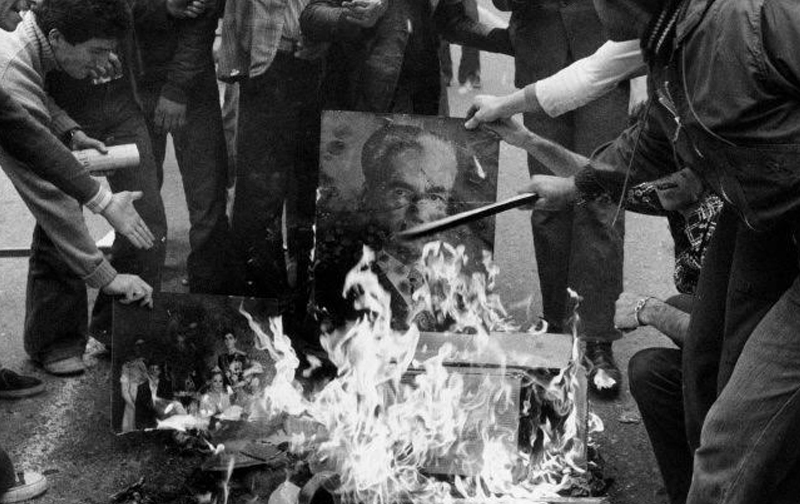
Within months, however, the left and right began to diverge sharply. Ayatollah Khomeini’s faction consolidated power by 1980. Clashes broke out: secular and Marxist guerrillas that had fought the Shah turned against the clerical government. By mid-1980, the revolutionary government banned all non-Islamist parties. Leftist organizations were outlawed and their leaders arrested or executed. For example, the Tudeh Party – which had briefly been legalized – was banned again in 1983 and thousands of its members were imprisoned . On the whole, “Iran has not been as undemocratically run as it is today” since before 1906, writes a socialist commentator, noting that the Islamic Republic “executed 50 times more socialists than the Shah’s regime did in 30 years of rule” . Movements in Kurdistan and Azerbaijan that leaned left (like the short-lived Kurdish Democratic Party of Iran) were suppressed militarily.
The new regime also attempted to co-opt leftist imagery. Revolutionary authorities adopted nationalist and anti-imperialist language, and even borrowed Marxist symbols on occasion. As art historians note, the Islamic Republic repurposed May Day: posters by the Islamic Republican Party used classic leftist motifs (workers, factories, clenched fists) but added Quranic verses and religious slogans . This was an “Islamization” of left iconography – for instance, one poster declared “Islam is the only supporter of the worker.” . In effect, Ayatollah Khomeini’s camp “sought to redefine [May Day] in an Islamic manner by adopting Marxist mass-oriented symbols” . By 1981 the Revolution’s secular and leftist allies (the National Front, Fedaiyan-majority, etc.) had been marginalized or banned entirely, and May Day itself was rebranded as a holiday for “Workers’ and Teachers’ Day” in honor of Ayatollah Beheshti and Motahhari. Nonetheless, the Iranian labor movement – though confined – retained institutional presence in factories and professional unions, continuing to voice demands for rights under an increasingly repressive state.
After 1979 many Iranian leftists went into exile or underground. Diaspora communities in Europe and North America became centers for opposition. Exiled former Tudeh leaders, Fedai guerrillas, and pro-socialist intellectuals set up publications and think tanks. In the 1980s, leftists in exile (for example, the Iranian Socialist Workers’ Party) produced Marxist analyses of the Revolution’s outcome . Though marginalized in post‑1979 Iran, leftist thought found new life abroad: published memoirs, party manifestos, and digital media helped keep socialist critiques alive.
Inside Iran, the “reform era” of the 1990s brought a mild revival of some left-leaning ideas. President Khatami’s government (1997–2005) opened limited space for civil society and intellectual debate. Former Marxists who had turned toward secular nationalism or democracy (so-called “green left” figures like Mir-Hossein Mousavi and Mehdi Karroubi) reappeared in politics, often labeled “reformists.” They advocated greater social justice and political freedoms, aligning with labor and student activists. However, hardline backlash quickly curtailed these reforms by the mid-2000s. Subsequent protest movements (notably the 2009 Green Movement) saw participation from secular nationalists, women’s activists and some labor unions, but by then the traditional Marxist left had largely fragmented.
Throughout the 1990s and 2000s, leftist sentiment in culture persisted in subtler ways. Writers, filmmakers and artists who had opposed the Shah often remained dissidents. Many notable cultural figures of the Islamic Republic era were former leftists – for example, film directors Mohsen Makhmalbaf and Bahram Bayzai had roots in radical circles. Students and workers frequently referenced socialist ideals in their slogans (“Workers, teachers, overthrow the dictatorship!” was a common chant in strikes). And in the universities, seminars on Marx and critiques of capitalism continued underground. Even if the Iranian Left never again coalesced into a mass political force as it had in 1940s, its legacy endured as a language of resistance against authoritarianism and inequality. I wanna mention ideologies and organizations. Key examples include:
The Tudeh Party (1941–present) – Iran’s historic Communist Party, founded after Reza Shah’s fall and aligned with the USSR. It was the largest leftist party of the 1940s and 1950s, but was banned or driven underground after 1949 and post‑1953, briefly tolerated in 1979 before a final ban.
Fedaiyan-e Khalq (Organization of Iranian People’s Fedai Guerrillas) – A Marxist-Leninist guerrilla movement founded in 1971. It split into several factions (Majority, Minority, etc.) with varying ideologies (Maoist, Guevarist). The Fedaiyan waged armed struggle against the Shah, and some factions also fought the post-revolutionary government; many members were executed or exiled. Mojahedin-e Khalq (MKO/MEK) – Originally a syncretic Islamist-Marxist guerrilla group (formed 1965), it played a role in the revolution then clashed with Khomeini. After 1981 it veered away from Marxism and in exile allied with Saddam Hussein against Iran. It remains controversial but was initially part of the radical left bloc. Peykar (Organization of Struggle for the Emancipation of the Working Class) – A Marxist splinter group formed in 1975 from MKO dissidents. It upheld militant anti-imperialist and secular positions but dissolved after heavy repression. Sorosh Society (early 20th c.) – An intellectual society of the 1900s that discussed socialist ideas; it influenced Constitutional Revolution reformers. (Not a mass party, but shows early leftist roots.) Political Islam with Leftist Leanings – Figures like Ali Shariati advocated a fusion of Shi’a theology with Marxist anti-imperialism. They were neither fully Marxist nor conservative Islamists, but their activism mobilized students in the 1960s–70s. Labor and Union Movements – Trade unions and guilds (bazaaris, teachers, oil workers, etc.) often acted as left-aligned groups. They did not always form distinct “left” parties, but alliances like the Central Council of United Trade Unions (1944) and later grassroots labor organizations served as conduits for socialist ideas. Other organizations included Kurdish socialist parties (e.g. Komala, KDPI), the Soviet-backed Democratic Republic of Azerbaijan (1946), the nationalist National Front of Iran (with leftist elements around Mossadegh), and diaspora Marxist parties like the Tudeh-linked Communist Party of Iran (exile). Post-1979 exile groups ranged from socialist to anarchist in orientation. Reformist factions within the Islamic Republic – loosely called “new left” or “Green Movement” by Western media – have included individuals advocating social justice, women’s rights and anti-neoliberalism, though they operate within a broadly Islamist framework. (For example, two leading 2009 Green figures, Mir-Hossein Mousavi and Mehdi Karroubi, frame themselves as progressive democrats.) In short, the Iranian Left has never been monolithic. It includes Marxist-Leninists (e.g. Tudeh, Fedai), Maoists, Trotskyists (e.g. internationalist student factions), nationalist socialists, liberal socialists, and religious progressives. All these currents shared hostility to imperialist intervention and the Shah’s autocracy. Over time they adapted – collapsing underground during repression, merging with populist movements, and later reinventing themselves in exile or via cultural work.
Iranian literature of the 20th century shows clear waves of leftist influence. From the 1940s onward, socialist themes entered novels and poetry, and writers often saw themselves as intellectually committed to social change. One scholar notes that “between 1940 and 1979, Iran underwent significant socio-political upheavals… leftist ideologies…gained prominence through the pro-Soviet Tudeh Party, which dominated intellectual and literary circles in the 1940s and 1950s” . During the Allied occupation and oil-nationalization period, Tudeh-backed magazines and the Writers’ Association of Iran propagated a revolutionary vision of literature: criticism of injustice, class consciousness, and solidarity with global anticolonial struggles.
Prominent figures exemplify this trend. Poet Ahmad Shamlou became known as “the most outspoken” leftist poet of his time . His mid-1960s literary journal Khusheh (“Cluster”) translated and published Third-World revolutionary literature alongside his own poetry. Shamlou sought “literary solidarity-building” with global movements – for instance, he translated Latin American and African liberation poetry into Persian . Young women poets also joined this milieu. The sisters Mahvash and Zhila Mossaed emerged in the 1960s writing communally committed poetry and translations in Shamlou’s publications . Zhila, in particular, used symbolism to critique social inequalities: her poem “Woman” (1977) sympathizes with a laborer’s mother, contrasting her own class privilege with the worker’s plight . As the scholar of women’s literary production puts it, these authors used a “highly symbolic language” – employing tropes like “night” for oppression and “wind” for change – to covertly mobilize resistance under censorship .
Other literary figures include Zhaleh Esfahani, a pioneering woman poet and Communist Party member who was twice exiled for her politics , and Fatemeh Sayyah, the first female professor of comparative literature in Iran and a noted Marxist critic . Among novelists, Houshang Golshiri and Simin Daneshvar depicted modern society’s moral and economic challenges, often shading in critiques of the regime (though Golshiri later expressed ambivalence about turning literature into overt propaganda). Forough Farrokhzad, though primarily known as a feminist, also reflected generational dissent and modernist break with tradition. In later years, writers like Reza Baraheni and Monir Koushyar wrote in exile about exile itself and the longing for a free Iran.
Critics have noted that by the 1960s, Iranian literature had entered a “second episode” wherein the Left’s popularity pressed authors to retool their artistry. After the 1953 coup dashed hopes for revolutionary change, many writers turned to allegory and symbolism to evade state repression . In practical terms, editors would translate Marxist and Third-Worldist works (e.g. Neruda, Mao, Fanon) in leftist journals as a “stealth pipeline” of ideas . Poets continued to weave coded critiques into ostensibly traditional verse. One historian observes: “The dominance of the Left in political thought…was characterized by…authors [using] a highly symbolic language, especially in poetry, to convey their oppositional messages” . This era’s committed poetry – whether male or female voices – sought to “call the masses into action against the Western-backed regime”.
After the 1979 Revolution, state control over literature tightened, and much overt leftist publishing ceased. Nevertheless, many post-1979 Iranian authors still carry the influence of leftist education and Marxist aesthetics. The underground literary culture of the 1970s laid the groundwork for later generations to view literature as a form of social protest. In contemporary Iran, there has been a renaissance of socially conscious poetry and fiction once again circulating on social media and samizdat presses. Younger authors often cite both traditional Persian poetics and revolutionary-era slogans, reflecting this historical lineage.
Iranian cinema and television have also been influenced by left-wing ideas, although often indirectly. The Iranian New Wave of the late 1960s and 1970s – often compared to Italian neorealism – brought social critique to the screen. Early masterpieces like Dariush Mehrjui’s The Cow (1969) and Masoud Kimiai’s films depicted rural poverty and class struggle with allegorical depth. While directors of that era were not all card-carrying Marxists, they were attuned to the era’s conflicts. For example, The Cow has been interpreted as a subtle critique of alienation among Iran’s peasantry. Mehrjui himself once commented that he was inspired by Kafka and social alienation – themes consonant with Marxist thought . Abbas Kiarostami’s later work (e.g. Where Is the Friend’s Home?) often depicted poor children with empathy, reflecting humanistic and egalitarian values consistent with leftist concern.
Documentaries and television also carried political undertones. Leftist filmmakers like Forough Farrokhzad used film as activism – her short 1962 film The House is Black spotlighted marginalized communities (lepers) in a humane light. After 1979, many politically outspoken directors fled Iran; some (like Makhmalbaf) made revolutionary cinema abroad, though later Makhmalbaf shifted views. The Islamic Republic’s film industry eventually promoted social realism in the 1980s (often supporting war narratives), but internationally acclaimed directors (Kiarostami, Jafar Panahi, Mohsen Makhmalbaf, Rakhshan Bani-Etemad, Samira Makhmalbaf, etc.) often critiqued social injustice or authoritarianism, a legacy of New Wave political engagement. In the 21st century, Iranian indie filmmakers are increasingly active abroad; their stories of diaspora, labor, and human rights owe part of their sensibility to the older leftist tradition of socially engaged art.
Television and online media have similarly reflected left‑leaning concerns. For example, Iranian artists and journalists have used social networks to document labor strikes, environmental protests and women’s rights campaigns – echoing the left’s historical role in “free association” and rights struggles . The spread of satellite channels and internet means that foreign leftist commentary (from socialist publications or state media) now reaches Iranian audiences, often debated in blog posts and chat groups.
Visual art in Iran—from painting and graphic art to architecture—has often interacted with leftist ideas, either in content or form. In the pre-Revolution period, a few painters and sculptors openly embraced socialist realism. Monir Farmanfarmaian and Parviz Tanavoli, while not overtly political, produced work that modernized Persian motifs, resonating with progressive (if not specifically leftist) cultural agendas. Cartoonists and graphic artists more directly critiqued social issues: Ardeshir Mohasses, for example, lampooned political and social elites in Tehran during the 1970s (his left‑leaning style led him to flee after 1979).
One very visible example is the tradition of political posters. As illustrated above, Iranian leftist movements produced striking posters for rallies and May Day (see Figure 2). These posters were explicitly designed in the socialist‑realist idiom – “the first two posters portrayed were produced by the Fada’i-e Khalq (Marxist-Leninist guerrilla group)” . The imagery (clenched fist, workers, factories) was internationalist, as artists borrowed motifs from European and Latin American leftist art . Anthropologist Susan Talbot observes that by mixing Persian cultural elements (like tulips, cogs, gears) with global worker symbols, leftist posters communicated “collective mobilization against capitalism and imperialism” . These were public art meant to spur solidarity.
After 1979, mural art and protest graffiti became a language for dissent. Although largely suppressed by the authorities, graffiti with socialist slogans occasionally appeared during the 1980s and ’90s. For instance, during labor strikes or anti-regime demonstrations, walls in major cities might be stenciled with phrases like “Workers’ rights are our revolution” or images of industrial workers. In recent years, street art about the “Woman, Life, Freedom” uprising has drawn on revolutionary imagery (red, black, green) and sometimes quotes from leftist writers. While few such pieces survive in state‑controlled Iran, they circulate widely on social media.
In architecture and design, leftist ideology had a less obvious but real influence. In the 1960s–70s, modernist architects in Iran (such as Houshang Seyhoun and Ali Sardar Afkhami) combined Western modernism with an egalitarian ethos – for example in designing public cultural centers and worker housing. After the Revolution, some architects (often clerics or Bazari businessmen) openly preferred vernacular or Islamic motifs. Yet secular leftists in exile began theorizing “Islamic socialism” architecture, emphasizing communal spaces and local materials (though few built examples exist, due to political constraints). Notably, Iranian architects like Nader Khalili, who championed sustainable mud-brick construction in the US, argued for a synthesis of modern technology with modest, community‑oriented design – a perspective resonant with socialist principles of social welfare and anti-consumerism.
Taken together, the intersection of aesthetics and ideology on the Iranian left can be summarized: socialist realism reappeared periodically in Iran to celebrate labor and collective ideals, while religious leftists tried to fuse Islamic art with worker imagery . As one scholar observes, “the blending of various ideologies [in visual art] is a testimony to [their] flexibility and heterogeneity – utilizing religious, national‑liberationist, anti‑imperialist, and even Marxist iconography to fashion a broad revolutionary (and sometimes contradictory) message” . The leftist influence on architecture and design has been more subtle but can be seen in any project that prioritized communal function over elitist luxury.
Left-wing values have also found expression in Iranian fashion and lifestyle, especially among youth subcultures. During the oil-boom 1960s and ’70s, Western-style fashion (miniskirts, ties, bright colors) was popular among Tehran’s urban youth and can be read as a form of social liberation. While not exclusively leftist, this countered the conservative dress norms of traditional society. Some youth intentionally adopted working-class aesthetic (e.g. denim overalls, slouchy caps) to express solidarity with the underprivileged. Student and artist collectives sometimes held fashion shows mixing proletarian motifs (oil drums, factory imagery) into clothing, paralleling international revolutionary fashion experiments.
Following the Revolution and the imposition of mandatory hijab, dress became an explicit political battleground. Among reformist and left-leaning circles in the 1990s and 2000s, there was a fashion trend of “modest chic” that combined piety with progressive style (colorful scarves, layered garments, etc.). Youth women in tech and academia would wear heavier chadors but with trendy makeup, an implicit statement of resisting rigid norms. Some leftist feminists see this as a form of “everyday resistance” – reclaiming personal style under an oppressive system. Conversely, the 2022 “Woman, Life, Freedom” protests saw young women cutting their hair and burning scarves as radical political fashion acts, recalling leftist iconoclasm [Just as I shaved my iconic hair](note however that today’s slogans also draw on feminism and nationalism as much as socialism).
On the cultural side, leftist ideas influenced popular music, art collectives, and media. In the late 1970s some politically-minded rock bands (like Black Cats and Indigos) composed anthems about social injustice and revolution (though often censored). Later, underground hip-hop and rap artists in Iran have expressed anger at corruption and inequality, a genre that often overlaps with left-wing critique. Visual youth culture (zine-making, graphic T-shirts, street art) has frequently drawn on Marxist or eco-socialist motifs; for example, some modern graffiti incorporate Che Guevara’s image or red-star symbols.
In architecture and city life, young Iranians in recent years have been inspired by communal living ideals. For example, co-housing projects and community gardens in Tehran and other cities reflect a socialist ethos of sharing urban space. Even tech startups with participatory internal cultures sometimes use Marxist slogans humorously (e.g. a co-op initiative calling themselves “Workers of the World Tech Unite”). This likely reflects the diffusion of leftist language into general protest culture, rather than adherence to a formal ideology.
Overall, the youth culture of Iran today – as measured by music, fashion and public expression – is highly syncretic. Many young Iranians oppose authoritarianism, sexism and economic inequality, echoing left-wing values. Global liberal and socialist currents all mix together. Surveys show that Gen-Z Iranians are more secular and egalitarian than older generations, and in public forums they often quote international figures (Marx, Mandela, etc.) alongside Persian poets. In this sense, the spirit of the Iranian Left lives on as a reference point for new generations, even if organized left parties are weak.
Across all these fields, certain Iranian figures are famous for their leftist convictions or influence: Forough Farrokhzad (1935–1967) – Iconic poet and filmmaker. Though not a party member, her frank poetry about women’s inner life and social constraints resonated with progressive youth. Her 1962 documentary “The House Is Black” portrays a leper colony with poetic empathy, reflecting a humanist solidarity that aligned with leftist ideals.
Houshang Golshiri (1938–2000) – Novelist and short story writer. He often explored class conflict and alienation in contemporary Iran. Active in the Writers’ Association, he critiqued censorship and was briefly imprisoned after the revolution. Golshiri’s modernist style nevertheless carried an undercurrent of social commitment.
Shirin Neshat (b.1957) – Artist and filmmaker known for striking black-and-white photographs of women. Growing up in Iran and later moving abroad, Neshat blends feminist and social realist imagery. Though her work addresses religion and gender, it also critiques power structures – a stance resonant with anti-authoritarian left currents.
Ardeshir Mohasses (1938–2008) – Cartoonist and satirist. Known as the “Persian Lowenherz,” he caricatured clerics and politicians alike. His bold cartoons in the 1970s and early 1980s targeted hypocrisy and corruption. Mohasses described himself as an “avowed leftist”; his art satirized both the Shah and the clergy’s hypocrisy, often at great personal risk.
Mohsen Makhmalbaf (b.1957) – Film director. In the 1970s, Makhmalbaf was a Marxist revolutionary engaged in street fights against the Shah. After imprisonment, he emerged as a filmmaker; early works (Boycott, The Cyclist) depict social realism and revolutionary zeal. Though he later changed his views, Makhmalbaf’s early career exemplifies the fusion of activism and art.
Jafar Panahi (b.1960) and Mohammad Rasoulof (b.1972) – Independent filmmakers jailed by the Islamic Republic. Their films often portray the lives of the poor and critique state power indirectly. Their courage under repression has made them left‑aligned icons of artistic freedom.
Hamid Dabashi (b.1940) – Intellectual and Columbia University professor. A Marxist social scientist originally from Iran, Dabashi’s writings (e.g. Iranian Cinema, Staging a Revolution) provide critical theory on culture and power. Though often controversial, he situates Iranian leftism within postcolonial discourse. His work on revolutionary aesthetics has shaped Western understanding of the Iranian Left.
Ali Shariati (1933–1977) – Sociologist and philosopher. Shariati blended Shi’a theology with Marxist analysis to articulate an Islamic socialism. He argued that Shi’a martyrdom embodied class struggle, inspiring students in the 1960s–70s. Though his ideology was theocratic, it shared the Left’s anti-imperialist, socialist aims. Many consider him a bridge figure: “the new kind of left-wing politics” that initially supported Khomeini was partly Shariati’s legacy .
Mehdi Karroubi (b.1937) and Mir-Hossein Mousavi (b.1941) – Cleric and painter (Karroubi) and architect/prime minister (Mousavi). Both led reformist movements (the Green Movement of 2009) and advocated economic justice. Coming from within the Islamic Republic establishment, they nevertheless championed many policies (female quotas, labor rights) usually associated with the secular left.
Simin Behbahani (1927–2014) – Poet. Behbahani wrote about social issues and women’s rights. While not explicitly Marxist, her poetry’s progressive spirit and support for the 2009 protests earned her respect on the Left.
Sadegh Zibakalam (b.1948) – Political scientist and public intellectual. A secular liberal, Zibakalam frequently defends laborers’ strikes and critiques the ruling elite. Though not a Marxist, he is sometimes described in media as Iran’s “left-liberal” conscience, urging citizens to adopt democratic socialist principles.
Fatemeh Ekhtesari and Toomaj Salehi – Younger cultural activists (poet and rapper respectively). Both were imprisoned in the 2020s for expressing dissent. Toomaj’s rap “Khodavir” invoked Khomeini-era martyrdom themes to criticize the regime – a consciously revolutionary style. Ekhtesari’s poetry has won international awards and draws on universalist socialist images (ploughshares, revolution, suffering) while critiquing gender injustice.
This list is far from exhaustive, but it shows how artists and intellectuals from different fields adopted leftist or progressive stances. Some, like Shamlou and Mohasses, were card-carrying Marxists. Others, like Neshat and Panahi, came to left-leaning positions through resistance. Together, they ensured that left-wing critique remained alive in Iran’s cultural DNA, even when parties were banned.
One crucial dimension of Iran’s left is how ideology was projected through aesthetics. This includes not only posters (as discussed) but also symbols, slogans and visual culture. Revolutionary workers’ demonstrations often displayed banners and placards with stylized images of oil rigs, hammers, sickles, the globe – borrowed from Soviet iconography but localized (e.g. the Iranian flag or Persian script). Similarly, theaters and exhibitions promoted “People’s Art,” featuring folk dancers and workers on stage.
Portraiture took on political value too. After the Revolution, portraits of 20th-century socialists began to circulate quietly in leftist cafes and offices – for instance, images of Karl Marx, Lenin, Rosa Luxemburg or Ho Chi Minh could be found in reformist bookshops alongside Persian poetry. Some graffitied walls include sketches of Amir Kabir (the Qajar-era reformer) or Mossadegh as proto-socialists. In education, schools in some working-class districts (now illegal) would decorate classrooms with murals depicting the struggle of the proletariat.
Even the content of exhibitions and books reflected this blend. For example, a post-1979 art exhibit in Tehran (documented in Pictures from a Revolution) focused on pre-Revolution art that represented “revolutionary steps” – linking historical art movements with leftist politics . After 2009, state-sponsored museums occasionally mounted reluctant retrospectives on the Revolution’s art; critics noted that they often sanitized or abstracted overtly socialist symbols to avoid political trouble.
In Iran’s architecture, while much public construction has been driven by religious or national symbolism, there have been minor leftist footprints. Worker-owned cooperatives built schools and clinics in the 1980s inspired by communist models (though usually with Islamic banners atop). The city of Khomeini Shahr outside Isfahan, for instance, was planned in the 1970s as a workers’ town (then called Saffar) with communal utilities, before nationalization halted the project. In recent years, hip urban art installations sometimes repurpose old monuments of the Pahlavi era into “people’s memorials,” an idea resonant with socialist reappropriation of space.
The academic discourse on left aesthetics in Iran includes works like Chelkowski and Dabashi’s Staging a Revolution (2000) which analyze how visual persuasion was used by both left and right. They show that the Left’s socialist-realism style (bold colors, heroic figures, emphasis on machinery) was directly countered by the Right’s use of Islamic calligraphy and traditional art. This interplay is notable: in the early 1980s, one artist said that Islamist May Day posters often “included Qur’anic verses… by synthesizing the iconography of the leftist tradition with divine textual messages, [they] subsumed worker’s solidarity under a religious cosmology.” . In other words, what was militant secular imagery in 1978 became sanctified rhetoric in 1982 – illustrating how the regime co-opted the left’s aesthetic language.
Another example of form meeting ideology is architecture-for-the-people. After the Revolution, Iranian architects debated whether to design buildings that served the masses. In the 1990s and 2000s, small cooperatives funded by unions built modest housing complexes (often blocky utilitarian structures) for low-income workers, in contrast to luxury developments. These projects rarely attract media attention, but they embody a literal translation of socialist ideals into spatial form. Similarly, book cover design in the 1980s often featured red or black color schemes and sans-serif fonts – a small but telling concession to international leftist graphic norms.
In sum, the Iranian Left’s ideological aesthetics married international socialist imagery with local content. Whether through posters with red tulips and gear wheels , poetry using hidden metaphors for revolution , or murals of collaborative labor, these symbols served to educate and unify supporters. Even the Revolution’s glass mosaics and banners incorporated worker motifs in Iran’s public spaces. Cultural scholar Zahra Saberkari argues that this “visual testimony to leftist influence” helped maintain a “pluralistic…message” during the Revolution . Today, many of those symbols have been suppressed or repurposed, but they remain vivid in memory and archive collections.
In recent years, major historical events – from the end of the Iran–Iraq War to international sanctions to catastrophic environmental and economic crises – have set the stage for a new phase of left-wing activism. The 2009 Green Movement signaled a moment when urban youth openly challenged the system; many participants cited justice and freedom – values long championed by the Left – in their demands. The slogans of the 2022 “Women, Life, Freedom” uprising have likewise echoed leftist themes, even as they also draw from feminist and nationalist sentiments. For example, protestors in late 2022 and 2023 frequently chanted “Down with the dictatorship” and “Death to poverty,” linking political repression with class grievances. Though not explicitly Marxist rhetoric, the unions and laborers’ demands (higher wages, safer conditions) reflect the socialist legacy.
Labor activism has notably resurged. Reports from Human Rights Watch and others document widespread strikes and protests in multiple sectors (oil, teachers, railways, etc.) from 2020 onward . As one expert notes, “Iranian labor activists have been at the forefront of the struggle for the rights to free association and assembly in Iran” . Unions like the Coordinating Council of Iranian Teachers and numerous oil-worker syndicates have led rallies demanding economic justice – a continuation of the old left-labor axis. The authorities have responded with arrests (for example, the ITTA secretary was jailed for five years) . Yet the sheer number of workers mobilizing suggests that class-conscious protest is not dead.
Trade unions still remember their lineage. For instance, Tehran’s May Day in the 1940s could draw 80,000 workers in a single demonstration . Today, although such crowds are prohibited, smaller protests on International Workers’ Day still take place, often curated by union activists citing that history. (One academic observation: “During the height of Tudeh influence in the late 1940s, May Day festivities in Tehran were attended by more than 80,000 people” .) In the late 2010s and 2020s, even private media outlets and NGOs began analyzing protests in Marxist terms, indicating that leftist conceptual frameworks have re-entered public discourse.
In the diaspora, young Iranian activists often fuse leftist critique with global causes like climate justice, anti-racism and anti-imperialism. Social media channels link Iranian issues to international solidarity networks (for example, hashtags combining “Iran” with #anti-capitalism or #blacklivesmatter can be found). Prominent expatriate Iranians – some of whom were former leftists – speak on Western campuses and media about neoliberalism, corporatism and democratic socialism. One Western commentator notes that “the revolt in Iran is rallying its diverse working class,” citing students and labor groups uniting across ethnic lines. This suggests that the global left is re-embracing Iran as a site of class struggle.
Moreover, the memory of past repression has begun to soften the taboo on leftist labels. In 2021–2024, some young activists explicitly studied Marxist classics and resurrected banned slogans. Poetry slams in Tehran and Shiraz included readings of Tudeh-era verses. Literary anthologies of revolutionary poetry (like those of Shamlou, Farrokhzad, Behbahani) have been reprinted underground. Even some Tehran graffiti artists now sign their murals with traditional socialist phrases (often in English to avoid detection). At universities, student clubs quietly host talks on socialist feminism and communal ownership.
Throughout Iran’s modern history, left-wing movements have continually adapted to seismic events that i wanna describe : Constitutional Revolution (1906–1911): Early leftists (often allied with liberals) pushed for parliamentary rule, social reforms, and national sovereignty. Socialists like Mirza Kuchak Khan took these ideas regionally (Jangal Movement). Revolutionary rhetoric of democracy and anti-colonialism embedded socialist ideals into Iran’s political imagination. Allied Occupation & Mossadegh (1941–1953): The end of the Shah’s dictatorship allowed a brief flowering of the Left. The newly formed Tudeh Party reorganized the working class, and through unions secured mass mobilization. Mossadegh’s oil nationalization (1951) had leftist economic overtones, although its leadership remained non-communist. The 1953 coup violently crushed these hopes: thousands of leftists were imprisoned, forcing the movement underground. 1960s–1970s (Cold War & Global Revolutions): With Iran swept up in global dynamics, new generations turned to anti-imperialist guerrilla tactics. The worldwide wave of 1968-style student revolts and Third World insurgencies inspired Iran’s Fedaiyan and student groups. Leftist ideology competed with rising political Islam for young hearts; some, like Shariati’s followers, moved between them. The left’s cultural impact was strong: revolutionary poetry, music and art flourished, even as parties were banned. 1979 Islamic Revolution: Initially, Islamists and leftists collaborated against the Shah. Leftists entered the provisional government and controlled media briefly. Yet they underestimated Khomeini’s populism. Within two years, the regime co-opted pro‑Iranian worker rhetoric (“Islam is the only supporter of the worker” posters emerged ) while dismantling secular left power. The left’s failure to unify or seize the moment was interpreted by some historians as a tragic miscalculation. (As noted by scholar Fred Halliday, Tudeh was seen by young radicals as having “betrayed Iran by prioritizing Soviet interests” – a charge that fractured trust. Post-1979 Repression: The new regime’s war with Iraq (1980–88) initially sidelined internal dissent, but after 1983 it systematically purged leftists. This decades-long repression forced many leftists into exile or silence. During the 1990s, under Khatami’s “dialogue of civilizations” rhetoric, some space re-opened: left-wing intellectual journals and student debates modestly resumed. However, after 2009 the regime again clamped down. The left as a cohesive movement never fully rebounded, but its core critique of injustice continued to resonate underground. Diaspora Movements: In exile, Iranian leftists established cultural and political organizations (e.g. Tudeh remnants in Europe, Fedai associations in France, socialist networks in the US). These groups produced histories and analyses of the Iranian Left, trying to preserve continuity. They also lobbied foreign governments and engaged in international anti-war and pro-democracy campaigns. Contemporary Protests (2018–2025): Economic collapse, political frustration and the spark of the Mahsa Amini case have reactivated mass mobilization. For the first time in decades, protests blend feminist, labor and anti-monarchy slogans. Students and factory workers jointly demonstrate – for example, teachers’ strikes turn political. Although the government labels all dissent “terrorism,” the ideological undertone of many chants is secular and egalitarian. International left commentators like the Jacobin writer above have observed this “paradigm shift…[in the] Iranian left”, noting that today’s uprising is rallying a “diverse working class” in ways reminiscent of 1940s struggles . While it is too early to know whether a new socialist movement will be built, the Left’s lexicon is unquestionably back in circulation among the street-level opposition.
From the Constitutional Revolution to the present, Iran’s left-wing has been a persistent if embattled current. Its fortunes have risen with phases of political openness (1940s, 1979) and fallen under repression (Pahlavi police state, post-1980 Islamic rule). In exile and exile’s literature, in the shadows of censorship, leftist ideas nevertheless endured. Scholars like Val Moghadam have traced this as part of a “New Left” which fused anti-imperialist nationalism with socialist ideals . Others, such as Ervand Abrahamian, have analyzed why secular leftists failed to dominate Iran the way they did in other countries (concluding in part that they misread Khomeini’s appeal) .
Culturally, the Iranian Left left deep imprints. Poets like Shamlou and Farrokhzad expanded the limits of Persian verse to include protest and social critique. Filmmakers and artists turned every available medium – from film reels to wall murals – into canvases of dissent. Even under the strictures of revolution and dictatorship, leftist symbology found its way into public squares: workers’ processions, political posters (Figure 2), and religious festivals like May Day (before and after Islamization) all testified to a dialogue of ideologies. Today’s scholars note that even the Islamic Republic “utilized leftist visual motifs” (factories, fists, unity hands) in its propaganda – a grudging acknowledgement of the Left’s cultural power.
In sum, Iran’s left-wing tradition has been heterogenous: a spectrum from Soviet-aligned communists to nationalist reformers to religious socialists. It has always been intimately linked to Iran’s struggles against foreign intervention and autocracy. And in culture and everyday life, it has provided a language of equality, resistance, and artistic innovation. As Iran enters new periods of crisis and protest, many observers believe the left-wing legacy – in the form of union organizing, protest art, and intellectual debate – is once again relevant. What was true in 1906 and 1979 remains true: Iranians continue “toiling and disinherited” , and some still look to the ideals of “workers of the world, unite” and land reform as paths toward justice. Whether through party building or cultural expression, the Iranian Left’s story is one of continuous adaptation: from secret societies and mountain forests to underground presses and social media, its ideals persist amid changing regimes.