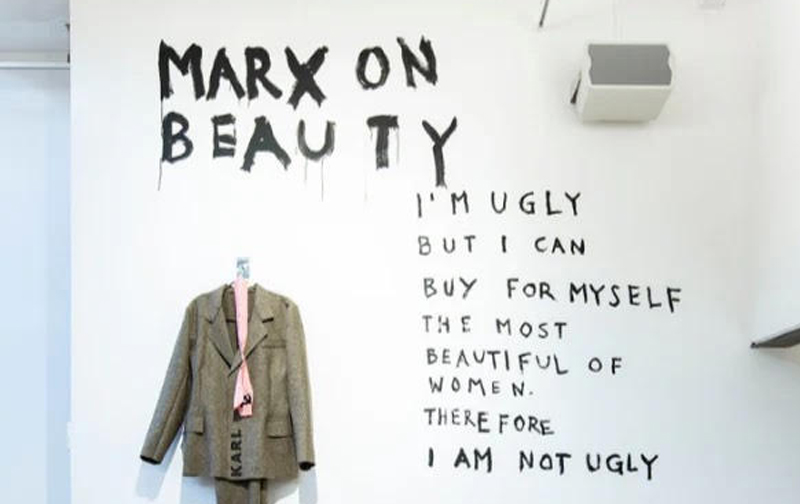
In a world where the fashion runway meets revolutionary theory, the project Comme des Marxists stands out as a bold experiment in merging style with radical critique. At first glance, high fashion and Marxism make strange bedfellows—one evokes luxury and consumerism, the other, a call to overthrow those very values. Yet Austrian-American artist Rainer Ganahl’s Comme des Marxists defies this contradiction. Conceived as a conceptual fashion label and art exhibition, it uses garments, performances, and visual puns to interrogate capitalism from within its own aesthetic domain. Ganahl’s 2018 exhibition at London’s Fashion Space Gallery presented clothing, jewelry, videos, and performances that explored “the relationships between daily life, culture, economic systems and political structures”. In essence, Comme des Marxists asks: can the tools of fashion—branding, clothing, spectacle—be turned against the capitalist system they normally serve? By examining this project through a global leftist lens, we uncover a richly layered commentary that draws on political theory, philosophy, anthropology, and sociology. Comme des Marxists becomes a case study in how fashion can critique consumerism and commodity fetishism, engaging thinkers from Karl Marx to Judith Butler, from Antonio Gramsci to Frantz Fanon.
Ganahl’s approach is at once playful and pointed. The very name Comme des Marxists is a cheeky riff on the avant-garde Japanese label Comme des Garçons (French for “like the boys”), replacing the boys with Marxists. The project’s logo mimics the original brand’s font, instantly détourning a symbol of elite fashion into a Marxist in-joke. This act of cultural hijacking—or semiotic guerrilla warfare, to borrow a phrase inspired by Frantz Fanon —sets the tone. Throughout the exhibition, famous luxury and high-street brands are subverted with Marxist references, connecting the dots between haute couture and the “on-going class struggles” of capitalism . Ganahl creates collections with titles like Karl Marx Wears Prada, HERMÈS–MARX, and Marx 99 Cents, collapsing the distance between Karl Marx and Karl Lagerfeld in witty provocation. One series emblazoned “Karl Marx Wears Prada” on actual safety jackets and skirts was first shown in 2012 , turning the glamour of Prada on its head. Another collection, titled Joe Fresh Benetton; Bangladesh, Rana Plaza Building Collapse, More Than Eleven Hundred People Died, 2013, printed news clippings and “Made in Bangladesh” labels onto garments from those brands —a haunting reminder that behind cheerful retail brands lie sweatshops and tragedy. Ganahl explicitly tied this work to the Rana Plaza factory collapse that killed over 1,100 garment workers in 2013 . By printing the hidden costs of fashion onto the clothes themselves, he forces the consumer/viewer to confront what is normally kept out of sight: the blood and tears underpinning “fast and disposable fashion” . In these ways, Comme des Marxists operates through aesthetic interventions that critique capitalism’s abuses, be it labor exploitation in the Global South or the fetishism of logos in the Global North.
Walking through the Comme des Marxists exhibition was like touring a surreal wardrobe of rebellion. Each rack or display was a provocation. Ganahl drew inspiration from diverse sources: not only Marx and Engels, but also early 20th-century radicals in art and design. One collection paid homage to Constructivist artist Varvara Stepanova, whose 1920s Soviet garment designs sought to democratize clothing. After seeing a Comme des Garçons felt collection that borrowed from Stepanova, Ganahl had the lightbulb moment for Comme des Marxists . He produced felt dresses and suits adorned with Soviet stars, hammers and sickles, and words like “CLASS STRUGGLE” and “PROFIT,” directly evoking revolutionary imagery . There is a touch of parody—one review quipped these outfits looked like a child’s arts-and-crafts version of Stepanova —yet the intent is serious. Ganahl recalls that as he poured “thousands and thousands of Euros” into fine wool felt and skilled labor for these pieces, “contradictions became very quickly apparent…exclusive and insanely expensive materials” carrying slogans about equality . He emphasizes this irony as part of the work: the tension of using luxury fashion methods to convey anti-capitalist messages. Rather than shy away, Comme des Marxists highlights that paradox, asking viewers to wrestle with it. It practically stages a Marxian dialectic on the body of each garment—the thesis of revolutionary slogan meets the antithesis of couture extravagance—perhaps hoping to spark a synthesis of awareness.
To situate Comme des Marxists in a broader context, we must recognize it as part of a global tradition of leftist fashion activism and protest aesthetics. Ganahl is not the first to merge style and radical politics; indeed, his work nods to a lineage of cultural resistance using clothing as its medium. The punk fashions of 1970s Britain offer an early example: designer Vivienne Westwood, in partnership with Malcolm McLaren, crafted the ripped shirts, safety pins, and anarchic slogans that became the uniform of youthful rebellion. Westwood’s designs in that era—T-shirts with provocative graphics like upside-down crucifixes or the Queen’s face defaced—were acts of defiance against the conservative social order and the commercialization of culture. Over the decades, Westwood continued to link fashion to politics, evolving from punk provocateur to outspoken activist on issues like climate change, nuclear disarmament, and consumer culture. Her runway shows often double as political rallies. For instance, at her Autumn/Winter 2015 collection, Westwood printed a bold “Vote Green” manifesto on the show notes and declared that we are “controlled by the 1%… They preach consumption, and they preach war, and they’re taking us into disaster” . Models strode the catwalk with bruised faces as “eco-warriors on a mission to save the planet” . By explicitly calling out the ruling class and its ideology of consumption, Westwood turned a fashion show into a platform for anti-capitalist critique. Such moments laid important groundwork: they proved that fashion can be more than commercial spectacle—it can be a vehicle for dissent. Ganahl’s Comme des Marxists follows this path, treating the runway and gallery as arenas of class consciousness. Indeed, he extends Westwood’s impulse in a more theory-driven direction, weaving academic references into garments in a way Westwood’s punk slogans presaged.
On the global stage, the interplay of fashion and protest has taken many forms. Consider the Fashion Revolution movement (I have written for Fashion Revolution in a book published in Iran.) that arose in response to the same Rana Plaza disaster Ganahl referenced. Founded in 2013, Fashion Revolution launched the viral hashtag #WhoMadeMyClothes, urging consumers to demand transparency about garment workers’ conditions . Every year on the disaster’s anniversary, people wear their clothes inside-out to reveal the labels, a symbolic inversion that forces observers to think about the often-invisible workers behind each seam . What began as a commemorative gesture is now a worldwide campaign spanning over 100 countries, with designers, laborers, and activists joining to call for a “clean, safe, fair” fashion industry . This movement echoes Marxist concerns about alienated labor and exploitation, yet it does so through the language of clothing activism rather than pamphlets or manifestos. By appropriating the tactics of branding (a hashtag, a unified message) and subverting them, Fashion Revolution turned the simple act of wearing a garment into a statement of solidarity with the working class. In a way, Comme des Marxists can be seen as operating in the same spirit, though with a more avant-garde flair. Both ask the public to look beyond the glossy surfaces of commodities to see social relations underneath—what Marx famously called the commodity fetishism that “mystifies” the true source of value in labor. As writer Tansy Hoskins observes, consumer passivity “mystifies clothes and lands us in a visual world that we did not make for ourselves” . Ganahl and movements like Fashion Revolution seek to break that passivity, to demystify the commodity by literally writing its story (or its antithesis) onto it.
Nowhere is the fusion of fashion and direct political action more vivid than in the performance art of groups like Pussy Riot. This Russian feminist punk collective became globally renowned in 2012 after staging a guerrilla performance in a Moscow cathedral, railing against President Vladimir Putin and the Orthodox Church’s patriarchy. Their arrest and subsequent trial turned them into international symbols of resistance. But it was their distinctive visual style that first captured the world’s attention: the clashing neon dresses, bright tights, and knitted balaclavas in pink, lime green, purple, yellow. The members of Pussy Riot understood the power of image in our spectacle-driven age. “The rupture of the hegemonic order… was significantly aided by the provocative aesthetics they chose to embody,” writes scholar Rada Georgieva, noting that Pussy Riot’s costumes drew on both Western punk influences and Russian avant-garde art.
With their faces hidden by candy-colored masks, these young women inverted a traditional dynamic of power. Normally, masking is associated with subservience or crime, but Pussy Riot used it to claim freedom. “We cover our faces so that you can see us,” went their famous slogan —an apparent paradox that underscored how the anonymity of the mask actually made the collective visible, focusing attention on their message rather than individual identities. Here we see Judith Butler’s notion of performativity in action on a political stage. Butler argued that identity is not a fixed essence but a series of performed acts, stylizations of the body repeated until they feel natural . Pussy Riot turned gender expectations upside down: performing a brash, confrontational femininity that combined day-glo dresses (signifiers of youthful innocence or femininity) with aggressive punk music and anti-authoritarian rhetoric. In doing so, they exposed the constructed nature of both gender roles and political authority—after all, what is more “performed” than the pomp of autocratic power? Their balaclavas, inspired partly by Kazimir Malevich’s faceless figures in abstract art , were a direct affront to the cult of personality in politics. The authorities could jail some members, but new anonymous women in masks could rise to take their place, showing the power of a de-individualized, performative protest. The aesthetic choices of Pussy Riot were not incidental; they were integral to the group’s ability to galvanize global support and highlight the absurdity of the system (as evidenced when their style was emulated by activists worldwide and even as costumes on Halloween). This exemplifies how protest fashion in the Global South and beyond often leverages symbolism: by flipping the script on cultural signs, turning oppression into resistance. Just as Algerian women during the anti-colonial struggle used the veil both to defy the French and to smuggle revolutionary messages (a tactic analyzed by Fanon, who noted that resistance “re-signif[ies] the meaning of the veil” against colonial domination ), Pussy Riot’s balaclavas re-signified the ski mask from a tool of suppression to one of liberation.
The Global South provides further paradigms of fashion as resistance. One of the most iconic is Mahatma Gandhi’s adoption of khadi—hand-spun, hand-woven cloth—as both personal attire and political strategy in India’s fight against British colonial rule. Rejecting the finely tailored European suits he wore as a young lawyer, Gandhi embraced the simple dhoti and charkha (spinning wheel) as symbols of self-reliance. He urged Indians to spin and wear homespun khadi as a boycott of British textiles. This act turned a fabric into an emblem of anti-colonial struggle: khadi “came to symbolize Indian independence” and the Swadeshi movement’s push for economic self-sufficiency . British authorities understood the threat—at one point colonial officials banned their employees from wearing Gandhi’s cap made of khadi . Gandhi’s sartorial choice carried deep meaning: it signified “cultural pride, the use of Swadeshi goods… and solidarity with India’s rural masses” . In Gramscian terms, this was a counter-hegemonic fashion statement. The ruling British had enforced their cultural hegemony by making Western dress a marker of status and “modernity”; Gandhi inverted that, making indigenous dress a marker of resistance and authenticity. It was a shrewd anthropological insight: clothing is a key site where power manifests and can thus be contested. The subaltern can speak through style, as it were. We find similar cases across the Global South: the Black Panthers in the United States, influenced by anti-colonial movements, adopted berets, leather jackets, and natural afros to project militant dignity and counter white hegemonic images of Blackness. In Mexico, the Zapatista rebels of Chiapas have, since the 1990s, famously worn black ski masks and red bandanas as they build autonomous communities. Their masks, like Pussy Riot’s, paradoxically give them identity as a movement; as one Zapatista slogan put it, “we cover our faces so that you can see us” . By effacing individual faces, the Zapatistas force the world to see a united indigenous struggle that had long been invisible. Those ski masks have “become iconic imagery” of the movement , conveying that the peasants who were faceless to neoliberal globalization are now a visible force. In each instance, whether Gandhi’s khadi or the Panthers’ beret or the Zapatistas’ mask, fashion becomes a language of protest, rich with symbolic capital.
The notion of symbolic capital here is key. French sociologist Pierre Bourdieu coined this term to describe how intangible qualities—prestige, honor, recognition—function as a form of power or capital in society . In the realm of fashion, clothing and style are currencies of symbolic capital, signifying status, taste, or belonging. A Chanel suit or a pair of Nike sneakers confer a sort of prestige (or street cred) beyond their material value. Ordinarily, these signals reinforce class and social distinctions; Bourdieu noted how elites define “good taste” to uphold their status, a process he termed distinction. However, in the hands of subversive actors, style can be wielded to undermine and redirect symbolic capital. Dick Hebdige, writing on punk subculture, observed that by “repositioning and recontextualizing commodities, by subverting their conventional uses and inventing new ones, the subcultural stylist gives the lie to… the ‘false obviousness’ of everyday practice” . In other words, when punks wore trash bags as shirts or adorned their clothes with graffiti, they were breaking the accepted meaning of those objects and creating new, oppositional meanings. This tactic, which Hebdige calls bricolage, opens up a “world of objects to new and covertly oppositional readings” . We can see Ganahl’s Comme des Marxists as engaging in a similar strategy of symbolic rearrangement. He takes the embodied symbols of capitalist prestige—logos, designer cuts, luxury materials—and mashes them up with the symbols of communist revolution—Marx’s face, red stars, proletarian slogans. The resulting garments are neither straightforward fashion nor straightforward propaganda, but a destabilizing mix. They confer a new kind of symbolic capital on the wearer or viewer: not the status of wealth or chic, but the status of being in on the critique, of flaunting one’s awareness and dissent. To wear a Comme des Marxists piece (say, a jacket that shouts “SURPLUS VALUE” in reflective letters) would be to signal a rejection of the usual fashion game of one-upmanship, while simultaneously playing a new game of radical chic. Indeed, there is an element of irony that such items could become coveted art-fashion pieces themselves, sought after by collectors or museums, thereby attaining a different form of prestige. Ganahl is well aware of this tension; it is the crux of the project’s self-reflexivity. The commodification of resistance is a constant danger—today’s subversive style can become tomorrow’s capitalist fodder, stripped of its bite. (One thinks of how the Che Guevara revolutionary beret morphed into a banal T-shirt graphic sold worldwide). By explicitly thematizing Marxist theory and references, Comme des Marxists perhaps inoculates itself against mindless commodification; it’s hard to imagine its more esoteric pieces becoming mere mass trend. They demand too much thought from the consumer, sitting more comfortably in galleries and academic discussions than in H&M’s display windows.
Ganahl’s work also resonates with Guy Debord’s concept of the spectacle, which he defined in 1967 as the historical moment when “all that once was directly lived has moved away into a representation” . The spectacle is essentially the worldview of late capitalism: a social order in which images, advertising, and mediated appearance dominate lived reality, and human relations are increasingly mediated by commodities. Fashion is arguably a prime engine of the spectacle—a perpetual parade of images and trends for consumption, encouraging people to see identity itself as something one purchases and displays. Debord warned that this regime transforms citizens into passive spectators, consuming images rather than actively living. Comme des Marxists, by staging a fashion show that contains its own critique, attempts to short-circuit the one-way flow of the spectacle. It is fashion that winks back at the viewer, as if to say: “Yes, I am a spectacle, but I’m a conscious spectacle that exposes the absurdity beneath the glitz.” When Ganahl held the original Comme des Marxists show at White Columns in New York in 2013, it was indeed a spectacle—but a self-aware one that drew largely “favorable reviews” for its provocations . By 2018, restaging it in London during Frieze Week (when the art world’s glamour is at its peak), he made it clear that the performance was meant to be a spectacle, one that mirrors the fashion industry’s pageantry while simultaneously turning it inside out to reveal its inner workings. Michel Foucault might note how this strategy directs our attention “away from the spectacle of fashion” to consider how fashion is constructed, who it benefits, and how it disciplines us . Foucault taught us to see power not only in overt politics but in everyday rituals and institutions. Here, the fashion show itself is an institution of social control—establishing norms of beauty, gender, consumption—and Ganahl’s parody of it lays bare those controlling images. In a Foucauldian sense, Comme des Marxists performs an archaeology of the fashion system, digging at the unspoken assumptions (why do we covet a brand? what social narratives are woven into a silk dress?) and a genealogy of how those assumptions came to be. By invoking the likes of Stepanova, Malevich, and other historical figures, the project reminds us that alternative visions of fashion have existed—visions tied to utopian social projects rather than profit. For example, one of Ganahl’s collection titles, Karl Marx Superstructure, explicitly alludes to Marx’s theory of base and superstructure (the economic base of society shaping the cultural superstructure). In a piece from that collection, he printed Marx’s head onto a canvas bag in the style of a famous Malevich painting , blending the idea of art’s autonomy with Marx’s suggestion that culture is conditioned by economics. It’s an intellectual puzzle in object form, inviting the viewer to question the relationship between art, fashion, and ideology.
Crucially, Comme des Marxists and similar interventions raise the question: Can one truly critique capitalism via products that enter the capitalist marketplace? This is the classic paradox of “selling out” in activist art. The tension is palpable: Ganahl produces these one-of-a-kind or limited-run pieces that might fetch high prices as art objects. In doing so, is he complicit in the system he critiques, or is he subverting it from within? The answer may be a bit of both. Antonio Gramsci’s concept of ideological hegemony is useful here—hegemony being the subtle control exercised by a dominant class through culture, making their values seem natural and inevitable . The fashion industry is a stellar example of hegemonic influence: it persuades people to desire certain looks, to define success or beauty in terms set by luxury brands and advertising. Breaking out of this is difficult, because even rebellion can be co-opted as style. Yet Gramsci also emphasized the possibility of counter-hegemony: creating alternative values and narratives that challenge the dominant ideology. Comme des Marxists can be seen as a counter-hegemonic gesture within the heart of fashion. It speaks a fundamentally different language (Marxism, class consciousness, anti-consumerism) in a space usually reserved for reinforcing elite status and consumer anxiety. It attempts to redirect the conversation from what’s the new trend? to why do we care about trends at all?. When Ganahl prints “Karl Marx $” on a Hermes-style silk scarf or titles a piece “Capital (Das Kapital) One – Visa/Visa” blending Marx’s tome with a credit card motif , he’s performing a kind of intellectual sabotage of the commercial lexicon. The aim is to induce critical awareness—or even just an arresting confusion—where normally the mind would slip into a pleasant trance of desire. This is akin to the Situationist tactic of détournement, which Debord and others practiced by hijacking advertisements and comic strips, altering slogans to jar audiences into recognition. Ganahl’s work is détournement on the level of garments and branding. Its success, however, depends on the audience’s willingness to engage. There is always the risk that viewers will simply find the pieces amusing or aesthetically interesting and stop short of the deeper critique. After all, a hammer-and-sickle dress could just become a quirky trend for a season—capitalism has a well-documented ability to neutralize radical symbols by commercializing them (as seen when Che Guevara’s revolutionary visage became a pop art icon printed on swimwear and coffee mugs).
In this regard, Comme des Marxists may function best in contexts that encourage reflection rather than consumption. The gallery setting, supplemented by explanatory texts and discussions, helped frame it as art with a message. Indeed, the London exhibition was accompanied by a booklet unpacking the references and was part of an academic anniversary event around sustainability . By contrast, when Ganahl took his fashion activism into a more public realm—such as his performance “Please Teach Me Chinese, Please Teach Me Italian – Marx a Prato, Gucci a Prato” in Prato, Italy, 2018—the reception became more volatile. That project, related to Comme des Marxists, was staged in a town known for its garment factories, many run by Chinese immigrants producing for luxury brands like Gucci . Ganahl designed outfits that juxtaposed the experiences of Chinese textile workers and Italian managers, literally having some performers wear clothes “bought off of the backs of actual laborers” in Prato , embellished with his logos and imagery of factory life . He intended to bridge communities and critique exploitation. Yet local officials became uneasy when he paired the Gucci logo with violent film scenes in background videos , fearing legal trouble and damage to the town’s image . Despite compromises (Ganahl covered some logos), the performance sparked chaos: audience members and even performers protested mid-show when confronted with raw video of police beating Chinese workers . The event devolved into shouting, and the museum director cut it short . The fact that a fashion performance could cause such an uproar is telling. It demonstrates that when artistic critique via fashion hits a nerve in the real relations of power—labor abuse, racism, corporate complicity—those in power may react defensively. In Prato, the spectacle of Marx a Prato refused to remain a safe, consumable exhibition; it intruded upon reality, eliciting real emotions and conflicts. One city official complained that what was meant as a positive cultural bridge had become “a condemnation of many aspects” of the fashion industry’s local practices . Ganahl retorted that the authorities failed to see the difference between an artist and a PR agency —pointing out that he was not there to whitewash problems but to highlight them. This incident underscores a broader point: fashion used critically can provoke as much as any pamphlet or protest, precisely because it operates at the junction of the personal and political. Clothing touches our everyday lives and also our collective imagination; it can comfort or confront us. When a piece of fashion activism like Ganahl’s shows the blood under the glitter, it forces a confrontation with the contradictions we often tolerate in silence.
From a sociological and anthropological perspective, Comme des Marxists invites us to consider how deeply fashion is entangled with systems of power and identity. Sociologist Joanne Entwistle has described clothing as a “situated bodily practice,” meaning it is something we do with our bodies in social contexts that both reflect and reproduce norms. Our choice of dress is rarely neutral—it signals our gender, class, profession, even our political outlook, whether we intend it or not. As one commentator noted, “when people accept to wear any clothes… they are participating in fashion/personal style, whether they want to or not” . We cannot step outside of clothing as a social language; even rejection of fashion (say, wearing utilitarian anti-style) is itself read as a style. This aligns with Butler’s claim that there is no “natural” body pre-existing culture ; the way we present ourselves is always embedded in norms and meanings. If it is impossible to refuse to participate in this system , then the only option for would-be subversives is to participate differently—to change the content of the communication if not the fact of it. Ganahl’s work does exactly that: it participates in the fashion system, but in a way that sends a discordant message, one that jars against the usual programming of desire. His runway is a parody of a runway; his brand, a parody of branding. This is reminiscent of the culture jamming techniques popularized by groups like Adbusters Media Foundation (though Ganahl’s approach is more high-art). Culture jammers would spoof ads—like altering a Calvin Klein billboard to critique eating disorders, or a cigarette ad to display cancer warnings—thereby using the language of advertising against itself. Comme des Marxists similarly jams fashion. It uses the cut, materials, and presentation of clothes—the very things that give fashion its seductive power—to draw us into a critique of why we are seduced. It is both an attractive collection (bright colors, bold graphics, witty mashups) and an ugly one (in the sense that it purposefully “insults” the luxury sensibility with blunt political sloganeering , and sometimes crude finishing). This oscillation is intentional and unsettling.
We might ask: what is the endgame of such a project? Is it simply to provoke thought, or can it effect tangible change? The answer may depend on how we measure change. Certainly, Comme des Marxists is not a commercial brand aiming to replace Louis Vuitton in consumers’ hearts. Its impact is more likely in the realm of discourse and consciousness. It operates much like an academic essay or an art installation, aggregating references and ideas to illuminate connections between, say, a Hermès handbag and the idea of private property, or between a Chanel camellia and the opium trade (one collection Ganahl did is titled Marx Cover Up — Opium, linking luxury fashions to colonial narcotics and the “cover-ups” of history ). These are conversations more than products. In that sense, Comme des Marxists succeeds by existing at all, by carving out a space where these conversations occur in the very format where they’re usually suppressed. When a visitor to the gallery sees a child’s black school blazer embroidered with “Karl Marx Schule” next to logos of elitist prep schools (one of Ganahl’s pieces on education and class), they might be struck by how education and fashion both serve as gatekeepers of class privilege. Or when confronted with a bright orange safety vest labeled “Class Struggle” and “Surplus Value” , they might recall that real workers wearing such vests are often invisible cogs, and perhaps feel a jolt of recognition or empathy. These subtle shifts in perspective are part of the slow burn of cultural change. They do not overthrow capitalism overnight, but they plant seeds of critical doubt within the culture industry’s own terrain.
Moreover, fashion activism of this sort contributes to a larger collective effort to resist and reform the fashion industry. In recent years, we have seen rising awareness of issues like sweatshop labor, environmental devastation from garment production, and the psychic toll of fast-fashion consumerism. Activist-designers and organizations worldwide are harnessing aesthetics to push back. For example, the Climate Revolution banner unfurled by Vivienne Westwood at the 2012 Paralympics , or the way designers in the Global South incorporate heritage textiles as a statement of decolonization and pride. In Nigeria, some designers use Ankara prints (wax-resist textiles) to celebrate African identity while commenting on neo-colonial trade patterns; in Guatemala, Mayan weavers cooperatives sell traditional huipils reimagined for modern buyers, subverting the logic that indigenous textiles are primitive or only of tourist value. These efforts underscore a key anthropological insight: clothing, being so tied to identity, can be a powerful means for communities to assert autonomy and resist homogenizing forces.
Finally, let us reflect on the body itself as the site of these struggles. The clothed body is where abstract politics become intimate and tangible. Judith Butler, in Notes Toward a Performative Theory of Assembly, argued that the mere gathering of bodies in public (in protests, for example) is a performative act that declares: these lives matter, these people deserve a voice. The fashion choices of those bodies can amplify the message. When thousands of women donned knit pink “pussy hats” during the 2017 Women’s March, they created a sea of visual solidarity—an unabashed reclaiming of a vulgar insult as a badge of resistance. In South Africa under apartheid, the Black Sash movement had women wearing black sashes as mourning bands for the death of justice. In Chile under Pinochet, the Mothers of the Disappeared wore white headscarves embroidered with their missing children’s names, turning an item of clothing into a poignant protest banner on the body. Each of these examples, like Comme des Marxists, uses the semiotics of dress to speak truth to power. They demonstrate a profound sociological principle: that even under conditions of extreme repression or alienation, people find ways to communicate through the materials of everyday life. Fashion, broadly understood, is one such material—a textile text we all write and read, consciously or not.
Comme des Marxists operates in a more playful, art-world register than some of those grave protests, yet it is animated by the same belief that what we wear can reflect and reshape our worldviews. It asks us to see a piece of clothing not as a mere indulgence or shield for our modesty, but as a crystallization of social relations—class, labor, gender, colonial history, and more. Marx wrote in Das Kapital of the “dancing table” of the commodity: how a wooden table, once exchanged in the market, “stands on its head” and seemingly dances with a life of its own, obscuring the labor that produced it. Ganahl might say that a designer dress similarly dances away from its origins—hiding the factory conditions, the cotton farms, the inequitable global trade. By scribbling Marx all over these dresses, he tries to pin the dancing table down, to make it speak plainly about what it is. The result is often humorous; humor can be a potent weapon. The sight of Karl Marx’s stern face patterning a luxury silk scarf is absurd, but that absurdity prompts us to question why we revere a pattern of interlocking Cs (for Chanel) yet find a pattern of Marx heads jarring. Is it because one symbol has been carefully cultivated as desirable, while the other has been relegated to political iconography not fit for everyday adornment? Why shouldn’t Marx be on a scarf—if Che can be on a T-shirt? These small provocations accumulate, and the spectator is gradually turned into a thinker, no longer pure consumer.
Comme des Marxists is a rich, multilayered cultural intervention that exemplifies how fashion can serve as a canvas for leftist critique. Through its aesthetic and conceptual play, it reflects many facets of Marxist thought and critical theory: Marx’s indictment of exploitation, Gramsci’s battle for hegemony in culture, Bourdieu’s insight into symbolic power, Debord’s deconstruction of spectacle, Butler’s performative subversions of identity, Fanon’s decolonial reinterpretation of attire, and more. It also connects to a global history of fashion activism—from the khadi spinning wheels of anti-colonial India to the neon masks of Pussy Riot—showing that across eras and continents, clothing has been a potent toolkit for the oppressed and the dissident. Of course, the project is not without its contradictions; it lives in the tension between critique and commodity, art and product, elite gallery and street struggle. But rather than being a flaw, this tension is the very essence of Comme des Marxists. It forces the uncomfortable questions to the surface, insisting we grapple with them. If late capitalism has enmeshed even our self-expression in systems of profit, then perhaps only by confronting that fact head-on—by wearing our contradictions on our sleeves, literally—can we begin to unravel them.
Ultimately, Ganahl’s Comme des Marxists does not offer a blueprint for revolution (no jacket or tote bag, however clever, can do that). What it offers is a mirror and a prod. In the mirror, we see a distorted reflection of our consumer society: logos and slogans scrambled, truths smuggled into fashion’s language. The prod is the provocation that sticks with us after we leave the gallery or finish watching the runway: a nagging awareness that every tag in our shirt, every ad we scroll past, every desire we harbor for the latest style is part of a larger story about power and profit. By reframing fashion within that story, Comme des Marxists performs a small act of liberation—it frees our imagination from taking the status quo for granted. In a world “controlled by the 1%… who preach consumption” , such imaginative freedom is a seed of resistance. And as long as people keep weaving politics into their clothing, whether through an artwork like Comme des Marxists or the everyday bravery of wearing one’s values, the conversation continues. In the end, the revolution may not be televised, but it might be well-dressed—and in that subversive sartorial elegance, point the way to a different kind of world.