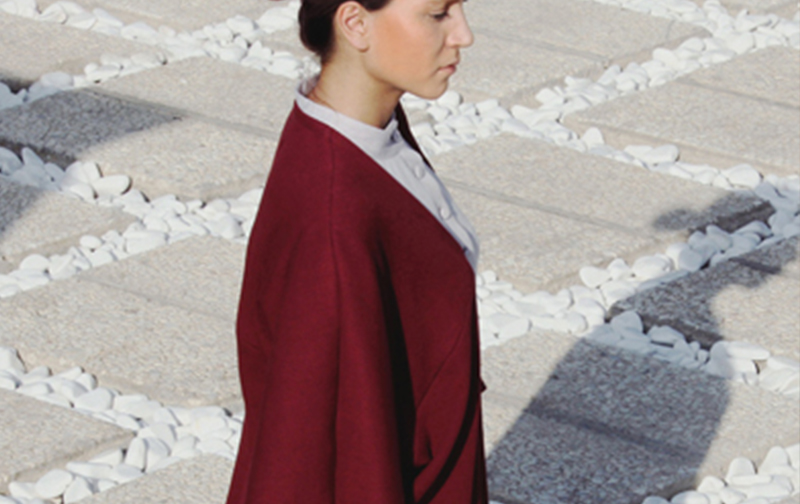
In the global dialogue of fashion, clothing becomes a “silent language” of culture – a semiotic system through which identity and history may speak without uttering a word. Modern designers seeking an Iranian resonance must do more than transcribe folk costumes; they must invoke the spirit of Iran. As Roland Barthes famously suggested, garments function like signifiers in a mythic code, and as Susan Sontag insisted, style itself carries meaning beyond mere decoration. To “inhabit” Persian culture in a contemporary way, fashion must work like poetry: evoking memory, atmosphere and emotion rather than reenacting literal motifs. In this sense, each cut or color can become an echo of Persian heritage. Craftestan, writing of Persian clothing history, puts it aptly: “Woven with exquisite care and steeped in symbolism… Each motif, colour, and pattern is a visual poetry, drawn from nature’s splendour, ancient folklore, and the region’s rich historical tapestry” . This suggests that the essence of Persia in fashion lies not in reproducing a palace robe or tribal dress, but in weaving a kind of symbolic tapestry – a whisper of gardens, calligraphy, geometric space, and mystic longing – into the cloth.
To achieve this poetic mode of design, one must navigate the tension between authenticity and interpretation. Edward Said’s critique of Orientalism reminds us that Western depictions of Iran have often exoticized and flattened a “diverse conglomeration of peoples and cultures” into a romantic stereotype . As Roxane Zand notes, Said’s Orientalism exposed how the East was “viewed with a romanticized exoticism” by the West . Today, Iranian and global artists are eager to reclaim their narrative “with pride” , but they must steer clear of cliché. Instead of parroting foreign expectations, designers can follow the lead of Persian writers: suggest the feeling of a sunlit meadow or moonlit garden, the whisper of Rumi’s poetry or Hafez’s metaphor, without resorting to literal gems or snake-charmers. In practice, this means referencing Persian culture as an echo or an atmosphere, not as an ornament or costume. Lorenzo Salamone observes that recent fashion shows have been careful “not to imitate the costumes of those [Asian and Middle Eastern] reference countries but rather to evoke their atmospheres and colors” . The result is clothing that flirts with a vague, distant horizon – “almost that faraway, mythological, and imaginary land” of the old “Orient” – where Indian, Arab, and Persian inspirations meld into something new . In Salamone’s words, these pieces “wink at an ambiguous and composite audience” and contribute to a “global wardrobe” rather than locking any one people into a static historical look . Such globalism echoes Homi Bhabha’s notion of a hybrid “third space,” where new identities form between tradition and modernity.
Philosophically, this approach resonates with Walter Benjamin’s reflections on art and aura. In The Work of Art in the Age of Mechanical Reproduction, Benjamin notes that a traditional craft gains a unique “aura” from its place in time and history; when a motif is endlessly copied, that aura fades. By not literally copying historic Persian designs, contemporary fashion can preserve their aura – an authenticity born of context. Instead of printing the literal pattern of a Safavid textile, a designer might abstract its geometry, or take its subtle colour palette, thereby suggesting the Persian garden or mosque rather than reenacting it. In this way, every garment maintains its own originality while still carrying the intangible glow of its inspiration.
Memory and longing – themes central to many Iranian poets – also find expression through abstraction. Iranians in exile often carry the ache of home in nonliteral ways, and fashion can similarly evoke absence as well as presence. Forough Farrokhzad’s poetry, for instance, is steeped in images of captivity and yearning that apply not only to personal love but to cultural displacement. In “The Captive,” she writes, “I, in this corner of the cage, am a captive bird… O sky, if I want one day to fly from this silent prison” . Here the “cage” could be literal society’s constraints or the distance from one’s homeland – and the desire to “fly” recalls how art transcends boundaries. Similarly, in “On Loving,” she begs to be wrapped “in sleep’s silk” so she might “grow wings of light, fly through [sleep’s] open door beyond the world’s fences and walls” . This exquisite line, though about love, carries a broader metaphor: the longing to pass beyond fences – of nation or culture – to union. A designer who invokes this spirit might create pieces that feel like the memory of something lost – a silhouette tinted as if by sunset light, a fragrance of damascene rose in the fabric, a line of calligraphy decoded into a folded seam – suggesting a flight beyond literal walls. These are poetic gestures, not literal ones, and they respect Farrokhzad’s subtle, haunting tone.
The Iranian literary canon is full of such imagery that can inform conceptual design. The mystic Rumi, for example, calls us to a field “beyond ideas of wrongdoing and rightdoing,” an open space where love unites all . While we may not quote Rumi directly on a garment, we can channel his ethos of boundless movement: flowing drapes or layers that shift like shifting perspectives, patterns that have no true beginning or end. Hafez’s verses about the moon, wine, and the beloved could inspire color and mood rather than motifs: a silver lantern of a pendant, a deep indigo like night, a chant-like rhythm in a pleat pattern. Such references are cultural underlayment rather than decals. In traditional Persian miniatures and tile-work, we see philosophy: the infinite swirl of a garden fountain, the merging of heaven and earth in a sky dome. A minimalist collection might echo these abstractions – say, an iwan arch reinterpreted as a collar, a geometric tessellation rendered as a tonal jacquard, or a sufi-whirl headdress reimagined as a swept hair silhouette. The key is that nothing reads as a costume; instead, it feels resonant.
This approach also acknowledges the sociology of fashion. As Michel Foucault reminds us, clothing is part of the discourse of power and identity. In Iran, garments can encode social roles or rebellion. Conversely, reading Western fashion through an Iranian lens reveals how roles may be shared (the office coat and the bazaar vest both express labor, for example). In Farzaneh’s work, we see a dialog about masculinity and labor – yet dressed in fabrics that evoke her father’s tailoring and her grandfather’s unpatterned cuts. She notes that even in Tehran “the kids…are still trying to win each other over with their style choices” just as in London . Clothing thus unites; it is both conformity and individuality. By recontextualizing uniforms or workwear, Iranian-inspired fashion can question stereotypes (the militant tunic becomes a sartorial symbol of everyday dignity, for instance) without nostalgia.
To avoid orientalism, designers have learned to treat inspiration as a starting point rather than a blueprint. This means distilling the essence: a sense of proportion from Persian architecture, a love of texture from carpet weaving, a spirituality from calligraphy, a narrative from poetry. Edward Said’s shadow warns us that if designers simply copy a “folk costume,” they risk reinforcing the very dichotomies of “civilized versus barbaric” he critiqued . But if they transform a Persian garden pattern into a subtle jacquard, or reinterpret a muqarna vault as a layered silhouette, they create something both new and meaningful. In this process, authenticity is not fidelity to old forms but fidelity to feeling. The collections that resonate most feel charged with memory – not because they reproduce it exactly, but because they internalize it. Susan Sontag might say that such work is its style; its sincerity and depth become part of the design.
This strategy respects Walter Benjamin’s insight that mechanical copying strips an object of its unique aura. Instead of mass-producing a copied motif, contemporary Iranian-inspired fashion uses conceptual multiplicity: one shape might suggest a dervish’s circle, another the outline of Mount Damavand, another the tessellated floor of an Isfahan palace. Each garment acquires its own aura through context (a show, a narrative, a scene of wearing) while still whispering of lineage. The result is akin to Walter Benjamin’s ideal of aura regained: one-of-a-kind artistry built on collective memory.
Indeed, many Iranians carry their heritage in intangible ways. Fatemeh Shams, a scholar of Persian literature, observes that Iranian exiles often took with them “three books: Saadi, Rumi, Forugh” . These poets embody the soul of the culture. A designer might think of this tradition of reading as a metaphor: garments as pages, prints as verses. A coat could have a lining printed with a poem in delicate Nastaliq, visible only when opened. A dress might be named after a couplet or composed in metaphorical steps. The point is not to republish books, but to honor the idea that culture is carried in stories and feelings.
In practice, such fashion often ends up minimalist or conceptual. One might see a simple tunic in the dusty rose of Kashan clay, or a sleek coat whose seams echo the form of a cypress tree – elements that few would immediately identify as Iranian unless told, but which create an uncanny resonance. The Persian concept of anhal (meaning “shameless” or “audacious”) and ataq (arrogance but also splendor) suggest that the pride of beauty need not always be loud: it can be quiet elegance steeped in history. Even black, a color often worn in Iran, can be used not for mourning but for typographic drama; emerald can be a nod to the green paradises of Persian gardens. Abstract patterning – a swirl, a star, a crescent – can hint at celestial mysticism without stating it overtly. A single olive twist closure on a jacket might reference an olive grove. A fabric might be woven with a very subtle pattern of pomegranate seeds (a national symbol) that reveals itself only in light.
Throughout, the tone remains literary and introspective. As Walter Benjamin put it, in art one “brings forth the meaning of a hidden nature.” So too in fashion inspired by Iranian culture: the goal is to bring out the meaning of a hidden atmosphere. The garments are less illustrations and more poems: ambiguous, open to interpretation, resonant with the history and exile that shape Iranian identity. This avoids kitsch and exoticism by assuming the viewer’s intelligence and allowing multiple layers of significance. One might see a modern draped silhouette and feel something ancestral stirring, without ever knowing exactly why.
Indeed, designers and theorists today speak of this practice almost as a dialogue. Even as global audiences may not recognize each reference, they respond to the aura of meaning. Farzaneh herself hopes simply to “alter a select few people’s understanding of something as small as the aesthetic” . In doing so she follows the advice of postcolonial thinkers like Bhabha and Said: reframe the narrative. Postmodern philosopher Roland Barthes taught that myths are made by turning objects into language. In this case, Iranian culture is not turned into an object, but given a voice through abstraction. The myth (in Barthes’s neutral sense) is new. And yet it respects the past: as the Craftestan account reminds us, Persian fashion has always “been a testament to the soul of a people and the beauty they carried into the world” . Contemporary designers tap into that soul subtly – a halo of jasmine-scented memory around the wearer, rather than a direct print.
In sum, modern fashion can be Iranian-inspired by evoking echoes rather than images. It can embody the tension between tradition and innovation, much as an Iranian poet dwells in paradox. The garments become a “field” beyond straightforward categories – a space where East and West, past and present, the individual and the collective, merge. By choosing restraint over ornament, suggestion over citation, designers allow Persian cultural elements to operate like a “mythic code” that informed audiences can read but others experience as an undefinable elegance. The result is clothing that feels like an old memory seen through a new lens – deeply Iranian in spirit, yet wholly contemporary in form.