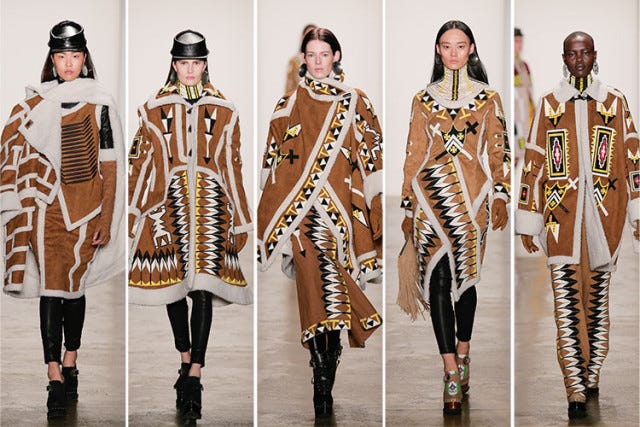
For Davis, social identity is more than symbols of social class or status but include any aspect of self that individuals use to communicate symbolically with others. In relation to fashion, this includes primarily nondiscursive visual and tactile means of representation within a social, cultural, and economic context.
This definition is elastic, and the focus will mainly be on what Davis (1994: 26–27) refers to as “master statuses” from the point of view that ambivalence is a way of enacting gender roles, social class identification, age, and sexuality through fashion that is hardwired to challenge the fixed and settled, creating shifts in perceptions of beauty, ideals, and status in the process.
Fashion’s appetite for change has been criticized for promoting an image of women as objects, for maintaining class structures, and for obstructing sustainability. The apparent pointlessness of fashion change has also invited satire, for instance, by Oscar Wilde in 1887: “Fashion is a form of ugliness so intolerable that we have to alter it every six months” (2004: 39).
Though phrased for the express purpose of humor, this unreliability of fashion in terms of, for instance, shifting conceptions of beauty points to fashioning identity as schizophrenic. Social identity displays are highly personal. We have selected them, they cover our bodies, and in the capacity of a second skin, we transfer our warmth and scent to these fashionable surfaces.
But they also function as social messages of self- and group belonging. The friction between individuality and community as conferred in a continuous visual and symbolic development is rooted in Simmel’s seminal observations originally published in 1904.
He argued that the transformative structure in fashion comes through the social tension between distinction and imitation—what he termed the social regulation through “aesthetic judgment” (Simmel 1957: 545)—in which the symbolic demonstration of status is copied in a linear adoption process. This progression moves toward an inevitable point of saturation that reboots the system.
In this sense, fashioning identity is a tragic game, a time bomb hardwired to self-detonate as the inevitable part of diffusion and social saturation. Though he refined the concept, Simmel’s observations were not entirely new.
In 1818, art critic William Hazlitt described fashion as “an odd jumble of contradictions, of sympathies and antipathies. It exists only by its being participated among a certain number of persons, and its essence is destroyed by being communicated to a greater number”.
While these contradictions form the basis in the present treatment of fashioning identity, the notion of death by popularity will also be challenged when looking at the perseverance of some trends such as leopard print, just as the dogma of distinction will be explored through its inversion, namely, looking fashionably bland.
The social schizophrenia of fashion runs on taste, access, and the “artful manipulation” (Davis 1994: 17) of the fashion industry. In early twenty-first century, the inner workings of fashioning identity are still informed by the pulse of the fashion industry that to a certain extent controls supply and thereby the tools for engaging in the social game of fashion.
However, the premise of this aesthetic judgment has shifted over time in line with changes in the industry, society, and social norms. The historical perspective is included here to provide background to the mechanisms of status competition in contemporary fashion.
As with many other sides of Kennedy’s life, his choice of what to wear on his head has been subject to speculation in terms of social, economic, technological, and personal developments. Hat sales had been on the down since the 1950s, and Kennedy may have brought the development to its culmination.
But there were also other perspectives. Was the rise of the hatless man a reflection of the flourishing youth culture? Was it caused by the increase in cars that left less room for a hat than in a tram or bus? Or can Kennedy’s giving up hats be explained simply by him wanting to show off a gorgeous head of hair?
From a fashion perspective, Kennedy was a trendsetter because of his social standing, his powerful position, and for what has been described as his “Cool Factor” (Betts 2007). He was navigating an era of transition and, in a very minor way, his ambivalence toward hats might be seen to reflect this.
As a trendsetter, he was instrumental in the diffusion of the trend for going hatless while also emulating the current mood. In this sense, Kennedy’s sartorial choices can be read as fashion flows. Fashion flows are understood here as the consumer adoption of new styles in fashion.
This social dynamic is informed by the fashion industry, culture, and societal contexts. Fashion flows—sometimes also referred to as tricklemovements—rest on the paradoxical need among especially the socially mobile for both individual distinction and group identification