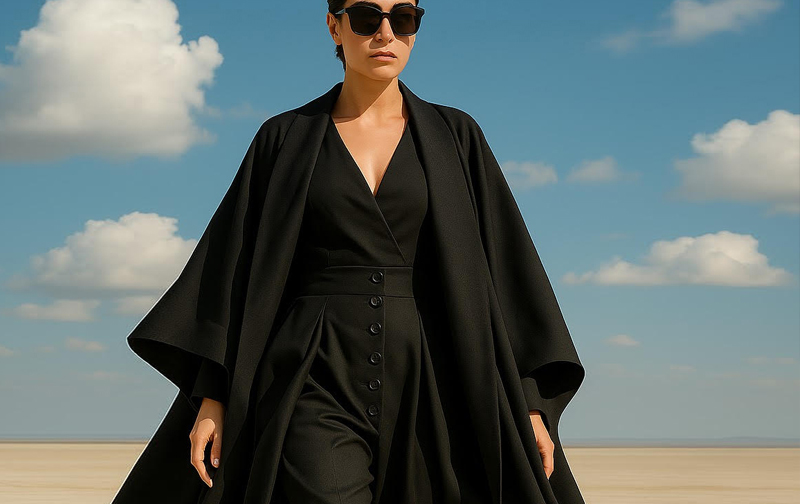
Fashion design is widely regarded not just as the crafting of garments, but as the creation of a vision. To “design” in the context of fashion means to invent and to express – to solve aesthetic and functional problems through clothing, and to articulate ideas or narratives through style. As the designer Ralph Lauren famously remarked, “I don’t design clothes. I design dreams.”
This highlights that true designing goes beyond stitching fabrics together; it involves imbuing clothing with meaning, story, and purpose. In contrast, merely adorning a dress with decorative trim or replicating another’s pattern without innovation is not genuine design – it is embellishment or imitation. Designing implies a creative act of origination, whereas decoration is about surface appeal and replication is the copying of an existing creation. The difference is profound: the former adds something new to the world, the latter merely recombines or repeats what already exists.
Underlying the ethos that a fashion designer should have their own style of designing is the belief that originality and personal vision are the lifeblood of fashion as an art form. To have a signature style is to have a distinctive point of view manifested consistently in one’s work – a unique aesthetic or technique that makes the designer’s creations recognizable.
This concept is akin to an artist’s fingerprint on their paintings or a novelist’s voice in their prose. In fashion, it might be a particular silhouette, a recurring motif, a construction technique, or an overall design philosophy. The couturier Giambattista Valli noted that “the hardest thing in fashion is not to be known for a logo, but to be known for a silhouette.”
In other words, the mark of true design talent is having an instantly recognizable form or style that does not rely on conspicuous branding but on creative substance. A strong signature look – say, the architectural lines of a Balenciaga coat or the exuberant prints of an Emilio Pucci dress – communicates authorship. It tells observers that this creation could only have come from one mind in particular. Such a personal style does not emerge from nowhere; it is cultivated over time through experimentation, courage, and consistency.
What does it mean for a designer to have “their own style”? It means that their designs reflect an internal coherence and a set of guiding principles distinct to them. It means the designer is not simply chasing trends or mimicking peers, but building upon a personal set of inspirations, values, and creative impulses. Coco Chanel, one of the most celebrated designers in history, advised that “in order to be irreplaceable one must always be different.”
Chanel herself exemplified this maxim: she forged a new design language in the early 20th century by rejecting the ornate, restrictive women’s fashions of her time in favor of clean lines and comfort. Chanel’s early designs were radical for liberating women from corsets and excessive frills. Her “uncluttered styles, with their boxy lines and shortened skirts,” allowed women unprecedented ease of movement and modern functionality, “freeing them for the practical activities” of modern life . Elements of these early innovations – the trim tweed suit, the use of jersey knit for elegant sportswear, the little black dress – became hallmarks of the Chanel look.
By channeling her personal ethos of simplicity and freedom into every garment, Chanel developed a signature style so strong that it made her an arbiter of taste for decades . She effectively marketed her own attitudes and way of life through design, proving that a designer’s individual style can define not only a brand but an era.
Just as Chanel’s minimalist chic stood out in the 1920s, other designers throughout history have risen to prominence by imprinting their unique style on fashion. When Christian Dior debuted his “New Look” in 1947 – with its cinched waists, padded hips, and billowing mid-calf skirts – it shocked and thrilled the world in equal measure. After years of World War II austerity and boxy utilitarian attire, Dior’s lavishly feminine silhouette was a jarring departure .
Some critics decried it as excessive or retrograde, with Coco Chanel herself quipping that “Dior doesn’t dress women, he upholsters them!” Yet Dior’s New Look undeniably bore the stamp of a singular vision, and it soon became the signature silhouette for well-dressed women in the late 1940s and 1950s . By turning women into what he poetically described as “flowers, with soft shoulders, blooming bosoms… and skirts opening up like blossoms,” Dior illustrated how a strong design viewpoint – even one that polarizes – can redefine beauty and set new standards .
Here was real design in action: not a mere tweak on prevailing styles, but a bold proposal of an entirely new aesthetic ideal. The controversy itself proved that Dior was designing, not just decorating; he was proposing something original enough to warrant debate and ultimately to change the direction of fashion.Yves Saint Laurent, trained in the house of Dior before establishing his own maison, offers another instructive case. Saint Laurent believed in the power of style as something enduring (“Fashions fade, style is eternal,” he famously said ) and in his work he continually introduced designs that bore his personal imprint. Perhaps his most famous contribution was Le Smoking, the first tuxedo tailored for women, unveiled in 1966.
At a time when societal norms still frowned upon women in pants, Saint Laurent’s androgynous evening suit was daring and new. It encapsulated his signature approach of borrowing from menswear to empower women: an idea he had earlier demonstrated when he opened his very first collection in 1962 with a chic pea coat and trousers ensemble. That outfit, inspired by a sailor’s uniform, “paved the way for Yves Saint Laurent’s signature style, which borrowed from menswear in order to make women feel comfortable and confident” . Saint Laurent’s designs consistently married elegance with rebellion – a respect for the classics (tuxedos, peacoats, tailored safari jackets) with an impulse to subvert gender conventions and power dynamics.
Over the years he built a vocabulary of style that was unmistakably his own, from the Mondrian shift dress that merged fashion with modern art, to opulent collections inspired by diverse cultures and eras yet always filtered through his particular sensibility . Each collection added to the composite portrait of YSL’s aesthetic world. By the 1970s, his name had become synonymous with a certain bold yet sophisticated style. This personal style legacy is why, even long after his retirement and passing, the label “Yves Saint Laurent” still evokes a clear image in the mind – testament to how a designer’s unique vision can become eternal.
If having a signature style is the hallmark of real design, then what counts as “not designing”? In the competitive arena of fashion, it is not uncommon to find brands or individuals who produce clothing by closely tracking whatever is en vogue, or by replicating the innovations of others with slight modifications. This may be savvy business, but it lacks the creative authorship that defines true design. As the designer Oscar de la Renta once drew the distinction, “Fashion is about dressing according to what’s fashionable. Style is more about being yourself.”
The designer who merely dresses according to what is fashionable – following the crowd, imitating the latest runway fads – is not exercising design so much as exercising trend compliance. We see this in fast-fashion retailers that rapidly copy luxury catwalk designs; they produce garments that mimic a look, but there is no individual creative vision behind them. Their products are decorative iterations of someone else’s idea, stripped of the context and innovation that gave the original its soul. The sociologist Georg Simmel observed long ago that fashion exists in a tension between imitation and individual differentiation . A true designer leans toward differentiation, offering new ideas that set them apart, whereas an imitator leans on imitation, conforming to styles set by others.
“Trendy is the last stage before tacky,” warned Karl Lagerfeld , capturing the peril of mindlessly chasing trends. When fashion turns into a mere commodity of trend replication, it loses the element of design-as-innovation. Those who copy may achieve momentary popularity, but they rarely earn enduring respect in the fashion world, precisely because they contributed no signature. They are, in effect, not designing in the creative or intellectual sense.
Originality matters not only for its own sake but for what it enables. One reason a strong, recognizable signature look is so important is that it is a mark of authenticity and creative integrity. In art and design, originality has long been equated with genuineness. The philosopher Immanuel Kant, in discussing aesthetic genius, wrote that genius must be considered “the very opposite of a spirit of imitation,” and that “the foremost property of genius must be originality” . The products of genius, Kant argued, are examples “not meant to be imitated, but to be followed” by others awakened to their own creativity .
In other words, original design sets a new paradigm; it does not merely conform to existing ones. Fashion designers who introduce a novel style thereby act as leaders and authors in their field, rather than followers. Their work has an inventive “aura,” to borrow Walter Benjamin’s term for the unique authenticity of an artwork that cannot be replicated . Consider how a genuine design by a great couturier carries a certain prestige and indefinable spirit – a Chanel suit, with its precise tailoring and heritage tweed, has an aura of Chanel’s pioneering modernism embedded in it.
A knock-off of the same suit may copy the superficial elements, but it lacks the intangible narrative and creative authority of the original. Thus, having one’s own style confers a kind of authorship and authenticity that cannot be faked; it is evident in the coherence and confidence of the designs.
Second, a signature style serves as a form of communication and connection. Fashion, as many have noted, is a language – “Fashion is instant language,” as Miuccia Prada put it . Designers communicate through their clothes, expressing ideas about identity, beauty, and culture. A consistent design style is like a dialect within that language: it makes the message of the designer clear and comprehensible over time. When viewers see a Rei Kawakubo garment with its deconstructed, sculptural form, they understand the visual syntax as Kawakubo’s unique language, often conveying concepts of rebellion, asymmetry, and reimagined beauty.
A clear signature style allows a designer’s work to speak loudly and purposefully amid the noise of an ever-changing fashion landscape. It creates a connection with an audience that comes to appreciate and trust that style. In marketing terms, it builds a brand, but on a deeper level, it builds a relationship between the designer and society. People begin to look to that designer for a certain perspective – whether it is Chanel for timeless chic, Westwood for subversive drama, or Kawakubo for avant-garde provocation. These designers effectively become auteurs of fashion. Just as filmgoers might seek out a movie because it is distinctly a “Hitchcock film” or a “Kurosawa film,” fashion connoisseurs find meaning in the work of designers with a strong auteur signature.
The loyalty and admiration they earn is not just a product of marketing, but of resonance: a signature style resonates because it stands for something clear and consistent. It reflects, perhaps, an authentic point of view about life and aesthetics that others can latch onto or draw inspiration from.
History provides rich illustrations of how a designer’s personal style can forge such connections. Take Vivienne Westwood, who in the 1970s essentially clothed the punk movement in its unmistakable garb of ripped shirts, tartan bondage trousers, and safety-pin accessories. Westwood did not merely follow an existing trend – she and her then-partner Malcolm McLaren actively created the punk look as an anti-establishment statement. “I didn’t consider myself a fashion designer at all at the time of punk. I was just using fashion as a way to express my resistance and to be rebellious,” Westwood recalled of her early career .
That attitude of using one’s own style as a voice of dissent defined her signature. The clothing from her boutique on King’s Road, provocatively named SEX, shocked and provoked, and that was by design: it was fashion as social commentary, with every ripped seam and anarchic slogan T-shirt reflecting Westwood’s values and anger at the status quo . By having the courage to inject her personal politics and creativity into her designs, she gave rise to an entire subculture. Punk style was so tied to Westwood’s vision that it remains her legacy – a perfect example of a signature style merging with a cultural movement. Here, the identity, culture, and values of a generation were literally woven into the fabric of fashion.
What Westwood offered was real design because it originated from a place of authenticity and bold creativity, rather than commercial calculation. And it mattered: not only did it propel her to iconic status, it also empowered others to use fashion as self-expression. As she advised, we should “express ourselves not by copying others, but by choosing our own style” – counsel that underscores how a genuine style can inspire individuality in others.
Another towering example is Rei Kawakubo of Comme des Garçons, whose work reveals why having one’s own style of designing is crucial to advancing fashion. Since her Paris debut in 1981, Kawakubo has “defied convention to redefine fashion,” regularly subverting garment shape and function and pursuing ideas that “did not exist before” . Her early collections shocked the Paris fashion establishment: critics in the early 1980s called her austere, mostly black clothes “apocalyptic,” even dubbing the look “Hiroshima chic,” yet others saw in it “newness, strangeness, inventiveness and surprisingly fresh thinking” .
Such polarized reactions testified to the originality of Kawakubo’s vision. She was not embellishing already-accepted styles; she was inventing a new aesthetic from the ground up – in her words, resolving “to ‘start from zero’ conceptually, to ‘do things that have not been done before’” . Over time, Kawakubo’s singular style – intellectually rigorous, avant-garde, and often challenging the definition of clothing – has made her one of the most influential designers alive . By steadfastly adhering to her own approach, she expanded the vocabulary of fashion. The shockwaves of her early shows opened doors for other Japanese designers and for new modes of design worldwide; contemporaries and critics admired the “strength and elegance” of her rule-breaking aesthetic .
Today, a Comme des Garçons piece is instantly identifiable; it carries the unmistakable imprint of Kawakubo’s philosophy. This recognizable signature matters because it represents the frontier-pushing role of fashion design. It encourages the industry (and consumers) to see garments not just as items to wear, but as conceptual art or social commentary, even when the results are not conventionally “pretty.” By contrasting Kawakubo’s approach with what came before, we see clearly what is design and what is not: her work has intention and inquiry in every stitch, whereas a look-alike garment copying her hole-punched sweaters without grasping the concept would only be surface-deep.
From a sociological perspective, the insistence on an original style reflects how fashion is intertwined with identity and culture. Clothing has always been one of the primary means by which individuals signal who they are – or wish to be – in society. As one observer noted, “clothing choices can reflect personal tastes, beliefs, values and cultural backgrounds, making fashion a powerful tool for expressing one’s identity.” A designer’s signature style often encodes that designer’s own identity and values, which in turn allows wearers to partake in a certain cultural or ideological message.
For example, Chanel’s pared-down, boyish elegance in the 1920s reflected her rebellion against the constraints on women – when women donned Chanel’s relaxed silhouettes, they were aligning with the modern, liberated identity that Chanel herself embodied. Similarly, someone wearing a Westwood punk-inspired jacket in 1977 was consciously embracing the anti-authoritarian, anarchic values that Westwood had stitched into those clothes. In this way, designers with a strong style influence culture: they offer new symbols and even “uniforms” for people to express themselves. Fashion is, to recall the witty formulation by Bill Cunningham, “the armor to survive the reality of everyday life.”
It follows that those who craft this armor with distinct purpose and identity are the ones effectively shaping how society visually converses and copes. A uniform or generic approach to design – one that merely follows whatever is already popular – cannot have this effect, because it carries no clear identity to communicate. Only authentic design anchored in a personal style can speak to the complexities of identity and community, because it originates from an authentic place and thus resonates with authenticity.
Philosophically, the value placed on having one’s own design style ties into ideas about creativity and authorship. Creativity, by definition, involves bringing something new into being. The process of fashion design at its best is an act of creativity comparable to writing a poem or composing a piece of music – it requires originality, vision, and often a message. The “authorship” of a fashion designer is evident when we talk about how a dress is a “McQueen” or a “Chanel” in the way we talk about a novel being a work of a particular author. We attribute creative ownership of the style and concept to that designer. In the realm of literature and art, original style is what distinguishes a great author or painter; the same holds in fashion.
The theorist Roland Barthes, in dissecting the system of fashion, noted how garments carry coded meanings much like texts, and one might say the designer is the author of those meanings. While the interpretation of fashion is ultimately open to the audience (just as a reader interprets a text), it remains true that designers inject personal intention and creativity into their work. The most revered designers are indeed treated as authors of a distinctive oeuvre. They have a voice.
When designers lack their own style, we might compare it to a writer producing cliché-ridden prose or an artist painting by numbers – technically they produce something, but it fails to captivate or break new ground because it lacks a singular voice. Original design, by contrast, has what philosophers call intentionality behind it: the presence of the creator’s mind at work, solving problems and making artistic choices. It bears emphasizing that originality in design does not mean creating in a vacuum with no influences – all designers draw inspiration from the world around them, from art history, from street culture, from myriad sources. The difference is that a skilled designer synthesizes influences into something fresh and personal, whereas someone who is “not designing” might simply replicate an influence with minimal transformation.
As the saying (often attributed to Picasso) goes, “Good artists copy, great artists steal,” meaning the great ones absorb and transform what they take, making it entirely their own. This creative ownership is what designers with a strong personal style achieve. Their work might nod to historical costume or global crafts or modern art, but ultimately the result is stamped with their identity. In doing so, they perform the creative act of bringing forth something that did not exist before in quite that form – creating, as it were, new rules for others to follow. The history and philosophy of fashion both affirm that the craft of design is most meaningful when it bears the signature of its author – when it is, in the truest sense, designed.
Even in the contemporary fashion industry, awash with fleeting micro-trends and global mass-market influences, the importance of a unique design style remains undiminished. It is notable that the world’s leading luxury houses often revolve around the distinctive “codes” established by their founding designers – proof that a personal style can become the DNA of a brand. Decades after Coco Chanel’s death, the designers who succeed her at the House of Chanel still incorporate the camellias, the tweeds, the gilt chains and pearls that were part of her signature, reinterpreting those elements for new generations but never losing the thread of her original vision.
The same can be said for Dior or Gucci, where creative directors are tasked with both innovating and respecting the unmistakable style heritage that defines the label. This dynamic illustrates how a designer’s own style of designing can outlast the designer, accruing cultural and commercial value over time. It also reinforces that originality is the wellspring of lasting appeal: trends may come and go, but a signature style builds a legacy.
Finally, we should recognize that cultivating one’s own style is fundamentally about self-expression – a truth that applies to designers and wearers alike. Fashion icon Iris Apfel encapsulated this when she said, “Fashion you can buy, but style you possess. The key to style is learning who you are, which takes years… It’s about self-expression and, above all, attitude.” Style springs from knowing oneself; for a designer, it springs from knowing one’s creative soul and daring to let it speak through design. When a fashion designer pours their identity, beliefs, and artistry into their work, the result transcends mere clothes and becomes a form of communication between the designer and the world. That act of communication – authentic and imaginative – is the essence of what real designing means.
It differentiates the luminaries of fashion from the faceless imitators. In this sense, the mandate that designers should have their own style is a call for creativity and sincerity. It ensures that fashion remains, as it has always been at its heights, a reflection of individual genius and a mirror to the society in which it exists. By having a signature style, a designer not only asserts their artistic autonomy but also enriches the tapestry of fashion, ensuring that this art of appearances never loses its substance or its soul.