The art of crafting visual worlds for performance – through set design, art direction, costume design, and fashion – has roots as old as performance itself. In ancient theatres, we find the first deliberate use of space, scenery, and dress to convey narrative and meaning. The open-air theatres of classical Greece, for example, relied on minimal sets but highly symbolic costumes and masks. Actors donned masks (prosopon) with exaggerated expressions to signify characters and emotions, a convention so integral that “comedy and tragedy masks” remain global symbols of theatre . Greek stage architecture featured a painted skené backdrop and simple machines – a crane (mechane) to fly gods, a rolling platform (ekkykléma) to reveal tableaux – but the storytelling largely unfolded through the chorus and performers rather than realistic scenery. This early priority of performance over literal realism persisted for centuries. In the Sanskrit dramas of ancient India, detailed in the Natya Shastra (~200 BCE), and in early Chinese court entertainments, we likewise see emphasis on stylized gesture, music, and costume rather than on built illusionistic sets. Theater was born in ritual and myth; its design elements were originally minimalist frameworks for maximal imaginative impact.
In the Achaemenid Empire (c. 550–330 BCE), the earliest foundations of staged performance and costume design in Iranian history can be observed, not in formal theatre structures akin to those in classical Greece, but within court rituals, religious ceremonies, royal pageants, and processional spectacles. These events functioned as highly choreographed, performative displays that employed visual symbolism, costume, and spatial arrangement to convey power, divine order, and imperial ideology. The Persepolis reliefs, among the most significant visual records from the Achaemenid era, offer insights into this performative culture. Carved into the stone walls of the Apadana and other palatial structures, these reliefs depict delegations from various nations, each bringing tribute to the king. The figures are rendered in exquisite detail, each group distinguishable by their distinctive ethnic costumes, hairstyles, and items they bear. Though not theatrical performances in a modern sense, these diplomatic rituals were carefully staged displays of imperial unity and order, with each costume acting as a coded symbol of regional identity and submission to the Achaemenid ruler. The processions themselves were likely enacted during Nowruz ceremonies, accompanied by music and ritual, suggesting an early form of performance art grounded in power, narrative, and visual spectacle. Costume during this period was not merely utilitarian or ornamental but ideologically loaded. The Achaemenid court dress, particularly that of the king and his high officials, featured flowing robes with pleated textures, tall headdresses or tiaras, and ornate jewelry, all of which communicated hierarchical status and sacred kingship. The king, as the embodiment of Xšaça (divinely sanctioned rule), often wore elaborately decorated garments with embroidered motifs and held symbolic items like a scepter or lotus. This regal attire functioned as a performative costume, signaling the wearer’s proximity to divine authority and setting a visual standard for imperial representation. Herodotus and other classical sources describe the Persian taste for ceremony, with banquets, royal appearances, and military parades taking on the character of theatrical events. These performances were staged with precision and adorned by costumed roles—the king, the Immortals (elite guards), priests, envoys—each distinguishable by their garments and regalia. The Immortals, for instance, were said to wear uniforms of woven gold, possibly including ornamental elements meant to dazzle and intimidate, underscoring the importance of visual impact in Achaemenid public display. Though the Achaemenids did not construct theatres or write plays as the Greeks did, their performative rituals—executed on the grand terraces of Persepolis or in sacred spaces like Pasargadae—suggest a theatrical consciousness rooted in architecture, attire, and ceremony. The spaces themselves, often elevated, symmetrical, and processional in design, created a kind of visual stage upon which power was enacted and witnessed. Scholars have argued that these imperial rituals constituted a “theatre of power,” where costume and movement were deliberately choreographed to produce awe and reinforce legitimacy. Thus, in the Achaemenid world, the seeds of stage and costume design are found not in narrative theatre but in statecraft and sacred ritual. These events deployed space, symbolism, and sartorial codes to craft spectacles of rule, many of which were designed to be witnessed by both domestic elites and foreign emissaries—making them, in effect, some of the earliest documented visual performances in Iranian history.
As theatre traditions developed, costumes and stage art became codified to communicate character and context at a glance. Nowhere is this clearer than in the Italian Renaissance comedy of commedia dell’arte. Each stock character of the commedia – the miserly old Pantalone, the braggart soldier Capitano, the clever servant Harlequin – wore a distinctive ensemble instantly conveying their role and social status . Pantalone’s red vest and tight trousers, Il Dottore’s black scholarly robe, or Harlequin’s patchwork motley (later the famous diamond-patterned suit) were essentially visual archetypes, as recognizable to audiences as uniforms . These costumes functioned as a kind of sartorial shorthand: an actor could stride onstage and, by costume alone, the audience grasped the character’s identity and station. This principle – that clothing on stage “must express essential ideas… beyond its own literal existence as a garment” – was articulated much later by theorist Roland Barthes, but the practice was intuitive in forms like commedia. Similarly, Japanese Noh theatre developed a rich vocabulary of costume and masks tied to character types. Noh performance on a classical stage – with its polished cedar floor, thatched roof and the iconic painted pine tree backdrop – exemplifies the fusion of sparse setting and sumptuous attire. In Noh, which dates to the 14th century, actors wear silk brocade robes and sculpted masks that transform them into gods, demons, or forsaken souls. Early Noh plays, shaped by the actor-playwright Zeami, aimed for clothing that genuinely befitted the character’s rank (court robes for nobles, simple kimono for commoners), but by the late 1500s the costumes had become more elaborate and symbolic than strictly realistic . A masked Noh performer in shimmering silk layers, moving to flute and drum, embodies an ideal of theatrical art: minimal scenery – often just the bare stage and a fan as a prop – balanced by maximal significance in each costume fold and carved mask. The stage itself is regarded as a consecrated space, a “shared experience between performers and audience” with no curtain to hide entrances . The architecture (an auspicious Shinto-style roof upheld by four pillars) and the painted pine tree on the rear wall all carry symbolic weight . Thus, in Noh we see the deep integration of design, from architectural space to garment detail, in service of a poetic, almost ritualized theatre experience.
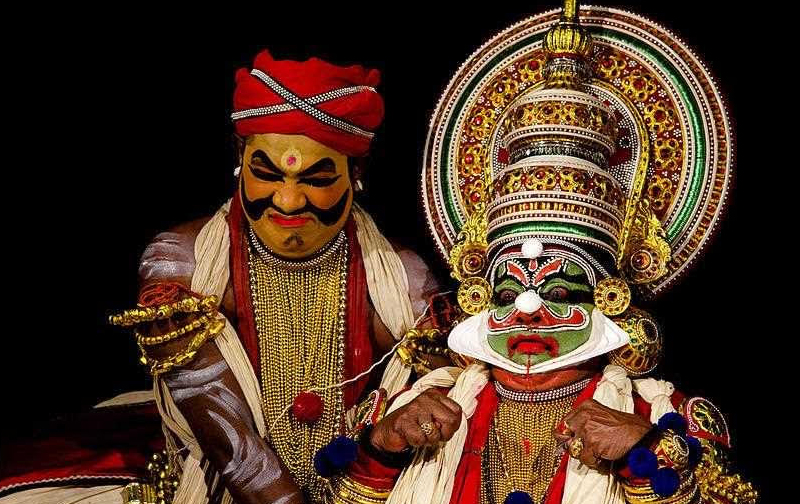
Non-Western performance traditions developed their own highly sophisticated design languages. In the vibrant Kathakali dance-drama of India, for instance, costume and makeup constitute a complex code that the audience learns to read . A Kathakali artist in full costume appears almost superhuman – face painted green or black or red depending on the character’s nature (noble hero, villainous demon, or divine being), wearing a towering headpiece and a billowing layered skirt . It can take artists hours to don these resplendent costumes and elaborate facial makeup, which together instantly signal a character’s identity and moral bearing . A green face with delicate rice-paste patterns (pachcha) signifies a virtuous hero or god, while a red beard or streaks indicate evil intent . Every color and ornament – down to the tassels and the concentric halo-like headgear – is codified, embodying an aesthetic of spectacle that heightens the epic, otherworldly tone of Kathakali performances. These visual codes in Kathakali are not arbitrary; they connect to ancient Hindu theory (the Guṇa qualities) mapping colors to personality traits . Much as a medieval European mystery play might dress the Virtues in white and Vice in red and black, Kathakali uses costume as a moral and narrative sign-system that complements its stylized choreography. Chinese Beijing Opera (Peking Opera) evolved a comparable system. Performers wear brilliantly embroidered costumes and often ornate headdresses indicating their role’s rank and attributes. In the absence of realistic sets (Peking Opera stages have remained essentially bare platforms with perhaps a table and chair to symbolize multiple objects ), costume carries extraordinary importance. Qing dynasty court robes, for example, are used to signify emperors and high officials – yellow silks with dragon motifs for the emperor, rich purple for ministers – whereas warriors wear armor-like vests and the clowns (chou) wear simple cotton jackets . The colors themselves form a code of status and virtue: red for loyal high-ranking men, blue for lower officials, white for the old or the young, black for commoners . Even sleeve length is meaningful: the famous “water sleeves” – long white silk extensions on the sleeves – are flicked in graceful arcs to express emotion. Beijing Opera’s spectacular facial makeup (the jing role’s painted masks with intricate color patterns) further externalizes character traits, much as in Kathakali. Across these global traditions, we see a common thread: when physical scenery is limited, costume and makeup take on an outsized dramaturgical role. They become moving scenery worn on the body – a kind of symbolic set design that travels with the actor.
While Asian theatres were codifying costume and mask to convey meaning, European theatre was undergoing its own evolution in design. Medieval European drama, particularly the church-sponsored mystery plays, began with almost no “set” other than the background of a cathedral or town square. Scenes from the Bible were staged on wheeled pageant wagons or fixed platforms, with minimal scenery but some striking props (a painted Hell-mouth that belched fire to consume sinners was a crowd favorite). Costumes in medieval drama often fell back on emblematic choices: Roman soldiers in church plays might don actual armor pieces on loan, while abstract virtues and vices in morality plays carried identifying objects or text labels. Despite its apparent simplicity, medieval theatre had a profound sense of theatrical space as shared between performers and onlookers, not unlike Noh’s open stage. Guild actors performed in the streets, close to their audience, relying on broad gestures and easily recognized costumes (e.g. white robes for angels, skeletal rags for Death) to put across their stories. It was a performative style that Erving Goffman’s sociology would much later echo: in public, people “maintain a show” of their role , much as medieval actors signaled their allegorical role through costume for the community audience. In a sense, everyday medieval life – with its strict dress codes demarcating peasant, priest, or noble – already had a theatrical quality. Sumptuary laws dictated who could wear luxurious fabrics or colors, effectively costuming society by rank. Theatre both mirrored and reinforced this: kings on stage wore purple robes just as real kings did, and devils wore the motley of social outcasts. By the Renaissance, theatre artists began consciously designing staging and costumes with artistic unity, borrowing perspective and painting techniques from the visual arts. Renaissance court masques in Italy and England around 1600 introduced painted backdrops and ingenious machinery. The Italian designer Sebastiano Serlio wrote treatises on creating the illusion of depth on stage with angled wings and backcloths, heralding the era of perspective scenery. In England, Inigo Jones famously designed elaborate scenery and costumes for court masques featuring moving clouds, descending gods, and classical costumes – a far cry from the bare platforms of medieval times.
The 17th and 18th centuries saw further divergence between theatrical traditions in the West and East, yet also some intriguing parallels. In Japan’s Kabuki theatre (emerging in the 1600s), technological innovation in staging rivaled that of Europe’s Baroque courts. Kabuki stages were equipped with revolving turntables (mawaributai) and trap doors by the 18th century, allowing swift scene changes and dramatic entrances, much like the rotating prisms and flying machines of Baroque opera houses in Italy. Kabuki costumes were exuberant: flowing silk kimonos with bold patterns, and in the case of the legendary onnagata (male actors playing female roles), costumes and makeup so elaborate that they created an idealized vision of femininity on stage. European visitors in the 19th century were astonished at Kabuki’s production values – the grandeur of a Kabuki samurai battle scene with its profusion of banners and theatrical fog could easily rival a lavish Shakespearean production at Covent Garden. Meanwhile, in Europe, the Baroque period transformed stage design into an art of illusion and splendor. Theatres like Teatro Farnese in Parma (1618) or the court theatre at Versailles were built with permanent proscenium arches and machinery for flying chariots or simulating storms. Italian stage designers such as the Bibiena family became renowned for their vast painted perspectives – architectural fantasies receding to dizzying vanishing points – which decorated the stages of opera and drama across Europe . These painted sets were often stand-alone artworks; they established an atmosphere of grandeur or exoticism even before any actor spoke. Opera in particular fueled the push toward scenic opulence. Early 18th-century operas in Venice or Vienna boasted multiple set changes with spectacular effects (such as entire gardens or palaces appearing between acts), in part to please aristocratic patrons who equated visual magnificence with cultural prestige. Opera buffa and opera seria alike demanded visual dazzle, and this spilled over into “straight” theatre as well . By the late 1700s, even non-musical plays might use painted flats to represent, say, a Roman forum or a Gothic castle, indicating a shift in audience expectations – they now wanted to see the world of the play, not merely imagine it.
A major turn toward historical accuracy in design also occurred in the 18th and 19th centuries. Whereas earlier Shakespeare productions had casually dressed Julius Caesar in an Elizabethan doublet (essentially costuming him like a 16th-century Englishman), antiquarian scholars and innovative directors started insisting on period-appropriate costumes and settings. The English actor-manager David Garrick in the mid-1700s began to dress his actors in something closer to classical Roman attire for Julius Caesar, and this antiquarian trend grew. By the 19th century, productions strove for immersive realism: the Meiningen Ensemble in Germany (led by the Duke of Meiningen in the 1870s) became famous for its meticulous historical sets and costumes – their crowd scenes in Shakespearean histories featured dozens of extras in authentic medieval armor, carrying historically accurate banners. Such attention to detail astonished audiences and influenced a generation of theatre makers like Konstantin Stanislavski. Realism as an aesthetic movement took hold of theatre in the late 19th century. Playwrights like Henrik Ibsen and Anton Chekhov wrote dramas about ordinary people in living rooms, and designers responded by creating fully detailed room interiors on stage, complete with real furniture and practical lamps. A benchmark of this trend was the work of American producer David Belasco in the early 1900s: he presented scenes so realistic that one famous set was a fully functional diner with working soda fountain and fresh coffee on stage . Such extreme fidelity to real life was meant to draw the audience into the play’s world completely – the set became a three-dimensional character in the drama, telling a story through objects and environment. Yet even as theatrical design reached this zenith of naturalism, a counter-movement was brewing. Many artists felt that pure realism could become a “trap” – a beautifully painted cage that limited imaginative interpretation. In 1911, Edward Gordon Craig, an English stage theorist, provocatively suggested replacing actors with large puppets (Übermarionetten) and using abstract, movable screens as scenery, to free theatre from slavish realism and create a more poetic visual language. Around the same time, Swiss designer Adolphe Appia proposed austere, fluid sets of platforms and ramps that, combined with expressive lighting, would harmonize with the movements of actors and music (especially for Wagner’s operas, which Appia adored). These modernist pioneers believed a set should not simply depict a location but rather embody the atmosphere or internal drama of the piece. Their ideas weren’t mere caprice – they stemmed from a desire to restore symbolic meaning to design, much as ancient theatre had done with minimal means. In effect, Craig and Appia were renewing the call that stage design must be an argument, not just an ornament . It’s a call Roland Barthes later amplified when he critiqued “obsessive aestheticism” in costume that exists only to be pretty, divorced from the play’s substance . Both men would likely agree with Barthes that a “healthy” design serves the production’s soul, whereas a “diseased” one – whether too slavishly historical or too showily gorgeous – distracts or detracts from it .
The invention of cinema in the late 19th century introduced a whole new arena for set and costume design – one that initially borrowed heavily from theatre, but soon developed its own distinct language. Early films often looked like stage plays captured by a static camera. In the 1890s and early 1900s, filmmakers simply erected painted backdrops or used existing theatre sets: for example, Georges Méliès, a magician-turned-filmmaker, built fantastical painted scenery (a trip to the moon, an underwater kingdom) in his glass-roofed studio, essentially treating the film frame as a proscenium. But film had capabilities beyond the stage – the camera could move, and scenes could be edited together. By the 1910s, film “art directors” such as Wilfred Buckland and others in Hollywood were creating expansive three-dimensional sets that took advantage of the cinematic frame. D.W. Griffith’s Intolerance (1916) featured a mammoth Babylonian courtyard set with towering elephants and staircases, far larger than any theatre stage could hold, built to be viewed by the roving eye of the camera. This era saw film set design rise to an epic scale. At the same time, cinema’s visual designers had to learn new tricks: a film set only has to look convincing from the camera’s viewpoint (and can be a facade just out of frame), whereas a theatre set must withstand the scrutiny of a live audience from multiple angles. The relationship between performer and audience also fundamentally differed. Cultural critic Walter Benjamin famously observed in 1936 that the film actor’s performance is mediated and fragmented by the camera and editing, unlike the stage actor’s continuous presence before an audience . In Benjamin’s analysis, a stage actor in costume carries a certain aura – the unique authenticity of “here and now” – for the audience, an aura tied to the actor’s live presence . But on a film set, the camera interposes itself; the actor’s performance can be shot in pieces, out of sequence, and is ultimately presented to viewers via a projector. “The aura that envelops the actor vanishes, and with it the aura of the figure he portrays,” Benjamin writes of film – a revolutionary shift in how design and performance reach the audience . Cinema, by mechanically reproducing images, traded the aura of unrepeatable live presence for the democratic reach of mass distribution. This had design implications: a costume on film, for instance, could become iconic in a way a stage costume never could, precisely because film images circulate broadly. Dorothy’s ruby slippers from The Wizard of Oz (1939) or Darth Vader’s helmet from Star Wars (1977) are instantly recognizable worldwide – they have a cultural life beyond their original performance, something a theatre costume (locked to a fleeting live moment) rarely achieves. At the same time, Benjamin’s insight highlights something lost: on stage, the audience sees an actor’s entire body moving through a designed space with continuity, whereas in film, set and costume are often absorbed into the kaleidoscope of montage. The film production designer must think in terms of shots and scenes, knowing that a close-up will reveal fabric textures imperceptible from a theatre’s balcony, or that a set might only ever be seen from one angle yet in extreme detail. This drove film design toward increasing realism in textures and subtlety in detail, even as theatre design was, by the mid-20th century, often headed in the opposite direction (toward abstraction and suggestiveness).
By the 1920s, the art direction of films had achieved remarkable sophistication, sometimes outpacing the theatre in visual experimentation. German Expressionist cinema offers a famous example: The Cabinet of Dr. Caligari (1920) presented a nightmare cityscape of crazily distorted buildings and painted shadows, deliberately unreal and reminiscent of avant-garde stage designs of the Expressionist theatre. This film’s designers (Hermann Warm and others) essentially created a psychological set – the world as seen through a madman’s eyes – using techniques that would be impossible in live theatre (such as perspectives that only “read” correctly from the camera’s fixed viewpoint). The influence flowed both ways. Films began to borrow stage conventions (like title cards that functioned akin to a Greek chorus, or stylized acting and makeup in the silent era), and simultaneously stage designers borrowed filmic ideas (projected scenery, cinematic scene transitions). A rich cross-pollination occurred among artists. In the 1910s–1920s, the Russian avant-garde led by Vsevolod Meyerhold constructed non-realist, skeletal sets (the constructivist style) that emphasized dynamic movement – actors clambered on scaffold-like ramps and wheels. These bold geometric stages paralleled the modernist design in Bauhaus dance and early abstract film. By the 1930s, theatrical practitioners like Bertolt Brecht in Germany were deliberately countering the lush illusionism of both Hollywood and traditional theatre with a stark, critical visual style. Brecht’s epic theatre employed exposed lights, simple, suggestive props (a sign stating “Snow” instead of fake snow falling, for instance), and costumes that sometimes were half-real, half-representational, to constantly remind the audience that they were watching a construct – and to encourage intellectual engagement with the play’s social message rather than emotional illusion. Brecht was deeply concerned with the politics of design: a stage too beautifully dressed, he thought, lulled the audience into passive consumption. Here we might recall Theodor Adorno’s indictment of the mass-entertainment aesthetic. Writing with Max Horkheimer in Dialectic of Enlightenment (1944), Adorno argued that the culture industry (exemplified by Hollywood cinema) standardizes and pacifies its audience, even remarking “every visit to the cinema, despite the utmost watchfulness, leaves me dumber and worse than before” . In the context of design, one might interpret Adorno’s critique as a warning against the soft seductions of spectacular but uncritical art direction. A glossy musical with sumptuous costumes and sets can indeed be a delight – but Adorno would ask, at what cost to our critical faculties? Brechtian theatre tried to combat this by deliberately making costumes and sets anti-illusionistic at times (actors might change costume on stage in view of the audience, destroying the illusion of character, or wear somewhat anachronistic clothing that doesn’t let the viewer simply sink into historical nostalgia). Ironically, even Hollywood had its self-aware moments; for example, in the postwar era, some filmmakers noirly subverted glamorous design with gritty, low-key lighting and claustrophobic sets (think of the sparse, cheap apartment in The Bicycle Thieves (1948) or the cluttered, shadowy offices of film noir). Nonetheless, mainstream mid-century cinema largely embraced an aesthetic of lavish realism or stylized beauty, depending on genre. The MGM musicals of the 1940s and 1950s, designed by talents like Cedric Gibbons (art director) and costume designer Helen Rose, created a Technicolor dream world of elegant penthouses and dazzling ballgowns that offered war-weary audiences pure escapism. In parallel, Broadway musicals of the same era, such as My Fair Lady (1956), featured Cecil Beaton’s opulent Edwardian costumes and impressive rotating sets – stage design that rivaled film in extravagance. Fashion designers also began to cross into costume design: Coco Chanel designed costumes for theatre and film in the 1920s, and later Hollywood routinely invited couture designers to dress its stars (e.g. Givenchy dressing Audrey Hepburn in Sabrina (1954) and Breakfast at Tiffany’s (1961)). This intermingling meant that theatre/film costume could set real-world fashion trends. When Bonnie and Clyde (1967) popularized 1930s berets and midlength skirts, or when Annie Hall’s mannish vest-and-tie ensembles in Annie Hall (1977) sparked a vogue, it was a case of costume design directly influencing street fashion – blurring the line between designed performance and everyday performance, a phenomenon that Erving Goffman would not find surprising. Goffman posited that in social life “we are all just actors trying to control and manage our public image” , choosing our daily attire as a kind of costume to fit the roles we play (employee, lover, rebel, etc.). The feedback loop between stage, screen, and street became ever tighter in the 20th century: what was seen on stage or screen one night might be imitated in attire by the public the next day, consciously or not.
By the late 20th century, both theatre and film design had exploded into a pluralism of styles, globally and aesthetically. As one historian noted, after the 1980s “there is no established style of scenic production and pretty much anything goes” on stage . Postmodern sensibilities allowed for pastiche and mix-and-match costuming – a production of Shakespeare might dress characters in a surreal combination of Elizabethan ruffs and modern business suits, for instance, to draw out timeless themes. In film, genre diversification and new technology likewise broadened the design spectrum. Science fiction and fantasy films created entire imaginary worlds with corresponding production designs that became cultural touchstones: Ridley Scott’s Blade Runner (1982) envisioned a future Los Angeles through towering electronic billboards, neon reflections in rain-soaked streets, and costumes mixing punk, Victorian, and film-noir influences – an influential neo-noir aesthetic that architects and fashion designers cited for years. The Star Wars series (1977–) drew on a potpourri of historical and cultural sources for its design: samurai armor inspired Darth Vader’s costume, World War II imagery informed its sets and props, and its “used future” production design (by Ralph McQuarrie and John Barry) introduced a grungy realism to sci-fi that contrasted with earlier clean utopian visions. Meanwhile, on the stage, directors like Peter Brook and Julie Taymor brought intercultural influences into design. Brook’s Mahabharata (1985) staged the Indian epic with a minimalist dirt floor set and simple costumes drawn from various Asian traditions, striving for a universal theatrical language. Taymor, drawing on her studies of Javanese and Japanese theatre, fused Western narrative with the mask and puppet techniques of Asia in works like The Lion King musical (1997), where actors in abstract animal costumes and headdresses evoke African art. These cross-cultural designs both educate and enchant audiences, adding layers of reference. They also resonate with philosopher Judith Butler’s idea that identity (be it gender or cultural identity) is “an act… a ‘doing’ rather than a ‘being’” – on stage we do identity through costume and performance, and innovative design can actually challenge audiences to question the fixedness of identities. Taymor’s use of an all-female cast to play traditionally male roles in The Tempest, for example, with costume elements that blend masculine and feminine, plays with the performativity of gender in a Butlerian sense. Indeed, Butler argued that there is no essential gender behind the acts that express it – “identity is performatively constituted by the very ‘expressions’ that are said to be its results” . The history of theatre has many precedents for this notion: boys played women on the Elizabethan stage, Chinese opera had male dan actresses for centuries, and modern drag performance explicitly exposes gender as costume. By integrating such awareness into design, contemporary theatre and film can make powerful social commentary. Consider the 2018 film Black Panther, whose costume designer Ruth E. Carter drew from numerous African cultures to create the fictional nation of Wakanda’s clothing. The result was not only visually stunning but politically resonant – a reclamation of African identity through a futuristic lens, using costume to assert a narrative of power and beauty that counters historical colonial costuming which often denigrated or exoticized. In that way, design itself becomes a form of storytelling agency and critique.
Parallel to these cultural shifts, technology has dramatically expanded design’s toolkit. The late 20th and early 21st centuries introduced digital design into filmmaking with computer-generated imagery (CGI). Starting with films like Tron (1982) and accelerating through Jurassic Park (1993) to the fully immersive CGI worlds of Avatar (2009), production designers now often work hand-in-hand with digital artists to create hybrid environments. Yet even a “virtual” set must be designed – conceptualized through drawings and now 3D models – preserving the designer’s role in shaping the story world. In theatre, projections and lighting have become so advanced that entire settings can be conjured with light and video mapping. The Royal Shakespeare Company’s 2016 production of The Tempest famously used motion-capture projected graphics to create a digital avatar for Ariel on stage, effectively a CGI character live in theatre. Such innovations raise new questions about the evolving role of the scenographer. But they also circle back to an elemental truth: whether using paint or pixels, the goal is to support the narrative and thematic intent. Even as methods change, designers remain the “architects of dreams” (to borrow a phrase used for Hollywood art directors). Tellingly, the film industry eventually acknowledged the primacy of overall vision by coining the title “Production Designer” for the person in charge of a film’s visual milieu – a term first used to credit William Cameron Menzies on Gone with the Wind (1939) for unifying set and color design . Today, production designers (and their theatre equivalent, often called scenic designers or art directors) coordinate teams of specialists from costume to lighting to digital effects, ensuring that every visual element speaks in harmony. In a large Hollywood film, there may be hundreds of craftspeople building sets, sewing costumes, sculpting creature suits or miniatures, programming LED backdrops – a level of specialization foreshadowed by the complex operations of 19th-century opera houses and now taken to new heights.
Yet amid this complexity, the core artistic challenge remains essentially what it was in the days of Aristotle or the Noh masters: to create a cohesive world in which the story can live, and to use visual elements expressively rather than just ornamentally. The strongest designs, whether sumptuous or spare, are those that illuminate the human beings in the story and the ideas at stake. When we recall iconic moments of theatre and film, we often remember the visual imprint: the stark, lone tree on the empty stage of Waiting for Godot; the vertiginous staircase in the set of Hitchcock’s Vertigo; the ghostly pale makeup and ruff of Paul Scofield’s King Lear in Peter Brook’s film; the instantly recognizable black and white tiled floor and red velvet drapes of David Lynch’s eerie dream set in Twin Peaks. These images endure because they crystallize something essential about the narrative and its mood. They are laden with what Walter Benjamin might term aura – not the aura of singular existence that a ritual object has, but an aura of meaning and affect that great art direction can produce, even in an age of mechanical (and now digital) reproduction. And in live theatre, that aura is literally present before our eyes, created anew each performance.
In summary, the journey of set and costume design from ancient ritual to the modern blockbuster is a journey toward ever-greater storytelling through visuals. It has seen the pendulum swing between realism and extravagance, between authenticity and artifice. Each era’s sociocultural context shaped its dominant style: the religious origin of theatre made medieval stages iconographic; the royal patronage of Baroque opera made stages into halls of wonders; the bourgeois passion for realism in the 19th century put real rooms on stage and real hoop skirts on actresses; the 20th century’s ideological battles produced both seductive Hollywood dream-factories and stark Brechtian playhouses stripped of illusion. And through it all, thinkers and practitioners have continually questioned how these designs influence audiences. Barthes dissected fashion and costume as a language of signs, cautioning that an overly ornate costume can become a fetish separated from context – a “masked” discourse rather than a meaningful one . Goffman reminded us that all the world’s a stage in everyday social interaction, that we have internalized the theatrical paradigm into how we present ourselves . Judith Butler pushed this further, arguing our very identities (like gender) are enacted like roles in a continuous performance, with clothes as prop and script . These insights underscore that the work of the set or costume designer operates not in a vacuum but in constant dialogue with cultural narratives and audience perceptions. A 21st-century audience is visually literate in ways even a 1950s audience was not; bombarded by screens and images daily, they catch references, appreciate design subtleties, and can be deeply influenced by them. Thus designers carry a significant cultural responsibility. When they reference a traditional Japanese Noh costume or an Indian Kathakali face makeup in a modern production, they become ambassadors of those cultures’ aesthetics (with all the respect and understanding that entails). When they create the visual ethos of a film like The Matrix (1999), with its sleek black coats and minimalist sets, they may inadvertently spawn a subculture of imitators in fashion and philosophy (the film’s design helped popularize a cyberpunk style and even tinted how a generation conceived “virtual reality”).
Today, the fields of set design, art direction, costume design, and fashion are more intertwined than ever, globally and across media. A top costume designer might work on a Broadway show one year and a historical Netflix series the next, bringing knowledge of theatrical construction to film and vice versa. Exhibitions of film and theatre costumes draw crowds to museums, highlighting these objects as art in their own right. The digital age even allows fans worldwide to scrutinize and discuss every design choice in forums, adding a new layer of audience engagement with design. Yet for all this change, one can still walk into the dimmed silence of a theatre and see, as the lights come up, a space transformed by painted canvas and carpentry into, say, an enchanted forest – and feel the same awe a groundling in Shakespeare’s Globe might have felt seeing the scrawled signs and thrones denoting Julius Caesar’s Rome. One can still sit in a cinema and be transported to galaxies far away or Victorian drawing rooms or the streets of Mumbai by virtue of crafted sets and costumes, experiencing what poet Ben Jonson in 1607 called “all wonders in one sight.” The tools and theories evolve, but the fundamental magic of set and costume design endures: through visual storytelling, it invites us to suspend disbelief and enter new worlds while simultaneously, if it is wise, holding a mirror up to our own world. As audiences, we are continually negotiating the line between believing the illusion and recognizing the artifice – a duality that design makes visible. And as long as there are stories to tell, designers will be imagining how best to clothe those stories in matter and space. The history of their craft is essentially the history of our collective imagination made material. In every silk robe on stage and every digitally rendered skyline on screen, in every mask, every painted backdrop, every seam and every shadow, the values, dreams, and contradictions of their time are woven – for those with eyes to see – directly into the fabric of the performance.