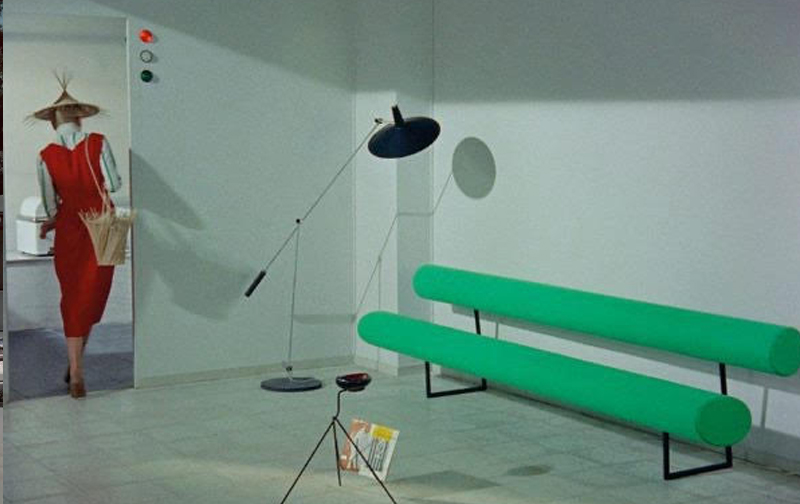
Jacques Tati’s cinematic oeuvre stands as a testament to his unique vision and meticulous craftsmanship. His films, characterized by minimal dialogue and rich visual humor, offer a profound commentary on modernity, technology, and human behavior. Tati’s attention to detail in fashion, art direction, costume design, and set decoration not only served comedic purposes but also provided a lens through which critics, philosophers, and sociologists have examined the evolving dynamics of 20th-century society.
In “Les Vacances de Monsieur Hulot” (1953), Tati introduces the character of Monsieur Hulot, a lanky, pipe-smoking man whose attire—comprising a crumpled hat, too-short trousers, and a raincoat—immediately sets him apart from his surroundings. This ensemble is not merely a costume but a deliberate choice reflecting Hulot’s outsider status and his gentle resistance to conformity. The seaside setting, with its uniform beachgoers and regimented holiday routines, contrasts sharply with Hulot’s idiosyncratic presence, highlighting the tension between individuality and societal norms.
Tati’s meticulous art direction is evident in the film’s settings, where every element is orchestrated to enhance the comedic effect. The hotel, beach, and dining areas are designed with a uniformity that underscores the monotony of vacation routines, while subtle disruptions—often caused by Hulot’s unintended antics—inject spontaneity into the environment. This interplay between order and chaos serves as a commentary on the rigidity of social structures and the human desire for authenticity within them.
In “Mon Oncle” (1958), Tati further explores the clash between tradition and modernity. The film juxtaposes the quaint, organic charm of Hulot’s neighborhood with the sterile, mechanized world of his sister’s ultra-modern home. The Arpel residence, with its automated gadgets and minimalist design, embodies the era’s obsession with technological advancement and efficiency. Hulot’s presence in this environment, marked by his outdated attire and bemused demeanor, highlights the absurdities of a society increasingly detached from humanistic values.
The film’s costume design reinforces these themes, with characters in the modern household donning sleek, monochromatic outfits that mirror their environment’s coldness. In contrast, Hulot’s attire remains unchanged, symbolizing his resistance to the homogenization of identity. This sartorial dichotomy underscores the film’s critique of a society that prioritizes form over substance, efficiency over empathy.
“Playtime” (1967) represents Tati’s most ambitious project, a cinematic endeavor that required the construction of an entire city set, dubbed “Tativille.” This artificial metropolis, characterized by glass facades, steel structures, and uniformity, serves as a backdrop for a narrative that examines the dehumanizing effects of modern urban life. Tati’s decision to shoot in 70mm film allowed for expansive shots where multiple actions occur simultaneously, encouraging viewers to engage actively with the visual field. He eschewed close-ups, believing them to be crude, and instead used sound cues to direct attention, a technique that emphasized the ambient noise of the city and the characters’ interactions within it.
The film’s color palette—dominated by grays, blues, and blacks—reflects the monotony of the urban environment, with occasional bursts of color symbolizing moments of human warmth and spontaneity. For instance, the character Barbara’s emerald green dress stands out amidst the drab surroundings, signifying her individuality and resistance to conformity. As the narrative progresses, the rigid structures of the city give way to more chaotic, lively scenes, suggesting a reassertion of human vitality over mechanized order.
Tati’s approach to set decoration in “Playtime” is both satirical and philosophical. The transparent walls and open spaces create a sense of surveillance and vulnerability, prompting viewers to consider the implications of architectural design on personal freedom and social interaction. Sociologist Michel Chion noted that Tati’s work blurs the line between observer and participant, as audiences become voyeurs of the characters’ lives, reflecting on their own roles within similar societal constructs.
Throughout his filmography, Tati’s use of fashion and costume serves as a visual shorthand for character development and thematic exploration. Monsieur Hulot’s consistent attire across films reinforces his role as an everyman figure, navigating the complexities of a rapidly changing world. His clothing, slightly outdated yet functional, contrasts with the evolving fashion trends of the supporting characters, highlighting the tension between tradition and progress. This sartorial consistency also serves to anchor the audience amidst the shifting landscapes and social dynamics presented in each film.
Critics have lauded Tati’s ability to infuse his films with layers of meaning without resorting to overt exposition. His visual storytelling invites multiple interpretations, allowing viewers to engage with the material on both comedic and intellectual levels. The absence of a central narrative in many of his works encourages audiences to focus on the minutiae of everyday life, finding humor and insight in the mundane. This approach aligns with philosophical perspectives that emphasize the significance of the ordinary and the importance of mindfulness in daily experiences.
Tati’s influence extends beyond cinema into broader cultural and academic discussions. His films have been analyzed through various theoretical lenses, including philosophy and sociology, for their commentary on modernity, technology, and social structures. Tati’s meticulous attention to detail and his unique approach to visual storytelling continue to inspire filmmakers and scholars alike.