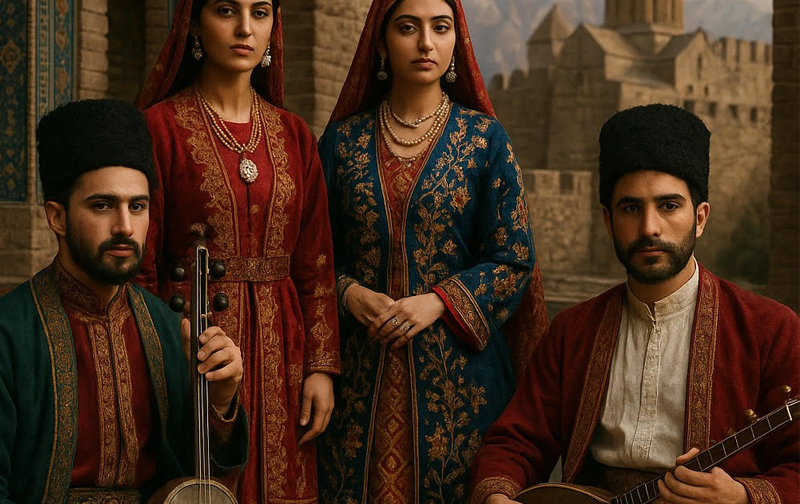
Iran lies at the crossroads of many civilizations, and its own culture has long both shaped and absorbed its neighbors’ traditions. Indeed, Iran’s heritage “is one of the oldest and among the most influential in the world,” and its geopolitical position has meant it “heavily influenced peoples and cultures” from Europe to South and East Asia . Iranian scholars and historians often emphasize this shared cultural field: one commentator observes that the peoples of Central Asia, whether Iranian or Turkic‑speaking, “have one culture, one religion, one set of social values and traditions with only language separating them” . In fact, historians note that the modern populations of Iran, Azerbaijan, Armenia, Turkey, Central Asia and Afghanistan have long been “related to one another as part of the … Greater Iranian cultural and historical sphere” . This broad context underlies the more specific exchanges of art, design and fashion that we detail below.
In the south, Iran’s contact with the Arab world after the 7th‑century conquest brought new religious and artistic elements. As one source puts it, “the Arab conquest in the 7th century introduced Islamic traditions, which merged with pre‑Islamic customs. This fusion resulted in a distinct cultural identity characterized by significant contributions to literature, art, and philosophy” . In practice, this meant Persian (Farsi) adopted the Arabic script and many Arabic words, and Iranian manuscripts and buildings began to show Islamic motifs. Yet Iran was not merely a passive recipient. During the medieval Islamic era, Persian poets, scientists and architects (such as those from the Seljuk and later Safavid courts) exported designs and knowledge back into the Arab world. For example, calligraphers of Persian origin helped create the scripts used throughout the Middle East, and Persian miniature painting influenced art in Ottoman and Mughal courts. In return, southern Iran (especially the oil‑rich coasts and Khuzestan province) retains many shared traditions with the Arab Gulf. Local dress in Khuzestan and Hormozgan provinces – colorful embroidered veils and flowing robes – echoes Gulf Arab styles, and architectural forms (windcatchers, courtyards) show parallels with Arabian Peninsula designs.
Along Iran’s southern coasts the Persian Gulf served as a conduit to Africa as well as Arabia. One vivid example is Bandari music, a folk style of Hormozgan and Bushehr. Bandari “stems from Iran’s south, around the Persian Gulf region,” and indeed is known in Arab Gulf countries as “Chamak” (or “Chamaki”) music, reflecting their shared culture. Bandari rhythms blend Persian and African elements: traditional instruments include the Iranian nei anban (bagpipe), tombak drum, daf frame-drum and darbuka, but modern ensembles also “use rhythmic instruments such as the … djembe, talking drum, quinto, [and] conga” . These African drums and 6/8 rhythms clearly show the influence of East African (and Afro-Iranian) communities along the Gulf. Historically, Afro-Iranian peoples – descendants of East African sailors and slaves brought by Persian Gulf traders – have preserved Swahili words and dance forms in villages near Bandar Abbas. Thus southern Iran’s music, crafts and even cuisine bear the imprint of African and Arab exchange alongside indigenous Persian tradition.
To the southeast, Iran’s old connections with South Asia are visible in clothing and architecture. Beginning in the Mughal era (16th–18th centuries), Persian culture flowed into India and present-day Pakistan. Persian was the court language of the Mughal Empire, and Iranian artists and architects were in high demand. A striking legacy is the Mughal garden: as noted by historians, “the Mughal emperor Babur introduced the Persian garden to India, attempting to replicate the cool, refreshing aura of his homeland” . Babur (himself a Timurid prince from Central Asia) designed gardens in Kabul and Delhi patterned exactly on Persian chahar-bagh layouts. His successors built many such gardens across the subcontinent – from Lahore to Kashmir – with the four-fold design of shade, fruit, fragrance and water. For example, the Taj Mahal gardens in Agra were laid out to “embody the Persian concept of an ideal paradise garden” , complete with irrigation channels from the Yamuna River. Likewise, Kashmiri shawl patterns (paisley boteh motifs) and Mughal palace frescoes show Persian floral designs. Pakistan’s Baloch and Sindhi traditions likewise share fabrics and jewelry styles with Iran’s Sistan and Baluchestan Province. Conversely, Persian artisans imported South Asian luxury goods: Mughal silks, spices and embroidery found their way into Iranian elite fashion. Even today, Persian sayings and poetry (such as the works of Hafiz or Rumi) remain widely quoted in Iran, Pakistan and India, underscoring the two‑way literary dialogue.
Turning to the north, Iran’s relations with Azerbaijan and the Caucasus are especially intimate. Iranian scholars emphasize that today’s Azerbaijanis (many of whom live in northwestern Iran as well as the Republic of Azerbaijan) share deep cultural roots with Persians. Indeed, although Azerbaijanis “speak a Turkic language, due to their culture, history, and genetics, they are often associated with the Iranian people” . This reflects centuries of intermarriage and Persian rule; under the Safavids (the early Iranian Shia dynasty), Iranian and Azeri elites even intermarried, and Persian was the high culture of both lands. Cultural practices like Nowruz (Persian New Year), mughām music, and even elements of carpet design and poetry are shared across the border. Architecture in Baku and southern Azerbaijan often features Persian-style tilework and inscriptions, a legacy of the region’s place in the Iranian world. In turn, Persian culture absorbed Caucasian touches: northern Iranian textiles (such as some Qajar-era rugs) show the geometric motifs common in Caucasus weaving. More broadly, Iran’s historic sphere extended through the Caucasus: modern Armenia, Azerbaijan and Georgia all contain Persian ruins and manuscripts. As one source notes, the northern Caucasus “is well within the sphere of influence of Persian culture” . Russia, too, became part of Iran’s cultural circuit in the 18th–19th centuries. Persian elites traveled to St. Petersburg and France, bringing back fashions. Even garden design shifted: by the Qajar period, “European garden design began to influence Persia, particularly the designs of France, and secondarily that of Russia” . Thus, Russian imperial culture (and through it Western European styles) left traces in northern Iran’s architecture, dress and urban planning.
Overall, these exchanges have produced a rich, syncretic culture. Iran has fed art and ideas to its neighbors and borrowed freely from them. Mughal India and Qajar Iran, for instance, both produced intricate silk textiles drawing on Persian patterns; Ottoman Turkey assimilated Persian book illustration styles; Gulf Arab art was enriched by Persian miniatures brought by merchants. Likewise, Iranian dress has both influenced and been influenced by neighbors: southern Iranian port cities once resembled Arab bazaars, and today young Iranians incorporate global fashions while traditional cut-work and embroidery draw on regional motifs. In recent decades the dialogue continues: Iranian designers have showcased Persian motifs internationally, and Iranian scholars collaborate on projects across the Middle East and Central Asia. In short, as Iranian historians often remind us, Iran’s culture is by nature a tapestry of influences, ever weaving Arab, Turkic, Indian, African and European threads into its own identity, just as its own ancient patterns continue to adorn the tapestry of the broader region