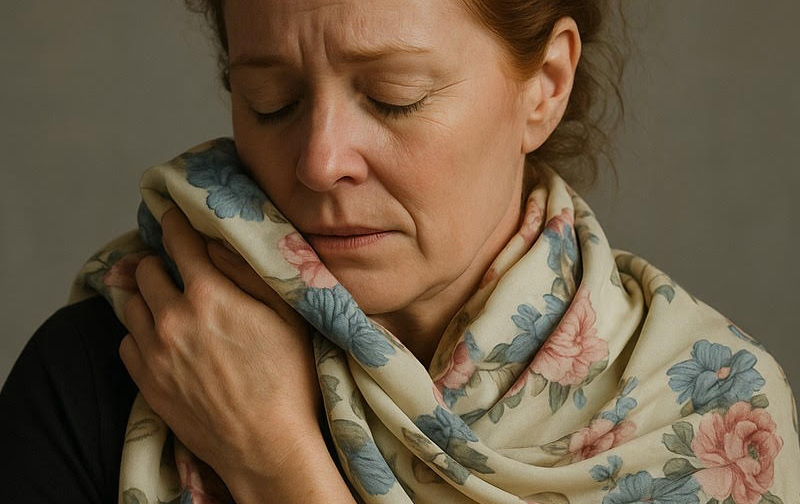
Conceptual Fashion as Witness – Fashion can serve as a silent witness, a living archive that carries experiences which often go unseen. Garments hold memories in their fibers: the tear in a sleeve, the scent lingering on a scarf, or the pattern on a cloth can all testify to personal and collective histories. In the chaos of war or displacement, when words fail and photographs may be suppressed, clothing can become an intimate archive of trauma and resilience. A blood-stained dress or a threadbare coat can speak volumes – these materials bear witness to what the wearer endured, silently preserving stories of conflict, migration, and survival. Just as anthropologists treat artifacts as cultural testimonies, a garment can be read like a document: a fabric that has weathered hardship or been modified for survival becomes a text of human experience . In this way, fashion transcends vanity, transforming into material testimony for the unseen and the unspeakable. The notion of fashion as mere adornment falls away; instead, clothing emerges as performance art and archive, a medium through which individuals and designers can document war, migration, and censorship, encoding these weighty experiences into texture, shape, and form.
At times of war, when destruction and loss defy straightforward representation, conceptual fashion can memorialize events in a uniquely visceral language. In 2000, designer Hussein Chalayan famously staged a performance where furniture became fashion – a coffee table morphed into a skirt as models fled a living room set . This was not a whimsical stunt; it was a poignant response to war and displacement. Chalayan’s Afterwords collection was explicitly inspired by war refugees forced to flee their homes with only what they could carry on their backs . As a model stepped into a round wooden table and lifted it to become a skirt, the audience witnessed a literal transformation of domestic stability into wearable survival. The skirt – stiff, ungainly, formerly a table – symbolized the idea of uprooting one’s life and wearing one’s home. In anthropological terms, this performance turned a garment into a mobile home artifact, illustrating how refugees internalize their homes after losing them. The fashion show became a ritual of empathy, inviting viewers to imagine the trauma of exile through the language of clothing. Chalayan, with his own heritage marked by conflict in Cyprus, handled the theme sensitively: even details like coats with built-in mitten-pockets alluded to the need for warmth and protection on a journey . In that moment, fashion became a theatre of war memory, every garment a prop that told of shelter turned shelterless. It was performance art in the truest sense: the runway as a stage for collective trauma, the clothing as actors bearing witness to what cannot be fully seen or spoken. Such conceptual designs show how a dress or skirt can carry the narrative weight of refugee experiences more powerfully than any journalistic report, precisely because it engages the imagination and emotions of the audience in real time.
This approach of encoding conflict into clothing has precedents and successors among visionary designers. The late Alexander McQueen, for example, shook the fashion world in the 1990s with theatrical shows that confronted violence and history head-on. His notorious “Highland Rape” collection (Autumn/Winter 1995) shocked audiences with models staggering down the runway in tattered dresses, faces smeared as if bloodied . The imagery was unsettling: torn lace, disheveled hair, bruised-looking makeup. It appeared as if the women had survived unspeakable brutality. Though initially decried by some as misogynistic spectacle, McQueen insisted it was a commentary on Scotland’s turbulent history with England – a title referencing the Highland Clearances, a form of 18th-century ethnic cleansing by the English army . In other words, the “rape” in question was not literal violence against the models but a metaphor for a cultural violation of a nation. McQueen’s models – “battered and bruised” with “clothes torn” – became living embodiments of historical trauma . The fashion show thus doubled as a dark historical pageant, forcing the audience to confront the ugliness of conquest and the vulnerability of those oppressed. This was fashion operating as provocation and memorial: the runway presented a narrative of atrocity and survival, encoded in ripped tartan and frayed seams. By aestheticizing the wounds of history, McQueen sparked conversation about the very real scars carried by people and cultures. His work exemplifies how conceptual fashion can bear witness – not by literally documenting an event, but by recreating its emotional truth in symbolic form. Such performances challenge the viewer: they blur the line between beauty and horror, compelling us to see the unseen violence that underpins so much of history.
However, when translating human suffering into art, there is always an ethical tightrope. Philosophers of aesthetics like Susan Sontag have cautioned that representations of pain (in photography, for instance) can sometimes desensitize or exploit . Yet, if handled with care and respect, fashion-as-witness can do the opposite: it can humanize statistics and honor victims. Judith Butler’s reflections on war remind us that often media framing renders certain lives “ungrievable,” invisible to the majority . Conceptual garments can counter that by making these lives visible and grievable. A dress, a coat, or a piece of fabric can carry the individuality and dignity of a person or a people who might otherwise be reduced to numbers. In this way, fashion can assert, This life mattered; this story should be seen. The key is that the designer approaches the task with empathy and depth, avoiding superficiality. In an academic sense, we might say the garment becomes a piece of material culture imbued with testimony. It operates similarly to how a historian might preserve a diary from a war – except here the diary is written in cuts, colors, and textures rather than words.
One powerful real-world example of garments serving as a social archive of violence is the REDress Project by Métis artist Jaime Black. This ongoing installation displays red dresses hanging in public spaces to commemorate missing and murdered Indigenous women in North America . The sight is arresting: empty red dresses suspended from trees and buildings, vivid against the environment, like silent witnesses crying out for those absent . Each dress symbolizes a woman who has been murdered or is missing, standing in for the presence that has been violently taken . By occupying space with these empty garments, the project forces passersby to acknowledge lives that would otherwise remain unseen and ignored. There is an eerie, poetic power in those dresses: they flutter in the wind, hollow yet evocative, bodies without bodies. They testify to trauma without showing any graphic images; as curator Arin Fay noted, “the art replaces statistics in a way… the dresses powerfully communicate it without all of that [overwhelming data]” . Indeed, the dresses succeed where numbers fail: instead of numbing us, they stir empathy and outrage by giving a visceral form to loss. The color red was chosen not only for its eye-catching quality but because in some Indigenous beliefs red is the only color spirits can see – dressing in red is a way to call the spirits of the lost back home . Thus the symbolism operates on multiple levels: red as blood, red as love and anger, red as visibility to the living and the dead. The REDress Project is at once an artistic intervention, a memorial, and a sociological statement. It demonstrates how hanging a simple dress in a tree can become a powerful performance of remembrance and resistance – fashion used not to adorn a living person, but to signify a person who is no longer there. The empty garment becomes a proxy for a voice that has been silenced. This is conceptual fashion as public testimony, stitching the personal grief of families into the public consciousness.
The REDress Project’s impact also underscores a psychological truth: clothing is deeply intertwined with memory and identity. In times of grief, people often cling to the clothes of their loved ones – a phenomenon well-documented by therapists and scholars. A widow might keep her partner’s coat hanging in the closet for years, finding comfort in its continued presence and scent. As one grief counselor described, “I kept my mother’s silk scarves for nearly a decade… They smelled like her perfume, and wrapping one around my shoulders felt like receiving one of her hugs.” . This intimate anecdote reveals how a piece of fabric can hold the psychological imprint of a person – the smell, the feel, the association with touch – becoming a tactile memory. In a poetic sense, clothes can be the second skin of memory, retaining echoes of the body that wore them. Sociologically, this speaks to how fashion items become extensions of ourselves: they absorb fragments of our life story. When someone dies or disappears, their clothes remain as phantom limbs of their presence, simultaneously painful and precious to those left behind. Many cultures formalize this connection; for instance, the Victorian tradition of mourning dress codified wearing black for extended periods as a visible language of grief . The color black – absence of color – was thought to mirror the inner state of loss, a visual sign that “a chapter in our lives is ending, and we may not be able to express it with words” . Though strict mourning dress codes have faded in modern times, the instinct to wear somber colors or the deceased’s clothing in remembrance endures . Fashion becomes a language for grief when words are inadequate. Even without formal rules, many bereaved individuals today create their own rituals: wearing a loved one’s favorite color instead of black, or transforming their clothes into memorial objects – quilts, teddy bears, or jewelry incorporating fabric and buttons from the garments . These creative acts highlight the human need to keep the memory of loved ones alive in tangible form. A piece of clothing can thus serve as a bridge across the chasm of loss, a solace that the person’s story continues to be “worn” in the world. Such practices are both deeply personal and anthropologically significant: they show how we use material culture (in this case, fashion) to navigate universal human experiences like mourning.
In recognizing this profound connection between clothing and memory, some designers explicitly incorporate it into their creative process. The field of memorial fashion has emerged, where designers work with clients to transform garments of the deceased into new creations that honor their memory . For example, stitching a quilt from a father’s collection of neckties, or crafting a new dress from a patchwork of a mother’s favorite dresses. In these acts, the past is woven into the present, allowing the living to literally wrap themselves in the memories of those they lost . One might view this as fashion functioning as therapeutic archive – each stitch a form of processing grief, each wearing a form of keeping the departed close. Psychologically, this echoes how trauma therapy sometimes uses personal objects to help individuals feel connected and grounded. Philosophically, it raises intriguing questions about identity and materiality: if a person’s essence can be felt through their clothes, then clothes indeed carry a piece of the soul or story. It aligns with the concept that objects hold an aura (to borrow Walter Benjamin’s term) – a presence that exceeds their physical form due to the history they bear. In this way, conceptual fashion that addresses grief is not just designing garments; it is designing vessels of memory, wearable testaments that love and loss are intertwined in the very fabric.
Just as fashion can archive grief and war, it can also document and protest censorship and oppression. Clothing often becomes a battleground for political and cultural expression, especially when regimes seek to control bodies. In societies where personal expression is stifled, what one wears (or is forced to wear) can speak volumes. Consider Iran, where for decades women have been legally required to cover their hair with a hijab and dress modestly under strict Islamic dress codes. The very act of choosing what to wear each day became, for Iranian women, a quiet but potent form of resistance. Indeed, amid the protests ignited by the death of Mahsa Amini in 2022 – who was arrested for an “improper” hijab and later died in custody – Iranian women began publicly discarding their headscarves and wearing previously forbidden attire. Fashion became the main tool Iranian women utilized to defy oppression; every outfit turned into a political statement . When women walk down Tehran’s streets without headscarves or in jeans and vibrant clothes, they are essentially wearing their protest. One Tehran-based tailor observed a dramatic shortening of women’s coats (mantos) after the uprising – a bold deviation from the mandated lengths – which she knew “is not a coincidence” but a result of the Mahsa movement . These changes in style are a visual barometer of sociopolitical change: clothing as a mirror reflecting a shift in society’s mindset . Sociologically, this is fashion’s role in shaping and expressing collective identity; it has become one of the “forces actively driving the protests” in Iran . It’s an astounding example of how personal style can intersect with political action. Each uncovered head, each colorful garment flouting the drab state code, is a courageous performance art piece on the stage of the street – one that can be seen by everyone despite the censorship of media. Through fashion, Iranian women (and supportive men) have documented their refusal to be silenced, effectively writing a chronicle of dissent in fabric and body.
One might view these acts through an anthropological lens as well: dress codes enforced by authorities are a means of social control, and the subversion of dress is a reclamation of agency. In the context of Iran’s regime, telling women what to wear is a way to erase individual and cultural difference, to enforce a singular ideology on the body. Yet the ingenious ways Iranians have pushed back – from wearing lipstick under their masks to covertly styling the hijab in fashionable ways, and now outright removing it – demonstrate how clothing can encode messages that slip through censorship. In a sense, the body becomes the message board and clothing (or its removal) the script. A poignant example occurred during the recent protests when women filmed themselves cutting their hair or burning their scarves – deeply symbolic acts that went viral worldwide. Fashion in these moments was both the medium and the message: cutting hair (while not exactly clothing) resonates because hair and head-coverings are highly charged symbols of identity and control in Iran’s sociopolitical context. Similarly, the burned veil is a defiant rejection of imposed morality. These images circulated despite the regime’s attempts at censorship, proving that embodied visual protest can outmaneuver the censors. In diaspora communities, exiled Iranians have further amplified this by holding demonstrations where they twirl hijabs on their fingers or display dresses splattered with red paint to signify blood – performance art tactics that ensure the struggle is seen abroad. The diaspora fashion collective “Woman, Life, Freedom” even organized runway-like events to showcase protest art and sartorial solidarity . All of this shows that whether in Tehran or Toronto, fashion can be a frontline of the fight for freedom, archiving the spirit of a movement through style. It documents not just the fact that protests happened, but how they felt – the exhilaration, the anger, the courage – as expressed in the clothes people dared to wear.
Looking at another repressive context, consider how garments can encode messages under censorship beyond just political dress codes. In many authoritarian settings, artists have used clothing as a canvas for censored voices. An example is Iranian artist Shirin Neshat, who isn’t a fashion designer per se but often uses the imagery of veiled women with calligraphy on their skin or chadors in her photographs. In her acclaimed Women of Allah series, Neshat overlaid Farsi poetry and texts onto the black garments and exposed skin of her female subjects . These inscriptions included verses by poets like Tahereh Saffarzadeh addressing martyrdom and freedom, essentially giving voice (literally text) to women who are often voiceless under a theocratic regime . The visual of a woman’s face or body veiled by words is powerful: it’s as if the silenced thoughts of a generation have been written out for all to see, turning the garment and the body into a page of forbidden literature. Here, clothing (the veil) becomes not a tool of silencing as the regime intended, but a medium of speech – the very surface that was meant to erase identity now showcases individual expression in beautiful, flowing Persian script. Neshat’s work highlights a philosophical idea: that even within oppressive constraints, creativity finds a crack to emerge. By aesthetically integrating censored text into clothing, she made a political statement that could survive censorship because it lived in the realm of art and symbol. One could imagine taking this concept into literal fashion design: for instance, creating a line of garments printed with poetry or newspaper articles that were banned, with strategic pleats or overlays that hide and reveal the text. At first glance, the garment might look simply decorative, but as the wearer moves or under certain light, the suppressed words would become legible – a poetic metaphor for how truth can be obscured yet still present, waiting to be seen. Such a design would act as an interactive archive of censorship: the clothing itself carrying the record of what a regime tried to erase, bringing those words back into public visibility in a subtle, resilient way.
In other times and places, fashion has literally carried physical pieces of history to preserve memory under censorship. A moving historical anecdote: during World War II, when Poland was occupied and libraries were destroyed, some brave individuals sewed pages of banned books into the linings of their coats to save them from Nazi book burnings (a true act of “wearable archive”). The coats became clandestine libraries. Likewise, refugees fleeing wars have been known to secrete photographs or letters in their clothing, the fabric shielding their personal archives when borders and checkpoints threaten to strip them of identity. The Hmong people of Southeast Asia, after the Vietnam War, found a unique way to document their experiences: in refugee camps, Hmong women developed story cloths, elaborate embroidered textiles that depicted the pastoral life they left and the harrowing journey of escape from conflict . These weren’t exactly garments worn on the body (they were more tapestries), but they emerged from a rich textile tradition and served as portable records of history and culture. The story cloths showed scenes of villages, war, fleeing across rivers – essentially a stitched chronicle of forced migration . Families later carried these embroidered narratives with them to new countries, or sent them to relatives abroad, turning them into cherished heirlooms. The Hmong story cloths illustrate how textile arts, closely related to fashion, can preserve collective memory in a visual code that transcends language barriers. Even if a censor confiscated written journals, an embroidered cloth might pass as a decorative item while quietly containing the whole history of a people. This is the cunning power of fashion and textiles as witness: they can fly under the radar of oppressors who underestimate “women’s work” like sewing, all the while preserving truths for future generations. It is a testament to human ingenuity in the face of censorship – when the page is forbidden, we write on cloth; when speaking is forbidden, we wear our words.
Indeed, throughout history, oppressed communities have often turned to sartorial expression as one of the few outlets the oppressor did not fully control. There is a kind of camouflage and code in fashion that can be exploited. Slaves in the American South wove coded messages into quilt patterns that signaled safe houses on the Underground Railroad. During the Yugoslav wars, some artists wove bullet casings and bits of shrapnel into clothing as an art statement, essentially wearing the war so the world could see it. In repressive regimes, simply wearing the wrong color can be a statement – like how wearing white became a symbol of protest in Belarus or how green became associated with the reform movement in Iran (2009). The color or style itself holds meaning understood by those in the know, while appearing innocuous to outsiders. This is semiotics in action in the fashion domain: an entire language of resistance can exist in the tilt of a hat, the length of a skirt, a particular accessory. The field of fashion sociology examines these phenomena, showing that clothing is not merely personal but deeply social and communicative. Fashion is inherently political, as designer Yasmeen Mjalli said, “whether or not it’s being produced in Palestine” . She works with Palestinian craftswomen to incorporate traditional embroidery (tatreez) into contemporary streetwear, which in itself is an act of cultural preservation and resistance . Every stitch of those garments tells a story of occupation, resilience, and continuity of identity under siege. Mjalli’s designs use craft to tell stories of life under occupation, blending the past and present . The fact she has to coordinate via WhatsApp with weavers in blockaded Gaza, because those women cannot travel freely, only reinforces how each piece is imbued with the struggle of its making . We see that the sociological aspect of conceptual fashion is about community and dialogue: it connects the wearer, the maker, and the referenced cultural history in a meaningful exchange. When one dons such a piece, they are not just wearing a garment; they are effectively wearing a narrative, a statement of solidarity and awareness that can spark conversations and keep an issue alive in public consciousness.
The convergence of anthropology, psychology, philosophy, and sociology in these examples reveals why conceptual fashion as witness feels so profound. Anthropologically, clothing is an artifact, a ritual object, a carrier of culture – from mourning clothes to ceremonial dress, it encodes the values and experiences of a group. Psychologically, clothing is second skin, interwoven with personal identity and memory; it affects how we feel (a widow’s black dress vs. a protester’s proud refusal to veil). Philosophically, fashion raises questions about representation, ethics, and the nature of witnessing. What does it mean for an object to witness? Can a dress remember? In a metaphoric yet very real sense, yes: a dress can remember if we as a society agree to treat it as a container of memory. The philosopher’s concept of the “witness” usually refers to humans testifying to events, but here the garment stands in proxy, a delegate of memory for those who can’t speak or who are gone. It invites an almost animistic idea that objects have souls or at least stories – something indigenous belief systems often acknowledge, considering special garments or textiles as living relatives or storytellers. Meanwhile, sociology reminds us that none of this occurs in a vacuum: the meaning of a garment is constructed by communities. A bloodied shirt from a protest becomes a revered relic only if a movement frames it that way; otherwise it’s just dirty laundry. So conceptual designers and artists play a role akin to social narrators or historians, curating and presenting these garments in contexts that highlight their significance. When Ai Weiwei took 14,000 discarded refugee life jackets and draped them around the columns of Berlin’s Konzerthaus in 2016, he deliberately turned a symbol of invisible suffering into a public spectacle . Each of those fluorescent orange life vests had been worn by a refugee crossing the Mediterranean – each one a witness to a journey of hope and peril. By clustering them en masse on a grand Western building, Weiwei confronted European society with the scale of the crisis and the individuality of each life lost or saved. The installation was overwhelming to behold: pillars turned into towering memorial candles of orange, each vest silently speaking of a person – someone who may have drowned, or someone who survived to wear it to safety. In this case, the garment (life jacket) as archive bore literal witness: many had the wear and tear of use at sea, even names or numbers scribbled on them. Weiwei’s art performance made sure those stories would not remain on a distant shore, unseen. It was a cry for empathy, visually striking in the heart of a city that had welcomed many refugees but where the politics of exclusion still loomed. Here, fashion (or wearable gear) transcended its utilitarian role to become a solemn installation – a plea and a warning to the world about a humanitarian tragedy . The lifejackets, bright and foreboding, told a truth that no news headline could fully capture: the weight of 14,000 human odysseys hanging before our eyes.
Through such examples, we see that conceptual fashion can serve as a powerful witness and storyteller precisely because it operates on multiple levels of human perception. It is visual and tactile, intellectual and emotional. A garment can be touched, worn, seen from different angles – it invites intimacy in a way a written document or photograph might not. This multisensory engagement can create empathy and understanding that pure facts often fail to evoke. A dramatic gown with shredded fabric and burns might viscerally convey the ravages of war in a way that a statistic (“X homes burned”) cannot. Similarly, a performance piece where people wear barbed wire or chains as clothing can wordlessly demonstrate the feeling of oppression or imprisonment. These artistic choices often rely on metaphor and metonymy – using a part to represent a whole, or one concept to evoke another. For instance, a heavy dress made of lead might be crafted to let the audience literally feel the weight of grief or guilt as the model struggles to move. A transparent garment with hidden text inside might symbolize censorship – to the observer it looks like a plain dress, but under UV light the suppressed story shines forth, meaning the truth was there all along albeit unseen. These poetic gestures stick in the mind. They create what performance studies scholar Diana Taylor would call the “archive and the repertoire”: the archive being the physical garment itself preserved for posterity, and the repertoire being the live performance or act of wearing that transmits knowledge through doing and seeing. Conceptual fashion as witness uses both – the tangible artifact and the ephemeral act – to ensure that knowledge (of war, of exile, of pain) is not lost.
Now, moving from analysis to creation, let’s consider how one might design garments explicitly as witnesses for specific unseen crises. This calls for a blend of creativity, empathy, and scholarly reflection – essentially design anthropology. The user’s prompt asks: how would you design a garment for Gaza? For exiled Iranians? For grief? These are deeply challenging yet inspiring prompts. They imply designing not for aesthetics or commerce, but designing as a form of testimony and healing. As an Iranian conceptual fashion designer myself, I approach these questions with personal stakes and careful thought.
For Gaza, a region scarred by warfare, blockade, and humanitarian crisis, I imagine a garment that encapsulates both the resilience and the confinement experienced by its people. Gaza is often described as an “open-air prison,” and its residents carry generational trauma largely unseen by the outside world. A conceptual garment for Gaza might start with the idea of fragmentation and strength. I picture a cloak or abaya-like overgarment constructed from dozens of patchwork pieces of fabric, each sourced or inspired by something in Gaza’s daily life: fragments of traditional Palestinian tatreez embroidery (which in itself is an art of storytelling through geometric patterns), pieces of keffiyeh scarves symbolizing Palestinian identity, and even printed images or textures that resemble the concrete rubble of bombed buildings. The patches would be stitched together with heavy red thread – red to signify the blood and love interwoven in the struggle. The silhouette of the garment could be voluminous and enveloping, akin to a protective shelter. This would symbolize how Gazans often must hide or take cover, and how their lives are circumscribed by barriers. Inside the lining of the garment, I would incorporate secret pockets or sewn-in items that represent the inner life and memories of Gaza’s people: perhaps copies of keys (symbolizing the keys to homes lost in 1948 and 1967, heirlooms of the displaced), or children’s drawings from trauma therapy sessions (many kids in Gaza draw scenes of war – placing those drawings in the lining is like carrying the psychological imprint visibly). The garment might also integrate burn marks or bullet holes in a controlled way: for example, laser-cut patterns that mimic bullet holes across the fabric, artistically arranged but clearly evocative of violence. These would allow light to pass through – a metaphor for hope shining through or the souls of the lost ones being remembered. To wear this cloak would be a heavy experience: it should feel a bit weighty (maybe weighted with sand in the hem, alluding to Gaza’s beaches and the idea of being weighed down by history). The wearer, in a performance, might walk slowly and with difficulty, the garment’s bulk and weight dramatizing the hardship under siege. Yet the patchwork nature also shows unity and resilience: despite being in pieces, the garment holds together firmly, just as the community holds together. If displayed on a mannequin or in an installation, perhaps the cloak could be spread out on the ground, resembling a tent or shelter, inviting viewers to step inside – once inside, they would see the personal items in the lining and hear audio recordings of Gazan voices telling their stories (I imagine speakers playing snippets of lullabies sung during bombardment nights, or testimonials). In this way, the garment becomes an immersive archive of Gaza: visually striking from afar, deeply personal up close. It documents war and blockade not by depicting violence straightforwardly but by embedding the signs of conflict into a wearable sanctuary. The process of designing it, for me, would involve collaborating with Gazan artisans (perhaps digitally, as Yasmeen Mjalli does via WhatsApp ) to include genuine pieces of Gaza – maybe embroidery made by women in Gaza’s cooperatives, thus directly supporting them and incorporating their authentic voices. The end result: a garment that when exhibited or worn internationally, bears witness to Gaza’s plight beyond headlines, allowing observers to feel, touch, and almost step into the life of Gazans.
For exiled Iranians, the design would revolve around themes of displacement, nostalgia, and the tension between visibility and invisibility. As an Iranian, I know how it feels to carry a homeland in your heart that you cannot fully display due to political or social constraints. I imagine a transformative garment – one that can be worn or styled in multiple ways, symbolizing the dual identity of life in exile. Perhaps a two-layer ensemble: the inner layer a rich fabric with Persian motifs and poetry, the outer layer a more neutral, conforming coat or jacket that one might wear in the adopted country to “blend in.” The trick would be that the outer layer is reversible or translucent in places. Picture a long coat in a subdued tone (say, charcoal gray or black) which on the outside looks minimal and modern – the image of a cosmopolitan exile who has assimilated. But this coat has laser-cut Persian calligraphy running all over it in a barely perceptible manner – maybe along the hem and cuffs, maybe hidden in the lining. The text could be lines from classical poets like Hafez or Rumi, or from contemporary Iranian poets whose works are banned back home. By default, the calligraphy is tone-on-tone, not easily noticed (like black on black embroidery), much as exiles often feel they must keep their cultural expressions somewhat subdued in public. However, as the wearer moves, the light catches these tonal patterns, revealing flashes of the beautiful script to those who pay attention. The inner lining of the coat, by contrast, could be vibrantly printed with a design of the Iranian landscape or cityscape left behind – maybe a montage of Tehran’s skyline mixed with images of historic Persepolis and pomegranates (a fruit often associated with Persian culture). This is the inner world the exile carries. The garment could be designed so that it can be worn inside-out as well, daringly displaying the colorful, cultural side on the outside. This reversible nature is symbolic of living between two worlds: one day you present as just another person in Paris or L.A., the next day you join a protest and literally turn your coat inside out to show the “Iran” you carry. In a performance art context, an exiled Iranian wearing this might walk among a crowd incognito, then dramatically invert the garment to reveal the Persian poetry and art, making a statement of pride and defiance – I will not hide who I am. Another element: the garment could incorporate fragments of memory – for instance, one pocket could be made from fabric taken from a real chador or a piece of clothing left behind. Perhaps the buttons are made of turquoise stone (Iran’s native gemstone) or the design subtly echoes a map (maybe the seam lines trace the shape of Iran’s map when laid flat). If I were constructing an archive for censorship through this garment, I might even take letters or stories from Iranian political prisoners (with permission and anonymized) and print them in microscopic font onto the fabric, so that the very threads carry censored stories. Only on very close inspection or under a magnifying glass could one read them, which adds to the concept: the truth is there but hard to discern, requiring effort and empathy from the observer. Thus the garment is a tool of education – those intrigued by the patterns might come closer and discover the hidden words of an imprisoned journalist or a dissident’s poem in exile. Such interactivity engages the philosophical idea of witnessing through interpretation: the garment does not shout its story; it whispers, inviting the viewer to listen carefully. For exiled Iranians, much of our witness is through storytelling and art since we cannot return home freely; this coat would function as a wearable story, a testament to the persistence of identity even in displacement. It documents migration and censorship by literally wearing the suppressed culture on one’s sleeve – turning the body of the exile into a moving canvas of cultural memory and protest.
Lastly, designing a garment for grief is an especially delicate endeavor – grief is universal, yet deeply personal and often invisible. How to make a universal statement that still feels intimate? I would approach it by focusing on the process of grieving as a journey, acknowledging both the pain and the transformation that grief brings. One concept is a garment that changes over time or with use, mirroring how grief evolves (or rather, how we evolve around our grief). Envision a dress or suit made of a special fabric that reacts to tears or water – for instance, a pale gray cloth dyed with a hydrochromic dye that darkens when wet. In a performance or exhibit, the garment could start entirely gray, and as the performer (or participants) spritz water (symbolizing tears) onto it, dark blotches spread and eventually the whole garment turns black. This dramatizes the wave of mourning that envelops a person – the visual emergence of grief. Then, as the fabric slowly dries, parts of it revert to gray or white, but not uniformly – leaving tie-dye-like patterns, maybe resembling Rorschach inkblots or abstract landscapes. This could represent how grief leaves an indelible pattern on us; even when the acute phase passes (the fabric dries), the garment is changed with subtle stains or tide-marks. The pattern might even be beautiful in a somber way, suggesting that there can be growth or meaning that arises from integrating the grief (a nod to the Japanese art of kintsugi, where broken pottery repaired with gold is considered more beautiful). To incorporate a memorial archive aspect, the dye or water could be mixed with something symbolic – perhaps a drop of ink from the loved one’s pen, or water collected from a place of significance (like water from the Ganges for someone who died, or holy water, etc.), making each “tear” mark unique. Another approach: a modular garment that can be gradually taken apart. Imagine a layered robe composed of multiple sheer layers of fabric, maybe 7 layers to correspond to stages of grief (if one subscribes to that model). In a ritualistic performance, the mourner wearing it removes one layer at a time over a period – each layer could have words or images on it representing disbelief, anger, bargaining, depression, etc., in delicate prints. As they peel off layers, those emotions are externalized and set aside, until the final layer is a plain, light garment symbolizing acceptance or resolution. The peeled layers don’t disappear; they might be arranged around the space or folded into an “archive” box – signifying that we never truly shed these feelings, we store them as part of our story. The final outfit of acceptance might still carry faint traces of the prints from prior layers (because grief never leaves us entirely; it leaves traces). This concept showcases grief as both performance (the act of removing layers, much like psychological shedding) and archive (the preserved layers with their printed expressions of each stage). The prints on each layer could be inspired by actual expressions of grief – perhaps one layer has a handwritten letter to the deceased (psychologists often encourage writing unsent letters to loved ones who passed; those words could literally be printed on the fabric, making the garment a letter one wears close to the body). Another layer might have imagery like a shattered heart motif that gradually reassembles by the next layer. The design would aim to evoke empathy: an onlooker seeing the performance will witness a visual metaphor of grief’s progression, something that might resonate with their own experiences of loss. In terms of everyday wear (if that concept were translated beyond art), perhaps the garment isn’t meant to be worn normally but kept as a commemorative piece – like a wedding dress, but for the end of life’s journey rather than the start of a new union. It could be hung or displayed every year on a death anniversary, as part of a memorial ritual, each layer revisited like one revisits photo albums. This would create a living archive of grief, where the garment evolves with the person: maybe new layers can be added over years, with different colors as one’s grief takes on different shades (people often say grief can resurge or change form over time). The use of color is important: many cultures use white for mourning (e.g., parts of Asia) rather than black. Perhaps the garment starts white (pure mourning) and through interaction becomes dark (sorrow manifest) and then in time returns to white or even gold, signifying finding peace. I recall the analogy from a grief counselor that grief is like carrying a stone in your pocket – it never gets lighter, but you get stronger . A clever design nod to that could be literally a small weighted stone sewn into a pocket of the garment, which the wearer carries during the performance and perhaps removes at the end and places it down (a symbolic release or the moment when the weight is no longer crippling). By integrating such symbolism, the garment would be less about fashion trends and more about human emotional experience rendered tangible. It serves as a witness to an individual’s grief journey, but also as a communal symbol that can speak to anyone who has lost someone – very much in line with sociology (shared rituals of mourning) and psychology (personal coping).
Across these speculative designs – for Gaza, for exiled Iranians, for grief – a common thread is the intent to materialize the immaterial, to give form to absence, loss, and hope, thereby allowing others to witness what is otherwise unseen. This is what conceptual fashion as witness aspires to achieve. It invites a certain poetic academicism: one must research and understand the history and psyche behind an issue (be it Gaza’s humanitarian context or the psyche of grief) and then express it in a creative, symbolic language that others can interpret and feel. It’s akin to writing an ethnography, but instead of text on paper, the ethnography is composed in textile and body movement. Every choice – the fabric, the color, the construction technique, the way it’s worn or displayed – carries semiotic weight. Thus, the designer in this mode is part scholar, part storyteller, part activist.
It’s worth acknowledging that the effectiveness of fashion as a witness depends on audience engagement. In an academic sense, this parallels reception theory : the meaning is co-created by the viewer. A garment witnessing war could be seen as a mere costume if the viewer is oblivious, or it can move someone to tears if they grasp the narrative. Therefore, contextualizing these works is often important – through accompanying text, or performance, or interaction. Think of museum exhibits of clothing: seeing a charred garment from Hiroshima or a pair of shoes from Auschwitz has an almost sacred impact, but it’s often the surrounding information that confirms the provenance and significance. Conceptual fashion pieces, when exhibited, usually come with artist statements or on-site performances that activate their meaning. This is similar to how in literature a piece of testimony might come with annotation. In our practice, we must ensure the garments don’t become fetishized objects devoid of context. The goal is empathy and understanding, not aesthetic shock alone. For example, McQueen’s Highland Rape without context might look like gratuitous violence, but knowing the narrative reframes it . As designers or observers, we have to be careful to maintain that balance – to bear witness ethically. The fashion academic Caroline Evans once wrote about how fashion shows can create a “spectacle of suffering” and the fine line between raising awareness and exploiting imagery. To avoid the latter, I believe the creation process should involve those whose story is being told whenever possible (like involving refugees in making the lifejacket installation, or survivors in conceptualizing a grief piece). This participatory approach roots the work in authenticity and respect.
In conclusion, conceptual fashion as witness is a marriage of art and document, feeling and knowing. It leverages the fact that clothes accompany us in our most pivotal moments – birth, marriage, death, war, flight – and does not shy away from imbuing them with those stories. In a world saturated with digital images and written reports that often fail to move people, a single garment, charged with genuine narrative and presented in the right way, can jolt someone into recognition. It can whisper truths that were buried, or scream in colors and shapes about injustices that too many ignore. From the red dresses that cry out for stolen sisters , to the high-tech survival coats that render the homeless visible on city streets , to the simple act of a woman removing a veil to assert her freedom – all these are part of a continuum where fashion intersects with performance, activism, and memory.
We stand on the shoulders of great people in this endeavor: artists like Yoko Ono, whose 1964 Cut Piece invited audiences to cut away her clothing – a metaphor for vulnerability and violence that doubled as an anti-war statement . Designers like Lucy Orta, who created Refuge Wear – ingenious portable shelters that transform into coats and sleeping bags, explicitly to help and highlight refugees and homeless populations . Or Vivienne Westwood, who turned runway shows into climate change protests. Or Martin Margiela, who often used discarded materials, literally sewing the detritus of consumerism and history into garments that question society’s values. These pioneers and many others have shown that fashion can carry immense conceptual weight. They inspire us to think of clothing not as consumer product but as cultural artifact and agent.
As an Iranian conceptual designer, I feel this calling intensely. My own process involves deep research (historical, emotional, material) followed by experimentation with forms that can evoke what I’ve learned. When I design, I sometimes close my eyes and ask: If this pain or hope could be worn, how would it drape over the body? If this story could whisper from a garment, what texture would its voice be? The answers come in unexpected flashes – a vision of a coat too heavy to wear (so the audience must help the wearer, showing communal support), or a dress that leaves a trail of thread wherever it goes (as if unspooling the story to others). I sketch, I write poetry alongside the sketches, I consult survivors or community members if possible to ensure I’m on the right track. It’s a process as much about listening as creating. And when the piece finally comes to life, either on a runway or a gallery or the street, the greatest reward is seeing someone stop and truly see what it represents. In that moment, the conceptual garment has done its job – it has testified; it has made the unseen seen.
In a time where so much feels transient and attention is scarce, these deep, poetic works of fashion have a unique ability to cut through the noise. They combine visual impact with layered meaning, appealing both to the heart and the intellect. They invite us to slow down and contemplate. They stand as reminders that what people wear and how it is worn can carry the weight of history, the cries of the oppressed, and the love of those departed. Our wardrobes quietly hold our biography – the shirt from the day we got terrible news, the dress our grandmother made, the uniform that once segregated us, the costume that once liberated us on stage. Conceptual fashion as witness simply amplifies this innate power of clothing and directs it toward collective narratives that demand witness.
Ultimately, to create for the unseen is an act of faith and empathy – faith that even if the world averts its eyes, these garments will persist and speak; empathy in wanting to share in the suffering and hopes of others and not let them remain invisible. A well-conceived garment can become a beacon. It can educate and memorialize in ways a static medium might not. And long after the performance is over, the garment remains, like a relic, to inform future generations. Imagine one day, decades hence, someone finds the Gaza cloak in a collection: even if they don’t immediately know its story, the bullet-hole patterns and patchwork might prompt them to ask, and learn about what happened in Gaza. In that sense, the fashion archive complements the written archive.
Fashion is often dismissed as frivolous, but here we have seen it is anything but. It is skin and story, body and soul. It provides a canvas to engage with anthropology (by respecting cultural symbols and meanings), with psychology (by acknowledging emotional resonance), with philosophy (by questioning how we represent reality and suffering), and with sociology (by interacting with social issues and communities). It allows for a kind of academic inquiry that is not confined to a paper or a lecture, but lived and felt. In crafting garments as witness, we create not only aesthetic experiences but also moral and reflective experiences. We are asked to witness together – designer, wearer, viewer – and in doing so, perhaps to share a sliver of the burden carried by those who actually lived these realities.
In sum, conceptual fashion has the remarkable capacity to stand as a witness for the unseen. Through performance art and archival preservation, through poetic symbolism and academic rigor, it can document wars and migrations, challenge censorship, and honor grief. It is a language without words, yet profoundly articulate. It ensures that the unseen are seen, the unheard are felt, and the forgotten are remembered. When done with integrity, a garment can indeed become a witness – testifying to human experience and crying out, in silence and beauty, for a more compassionate world.