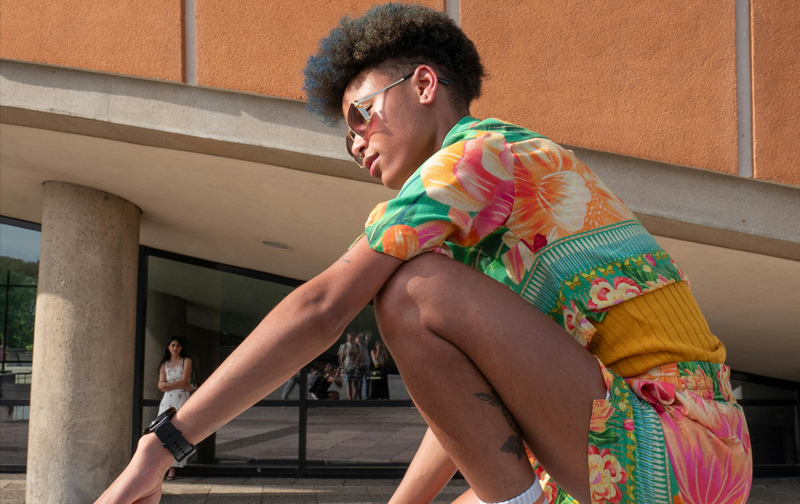
Coco Chanel’s aphorism that “Fashion is architecture, it’s a question of proportions” opens an intimate dialogue between garments and the built environment. In the life of the metropolis, fabrics fold and unfold like origami facades, as bodies navigate grids of pavement and steel. In Tokyo, Yohji Yamamoto’s all-black Karasu-zoku (crow tribe) incited young women to become silhouettes in the neon city, and in Berlin, streetwear emerged as a “gritty blend of brutalist minimalism, utilitarian function, and underground culture” . These are not accidents; they demonstrate that structural geometry and social need entwine. At every stage, structure creeps into style: both architects and designers rely on basic geometric forms as building blocks. Indeed, “whether it’s the shape of a building or the cut of a garment, geometry helps to establish order and balance in design” . In practice, this principle animates the work of creators across the globe. Japanese designer Issey Miyake, for example, pioneered pleated garments from simple geometric panels so that a skirt “uses geometric pleating to create garments that change in shape and volume, emphasizing the relationship between fabric, form and motion” . Whether through folding textiles or stacking concrete slabs, design becomes an articulation of both structural precision and human rhythm.
Modern architects have also lent their vocabulary to fashion. Tadao Ando reduced buildings to concrete rectangles and circles that enhance light and shadow, and Ludwig Mies van der Rohe famously used the universal grid to celebrate the “purity of geometry” with clean lines and open, transparent spaces . Echoing these ideas, fashion houses and street labels alike translate the purity of a Bauhaus façade into spare yet spirited garments. Designers often treat clothing like architecture: Hussein Chalayan, an architect at heart, sent down the catwalk mechanized gowns that literally changed shape via hidden motors . Dutch designer Iris van Herpen worked with 3D printing to craft dresses whose repeating patterns “are reminiscent of architectural facades” . Such pieces blur the line between structure and skin. One imagines a jacket’s sharp lapel as an obelisk, a coat’s hem as a skyline, each outfit a miniaturized building that both shelters and announces the body. In this ongoing conversation, neither discipline dominates: a garment can be both fortress and canvas, echoing Marcel Duchamp’s insight that “the work of art is a bridge between architecture and poetry.”
In Europe, these currents run deep. In Berlin the streets themselves dictate a form of urban chic: as one streetwear writer notes, “architecture is fashion in Berlin. Many German streetwear brands pull visual references from Bauhaus minimalism and brutalist concrete… geometric structure, bold simplicity, and functionality above frill” . Here every pocket and zipper has purpose — pants bristle with cargo pockets large enough to carry zines and water bottles — and black-on-black outfits wrap the city’s scars like armor. But minimalism in Berlin is not apolitical. Jackets are often hand-painted with protest slogans, keffiyehs are worn beside combat boots, and thrifted denim is patched with anti-fascist insignia . In this gritty center of Europe, “fashion is resistance as style… fashion as refusal” . The result is a streetwear that stares you down in silence — a quiet revolt sculpted in charcoal grays and rigid lines. Its elegance is austere but unyielding, an eloquent rejoinder to conformity.
Paris, by contrast, whispers its defiance. French streetwear has always favored “clean lines, monochrome palettes, tailored fits, and a quiet confidence that doesn’t scream for attention — it invites it” . Gone are the ostentatious logos and garish prints of other scenes; instead Parisian youth and designers mix a heritage of bespoke tailoring with streetwise nonchalance. Even so, that chic austerity is underpinned by a history of rebellion. Parisian streetwear is “deeply intertwined with [the city’s] art scene, music subcultures, and political activism” . From graffiti-tagged alleyways in Belleville to the hip-hop basements of Marseille, the modern Parisian ties a sleek leather moto jacket or a trench coat to generations of protest. In the aftermath of a decade’s turmoil, a structured blazer can be as provocative as a slogan-tee in its contradiction. Thus the city that once saw the barricades of 1968 now sees vestiges of them in carefully cut drape: fashion that feels both refined and raw.
Half a world away, Asia’s megacities spin their own stories of form and function. Tokyo’s street is kaleidoscopic, yet within it the effect of architectural order is striking. Shoichi Aoki’s famed street photography showed Harajuku bursting with color and maximalism, but another narrative has always run through the Japanese capital: the discipline of uniform. Girls and salarymen alike take refuge in monotone; one guide describes how Tokyoites in minimal black or gray “stand out quietly among the chaotic street styles” as if a calm glaze over the city’s hyper-stimulation . These minimal looks “state and not shout, [and] add a sense of calm to the overstimulating city life” . In other words, these outfits function like buildings – providing order to disorder. In recent years the gorpcore craze shows this plainly: technical outerwear brands (like Arc’teryx or Salomon), embraced as streetwear staples, marry “hardcore functionality with fashion” . Japanese designers such as Snow Peak and ASICS similarly turned their advanced performance garments into quiet style statements. One imagines a commuter’s parka with its vents and drawstrings acting like an urban climate system, responsive to airflows and crowds. The city becomes a laboratory, and clothing its adaptive technology.
Meanwhile, Seoul’s youth craft an aesthetic of their own. Korean streetwear often trades in a “minimalistic aesthetic – clean lines and simple silhouettes” . Influencers and underground designers layer oversized jackets over tailored trousers, creating looks as sleek as they are subtle. This minimalism does not mean meekness: it is instead a curated armor, reflecting centuries of ritual formality recast as casual cool. In Seoul, as in Tokyo, one senses a respect for geometry and order — a persistence, almost, of traditional grid-planning even in the most avant-garde sneakers. From Gangnam’s neon towers to Busan’s rugged coast, garments incorporate architectural detail: panel-seams mimic building joints, ribbing echoes facade textures, and monochrome palettes mirror concrete and sky. And yet under the surface runs the vitality of youth rebellion — a quiet undercurrent of colors and cuts that betray an instinctive push against the homogeneity of the city’s design.
In the Americas, the narrative of street as both stage and battleground is vivid and well-documented. Across the United States, clothing has long signaled affiliation and dissent. In the 1940s zoot suits of Los Angeles, young men of color exaggerated proportions to reclaim space: these “voluminous amount of space [they] occupied” in drooping coats and wide-legged pants was itself seen as “threatening” to the mainstream . In the 1960s and ’70s, the Black Civil Rights and Black Power movements consciously used style as protest. Suits and dresses became symbols of respectability; then black turtlenecks and denim became emblems of Black pride. As one historian points out, “the militant black turtlenecks and denim of the Black Panther Party of the 1970s… spread the message of Black pride and resistance… even more so than pamphlets and speeches” . Visual identity was a weapon – a way to reorganize urban space by who was seen and how. When Angela Davis and Huey P. Newton stood up in court wearing afros and overalls, or when Malcolm X traded his flashy zoot suit for a sharply cut suit and tie, they were rewriting the blueprint of the public sphere.
By the 1980s, hip-hop culture continued this thread. In New York’s boroughs, working-class Black youth dressed like brash assemblages of architecture and excess: the walls of a soundproof booth became gold chains, graffiti scrawls translated into neon windbreakers. As Louis Marin observed, these ensembles told stories of neighborhood and resistance. Historian Tanisha Ford notes that young SNCC activists replaced starched cotton with denim overalls when street confrontations turned violent; fashion was not a trivial choice but a matter of survival and identity . Even in recent graffiti-laden streets of Mexico City or the Caribbean coast of Colombia, you see sneakers dyed by salt and concrete pigment, and jerseys splashed by blood and oil. South of the border, designers have similarly engaged with social context. In Brazil, the Salvador-based label Dendezeiro took its name from a lively tree and brought funk rhythms to the runway, using “tailored streetwear pieces in muted tones and oversized outerwear” to address the country’s history of exclusion . Their 2025 collection confronted the colonial-era Vagrancy Law by turning oppression itself into “a celebration of resistance and statement of survival” on fabric . Likewise, veteran Brazilian designer Alexandre Herchcovitch regularly fills catwalks with silhouettes that are at once “simple and fluid… sophisticated and geometric” – a sensibility that treats clothing as tiny pavilions, each assembled with avant-garde precision. These Latin American voices remind us that the city’s vision can range from riotous color to the most controlled geometry, but in either case it is charged with meaning.
Across Africa, a similar merging of clean modernity with local reality is underway. South African label Black Coffee, for example, builds its garments with “architectural precision, sculptural silhouettes, and meticulous construction” . Its founder designs each piece as if drafting a building: pleats and folds become beams and columns, and negative space (the unfilled areas of a seam or collar) becomes intentional form. One article praises how Black Coffee makes clothes that feel “engineered rather than merely sewn,” transforming the wearer into a living structure . Yet for all its discipline, the brand knows drama: an ivory dress with a sharp folded shoulder can create “an entire narrative” with a single pleat . The creative philosophy is a kind of parable: less shouting, more presence. As one writer observes, Black Coffee demonstrates that “discipline and innovation can coexist, producing pieces that are both wearable and artful” .
In Lagos and Abuja, new labels are also bridging modern minimalism with heritage. NASO, a Nigerian brand, mounts stores not with wild prints but with “clean designs that appear comfortable and functional, with touches of African flair” . Its founder insists that “simplicity is the ultimate sophistication,” taking basic shapes and accenting them with authentic local textiles . By infusing the plinth of each garment with African patterning, NASO’s designers show that a line can be spare yet still carry cultural weight. In these cases, minimalist streetwear is not a statement of the void but of roots – a modernist dwelling built atop ancestral ground.
All of these examples embody tensions that thinkers have long theorized. Philosopher Michel Foucault would remind us that the city is not a blank canvas but “a set of relations that delineates sites… irreducible to one another” ; every street corner and storefront is a context that shapes how we dress and move. He even suggested, rather provocatively, that architecture exerts power over us: “architecture triggers proportionally more control as the amount of energy that is required to change its formation is greater” . In other words, a concrete cathedral or a gated skyscraper fixes space the way a bold pattern might fix attention on fabric. Georg Simmel taught that fashion itself plays out a fundamental social dialectic: each outfit is both a demand for conformity and an assertion of individuality . On the streets of Paris or Lagos, we see that dialectic embodied: people imitate each other’s hoodies and jackets to belong, yet tweak them to stand out. “Fashion is a product of class distinction,” Simmel wrote, for a look “affects only the upper classes” until it is copied . The cycle repeats on the sidewalk as quickly as on the runway.
Anthropologists and sociologists have argued that clothing is a kind of social ritual. Claude Lévi-Strauss, for instance, might liken the patterns on a dress to the structure of a myth – each motif a sign that ties wearers into a collective story. Marcel Mauss would note that garments travel through economies and gifts, from tailor to wearer to heir, binding communities like a gift exchange. Pierre Bourdieu would highlight how an elegant, minimalist coat becomes a piece of cultural capital, marking its bearer as worldly or ascetic; Dick Hebdige would see its capacity to signal “resistance through style.” In a single outfit, the body negotiates power and identity: who walks free, who is surveilled, who remains invisible.
Ultimately, “street architecture” as a theme describes more than the literal shelter of fabric; it describes an entire philosophy of living artfully within constraints. On every continent, designers, architects, and wearers are learning that function need not kill beauty—instead it can give it an edge. A pared-back jacket line can mirror the skyline, providing room to breathe; a geometrically draped scarf can frame a face as precisely as a building frames a plaza. As South African designer Jacques van der Watt (of Black Coffee) puts it, elegance need not shout to command attention . In the rhythm of sidewalks and subways, in the geometry of bodies against buildings, function and grace continue to dance. Each street — from the galleries of Manhattan to the medinas of Marrakech — remains both stage and canvas, where clean architectural lines and human desire compose a silent urban symphony. In that symphony, every seam, seamline, and footstep is tuned to the same key of proportion and purpose.