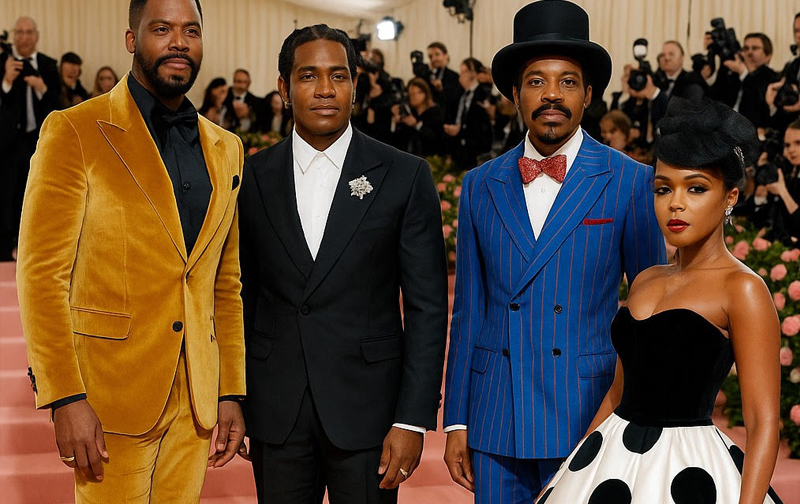
Fashion, identity and politics are inextricably entwined in the new Met Gala theme, “Superfine: Tailoring Black Style,” and as cultural critics have noted, the choice is not merely aesthetic but “incredibly political” . In historical perspective, the Black dandy emerged from the peculiar intersection of slavery, class and resistance: as Monica L. Miller documents in Slaves to Fashion, 18th-century “luxury slaves” would “tweak[] and rework[] their uniforms” into flamboyant attire, becoming “known for their sartorial novelty and sometimes flamboyant personalities” . This was a forced fashion, imposed first by slaveowners’ tastes but appropriated by enslaved men as a means of asserting self-worth. In such early instances one sees Marx’s insight that bourgeois society is defined by ceaseless revolution in production and cultural forms . The “fetishism” of luxury clothing, which Marx argued confers an almost mystical value on commodities, can here be turned on its head: garments of luxury become tools of liberation rather than mere luxury . Gramsci’s notion of cultural hegemony is helpful to interpret this: by subverting the ruling class’s own style codes, Black dandies challenged the “common sense” of racial inferiority and asserted a counter-hegemonic identity.
From the Atlantic world to Harlem and beyond, Black dandyism became a strategic defiance of imposed norms. In 1920s Harlem, for example, Langston Hughes and other New Negroes used the black suit as a middle-finger to Jim Crow society. As Vogue notes, “the Black dandy’s outfit became a form of resistance, an elegant middle finger to a society that sought to define them by race, not character” . Here we see Fanon’s theme at work too: colonial Black men were often made to feel “condemned to the mirror” of white gazes, their bodies and clothes markers of subjugation. The Harlem dandy’s sleek attire refused that condemnation. In Du Bois’s terms, he challenged “double-consciousness” by outwardly reshaping identity rather than internalizing the demeaning gaze . Indeed, Miller points out that Du Bois himself, mocked as a dandy by racist caricatures, “didn’t understand why that was a bad thing” , because of the dignity and narrative power fine dress could convey.
The Guardian rightly emphasizes that Black dandyism “challenges social hierarchies by subverting expectations of how Black men should present themselves” . This subversion has both aesthetic and political valences. On the one hand it can be framed through Bourdieu’s theory of habitus and symbolic capital: style is a form of taste that “classifies, and it classifies the classifier” . Black dandies take what had been a marker of white aristocracy – the tailored suit, brooches, top hats – and infuse it with new meaning. By doing so they are both playing Bourdieu’s game (accumulating symbolic capital of distinction) and rewriting the game’s terms (sighting the racialized nature of the categories). In this light, as Vogue observes, “Black dandyism has always been about more than aesthetics. It has been about identity, power, and resistance” . Judith Butler’s notion of performativity resonates here: dandyism is literally a restaging of race and gender scripts, with clothes as “signs that do things” – acts of defiance that reconstitute subjectivity. As Butler might say, these men and women are not merely dressing, they are producing identity by the very performance of elaborate masculinity or fluid gender presentation. In doing so they expose the artifice of normative categories.
But the spectacle in which Black dandyism is celebrated – the annual Met Gala – carries its own contradictions. The Gala is the ultimate event of fashion’s neoliberal culture industry, a glittering fundraiser in the bowels of the Metropolitan Museum attended by billionaires and celebrities. On the one hand, reframing Black dandyism as a Met theme seems to announce an overdue recognition of Black creativity and historical experience: Monica Miller, curator of the associated exhibition, frames it as honoring how Black men have used style to “impose and liberate” , and to engage with “race, class, gender, sexuality and power” through dress . The public narrative is uplifting: as Vogue puts it, this is “a declaration, a defiant reclaiming of space in a world that has long sought to define and confine Black identity” . Even Guardian commentators describe the moment as “incredibly political” – a timely foregrounding of Black designers and history in a country riven by racial injustice.
Yet from a critical perspective, there is a tension between content and context. The Met Gala is, after all, run by Vogue’s Anna Wintour and is synonymous with high-end corporate sponsorship. It is both a museum fundraiser and a media circus. Ironically, the very millions spent on designer gowns can seem to eclipse the political messages of those wearing them. Adorno’s critique of the culture industry is instructive: for him, mass culture serves to reproduce the status quo by packaging resistance as commodity. As Adorno observed, “The culture industry is not the art of the consumer but rather the projection of the will of those in control onto their victims” – it “imbues” even radical gestures with the existing power structures . The Met Gala is capitalism’s stage par excellence, where every outfit is media fodder. A social-justice message scrawled on a $35,000 dress (as AOC once did) is immediately inverted into a publicity moment for high fashion. As one sharp observer put it of an earlier Gala, “Many of the costumes are, to speak frankly, deliberately repulsive, but they are treated seriously, imbued with substance by the sums of money that they represent. It is ever thus with the emperor’s clothes.” This is a Met Gala paradox: Black liberation stylized and televised to the world, yet embedded in a world economy of opulence that Du Bois or Malcolm X taught us systematically excludes Black lives.
Indeed, the wealth and privilege on display can ring hollow in moments of crisis. Last year’s Gala, for instance, took place amid inflation and unrest; critics (even within fashion) noted how little the extravaganza would change everyday conditions. In Marxist terms the red carpet can be viewed as a stage on which commodity fetishism and spectacle obscure real class relations. What may look like political symbolism is inseparable from the relationships of production that fashion both depends on and advertises. The haute couture behind the red carpet is still produced by global labor under neoliberal conditions. Even as Black designers gain visibility – a welcome trend noted by Miller – their craft is still bound to capitalist markets. The luxury jacket means thousands of dollars no working-class person can afford, creating an inevitable distance. Black dandyism has always walked this fine line: a dandy flouting class signifiers, but only after learning the very language of luxury from his oppressors .
This contradiction is visible in how media narrates the Black dandy story. The Guardian story highlights intent, history and subversion , but mainstream coverage inevitably also focuses on celebrity appearances and aesthetic drama. Television cameras follow the co-chairs – Colman Domingo, A$AP Rocky, André 3000, and Janelle Monáe – as though their outfits were self-evident cultural texts. Yet the audience’s reading may be shaped more by color and texture than by the complex histories behind them. Such is the nature of spectacle: ideology seeps in subtly. Angela Davis’s reminder that “the problem of racism is intertwined with the problem of capitalist exploitation” (a paraphrase of her thought) casts this gala as a mixed emblem. Is it a radical reclaiming of public space by Black icons, or simply a product placement for Dior and Gucci? Arguably it is both.
Still, even if the Gala is funded by capital, the content – the concept of celebrating Black tailoring – can have emancipatory effects. Recall Gramsci’s “war of position”: cultural battles can lay groundwork for broader change by shifting common sense. By centering Black menswear in a traditionally whitewashed institution, this event asserts that Black identity belongs at the pinnacle of fashion narratives. When Michelle Obama or Kamala Harris choose Black designers for powerful suits , as Miller notes, they use style as a means to claim belonging. Butler would say they are performing citizenship in codes that had excluded them. The black tailored suit thus becomes a kind of language of dignity – an assertion of autonomy, beauty, and power in the face of a world that often tries to “restrict Black expression” . In other words, wearing an exquisitely crafted Black-dandy-inspired ensemble is itself an act of symbolic protest. Fanon reminds us that the colonized subject will always grapple with an imposed self-image; here, Black celebrities and designers flip the script by crafting their own image, drawing on history but speaking a new style.
Critically, the Guardian’s optimistic framing – “claiming space, asserting dignity, imagining alternatives to the present” – must be assessed against how effective this space-claiming is. Does it extend beyond the ballroom? When a Black actor like Domingo says “I don’t just wear clothes, I wear stories” , he highlights intent: garments reference narratives of freedom, resilience, artistry. But unless audiences learn those stories, the symbolism can remain obscure. Here one might invoke Adorno again: popular culture can mystify such messages through its usual dilution. And yet, as Fanon taught, the very visibility of proud black bodies on an international stage can have powerful psychological effects. His insight that the Black man had “suffered the splitting of his skin” can begin to heal as global eyes witness Black elegance and complexity. Cornel West might argue that these moments foster an ethos of love and recognition across cultural lines.
On class, the Black dandy tradition has always teetered between worlds. Historically, it arose when wealth and style were scarce for most Blacks, making sartorial elegance a rare form of protest. Today’s Met Gala theme ironically celebrates this tradition at its apex – the intersection of Black creativity and wealth. But in doing so it risks sanitizing class struggle: it’s one thing to admire Janelle Monáe’s tailored ensemble and another to address income inequality. We should note how AOC’s earlier Gala stunt (“Tax the Rich” dress) was a moral rebuke to this gilded milieu, one that was disallowed from mere pink carpets. That debate – whether you attend and try to subvert from within, or boycott to delegitimize – mirrors longstanding debates on working within bourgeois institutions. In the spirit of Gramsci, the Met Gala event could serve as a moment of “war of movement”, a frontal assault via spectacle that normalizes Black leadership in fashion. Or it could be a blip, co-opted and neutralized by the system.
At stake is the dual nature of fashion as politics. Marx would remind us that capital itself produces tastes and desires. The Met Gala’s script both acknowledges Black aesthetic influence and packages it as another consumable theme. From a capitalist standpoint, declaring Black tailoring trendy increases sales – it’s essentially a corporate branding exercise. Yet cultural critique requires holding the contradiction: even commodified, these symbols retain kernels of agency. Adorno’s admonition about the culture industry projecting ruling-class will invites skepticism, but it doesn’t fully nullify the agency of individual style acts. Bourdieu’s view that taste perpetuates class differences suggests that elite Black gowns are also elite acts; still, they contest who counts as cultural elite. In the best scenario, a Black dandyist at the Gala can simultaneously revel in style and evoke its historical legacies, turning the red carpet into a kind of quilt of struggles.
This is the promise that Miller emphasizes: “understanding that the present moment is always informed by both history and our aspirations” . The exhibition and theme aim to draw that connection, much as Angela Davis has argued for bridging history with activism. If spectators and participants do learn something of Josephine Baker’s strategy or Gladys Bentley’s defiant suits , if they reflect on Equiano’s purchasing a “suit of superfine clothes” on the day of his manumission , then the Gala can transcend its glitz. It can become an immersive history lesson written on fabric, echoing Foucault’s idea that power relations are inscribed on bodies – only here they are inscribed in silk and wool.
Yet media complicity remains a real concern. Fashion press typically photographs and broadcasts the most extravagant looks while backgrounding critique. The Guardian article itself, though insightful, will reach a limited audience compared to Vogue or Instagram feeds. Most onlookers will see images of monochrome suits, jeweled lapels, beads, sequins – and perhaps not read a word about systemic oppression. This is reminiscent of Guy Debord’s “society of the spectacle”: images substitute for substantive understanding. The audience might experience the Gala much as one consumes any viral fashion photo spread, appreciating surface “representation” but leaving the deeper politics unexamined. The Guardian piece prompts some letter-writers to reckon with it, but the quick glances of media might reinforce spectacle over critique.
Furthermore, the performers themselves must navigate expectations. Miller notes that Black public figures often “are required to dress in a particular kind of way” to be taken seriously, whereas white men can be “slovenly” without censure . This double standard illustrates an underlying power dynamic. A$AP Rocky wearing antlers headpiece or Colman Domingo donning a peacock plume brooch each signals creativity – but also the burden of visibility: they must perform success aesthetically to claim access to spaces traditionally barred. Butler’s queer theory offers an angle: gender itself has “always been queer” for Black people under a white gaze , so adopting flamboyant masculinity is simultaneously a nod to Black queer history and a revolt against heteronormative patriarchy. Figures like Grace Jones and Janelle Monáe (mentioned by Miller ) have long mixed masculine tailoring with coded queerness, expanding what Black power can look like. Such moves complicate any simplistic reading of the Gala as merely corporate branding; they enact intersectional politics on the body.
In sum, the Met Gala’s homage to Black dandyism embodies a tension between emancipation and cooptation. It is “political” in that it draws attention to the politics of dress: how Black people have always had to contend with the meanings sewn into their suits. As Du Bois envisioned, Black artistry was to create a “co-worker in the kingdom of culture” , merging African and American identities without being “cursed and spit upon” . The Gala’s theme gestures toward this Du Boisian ideal by spotlighting the tradition of style as a form of self-making. Yet the venue of that gesture – an elite capitalist fundraiser – cannot be ignored. It risks reifying the spectacle that Marx and Adorno warned about: cultural symbols sold in market forms for the maintenance of the status quo.
Ultimately, the question is whether the symbolism empowers Black identity or simply commodifies it. On one level, seeing Janelle Monáe or André 3000 in tailor-made attire on world TV can inspire Black youth to claim space for their creativity. On another, the very act of translating struggle into glamour may elide the messiness of politics. Our critical responsibility is to hold both truths. Black dandyism at the Met Gala is not a panacea, but neither is it trivial. It illustrates what Angela Davis calls “changing the things we cannot accept” – if the thing is the invisibility of Black history in art institutions, then tailoring a gala to this theme is one small change. In Cornel West’s words, maybe “justice is what love looks like in public” – and so fashion, as a public art, can be a form of love-ethic if wielded consciously. At this “incredibly political moment,” the true test will be if the tailors’ handiwork sparks real dialogue and if, in the end, the flurry of tweets and headlines makes space for the hard work of justice that lies off-camera.