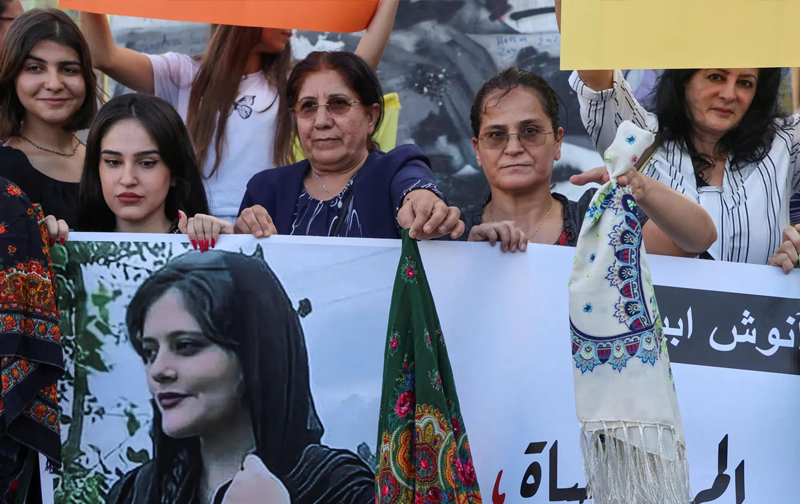
The young woman stands defiantly atop an overturned dumpster on a Tehran street, smoke swirling around her as flames devour the fabric in her hand. It is twilight in September 2022. Below, a crowd of protesters chants “ Zan, Zendegi, Azadi ”—“Woman, Life, Freedom.” With a triumphant cry, the woman raises the charred remains of a black headscarf to the sky. In that singular gesture – an unveiled head, a burning veil – an everyday article of clothing is transformed into a blazing weapon of resistance. The scene is both ordinary and revolutionary: ordinary, because a headscarf is a banal item Iranian women wear daily under state compulsion; revolutionary, because to cast it into fire defies an authoritarian regime at its core. The death of Mahsa Amini, a 22-year-old detained for an “improper” hijab, has ignited a conflagration of protest . What began as grief and outrage at the killing of one woman by Iran’s morality police has exploded into a broader uprising. And at the heart of this uprising is a striking paradox: fashion – the very fabric that covers the body – has become a battleground for political freedom. Iranian women, by the thousands, are peeling off their mandated headscarves, cutting their hair in public, and thereby flouting a theocracy that for decades has treated women’s bodies as territory to be patrolled. In doing so, they reveal far more than hair and skin – they reveal the power of clothing as political protest, a power that reverberates globally.
It is often said that the personal is political. In Iran, the personal is palpably political: a strand of hair slipping from a scarf, a bright swipe of lipstick behind a veil, a daringly short manteau – each is laden with seditious potential under the Islamic Republic’s dress codes. Conversely, the political is intensely personal: the state’s ideology is literally worn on women’s bodies every day. Mandatory veiling has been in force since 1983, turning the female body into a canvas on which the regime asserts its moral order . In such a context, a woman’s act of unveiling – of baring her hair to public view – becomes an act of reclamation. The stakes are life and death: security forces have beaten, arrested, even allegedly shot women for appearing unveiled in the streets . Yet, in the autumn of 2022, from Tehran to smaller cities like Bushehr and Saqqez, women and girls came out with heads uncovered, waving their scarves like banners before crowds of cheering allies . Schoolgirls tore off their hijabs in classrooms and playgrounds, and videos of unveiled women defiantly walking past morality police went viral. What Western fashion magazines might once have deemed a “wardrobe choice” is, in Iran, a frontline in the struggle between populace and power.
To appreciate the global significance of this struggle, one must recognize that control over clothing – especially women’s clothing – is a common feature of authoritarianism, patriarchy, and colonial domination alike. The drama playing out in Iran resonates with histories and movements far beyond its borders. From the Black Panthers donning leather jackets and berets in 1960s America to indigenous women in Latin America reclaiming traditional dress, from French Muslim women fighting for the right to wear the hijab to Ugandan activists marching in miniskirts, fashion has long been a language of resistance. The Iranian protests of 2022 have thus struck a chord worldwide. Progressive and left-wing movements across the globe have rallied in solidarity, seeing in Iranian women’s struggle a reflection of their own battles against bodily oppression. In Paris, famed actresses cut off their hair on camera in solidarity ; in Istanbul, protesters held up Mahsa Amini’s portrait as they burned scarves; in New York and London, crowds chanted “Woman, Life, Freedom” in multiple languages. Through these gestures, activists and artists underline a shared conviction: that a woman’s right to choose her appearance is integral to her freedom. As the feminist writer bell hooks succinctly observed, “Being oppressed means the absence of choices” – and compulsory dress codes, whether enforcing or forbidding a veil, strip women of choice. The global left recognizes that compulsion is the enemy of liberation, whether it comes cloaked in clerical robes or in secular patriotism.
In Iran’s case, compulsory hijab is explicitly a tool of state control over women’s bodies. The late Ayatollah Khomeini, upon seizing power in 1979, wasted no time in mandating the veil, cloaking the female form as one of the first acts of the new Islamic Republic . On the eve of International Women’s Day in 1979, he decreed that women must cover their hair in workplaces – a telling coincidence and a harbinger of the regime’s gender ideology . Ironically, many of those women had willingly worn hijab in the revolution against the Westernizing Shah, for at that moment donning the veil was seen as a symbol of anti-imperialist authenticity . But the very next day, thousands of Iranian women – including devout Muslims who believed the veil should be a personal choice – flooded the streets in protest of Khomeini’s order . They chanted, “We did not have a revolution to go backwards!” , asserting that freedom must include the freedom to not veil. Thus, from the start, Iranian women understood that what they wear is not a trivial matter of fashion; it is entwined with their status as free agents or subjugated subjects. To enforce a dress code by law is to assert ownership over their bodies and identities.
Michel Foucault, the French philosopher of power, famously wrote that “the body is directly involved in a political field; power relations have an immediate hold upon it; they invest it, mark it, train it, torture it, force it to carry out tasks, to perform ceremonies, to emit signs.” This insight finds vivid confirmation in Iran’s hijab laws. The state literally marks women’s bodies with prescribed coverings and forces them to perform the daily “ceremony” of veiling. A woman’s covered head emits the prescribed sign of modesty and obedience; an uncovered head emits, in the regime’s eyes, a seditious signal. Under such conditions, many Iranian women internalize what Foucault would call disciplinary power. An omnipresent “gaze” – not just the male gaze of society, but the ever-watchful eye of the morality police and surveillance cameras – looms over public space, instilling self-censorship and bodily regulation. Generations of women have learned to keep a shawl handy, to pull it forward over a few errant curls when a basij militiaman or a CCTV camera might be near. They have been made to understand that their bodily comportment in public is not truly theirs – it belongs to the state’s ideological theatre.
The internalization of such discipline recalls Pierre Bourdieu’s description of how social norms become embodied. Bourdieu, studying traditional Kabyle society, noted that the “specifically feminine virtue” of modesty “orients the whole female body downwards, towards the ground, the inside, the house,” embedding social hierarchy into muscle and gesture . He called this the transformation of a cultural mythology into bodily hexis – a “permanent disposition, a durable way of standing, speaking, walking, and thereby of feeling and thinking” . In Iran, too, an officially sanctioned mythology – that a woman’s unveiled body is a source of dangerous fitna (chaos) – has been inscribed onto women’s physical bearing. How many Iranian girls, from a tender age, have been taught to lower their gaze, to hunch their shoulders to hide budding breasts, to move cautiously so as not to “invite” male attention? Through both gentle socialization and the violent shocks of punishment, the regime’s ideal of womanhood (modest, invisible, obedient) attempts to write itself into the very flesh of women. By compelling the veil, the authorities hope to produce what Foucault called “docile bodies” – bodies that “may be subjected, used, transformed and improved” by those in power.
But as Foucault also reminded us, where there is power, there is resistance. The very intimacy of bodily oppression means that the body itself can become the site of rebellion. When Iranian women cast off their scarves, they are in effect reasserting authorship over their own bodies – performing what the anthropologist Homa Hoodfar calls a “symbolic act of resisting” the state’s gender politics . In these protests, the female body – long conscripted as a symbol of the Islamic Republic’s virtue – is reclaimed by women as a symbol of insurrection. There is a powerful feminist principle at work here: that women will no longer be the spoken-for objects of history, but its speaking subjects. The renowned feminist theorist Judith Butler argues that gender itself is a kind of performance, “an identity tenuously constituted in time, instituted in an exterior space through a stylized repetition of acts.” Wearing the hijab (or any prescribed garb) every day under duress is exactly such a “stylized repetition of acts” – a performance demanded by an external script. By disrupting that performance, Iranian women open up the possibility of a new script. In city squares and on social media, they enact a different identity: one that defies the state’s definition of a “proper” woman. As Butler might say, their collective, public unveiling is a performative act, one that doesn’t just reflect a pre-existing identity but actually helps constitute a new political reality. Each time a woman dances bareheaded in the street, or shares a video of herself walking unveiled in Tehran, she is doing more than breaking a rule – she is becoming a new kind of political subject through that very deed.
This embodiment of dissent has profound symbolic resonance. Hair, for instance, carries deep cultural meanings. In Persian literature and lore, a woman cutting her hair can signify mourning or protest – a motif now vividly revived as young women sheared off ponytails in fury over Mahsa Amini’s death. “Cutting one’s hair is a feminist act of resistance, an exercise of agency through which Iranian women are taking control and reclaiming their womanhood, their lives, their bodies and their freedom of choice,” one Iranian essayist observed . Indeed, the image of shorn hair has swept the world: from Tehran to Los Angeles, locks have been lopped off in solidarity, often accompanied by tears of rage or defiance. In one viral video, a grey-haired Iranian woman stands before her husband’s grave – he was executed by the regime years ago – and she chops off her hair and lays the braid on his tombstone, dedicating her personal grief to the present struggle. Such raw acts blur the line between personal sorrow and political statement. They also carry echoes of ancient rituals, recharging them with radical intent. A simple bodily gesture – slicing a scissor through one’s tresses – becomes a semaphore of liberation.
Observers in the West have been struck by the fact that unveiling can be a progressive act, given that in many Western contexts the veiling of Muslim women has been portrayed as oppressive. This apparent contradiction is easily resolved by foregrounding agency. In Simone de Beauvoir’s timeless words, “One is not born, but rather becomes, a woman.” In other words, society scripts the role of “woman” – including expectations of how a woman should dress and behave – and women are made (not born) to conform. What is at stake in both Iran and, say, secular France is who gets to decide how a woman “becomes.” Under Iran’s Islamist patriarchy, the state claims that power, insisting that a “proper” woman is one who veils and “behaves modestly” . Under France’s laïcist (secularist) regime, the state likewise claims the power to dictate a “proper” public woman, in this case one who unveils – witness the 2004 law banning hijabs in public schools and the 2010 ban on face-covering veils. In both cases, women’s personal choices are circumscribed by an ideology (be it religious fundamentalism or militant secularism) that uses women’s bodies as emblems of its values. The Iranian woman forced to cover her hair and the French Muslim woman forced to remove her headscarf are, in Beauvoir’s sense, being made into women according to someone else’s terms. Small wonder, then, that both have risen up to say no. Each is fighting to reclaim the right to shape her own identity. The principle is the same: la liberté de choisir – freedom to choose how to appear, how to live, how to be.
This is where left-wing and feminist solidarities worldwide find common ground with Iran’s protesters. True progressivism must oppose both theocrat-imposed modesty and state-imposed unveiling, for both are, at root, forms of patriarchal control. Gayatri Spivak, reflecting on colonial British moves to outlaw the veiling or other “barbaric” native practices, famously summarized the imperialist attitude as “White men…saving brown women from brown men” . In other words, colonial powers often purported to liberate indigenous women (from their own men’s oppression) as a pretext to assert dominance. Progressive activists today are cautious not to fall into that trap of paternalism. The global left’s support for Iranian women is markedly not about Western saviors coming to unveil them – rather, it is about amplifying the voices of the women themselves who demand bodily autonomy. In this, it sharply departs from the colonial paradigm identified by Spivak. The West is not “saving” Iranian women; Iranian women are saving themselves, and people of conscience worldwide are bearing witness and lending support.
Indeed, the specter of colonial history hovers over any politics of the veil. During the Algerian War of Independence in the 1950s, French colonial officers made a grand show of “liberating” Algerian women by ceremonially removing their veils – hoping to fracture the fabric of Algerian society. As Frantz Fanon documented, the French believed that to control Algeria, they must first control Algerian women; “if we want to destroy the structure of Algerian society… we must first of all conquer the women; we must go and find them behind the veil,” Fanon quoted a colonial doctrine . Unveiling ceremonies were staged, with French officials and their Algerian loyalists tearing off women’s haïks in public squares to cheering crowds of European settlers . Yet, as Fanon observed, this stratagem ultimately backfired: it only made the veil a more potent anti-colonial symbol, treasured by Algerian women as an emblem of resistance. Many Algerian women who had never worn the veil before the war took it up as a form of patriotic defiance. Some even used the colonizer’s expectations against them – for instance, revolutionaries would occasionally remove the veil to pass as assimilated “modern” women and thus more easily carry out underground missions. Fanon described how the Algerian woman’s body became a battlefield of warring gazes: to the French, a veiled woman was an insult and a mystery – “This woman who sees without being seen frustrates the colonizer. There is no reciprocity,” Fanon wrote of the colonizer’s gaze at the veiled Algerienne . Colonial soldiers felt uncomfortably powerless before a woman whose face they could not subjugate with their eyes. The veil, in that context, empowered its wearer by denying the colonizer a visual hold. Fast forward to Iran today: the dynamic is inverted but the underlying principle is similar. Now it is an indigenous authoritarian patriarchy, rather than a foreign occupier, that insists on the veil for its own hegemonic ends. And Iranian women, like the colonized Algerian women before them, have transformed the meaning of the garment through their resistance. When they cast it off en masse, the veil becomes, ironically, a symbol of what it was supposed to prevent: dissent and disorder. The regime’s greatest fear materializes – the “improperly” dressed woman as harbinger of revolution.
The life-and-death importance given to a scrap of cloth might bewilder those who have the privilege of taking clothing freedom for granted. But garments are never purely private; they are social skin. They carry symbolic capital, to borrow Bourdieu’s term, and can signal allegiance or opposition to prevailing power. For the Islamic Republic, the hijab is “evidently central in [the] battle against sexuality,” as even high-ranking officials have absurdly claimed that a woman’s exposed hair emits irresistible sexual “rays” that drive men wild . In this warped logic, forcing women into hijab is portrayed as a benevolent act to protect society’s morality (and to protect women themselves from male lust) . This echoes countless patriarchal scripts around the world and throughout history, wherein women are told that their bodies are inherently dangerous or shameful, needing to be covered for the good of all. But Iranian women have unmasked this argument as a self-serving rationalization for gender apartheid. By disobeying the dress code, they expose the power play behind the piety. As a popular slogan during the 2022 protests went, “Jin. Jiyan. Azadi.” – Kurdish for “Woman. Life. Freedom.” – asserting that women’s freedom is central to life and liberty for everyone. In practice, their refusal to comply with hijab laws has “won supporters worldwide” even as it invites brutal crackdowns at home . The morality police beat and arrest women for showing a few centimeters of hair, but each act of defiance sparks another – a viral video of a woman flinging off her headscarf and twirling in a city square will inspire another young girl to push back her own head-covering the next day.
There is a profoundly performative aspect to this resistance, as Judith Butler would highlight. The more women do it, the more it undermines the normativity of compulsory hijab. In Butler’s terms, the repetitive performance that sustained the gender norm is being disrupted by a new repetition – the repetition of disobedience. The politics of surveillance and spectacle are flipped: what was supposed to be a spectacle of female piety (rows of identical covered heads) is replaced by the spectacle of female dissent (bonfires of scarves, flowing hair in public parks). Social media has amplified this effect, turning local transgressions into global visuals. A schoolgirl in Iran tossing aside her veil in class instantly becomes an international icon of youthful rebellion, circulating on Twitter and Instagram as inspiration and indictment. The regime, in response, has doubled down on surveillance – installing cameras to catch unveiled women , prosecuting celebrities who dared to remove the hijab, and even, reportedly, hiring plainclothes agents to infiltrate women’s sections of parks or restaurants to enforce veiling. It is a veritable panopticon, recalling Foucault’s analysis of how modern power operates through continuous observation and the threat of punishment. Yet, even in the face of this Orwellian scrutiny, acts of sartorial subversion persist. The courage of these women – to walk unveiled past a camera knowing it may mean a jail cell by nightfall – is history-making. It shows the limits of authoritarian control: at some point, the human spirit, yearning to express itself freely, rebels against being draped in another’s command.
Notably, men have joined this resistance too, in significant if symbolic ways. In many protest gatherings, men have formed protective cordons around unveiled women, or donned hijabs themselves in satirical solidarity (as if to say, “If covering hair is so essential to moral society, let men do it too!”). These gestures chip away at the gendered logic of the state’s dress code, exposing its arbitrariness. They also instantiate what feminist solidarity can look like: not a battle of the sexes, but a joint struggle against an unjust system. It calls to mind bell hooks’ concept of “communities of resistance” – the idea that liberation is most powerful when collectively forged. “One of the most vital ways we sustain ourselves is by building communities of resistance, places where we know we are not alone,” hooks wrote . The scenes from Iran exemplify this: women refusing to bow down, and others – women and men – standing with them so they are not alone. In those moments, a new community is formed, one defined not by imposed dress or status but by shared yearning for freedom and dignity.
The defiance of Iranian women also resonates with feminist struggles elsewhere that likewise use fashion as a form of protest. Consider Uganda in 2014, when rumors of a “miniskirt ban” (stemming from an anti-pornography law) led to mobs harassing and stripping women deemed to be dressed “indecently.” In response, Ugandan women activists organized the “End Miniskirt Harassment” protest. Dozens gathered at the National Theatre in Kampala, many deliberately wearing short skirts, and held placards reading, “Thou shall not touch my miniskirt” and “My body, my business” . The protest was a reclamation of agency very much akin to Iran’s unveiling movement – in this case, asserting that no one had the right to attack or shame a woman for her style of dress. The Ugandan activists creatively mocked the prudish attitudes behind the harassment: one tongue-in-cheek proposal suggested the entire population be dressed in shapeless onesies to prevent any sexual temptations . Such satire echoes the witty signs Iranian protesters have been seen carrying – for instance, slogans like “Cover your eyes, not our hair” aimed at men who claim women’s clothing is the problem. In both Iran and Uganda, women turned the tables, pointing out that the issue was not their garments but the mentality of those who seek to control women’s bodies. The political contexts differ – a theocratic regime on one hand, a secular but socially conservative society on the other – yet the underlying feminist cry is the same: leave our clothes and our bodies alone.
Travel further back in time and across continents, and you find the Black Panther Party in the late 1960s U.S. also understood the political potency of appearance. Young Black revolutionaries in Oakland chose a signature uniform: black leather jackets, black pants, powder-blue shirts, and black berets – the beret adopted in homage to anti-colonial guerrilla Che Guevara . This carefully curated style made them instantly recognizable and camera-ready; it projected an image of disciplined militancy and Black pride. Photographs of Panther activists – Afroed hair, dark sunglasses, beret at a cocky tilt, shotgun in hand – became indelible symbols of Black Power. The aesthetic was part of the politics. As one commentator noted, the Panthers’ “ultra-cool, urban-militant uniform” fused fashion, function, and freedom, making their visual presentation a challenge to the mainstream portrayal of Black Americans . It was also pragmatic theater: the uniform helped unite members and intimidate opponents (including police who all too often saw only a Black man to be feared, but now had to consider that this leather-clad figure represented an organized movement). While the Black Panthers’ struggle was primarily about racial justice and armed self-defense, their understanding that clothing itself could be subversive presaged the later use of fashion by other movements. The Panthers demonstrated how oppressed people could seize the stereotypes foisted on them (the “dangerous Black man”) and weaponize them as tools of empowerment and solidarity. In a sense, they performed an opposite but complementary maneuver to Iranian women: instead of removing a mandated garment, they added a forbidden or radical one – firearms openly carried, military chic attire – in order to assert their rights. The commonality is that both groups used visual symbolism to invert power dynamics. If the oppressor’s gaze had cast them as weak or subservient, they would return that gaze as something fearless and unapologetic.
Similarly, indigenous peoples have long fought cultural oppression by clinging to or resurrecting traditional dress that colonizers tried to erase. Under European colonial rule in much of Africa, the Americas, and Asia, indigenous clothing and hairstyles were often banned or scorned as “uncivilized.” For example, under Spanish and later national elites in Latin America, many indigenous women were pressured to abandon their handwoven garments and wear European-style dresses; those who didn’t were relegated to lower social status. In Guatemala’s horrific civil war, simply wearing Maya traditional dress could mark one for persecution. One report notes how indigenous women working as maids in cities were often forced to strip out of their traditional dress, given demeaning generic names like “Maria” to erase their identity – all to “obliterate any remnant of ethnic identity and human value” in them . Yet, out of such denigration grew defiance. Today, across the Andean highlands and beyond, indigenous women proudly don polleras, huipiles, and other ancestral garments as everyday attire and as political statement. In Bolivia, the “cholitas” – Aymara women in bowler hats and layered skirts – have gone from being scorned by polite society to being icons of national culture and even legislators in parliament. In 2019, when Bolivia’s first indigenous woman mayor took office, she wore her pollera to the inauguration to signal that indigenous identity would no longer be marginalized. In Brazil, just in 2023, an indigenous fashion show was held featuring Amazonian tribes’ designs, explicitly framed as “a form of resistance” to centuries of cultural erasure . Each stitch in those garments is a thread of memory and resilience, a way of saying: we are still here, despite all attempts to make us disappear. The struggle of an Iranian woman to show her hair carries a similar weight of heritage and identity – Iran’s history includes eras when unveiling was forced by a modernizing Shah, and many devout women at that time resisted by keeping their veils. Iranian women today know that whether compelled to remove the veil (as in 1936 under Reza Shah) or to wear it (as after 1979), the issue was the same: men in power denying women’s agency. Thus, when they loosen their hair to the wind, they invoke not just contemporary rights discourse but a lineage of women’s fights in their land – from those who defied Reza Shah’s police by sneaking out with veils, to those who defied Khomeini’s edict by marching without them in 1979. The through-line is the insistence on choice. In the words of an old anti-shah slogan repurposed by today’s activists, “Whether with hijab, whether without hijab – onwards to freedom!” The point is that the freedom to choose must belong to the women themselves, not to any shah or supreme leader.
The symbolism of clothing in these struggles cannot be overestimated. Cloth has been used to signal both domination and liberation. It can be prison or banner. In the Orientalist imagination, as Edward Said analyzed, the veil was long a cipher for the East’s supposed backwardness and the Eastern woman’s voicelessness. European artists and writers depicted veiled women as mysterious, erotic, and oppressed – beings who “never spoke of herself…He [the Western man] spoke for and represented her” . The Orientalist narrative silenced the very women it claimed to describe, much as Flaubert’s famous account of an Egyptian courtesan rendered her a mute object of his fantasy . Iranian women’s recent actions shatter such tropes. They are speaking with their own bodies in a way that no one can politely ignore. In doing so, they are also issuing a challenge to Western feminists: stand with us, but do not condescend to us. They do not need “saving” by outside powers; they need solidarity and for the world to hear their demands – regime change, human rights, gender equality – on their own terms. As one Iranian feminist said in an interview, “This is the first time that the protests are actually gelling around women’s concerns and women’s issues, and men are standing by them” . It is a women-led movement, but inclusive and broad-based, uniting multiple ethnicities and social classes. This unity in diversity has been a key strength, reminiscent of how the Green Movement of 2009 in Iran (sparked by disputed elections) saw women at the forefront but not as isolated “women’s issues” demonstrators – they were leaders of a general democratic wave. In 2022-2023, however, women’s emancipation is not just an adjunct to some other political cause; it is the central cause. And this is why fashion – specifically the compulsory hijab – occupies center stage. It is the visible tip of the iceberg of gender apartheid, easy to grasp and powerfully emotional.
The ramifications of these protests extend beyond Iran’s borders. Regionally, they inspire women living under similar strictures. One can imagine young women in Afghanistan, newly re-subjugated by Taliban edicts to cover up, secretly taking heart from the images of their Iranian sisters tossing hijabs into bonfires. Already in 2022, brave Afghan women in Kabul protested Taliban rules by staging their own small demonstration, and some smuggled out videos of themselves unveiling in their offices or classrooms as an act of quiet rebellion. In the Arab world too, debates have been reignited about choice versus coercion in matters of hijab. Even in secular countries like France, Iranian women’s struggle has provoked reflection: French commentators are asking, if we applaud Iranian women for removing hijabs in defiance of state mandate, shouldn’t we equally defend a French Muslim woman’s right to wear her hijab in defiance of a state ban? The consistent principle is that the state should not police women’s attire. The left-wing and feminist groups that champion secularism must reconcile this by distinguishing between secularism as freedom from religious coercion and secularism misused as a pretext to impose different coercions. The conversation is nuanced, but the Iranian example clarifies one point starkly – a government that enforces dress codes (of any kind) is an enemy of liberty. And thus Iranian women’s fight garners genuine leftist support across the world, bridging what might have been divides. Progressive Muslim feminists, ardently anti-imperialist but also anti-patriarchal, see Iran’s “Women, Life, Freedom” as a model of intersectional resistance – against both dictatorship and misogyny simultaneously. Secular leftists, in turn, see beyond the religious trappings to the common humanity: these protesters are workers, students, mothers, radicals, dreamers, people who long for emancipation just as people in Chile or Ferguson or Paris have.
The political ramifications within Iran are also profound. By taking on the dress code, protesters implicitly attack the entire legitimacy of the Islamic Republic, since compulsory hijab is one of its ideological pillars. “Death to the Dictator!” and “Death to Khamenei!” have been shouted in the same breath as “Death to the mandatory hijab!” in the streets. The state’s response has been to dig in its heels – doubling penalties, using live ammunition on crowds , and deploying propaganda to paint the protesters as foreign agents or misguided youths. But even as overt street protests dwindled by early 2023 under heavy repression, an undercurrent of civil disobedience remains. A quiet revolution is visible in daily life: more and more Iranian women simply ignore the hijab law, walking in public unveiled despite warnings and signs. In Tehran’s trendy cafés and malls, an unveiled woman is no longer a rare sight – something unthinkable a decade ago. Some analysts speak of an irreversible change in social norms. “The protests have not achieved regime change, but they have changed the people,” an Iranian observer noted. The cost has been high – hundreds killed, including teenage girls , and thousands jailed. But the survivors carry the flame of those martyrs, much as Kurdish-Iranian teenager Nika Shakarami, who was killed after burning her headscarfThe cost has been high – hundreds killed, including bright young women like Nika Shakarami, Sarina Esmailzadeh, and Hadis Najafi, whose names have become rallying cries . But even amid mourning, the movement endures, carried forward by those who refuse to surrender. The image of Nika – a 16-year-old who reportedly burned her hijab at a protest and was later found dead, a victim of state violence – now lives on in murals and protest art, her uncovered hair flowing defiantly. Her generation has known nothing but the Islamic Republic’s strictures, yet they are the ones most boldly breaking from them. This generational revolt speaks to a broader human truth: the young often recognize that the emperor has no clothes (in this case, that enforced “modesty” cloaks nothing but fear and control), and they are unafraid to say so. In Iran, schoolgirls have torn down pictures of the Supreme Leader in their classrooms and posted videos of themselves dancing, hair flying – simple joys long suppressed. Such acts are part of the protest’s performative diversity: not only angry marches, but also songs, dances, and creative art have proliferated. The anthem of the movement, “Baraye” (meaning “For the sake of…”), lists everyday aspirations – for dancing in the streets, for kissing loved ones, for women, life, freedom… – implicitly contrasting these simple desires with the regime’s harsh prohibitions . Through it all, clothing remains a central motif. In protest art circulated online, women are depicted casting off black chadors to reveal wings, or using a hijab as a slingshot aimed at the regime. The very constraint is repurposed as a weapon against itself.
It bears emphasizing that the struggle is not against a piece of cloth per se, but against what that cloth has come to represent: the denial of women’s self-determination. As one Iranian woman put it succinctly, “It’s not about the hijab – it’s about control.” The veil can be many things: a personal devotion, a cultural heritage, a fashion choice, or, when forced, a cage. Edward Said noted that the Orient was long “Orientalized” by denying it the power to represent itself . Today, Iranian women are representing themselves with stunning clarity. They are saying that if they wear the hijab, it must be by choice, and that no authority – neither Eastern nor Western – has the right to compel or forbid it. In this sense, they are fighting not just for Iranian women, but for women (and men) everywhere who face dictates on their bodies. They have received messages of solidarity from Turkish women opposing their country’s creeping conservatism, from Indian women battling both religious extremism and sexist dress codes, from American women protesting abortion bans (another form of bodily control). The global feminist left intuitively understands these common threads. A protester in Los Angeles holding a “Women, Life, Freedom” sign might be marching for Iran one week and for reproductive rights in the US the next – the causes intersect through the fundamental principle that bodily autonomy is non-negotiable. Clothing is one facet of that, but an essential one, because it is so visible and so daily.
In reflecting on the past year, many have called the Iranian women’s uprising a revolution within a revolution. Even if the theocracy survives for now, something in our collective consciousness has shifted. The sight of Iranian women freely walking with their hair uncovered – once an unimaginable rarity – is now increasingly common on Iranian streets, a form of civil disobedience continuing in spite of the crackdown . The regime itself is at a crossroads, its legitimacy punctured by the protesters’ fearless cries. As an Iranian philosopher quipped, “The Islamic Republic has always been obsessed with women’s covering; it never expected that un-covering would uncover its own vulnerability.” The protests stripped the regime of its spiritual pretenses, revealing brute force beneath. Conversely, they clothed the protesters in a moral authority that has garnered respect worldwide. In a poetic twist, the very people once depicted as voiceless, veiled victims have emerged as the moral leaders of a global fight for freedom. And it is precisely through an act of unveiling that they have voiced their demand for dignity.
Looking globally, we can discern a rich tapestry of resistance where fashion and politics entwine. In each case, what is worn (or not worn) on the body becomes a statement about the body politic. In France, when Muslim women assert their right to wear a headscarf in school or at work, they are pushing back against an assimilationist view that would efface their identity – a stance as political as any street demonstration. In Uganda, when women put on their shortest skirts and parade in Kampala, they flip the script on those who sexualize and police them, essentially saying “we refuse to carry the burden of your gaze” . In the United States, when Black athletes like Tommie Smith and John Carlos raised black-gloved fists atop the Olympic podium in 1968 (effectively wearing a political symbol on their bodies), or when activists today wear hoodies en masse to protest the killing of a Black teenager in a hoodie, they use attire to confront racist stereotypes and state violence. Indigenous regalia, queer pride costumes, the pink “pussy hats” donned by thousands in Women’s Marches – all attest to the enduring truth that dress and appearance are a powerful theater for asserting rights. They allow individuals to declare, “I am here, I am visible, I won’t be erased,” or conversely, “I choose to disappear from your norms and reappear on my own terms.”
Under regimes of surveillance and authoritarianism, such acts take on heightened significance. They become stealthy revolutions. An authoritarian state can deploy armies of police, spend billions on weapons, erect prisons – yet it is flummoxed by the simple refusal of women to wear what it tells them. It is a kind of soft power that can’t be easily crushed by force. As the political theorist Hannah Arendt once observed, power and violence are opposites; where one rules absolutely, the other is absent. In Iran, the regime’s reliance on violence signals a loss of true power – the power of persuasion and consent. The protesters, meanwhile, exercise the power of no. Every woman who leaves her house with her hair uncovered is saying no – not with a shouted slogan or Molotov cocktail, but with the very fact of her presence in society on her own terms. It is a quiet revolutionary act that happens millions of times a day. The state can scarcely jail half the population if they all persist. This is how compulsion regimes crumble: first socially, then politically.
Ultimately, what we are witnessing in Iran and across the world is a re-definition of what clothing means. Rather than a marker of imposed identity, it becomes a canvas of self-expression and solidarity. The Iranian woman burning her hijab is not rejecting faith – many faithful Muslim women support the protests – she is rejecting the use of faith as a whip. The Ugandan woman in a mini skirt is not rejecting decency – she is rejecting the notion that decency resides in hem lengths rather than in human conduct. These protests refocus attention on ethics over aesthetics: a just society would concern itself not with the fabric on a woman’s head or legs, but with her rights, opportunities, and safety. Or, as one placard in Tehran wryly put it, addressing the authorities: “Deal with your own sins, not our hair.”
In the literary fabric of this global narrative, Mahsa Amini’s story has become a tragic but luminous thread. Her name, like those of George Floyd or Malala or others before her, has transcended her individual life to symbolize a universal plight. And fashion – the headscarf she was accused of wearing “improperly” – is the unlikely vehicle by which her memory catalyzed a movement. There is a heartbreaking symbolism in the fact that something as mundane as how a young woman wore her hair could seal her fate. Yet there is also profound hope in the response: her sisters (and brothers) in Iran and around the world rose up to say enough. They turned that symbol of repression into one of resistance. They have shown, in a lesson that will echo for years, that even under the boot of tyranny, acts of everyday rebellion can shake the foundations of a regime.
As the months pass, the immediate fury of Iran’s street clashes has given way to a stubborn, smoldering resistance. The struggle continues in quieter forms – a furtive gathering here, a social media campaign there, small victories like a shopkeeper refusing to enforce hijab on customers, or a judge tossing out a case against an unveiled woman. The feminist, progressive, and leftist networks internationally keep watch, pressuring their own governments not to appease the Iranian regime and amplifying Iranian voices. A great tableau of solidarity has unfolded: Parisians lighting the Eiffel Tower with the slogan “Femme, Vie, Liberté,” rallies in Toronto led by exiled Iranians, student unions in Chile and South Africa sending messages of encouragement, Turkish and Kurdish activists adopting the chant in their own protests. In this way, “Woman, Life, Freedom” has traveled the globe, entering the lexicon of liberation movements. It reminds us that while each struggle has its context, they are all part of a larger human quest for emancipation.
If one were to take a bird’s-eye view of the past century, the arc of such protests suggests that clothes often change long before laws do – but that change in attire can herald deeper social revolutions. Women won the right to vote in many countries not long after they won the socially accepted right to wear more comfortable, liberal clothing (think of the flappers of the 1920s who shocked society by showing their calves and cutting their hair short, defying Victorian norms – that aesthetic rebellion paralleled and presaged greater freedoms). Likewise, the natural hair movement among Black women preceded wider acknowledgment of Black identity and rights. In Iran, too, the erosion of the dress code might be the first crack in the regime’s broader apparatus of control. Already, by simply carrying on with uncovered heads, women have made the state’s vaunted “morality” regime look ineffectual and absurd. A law universally disobeyed is a law in twilight.
In the end of my article, the story of fashion as political protest is a story of symbolism made real. A piece of clothing is never just threads and fiber; it carries the meanings we imbue it with. In Iran, a piece of cloth became a flag – sometimes burned in sacrifice, sometimes waved in victory – for a people’s demand to be the authors of their own lives. The global significance of this moment lies in its fusion of the intimate and the universal. The humble arena of personal attire transforms into a grand stage for debates on authority, modernity, and rights. Iran’s women have taught the world that liberation can start with the simplest act of saying “no” to what you’re told to wear. Their unveiling is both literal and metaphorical – it unveils the hypocrisy of rulers who fear their own women, it unveils the power that lies in unity and courage, and it unveils a future in which perhaps, one day, “woman, life, freedom” will no longer need to be a rallying cry, but will be an ordinary fact of life.
In a moving scene during the protests, a young Iranian woman stood on a utility box and cut off her long dark hair, tossing it to the ground to cheers. “For freedom!” she shouted, tears in her eyes. In that instant, she could have been any woman, from any place or time, casting off chains seen and unseen. The politics of fabric and body converged in a single cathartic moment. Across the world, people bore witness – and many cut their own hair in solidarity, as if to say the distance between us is not so great after all. The language of fashion had become a shared language of protest. Clothing became poetry, rebellion became beauty. And an authoritarian regime, armed to the teeth, found itself confronted by an army of combs and scissors, of uncovered heads and unbowed souls – an army it could not easily defeat.
In the rich, embodied literature of human freedom, the chapter being written by the women of Iran will stand as unforgettable. It tells us that even when freedom is forced into the folds of a garment, it can be recovered and unfurled. A veil can be many things – shield, prison, identity, choice – but it can never extinguish the will to be free. That, ultimately, is the message radiating from Iran’s unveiled rebellion to the entire world. In a society of mandatory veiling, unveiling is a revolution. And in a world full of injustices, these revolutionaries have offered a vision as simple and profound as a woman’s hair in the wind: that liberty lives in the very fibers of our being, waiting to be set free. Woman, Life, Freedom – Zan, Zendegi, Azadi – the cry rings out, and will not soon be forgotten . The fabric of protest, woven from courage and hope, will continue to unfurl wherever people refuse to be silenced.