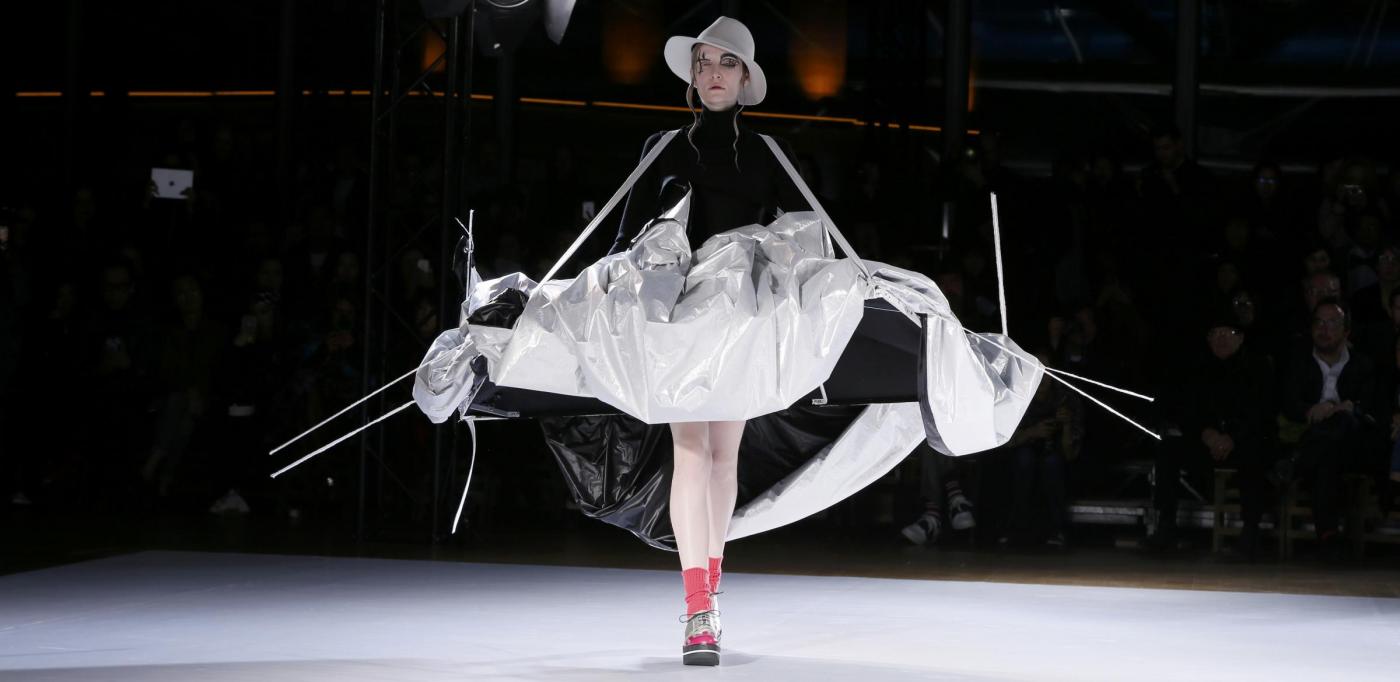
I found this collection moving, precisely because the combination of conventional femininity and the subversion of clothing conventions throws the viewer off balance. One’s expectations are at first defined by the conventionality of the clothing silhouettes and the feminine gender performances, but these are undercut by the fabric and drafting innovations.
Conventionality, then, creates a ground for the figure of striking innovation. The tension between reinscription and subversion of convention seems to be a productive one in this instance. Still, as in the previous collection, there is no doubt that the performances of gender here remain firmly within recognizable gender binaries.
These binaries are opened out and problematized four years later in the Comme des Garçons collection for Spring/Summer 1995, “Transcending Gender” which explicitly thematizes gender transgression. Labelled “Transcending Gender,” it features a combination of elements considered masculine with the conventionally feminine, pairing man-tailored suits and stiff fabrics with ruffles, skirts, and diaphanous materials.
It is the first collection we treat here that explicitly goes beyond the feminine/masculine binary to problematize conventional definitions of gender and sexuality. The leimotif of the collection is a skirt or dress worn over slacks, topped with a man-tailored jacket and finished with flat, mannish shoes. The collection begins with androgynous model Kristin McMenamy striding out in a gray suit jacket and white shirt, and a skirt worn over a pair of narrow slacks.
Her white “men’s” shoes pick up the dazzling white of the shirt and offer stark contrast to the gray slacks; their flatness emphasizes her businesslike walk. This first series offers variations on the serious business suit, worn by various supermodels with slicked down hair, spit curls, and bright red lips.
Like latter-day Marlene Dietrichs, they walk, serious and unsmiling, down the runway. The basic motif of dress or skirt over pants occurs in multiple variations. One series features diaphanous skirts that float over shiny, stiff pants, peeking out from a man-tailored jacket; another, all white, highlights asymmetrically, irregularly ruffled or scallopped dresses over white trousers, topped by morning coats or jackets.
A later series is based on variations of white shirts, often with tortured ruffles or ties, that are dress length and worn over pants. The subsequent series is based on variations of short evening or cocktail dresses, all characteristically asymmetrical, worn over narrow slacks.
Some are short ballgowns, white with black tulle underskirts, recalling in shape both the bridal dress of fall/winter 1990 and the red ballgowns of spring/summer 1991. Characteristic Comme des Garçons jumpers and dresses appear, but this time over straightleg trousers. A cocoa-colored strapless gown is paired with crisp, white slacks.
The Noir collection garners applause, shouts of approval, and an explosion of flashes as photographers catch the images on camera. The garments are truly striking: slim, tailored redingotes or morning coats and stovepipe trousers in black and charcoal are combined with a frothy overskirt of white tulle; sometimes the skirt is long enough to make a train. It is as though one could be Cinderella and Prince Charming at once, in a tuxedo/morning coat and a fulllength ballgown.
The collection highlights other characteristic Comme des Garçons themes. In a distinctive move returning to her work of the 1980s, Kawakubo sometimes plays with jackets, literally deconstructing them into their constituent elements.
“Jackets” appear with no back, hanging from the neck like an apron, a vestigial sleeve dangling from the front; in a few instances the jacket is simply a pair of asymmetrically cut lapels that hang off the neck, worn over unusually high-waisted pants.
It is as though Kawakubo is asking us to problematize what counts as a jacket. How many of its distinguishing features can be removed before it signifies something else? A third visible theme is a return to volume in some of the pieces.
Some pants and skirts are constructed to be so voluminously wide that they look several sizes too large for the wearer. Waistbands appear to be folded over and held up by a belt. Large-shouldered jackets appear, in an apparent parody of the broad-shouldered silhouettes of the 1980s.
As always, the collection both possesses its distinctive features-the skirt over pants, the transcending gender theme-and carries through recognizable Comme des Garçons motifs: layering, asymmetry, volume, uneven shirring and hems, the backless jacket, deconstructed silhouettes, the voluminous ballgown silhouette for Noir.
Elements of staging carry through the ironic “Transcending Gender” theme. Most obvious is the use of models: a pair of male twins stride down the runways with the women, reinforcing the ambisexual look of the collection. At one juncture, they open a series featuring diaphanous tops, suit jackets with open backs, and long skirts; at another, tight jumpsuits; at yet another, jackets with peplums ruffled in the back.
The men present no obvious break in continuity with the female models, save that they wear no lipstick. The musical aspect of staging plays ironic counterpoint to the clothing, serenading the audience with jazz versions of 1960s retro tunes: “Wives and Lovers,” where we see jackets and vests vaguely reminiscent of aprons appearing first on the male models; “Come Together,” accompanying a series of Nehru jackets; “The Look of Love,” featuring cocktail dresses over pants, in an avant-garde Palm Beach/Jackie 0 look.
Other instrumentals have a synthesized, astral quality, culminating in the finale: a synthesized version of “Telstar” accompanying the final parade of all the models on stage. Perhaps the synthesized quality of the music could be said to highlight modernity and constructedness. Perhaps it alerts us to the notion of gender as itself synthetic or man-made.
What, then, of gender subversion? Certainly, the collection strikingly recombines conventionally gendered elements in new, unexpected syntheses that subvert gender binaries. The masculine silhouette is modified by touches of conventional femininity when the jackets appear with both skirt and pants; the gender binary is problematized from the opposite side when masculine trousers are added to feminine cocktail dresses.
The use of male models highlights the potential appropriateness of the clothing for “both” sexes, while the combination of conventionally gendered elements highlight the constructedness of what is masculine and what is feminine. Moreover, the collection overtly introduces the issue of sexuality: the women in suits look relatively butch, if softened by lipstick and a skirt, while the men in skin-tight jumpsuits, diaphanous blouses, and jackets with ruffles on the back introduce a femme softness.
Notably, gender transgressions were not spectacularized in ways that made them seem unnatural. Rather, the seriousness of the models’ expressions, the businesslike walk, the seamless procession of both female and male models, made gender transgression seem unremarkable.
Though the explicit theme in this collection was “transcending gender,” I have argued that even the most “feminine” Comme des Garçons collections contain elements of subversion in their usual avoidance of Western curves: nipped waist, decollete, short, tight skirts. Nonetheless, the innovative and thought-provoking recombinations of gendered elements visible here do not occur in every collection.
Indeed, “Transcending Gender” was followed in 1995 by “Sweeter than Sweet,” which featured feminine motifs such as the use of pink-again, even though the silhouettes retain characteristic Comme des Garçons oddities and asymmetries. Gender reinscription thus followed gender “transcendence.”
To understand this shift, we must understand the workings of capitalist logics in these collections and in any designer’s work. Like others, Kawakubo operates according to this logic. Whatever the previous collection, the present collection must somehow both contrast dramatically with it and yet retain the distinctive features that mark it as the work of a particular designer.
I would argue that the function of the fashion show is to stage these crucial differences and similarities between collections. The differences create a sense of novelty in order to stimulate consumer desire: we must have the latest. Hence, the themes, the music, sometimes the fabrication, of specific collections become a study in distinctive contrasts.
For example, for a three-year period, including the two years I describe in this section, the themes were: (I) Fall/Winter 1990- “modem sweetness,” featuring jaunty, girlish models, “manmade” fabrics like tubular nylon, and a lighthearted feeling in music and presentation; (2) Spring/Summer 1991-“mature elegance,” a serious, ethereal, womanly collection, with transparent fabrics and a nostalgic air; (3) Fall/Winter 1992-“chic rebel,” tough gender images that featured black lipstick, strong shapes, vinyl skirts, fishnet leggings, and loud, 1960s music, notably, Led Zeppelin. The distinctive difference necessarily reproduces the logic of fashion, the marketing tactic that keeps consumers buying.
Yet because Kawakubo’s clothing and that of all the avant-garde designers is always off-kilter, never just the latest trend, it is also somewhat removed from the vicissitudes on the level of consumption that affect more conventional clothing.
It will always be unconventional. In this way, the work of the avantgarde goes “beyond fashion,” the industry’s highest compliment; never completely in-fashion in the trendy sense, it is also rarely out-of-fashion. While inevitably reproducing a capitalist logic premised on the recombination of old elements in new syntheses to whet consumer appetites, the work of Kawakubo and others can in fact be worn for years.
After all, the distinctive differences between collections cannot overshadow the necessity for the designer to possess certain trademark features that make it recognizably hers; Comme des Garçons garments are generally successful in imparting these trademark continuities. Though the construction of distinctive differences surely ignites consuming passions afresh with each collection, I am more skeptical about the differences between any two collections if one were to examine the garments free of their framing in the shows.
For example, the “modem sweetness” collection featured numerous pieces that were far from young and sweet. Many are suitable for a professional wardrobe and in fact remain “in-style” for many years. A constitutive contradiction, then: Comme des Garçons, like other designers, depends on the novelty and contrast from collection to collection to create and feed consumer desire, yet it must also perform its distinctive, recognizable Comme des Garçons features from collection to collection.
These continuities become their trademark. Finally, its clothing can also serve the wearer for many years, in some ways subverting the logic of incessant and rapid change that fuels the capitalist engine. Gender and aesthetic contestation, then, can be arresting, and it is always already contradictory, both reinscribing and contesting convention. These interventions in tum are inevitably compromised by their participation in the logic of commodity fetishism and the production of consumer-subjects.
Finally, then, what can it mean to be a “chic rebel”? What can we say about the contestatory potential of Kawakubo and Comme des Garçons in providing an aesthetic/political/intellectual challenge in the field of fashion? And what sort of intervention could this be, given the elitism of high fashion and its inextricability from the forces of capitalist reproduction?
Bourdieu gives us the tools to understand the operations of this particular field. His analysis would suggest that the Japanese, like other challengers, would have to present their work as innovative, whether in fabrication, color, experimentation, modernity, youth, or street style.
This strategy is itself dictated by the structure of the field and the designers they challenge: the “tradition” of elegance associated with the aristocracy and haute bourgeoisie. Here, Bourdieu captures the overall contours of the Comme des Garçons corporate image, marketing strategy, and critical reputation in the field.
In this case, the emphasis on modernity, experimentation, and new directions takes on a distinctive cast: it is linked with race and nation, as the Japanese are troped in terms of a culturally specific aesthetic and an emphasis on experimentation.
Extending Bourdieu’s analysis of the modernist revolution of the 1960s in the work of designer Courreges, in which he linked the appearance of such designers to changes in class structure, one could argue that the emergence of “the Japanese” simply indicates the addition of another first-world superpower to the roster of global capitalist consumers and corporate exploiters in the garment industry.
Such an interpretation is indisputable at one level, as interimperial and capitalist rivalries are played out in the fashion arena. Furthermore, as Bourdieu indicated, challenges to convention within a field of fashion are inherently limited. Even if new colors or fabrics or shapes or drafting techniques might appear, the game of fashion itself can never be fully called into question, for ultimately the new or subversive strategies are attempts for designers to distinguish themselves from others in order to succeed at that game.
Indeed, this necessity to ever recreate the new often leads designers, whether established or avant-garde, to plunder the world for ideas. The exotic, whether in terms of the Orient (Martin and Koda), Africa, Latin America, or folkloric costume from Europe, recurs in the fashion world.
So do enshrinements of a neocolonial WASP/European dominance, embodied most strikingly in the clothing and advertisements of Ralph Lauren and the success of companies such as Banana Republic. The politics of such moves are, of course, never considered, as relations of domination are rendered into high style.
A recent Comme des Garçons controversy serves as a case in point. Their 1995 men’s show featured models with shaved heads and striped, pajama-like clothing sometimes printed with identification numbers. The resonances with the Nazi death camps were unmistakable, and in the wake of protest from Jewish groups, Comme des Garçons removed those garments from their collection (“A Bad Fashion Statement,” 8).
Kawakubo herself claimed that the designs were supposed to resemble pajamas and averred that she had no intention of invoking the camps. Similar controversies had erupted the previous year when Chanel featured designs based on the Koran, and with Jean-Louis Scherrer’s collection that seemed to recall Nazi uniforms (“Designer Won’t Sell Pajamas,” 3).
Decontextualized from structures of power, oppressive historical events, sacred objects, and subjugated peoples can become simply appropriable aesthetic motifs. Finally, contestatory gestures-refiguring clothing conventions, offering different possibilities for constructing gender-are inevitably mitigated through the fact that fashion is above all a capitalist enterprise based on making a profit, that it is premised on the production of desire in consumers, and that high fashion in particular, through its exorbitant cost, is centrally implicated in the production of social distinction.
The breathtaking price tag is part of the object’s preciosity, an index of social status, and it arouses and maintains desire. Issey Miyake put it well when he stated that the price is part of the design. Kawakubo herself says that she is very practical; she wanted to be able to make something and sell it. She is equally dedicated to the notion that her work is different and challenging, insofar as the entire line cannot be so different that it will not sell.
The consideration of these issues cannot be seen solely in terms of the work of the design firm itself, and here, the fashion show offers one very partial and particular point of entry into issues of contestation. Ideally, further inquiry should be extended to include the processes of production and consumption.
Who is it, for example, who is sewing those clothes, and under what conditions? At best, the answer is likely to be problematic, as it would be throughout the garment industry. On the other hand, it is on the plane of reception where possibilities for contestation often lie, and much of the celebratory literature on fashion and subculture from British cultural studies, feminists and people of color, stress the ways the creative recombining of clothing and gesture provide potential arenas for opposition-that is never beyond contradiction and at least partial recuperation.
Production processes were off limits to me at Comme des Garçons, as was most of the business end of the enterprise, but preliminary interviews with consumers of avant-garde fashion in both the u.s. and in Japan suggest that in both settings Comme des Garçons signifies the different. Playwright David Henry Hwang, who sometimes wears Comme des Garçons, comments that there is always something off-kilter about Comme des Garçons clothing that gives it a distinctive quality.
This distinctiveness contributes to the construction of an inner circle of fashion cognoscenti who are able to recognize the aesthetic, classbound meanings of Comme des Garçons and other avant-garde designers. In Japan and in the United States, consumers tend to be those who want something artsy and different about their clothing, and include many in the art, design, advertising and media fields (gyakai, “the industry,” as it is known in Japan).
The prime difference between Japan and the U.S. is that the average Japanese consumer of Comme des Garçons and other Japanese designers is much younger. This is due in part to the strong yen and the correspondingly greater cost of the garments in the United States or Europe. It can also be attributed to the vast numbers of younger Japanese working people who live at home and have large disposable incomes.
For them, Comme des Garçons is something one might wear in college or before getting married-when one might tum to Hanae Mori, for example. The twentysomething graphic designer daughter of Japanese friends owns pieces from Yohji Yamamoto’s Y’s and from Comme des Garçons the latter she likes because “it’s a little different” (chotto chigau desha).
In the marketplace of commodity capitalism, Comme des Garçons signifies the unusual, even as it confers name brand social status and enforces exclusion and elitism, marking the wearer as unconventional, perhaps artistic, iconoclastic. When specifying the class fractions to which Comme des Garçons most appeals, one could say that Rei Kawakubo is an artist’s and designer’s designer.
As compelling as these interpretations might be, one wonders whether the narratives of global capitalist systems and class reproduction exhaust the political and interpretive possibilities presented by the work of Comme des Garçons and others.
What difference do gender and race make in the reproductive model of class? Two recent interactions at an academic party alerted me to one axis along which the work of Japanese designers continues to assume importance. Upon learning about my book, a woman asked how the Japanese designers were affected by Paris, as though Parisian fashion were the sole standard and model which, surely, the Japanese must imitate.
Later that evening, a colleague asked Kondo about the production of Comme des Garçons garments. She replied that both Comme des Garçons and Yohji Yamamoto produce their “simple” garments-the less expensive and structurally less complicated bridge lines such as Comme des Garçons Shirt-in France and Italy.
He evinced considerable surprise, averring that it was France and Italy that were known for the quality of their production. The existence of high-quality high-fashion production in Japan seemed astonishing, given Asia’s association with cheap labor. In both cases, assumptions of racialized cultural superiority in the terrain of fashion buttress a European hegemony.
Under such circumstances, the work of non-white, non-Western designers can reveal and challenge Eurocentrisms in the elitist domain of high fashion. Along the same lines, gender and race come to bear in Western discourses about designer Rei Kawakubo herself. As a Japanese woman, she is unusual in the field of international fashion design for her strong and unconventional aesthetic vision and for the figurations of gender her clothing allows.
Equally notable, she is president of her company. Other Asian women have been internationally successful, but through more conventionally feminine and elegant clothing and through more conventional personas. Kawakubo by contrast is known for her asceticism and seriousness. The stereotypes to which all Asian women are subject in the West also plague Kawakubo.
In the Western press, one invariably finds allusions to her height (“petite”) and her demeanor (“quiet,” “timid”), even as her designs are bold and iconoclastic. Alternatively, dragon-lady stereotypes resurface (e.g., “iron lady”), particularly in relation to Kawakubo’s control of the company and her leadership in projects such as the image book/magazine Six, and the design of her boutiques and furniture lines.
Kawakubo is inevitably subject to stereotyping as an Asian woman, but her production and creation of challenging garments and her simultaneous management of the business, disrupt any assumption of fragility or submissiveness. More important, Japanese avant-garde clothing offers to consumers different opportunities to construct gendered, raced bodies that do not seem like inferior imitations of normative Western bodies.
In a gesture of parity with the West, Kawakubo uses few Asian models in her shows. This is an eloquent statement that she, like other Asian designers, must work on the terrain of yofuku, Western clothing, at one level enshrining Western ideals.
An aesthetic imperialism is replayed there. However, Kawakubo does not attempt to adopt Western clothing conventions wholesale or to make Japanese bodies look like Western bodies; indeed, her clothing–especially in the earlier collectionscan adapt to the shape of the individual wearer.
It offers to consumers possibilities for gender figuration that are largely absent from the work of designers from the Parisian cut-and-tailor mode. In short, the work of Comme des Garçons and other Japanese designers implicitly contests Eurocentric racial hegemony in the garment industry.
Comme des Garçons and the others among the Japanese avant-garde further provided a challenge to established reading and interpretive practices in the world of fashion, including fundamental issues like what counts as clothing and the very definition of fashion itself. Bourdieu suggests that all designers must at some level invoke art in order to compensate for fashion’s more lowly status.
Yet the subversion offered here may be more thoroughgoing than Bourdieu would lead us to believe, for the work of Comme des Garçons and others suggests productive possibilities for critique in the blurring of boundaries between fashion and art, fashion and sculpture, fashion and architecture.
These border-crossings lead to questions about commodification in the artistic domain, where as in the fashion world, vanguardism always occurs within a capitalist regime that recuperates novelty and contestation as marketable difference. Such moves from a non-Western locale also allow fashion to make claims for intellectual, political, and aesthetic seriousness, including the rethinking of the field itself: for example, reconsidering the cultural and historical specificity of the art/craft boundary as in Japan, where conventions allow the designation of craftspeople as “living national treasures,” a phenomenon not found in the U.S.
Questioning the fashion/art boundary from the other direction calls to mind a whole host of artists, especially women artists, who use conventionally feminine materials and themes such as clothing in their artistic productions.
I think here of the work of Judith Shea, whose metal sculptures are eerie fragments of clothed bodies-a tank suit, part of a pair of jeans-that disturbingly evoke the fragmentariness of the subject, or the powerful feminist work of Japanese artist Shako Maemoto, who uses men’s and women’s clothing in installations bristling with savage irony.
These women tell us through their work that mundane feminine preoccupations like clothing can also be the stuff of serious art and of serious political and intellectual critique. Finally, what of gender contestation? I would argue that certainly the early collections of the 1980s and the “Transcending Gender” collection enacted possibilities for performances of gender, sexuality, and, less obviously, race that had not existed on the high-fashion runways.
The early collections departed dramatically from the fitted, womanly silhouettes prevalent in high fashion to that point. The intervening years have seen occasional gender subversions, such as leanPaul Gaultier’s eroticizing of male bodies with backless pants, transparent tops, and skirt/pants; Yamamoto has also put men in skirts.
The “Transcending Gender” collection is notable in women’s wear for its ironic, humorous, even parodic juxtaposition of conventionally gendered elements, and it provoked reflection on gender conventions. The use of male models for the women’s collection clearly departs from standard practice, even from Comme des Garçons’s own usual practice, drawing attention to the arbitrariness of the gender binary and to definitions of normative sexuality.
Other houses have sometimes used male models in their women’s collections, but in such cases, it is likely to be someone in flamboyant drag-RuPaul, for example. The marked difference in the Comme des Garçons show was the smooth continuity of male models with the female, the lack of disruption to the serious, yet gently ironic, tone. “Real men” and “real women” could wear these clothes on an everyday basis, the show seemed to say.
Though the runway show is indeed a particular, delimited phenomenon, certainly this Comme des Garçons collection presented a vision of gender and sexuality that remains unusual, both on the runway and on the street.
“Transcending Gender” dramatized this wish-image, a different form of cultural possibility despite, or rather enabled by, its enmeshment in capitalist structures of class reproduction. Ultimately, the point is to try and understand the multiple and contradictory forces at work when we consider issues of contestation and reinscription.
Fashion as a field is inevitably problematic, and as the logic of commodity capitalism, it permeates our lives: there is no outside fashion. It is also one of the key arenas for the formation of subjectivities, and as such, reproductive models of class-though crucial-cannot exhaust the complexities of subject formation. The emphasis on closure and totalization along the class axis forecloses the possibility of ruptures and interventions when other forces are considered.
Indeed, excluding those other forces is a fundamentally Eurocentric move that elides its own positioning in a gendered, neocolonial world system. For example, in the context of the nineteenth century, Ann Stoler argues that the formation of European bourgeois subjectivity and sexuality in fact occurred through a gendered, racialized imperialist project that implicitly contrasted the European bourgeois subject with its colonized Others.
Stoler’s point is telling: the formation of European class relations and classed subjectivities cannot be thought without considering its simultaneous enmeshment in the forces of race, gender, and imperialism. What difference do gender, race, and neocolonialism make in the work of Comme des Garçons?
I have argued that their shows and the reception of their work indicates that important kinds of gender subversions and rethinking of clothing conventions occurred, especially in the early collections. The neocolonial positionings and colonizations of consciousness represented by European and u.S. popular culture and standards of beauty were both reinscribed and contested in this work.
These interventions were in turn inseparable from geopolitical and racial positionings and were understood at least partially in racial and national terms. Indeed, one could argue that the challenge Japanese fashion offered to figurations of gender was precisely a racial challenge.
Over the years, the disruption Comme des Garçons and other avant-garde designers represented has become less surprising, as some of the moves have been incorporated into mainstream fashion. Still, one cannot say the clothing has lost its edge, as the “Transcending Gender” show indicated. Gender, race, sexuality, as well as class, shape the performances of identity enacted on the runway and the wish-images and visions of cultural possibility they represent.
In the end, the work of Comme des Garçons points us toward a proliferation of contradictions and questions, and perhaps a reconsideration of conventional categories such as resistance or accommodation, opposition or sell-out. Its contestatory gestures and radical moves should spur a rethinking of hierarchized binaries that would relegate to fashion and other conventionally feminine preoccupations a secondary place.
Such conventional critiques of fashion and of “mass culture as woman” (Huyssen), exemplified in the work of analysts like Jameson and neo-Frankfurt School analyst Wolfgang Haug, are premised on an anxiety of contamination that threatens the purity of the intellectual’s location above the masses.
But the recuperations and contradictions in the avant-garde enterprise also suggest the inadequacy of recent celebratory moves enacted in scholarship by feminists (Young, Silverman) and people of color (Mercer), or, more insidiously, Lipovetsky’s enshrinement of heroic, individualistic resistance through fashion, based on an always already masculine, liberal, individualist subject.
The complex, contradictory nature of contestation and of any attempt at intervention must be held in mind. Avant-gardes may make limited interventions that are at one level contestatory, but heroic claims for revolution, novelty, and vanguardism must always be suspect-and, therefore, interrogated. Inevitably, novelty and revolution become recuperated as commodifiable difference.
Nonetheless, as I argued in the context of a Japanese factory (1990), though one cannot cleave to easy definitions of accommodation, sell-out, and resistance, one cannot abandon attempts at intervention, no matter how problematic the site.
Ultimately, fashion seems a particularly compromised arena for hopes of radical contestation. But, as in academia-another elitist domain whose existence is partially premised on the reproduction of class-limited contestation within a field is possible, as the Comme des Garçons collections demonstrate. After all, meaning is never fully closed, and in those moments of instability, ambiguity, and contradiction may lie the potential for interventions that might destabilize a field, ultimately exposing and throwing into question its constitutive logic.
Indeed, to leave conventions unchallenged is, I think, the more problematic stance. To do so would abdicate whole realms of pleasure, desire, self-creation, and potential opposition and critique. As Baudrillard argued, this would fail to disrupt the totalizing logic of fashion and commodity capitalism, the regime of truth within which we, inevitably, fabricate our lives.
The work of the Japanese avant-garde designers, while seeming initially ex-orbitant to our political and intellectual concerns, may be suggestive, perhaps even instructive. Even as the designers mount a limited challenge on the terrains of clothing conventions, aesthetics, Orientalist figurations of race, and the representation of gender, they do so in a domain thoroughly constituted by the logic of the commodity, class elitisms, neocolonial dominance, and the global assembly line.
None of us can escape fashion; no one among us lives beyond it. In considering questions of cultural politics, the dangers are many: the claims of an avant-garde that would deny its enmeshment in capitalist reproduction, celebrations of the popular that ignore the forces of massification, celebrations of the aesthetic that ignore politics, pessimistic views of the masses that view any attempt at contestation as always already vitiated.
Our inquiry into high fashion suggests that narrowing our political scope to the aesthetic domain conventionally defined-remaining a chic rebel without engaging other organized efforts at mobilizing political subjectivities and effecting social transformation-is, to understate the case, a limited strategy. Yet to abdicate any site-particularly one, like fashion, that is so thoroughly emblematic of the workings of contemporary capitalism-is even more problematic. Our task as politically committed cultural workers is to seek out the conditions of possibility for efforts at transfonnation in multiple sites and to pursue those efforts, not as a heroic vanguard of resistance from some transcendent space outside discourse, politics, and the logic of late capitalism, but as subversion that is always and only subversion from within.