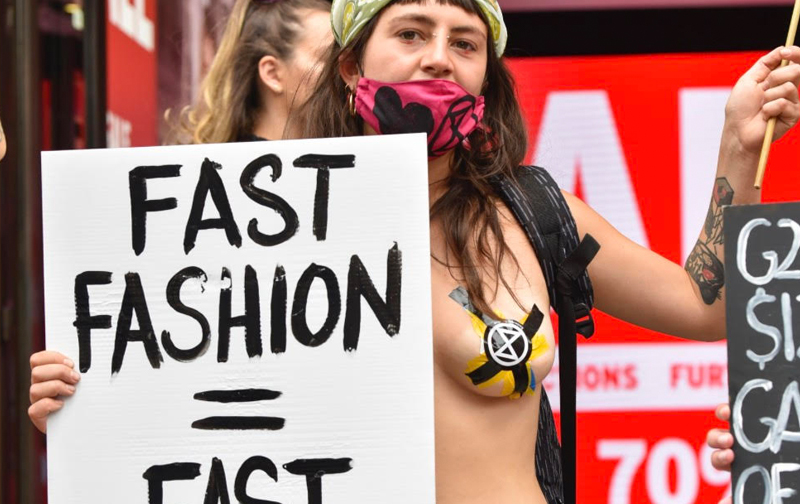
Slow fashion is not just a response to the environmental destruction caused by fast fashion; it is a direct challenge to the capitalist system that prioritizes profit over people and the planet. Rooted in left-wing ideologies, the movement critiques overproduction, labor exploitation, and the culture of disposability that defines much of the modern fashion industry. Instead of rapid cycles of consumption, slow fashion promotes mindful production, fair wages, and sustainable materials, aligning with socialist and anti-capitalist principles that seek economic justice and ecological responsibility. Politicians and activists who have long critiqued capitalism’s excesses recognize that the fashion industry is one of the most visible examples of its failures. As Bernie Sanders has said, “It is not acceptable… that the wealthiest people in this country live in incredible opulence while children go hungry.” This inequality is evident in the stark contrast between luxury fashion executives accumulating billions and garment workers struggling to survive on poverty wages.
The rise of fast fashion was fueled by globalization and neoliberal economic policies that prioritized deregulated markets, cheap labor, and unrestricted corporate expansion. While companies claimed to be democratizing fashion by making trendy clothes more affordable, they did so at the cost of human rights and environmental destruction. Cheap production relies on weak labor laws, ensuring that those making the garments remain underpaid and disposable in a system that treats workers as mere inputs in the manufacturing process. Alexandria Ocasio-Cortez has pointed out how neoliberal capitalism creates these exploitative conditions, saying, “We should not be haunted by the specter of being automated out of work; we should be excited by that possibility. But the reason we’re not excited is because we live in a society where, if you don’t have a job, you are left to die.” This applies to fashion as well—corporations exploit workers for as long as they remain profitable, then discard them when automation or outsourcing presents a more cost-effective option.
Slow fashion, as a resistance movement, calls for a rejection of this unsustainable model. It champions craftsmanship, small-scale production, and fair labor practices, advocating for a system in which clothing is made to last rather than to be replaced each season. This stands in direct opposition to the fashion industry’s reliance on planned obsolescence, where trends are manufactured to expire rapidly, pushing consumers to constantly buy new items. The late Vivienne Westwood, a designer known for her anti-establishment views, captured this philosophy perfectly when she advised, “Buy less, choose well, make it last.” Her words reflect the core values of slow fashion: rejecting wastefulness and prioritizing quality over quantity.
The environmental impact of fashion cannot be ignored in this conversation. Textile production is one of the most polluting industries, consuming vast amounts of water, releasing toxic chemicals, and contributing significantly to global carbon emissions. Despite the industry’s efforts to greenwash its image with sustainability campaigns, many so-called “eco-friendly” initiatives from major brands do little to address the core problem—overproduction. As Naomi Klein wrote in This Changes Everything, “Capitalism is not just changing the climate—it is changing the political and economic structures that were built to protect people.” In fashion, this means that corporations will not self-regulate unless forced to do so by strong policies and public pressure. While some governments have introduced regulations on textile waste and labor protections, these efforts remain fragmented and insufficient against the scale of the problem.
Leftist politicians and labor organizers have long pushed for stronger worker protections, recognizing that economic justice is central to sustainability. Jeremy Corbyn once stated, “We can create a society where everyone matters.” This ethos aligns with the goals of slow fashion, which demands that every worker in the supply chain be treated with dignity and fairness. In contrast, fast fashion operates on the assumption that the lives of garment workers—mostly women in developing countries—are secondary to corporate profit margins. The feminist dimension of slow fashion cannot be overlooked; many of the workers in the industry are women of color, facing not only economic exploitation but also gendered oppression. True ethical fashion must go beyond aesthetics and marketing to address these structural injustices.
Consumer culture also plays a key role in sustaining fast fashion’s grip on the market. Capitalism thrives on engineered desire, convincing people that they must constantly update their wardrobes to keep up with ever-changing trends. This cycle is reinforced by advertising, celebrity endorsements, and influencer culture, all of which create a sense of inadequacy that can only be remedied through consumption. Slavoj Žižek has critiqued this aspect of consumer capitalism, noting that “The fundamental lesson of psychoanalysis is that human desire is not simply given, it has to be constructed.” In fashion, this means that the industry does not merely respond to demand—it actively creates it, ensuring that consumers feel a constant need to buy more.
Slow fashion disrupts this cycle by encouraging people to redefine their relationship with clothing. Rather than viewing fashion as disposable, it promotes appreciation for well-made garments that carry meaning and longevity. The resurgence of practices like clothing repair, upcycling, and second-hand shopping reflects a broader cultural shift toward sustainability. However, individual choices alone are not enough to dismantle an industry built on exploitation. Systemic change—through labor laws, corporate accountability, and a shift away from profit-driven production models—is essential. As Rosa Luxemburg warned, “Those who do not move, do not notice their chains.” The slow fashion movement, when aligned with broader anti-capitalist struggles, has the potential to break these chains and redefine the future of fashion.
Beyond ethics and sustainability, slow fashion challenges the capitalist notion that progress is synonymous with constant growth. The degrowth movement, which advocates for scaling back production and consumption to align with planetary limits, is deeply connected to the philosophy of slow fashion. Instead of an economy that demands infinite expansion, degrowth calls for a system where resources are used more responsibly and equitably. Politicians like Yanis Varoufakis have critiqued the capitalist obsession with growth, stating, “The problem is not whether we should have more or less growth, but what kind of growth we should pursue.” In fashion, this means shifting away from mass production toward localized, ethical, and sustainable models that benefit both people and the environment.
Critics of slow fashion argue that it is inaccessible to many due to its higher price point compared to fast fashion. While it is true that ethical clothing often costs more, this critique overlooks the fact that the affordability of fast fashion is an illusion—it is only cheap because someone else is paying the price, whether through exploited labor or environmental damage. Additionally, slow fashion does not solely mean buying expensive ethical brands; it also includes practices like thrifting, swapping, and repairing clothes, which are often more affordable than constantly buying new items. The challenge lies in shifting cultural attitudes so that people see value in longevity rather than disposability.
Left-wing movements advocating for economic and social justice are natural allies of slow fashion. Policies such as higher minimum wages, corporate transparency requirements, and environmental regulations all contribute to creating a fashion industry that serves people rather than profits. The fight for ethical fashion is ultimately part of a larger struggle against capitalist exploitation in all its forms. As Noam Chomsky has argued, “Neoliberalism is not new. It’s just a new phase of capitalism, a new phase of the destruction of the commons.” The commons, in this context, includes not only natural resources but also the collective dignity of workers who make the global fashion industry possible.
The slow fashion movement is more than just an aesthetic or consumer choice; it is a political statement against the capitalist structures that treat both people and the environment as disposable. By embracing ethical production, sustainable materials, and labor rights, it envisions a future where fashion is no longer driven by exploitation and excess. The road to that future requires more than just individual choices—it demands systemic change, political action, and a rejection of the capitalist logic that has dictated fashion for far too long. Through a combination of policy reforms, labor activism, and cultural shifts, slow fashion has the potential to reshape the industry into one that prioritizes justice over profit.