Every costume is political. On stage and in life, what we wear is never neutral fabric – it encodes social power, cultural identity, and ideology. Consider the difference between a military uniform and tattered rags, a crown and a veil, a designer suit and plain overalls: each immediately signals a position within power relations. A soldier’s uniform commands authority and discipline; rags bespeak poverty and marginalization; a crown signifies sovereign power; a veil might imply religious piety or patriarchal control; a luxury brand suit announces wealth or status.
These garments are not merely aesthetic choices but are “a potent semiotic system where cultural identity is constructed, contested, and interpreted” . In theatre, costume designers know that clothing “carries more responsibility” – it can preserve cultural complexity or reduce it to stereotype . In other words, costume is a form of language. It speaks to us, hails us, and often hails the actor wearing it into a role laden with ideological meaning. This is the politics of fabric and form: costume as ideology.
To unpack this, we can use critical frameworks from Marxism and structuralism. Karl Marx’s concept of commodity fetishism is illuminating. Marx argued that under capitalism, people come to treat commodities (goods) as if their value inheres naturally in the objects themselves, obscuring the human labor and social relations that produced them. We fixate on the appearance and price of a thing, forgetting the exploitation or social conditions behind it. A costume can likewise become a “fetish” – a magical object in the audience’s and actor’s eyes. On a Broadway stage, for example, a sumptuous period costume or a sparkling gown might be admired as inherently glorious, removing thought of the costume-makers’ labor or the context of its creation.
The audience sees a princess or a glamorous celebrity, not the sweat of the tailor or the underpaid textile worker who made the fabric. The costume thus masks its own production. In a deeper sense, within the narrative, the costume can mask social reality as well. A beggar’s rags onstage might make poverty into a picturesque costume, potentially fetishizing suffering as a spectacle rather than laying bare its social causes. Conversely, a crown or designer dress can be imbued with an almost mystical aura of legitimacy or desirability – the “fetishism” Marx spoke of, where an object is “imbued with a value independent of the social processes that produced it”. In Marxist critique, this means costume can contribute to ideology by naturalizing power relations. The monarch’s robe makes monarchy look natural and majestic; the servant’s livery makes servitude look like a fixed identity.
Just as Marx said people “see the relationships among things (commodities) instead of relationships among people” , an audience may see the costume – the crown, the uniform – as the source of authority or value, rather than the human power dynamics it represents. The pomp of a dictator’s military attire, for instance, can awe spectators into forgetting the brutality behind the regime. Thus, costumes can entice us to “fixate on…commodities”, to use Marx’s phrase, and “prevent people from seeing the truth” – the truth that social hierarchies are human-made, not naturally ordained by the clothes one wears.
This phenomenon occurs not only in theatre but in everyday life. People “dress for the part” to such an extent that the attire can influence their own psychology – a concept known as enclothed cognition. Psychologists Hajo Adam and Adam Galinsky famously demonstrated this with a lab coat experiment. They found that participants who wore a white lab coat performed significantly better on attention tasks than those who did not wear the coat. Intriguingly, if the same coat was described as a painter’s smock instead of a doctor’s coat, the cognitive benefit disappeared. The mere belief that one is wearing a doctor’s coat (symbol of attentiveness and care) improved mental focus. The garment’s symbolic meaning was key. In effect, the idea of the costume hailed the wearer into the role of “attentive doctor,” changing their behavior. This experiment is a vivid real-world parallel to what actors experience: “once they put on the costume, actors feel like they’re in that character’s body, and the character comes alive,” as one costume director observed.
A shy performer might become swaggeringly confident in a king’s robes, or an actress might carry herself with new resolve in the simple uniform of a revolutionary character. The costume’s “symbolic meaning…is only realized once the individual embodied the clothes physically” – literally putting on the ideology with the attire. Louis Althusser’s theory of interpellation helps explain this transformative hailing by costume.
Althusser argued that ideology recruits individuals as subjects by “hailing” them – famously illustrated with the scenario of a police officer shouting “Hey, you there!” When you turn around in response, you are enacting your assumption of the subject position (here, the law-abiding citizen the police addresses) We are “always-already” subjects, because from birth society calls us by names and roles (boy/girl, student, citizen) and we respond, thus internalizing those identities. Now consider the costume as a mode of hailing. The moment an actor dons, say, a soldier’s uniform, a kind of interpellation occurs: the uniform “calls out” to the actor and everyone around, declaring that this person is now a soldier (at least within the world of the play). The actor, by putting it on, answers the call and behaves as a soldier.
In Althusser’s terms, the individual has been transformed into the subject (the role) through the material ritual of costuming. The ideology “acts…by that very precise operation which [Althusser] called interpellation or hailing” – like the police hail – except here the hail is visual. The costume is a “material ritual practice of ideological recognition” : saluting in a military coat, curtsying in a ballroom gown, bowing under a monk’s hood – all these bodily actions are elicited by what one wears. It is notable that many actors report a shift in posture and mindset once in costume. A slouching modern person might stand up straighter in a stiff 18th-century corset or tailcoat; the weight of armor can make an actor feel martial; an academic robe might make one feel more learned or dignified.
Althusser would say the costume is an Ideological State Apparatus in miniature: a tool that “recruits” the person into an ideology by encouraging them to enact expected behaviors freely, as if it were their own choice. Indeed, he wrote that an individual is interpellated as a (free) subject “in order that he shall make the gestures and actions of his subjection ‘all by himself’” A person puts on a judge’s robe and of their own accord adopts a gravitas of authority; the ideology has done its work when we willingly perform our roles.
Theatre provides a clear arena to observe this dynamic. The stage is a space where costumes have exaggerated purity of meaning. Classic theatrical traditions understood this well. In Japanese Noh theatre, for example, costumes are richly coded and strictly prescribed. A Noh actor’s costume (known as shōzoku) is not chosen for realism but for the symbolic image it projects. A mature female spirit might be represented by an exquisitely embroidered karaori kimono, while a vengeful ghost wears monochrome or flame-like patterns. The costume, combined with the carved mask, transforms the actor into the role – sometimes quite literally in the spiritual sense, as Noh performers describe feeling the spirit possess them when mask and costume are donned.
The heavy brocades of Noh costumes also physically restrict and dictate the actor’s movements, enforcing the slow, floating walk and stylized poses that are hallmarks of Noh. Here, costume is an ideological device twice over: on one hand, it “primarily [reflects] the image the actor wants his character to project” – an intentional sign system; on the other, it inscribes the actor’s body into the aesthetic-spiritual ideology of Noh, which valorizes restraint, elegance, and the obliteration of the performer’s ego in favor of the role. The costume liberates the actor from their everyday identity (they become an archetype or spirit beyond themselves), but it also subordinates them to the centuries-old tradition and its strict codes – an embodiment of cultural ideology.
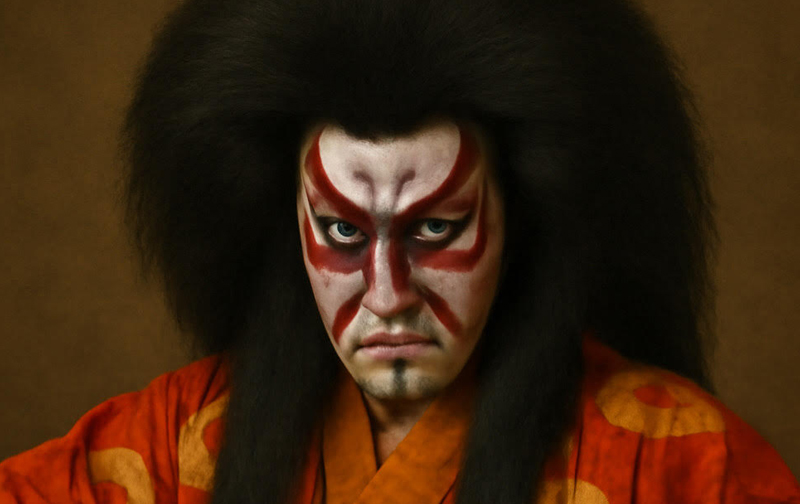
Similarly, in Kabuki theatre (a younger Japanese form known for bombastic spectacle), costumes and makeup telegraph character types and moral alignment instantly. Colors carry deep meaning: vibrant reds and oranges signal heroism, passion, or youthful vigor, whereas dark blues or muted tones indicate villainy, sadness, or seriousness. A Kabuki hero often wears flashy, gaudy costume with crimson hues (because red connotes courage and righteousness), while an evil samurai might appear in indigo or black patterned attire. These visual codes “become a throughline” that the audience can read at a glance. An experienced Kabuki spectator can tell a character’s social status and personality just from how their kimono is designed and worn – e.g. a frail princess versus a fearsome warlord have distinct costume silhouettes and colors.
Even the way an obi (belt) is tied in Kabuki indicates status (a diagonal drape means a samurai’s servant, a boxy knot means a noble lady) In this way, Kabuki costumes participate in Japan’s social ideology of the Edo period, reinforcing class and role distinctions visually. Yet Kabuki also shows how costume can liberate performers and enable play with identity: since women were banned from the stage in 1629, male actors called onnagata specialize in female roles, adopting women’s kimono, wigs, and makeup. Through costume, these actors create a highly stylized version of femininity onstage – so stylized that it both affirms and subverts gender norms. On one hand, the onnagata’s costume-constructed femininity was historically taken as an ideal, even above real women’s behavior, thus arguably reinforcing a certain ideal of womanhood defined by male performers. On the other, the obvious theatricality of men in female costumes can expose gender as performance.
It’s akin to what modern philosopher Judith Butler notes about drag: “in imitating gender, drag implicitly reveals the imitative structure of gender itself – as well as its contingency” . The Kabuki onnagata, like drag queens, demonstrate that what society calls “feminine” is an act that can be learned, rehearsed, and exaggerated via clothing, gesture, makeup. This has a potentially liberating insight – showing gender roles are not innate – yet it also sits within an ideological framework that restricted women and formalized gender portrayal. Butler cautions that even subversive drag still “operates within the cultural constructions of gender… limiting the extent of its subversion” . So too the onnagata: their art flourished only because the law forbade real women on stage, a patriarchal control. Thus, their costumes both resist and stem from an ideological structure.
We see a pattern: costume can liberate the body and imagination, but it can also inscribe and constrain them. It often does both at once. Consider a more familiar example from the West: the tradition of cross-dressing in theatre. In Shakespeare’s time, all female roles were played by boys/young men in women’s costumes, since women were not allowed on the English stage. This required the costume to effectively “gender” the male actor as female in the audience’s eyes, which arguably reinforced the idea that outward appearance and dress define womanhood. Yet Shakespeare’s plays themselves toyed with cross-dressing as plot device (e.g. Viola in Twelfth Night disguises as a man). The result is a layering of costume and identity: a male actor wearing a female character’s costume who within the story puts on a male disguise.
This playful recursion actually revealed gender as a mutable performance – a radical idea in a society with strict gender hierarchy. The male actor “liberated” from his male identity could evoke a female character with depth; at the same time the convention excluded real women’s bodies and voices, keeping the theatrical depiction of women under male control. So the costume was both a gateway to empathy across gender, and a tool of an exclusionary ideology. Anthropology and sociology further enrich this discussion. Across cultures, rituals often use costume to transform participants’ identities in liminal spaces (between ordinary and sacred). In initiation rites, religious ceremonies, or carnivals, people wear special garments – masks, body paint, ceremonial robes – that allow them to become “more than themselves” for a time. A shaman dons a spirit mask and fur cloak, and is believed to channel a deity or animal spirit.
Here the costume is explicitly liberating the wearer from the ordinary self; it is a vehicle to transcend into a supernatural role. But this liberation is in service of, and constrained by, the community’s cultural ideology. The shaman’s costume is usually prescribed by tradition (specific colors, feathers, designs) symbolizing cosmological concepts. The transformation is not arbitrary freedom; it is an inscription of the body into a mythic framework. Anthropologist Victor Turner described how in rites of passage, initiates often wear ambiguous or minimal clothing (or uniform garb) to mark their transition – their old identity is stripped, yet they all don a simple costume (like identical white garments) indicating communitas, an egalitarian unity in liminality. Such costumes break down individual distinction (liberating from previous social status) but impose a collective identity (the neophytes subject to the ritual process).
Similarly, in the European carnival tradition, everyday dress codes invert: commoners may dress as kings, men as women, fools as priests, etc. This temporarily suspends the ordinary hierarchies – a brief liberation through masquerade. Yet as theorist Mikhail Bakhtin noted, carnival’s transgressions ultimately reinforce order by framing it as a sanctioned exception; after the festival the norms snap back in place. The “world upside-down” costume play releases social tension but doesn’t permanently overthrow the hierarchy. In fact, by caricaturing authority (say, a peasant dresses in a mock crown to lampoon the king), carnival can make obedience easier to resume afterwards – it’s a safety valve rather than a revolution. The costumes of carnival are subversive, but only within limits; they highlight that normal roles are just roles, potentially undermining their mystique, yet society often contains this subversion within ritual boundaries.
In everyday life, as sociologist Erving Goffman famously argued, “all the world’s a stage.” We each perform roles in daily interactions, using attire as part of our “front.” Goffman’s dramaturgical analysis observed that people choose clothing, props, and manners to present a certain image of themselves in different settings – a form of costume design for social life. A banker wears a suit to exude professionalism, a teenager wears particular street fashion to signal belonging to a subculture, and so on. These are personal choices but guided by social norms (a kind of unscripted script). Goffman noted that we maintain a “frontstage” where we perform our role and a “backstage” where we can step out of character and relax our attire and manner. The metaphor is literal: when you come home and change out of your work uniform into pajamas, you have shed one identity and returned to a more authentic or private self. He wrote, “When we leave these social settings, we step out of our costumes and enter ‘the backstage’”
The very use of the word “costumes” for everyday clothes underscores that the boundary between theatrical costume and daily dress is one of degree, not kind. Everyday clothing also interpellates us: think of school uniforms or police uniforms. A student in uniform is constantly hailed as “student” – prompting discipline and studious behavior; an officer’s uniform not only tells others who he is, but reminds the officer of his duty and authority. Indeed, uniforms are often explicitly used to instill ideology. Militaries have long known that a soldier’s uniform and insignia foster obedience and esprit de corps. Uniforms enforce conformity (inscribing bodies into a hierarchy: one can literally “rank” people by the stripes or medals on their costume) even as they give the wearer a sense of pride and belonging (a form of liberation from individuality into collective identity).
Foucault in Discipline and Punish comments on how 18th-century soldiers were trained into perfect posture and synchronized movement – their very bodies molded by drills and uniforms into obedient tools of the state. The uniform is both a second skin and a constant sign of subjection to military ideology. The theatre stage often amplifies these real social dynamics for artistic ends. A playwright or director can use costumes either to reinforce stereotypes and power structures or to challenge them. For instance, in an anti-war play, dressing all generals in absurdly oversized uniforms bedecked with medals could satirize the pretensions of military authority, unmasking it as mere costume.
Bertolt Brecht, the Marxist theatre practitioner, often chose costumes that would not let the audience simply indulge in escapist belief. In his epic theatre, if a beggar was played by a well-fed actor, Brecht might dress him in obviously fake, ragged clothes and have him comment on them, to alienate the audience and make them think critically about poverty rather than just pity the character. Here costume was used against the grain of ideology – to reveal artificiality rather than mystify. Contrast that with a Hollywood movie where the hero’s immaculate designer wardrobe and the villain’s drab outfit subtly cue us whom to admire. The audience may unconsciously equate virtue with the hero’s clean-cut, stylish look (a capitalist consumerist bias: the well-dressed good guy). Such choices can inscribe prevailing ideologies of class and attractiveness into storytelling without us noticing.
Iranian theatre provides illustrative examples of costume’s ideological role, especially given Iran’s complex sociopolitical costumes (from traditional veils to Western suits) and strict state regulations after the 1979 Islamic Revolution. Playwright Gholam-Hossein Sa’edi, a prominent figure in 1960s-70s Iran, used a blend of realism and symbolism in his plays to comment on social issues. In his satirical drama O the Mad One, O the Fooled One (sometimes translated as O Fool, O Fooled), Sa’edi employs a motif of an old man with and without a hat (the Persian title literally referencing “kolah,” hat). The “hat” in Persian idiom can imply status or trickery (as in the phrase kolah bordan, to deceive). This play thematically explores how people are fooled by appearances and false alarms. At one climactic moment, a horde of thieves floods the stage “clad in black and carrying machetes,” emerging from the darkness.
They symbolize the ominous, faceless forces exploiting society – and indeed critics interpreted these black-clad thieves as representing colonial or Western imperial powers taking everything of value. The choice to dress them all in black is deliberate political imagery: black costume here equals evil and mourning (in Shi’a Islam, black is also associated with lamentation – a nod to Iran’s historical experience of tragedy). By contrast, any time Sa’edi wanted to depict the honest, oppressed folk, he kept their costuming humble, frayed – signaling truth but also victimhood. Thus, Sa’edi used costume color and condition as a language of allegory: those in tattered clothing were Iran’s poor, those in elegant or uniform attire were often agents of the corrupt state or foreign influence. His work, under Marxist and existential influences, insisted that audiences look past the surface – yet he acknowledged that the surface (the costume) is what first “hails” us in a visual medium, so he imbued it with meaning conscientiously.
Another Iranian luminary, Bahram Beyzai, explicitly grappled with the politics of appearance. In Beyzai’s film Mossafer-e Amoo Soroush (commonly known in English as Uncle Moustache, 1970), there is a striking scene where an authoritarian old man is depicted combining various costume markers of power: he has a big patriarchal moustache and a knife (markers of macho violence), he dons a formal suit and tie (marker of official secular authority), and also wears a skullcap and cloak (markers of religious authority) . By piling all these elements on one character, Beyzai was making an ideological point: the old man literally wears the symbols of power that have historically oppressed the people – whether secular or religious, violent or bureaucratic. At first, this costumed figure strikes fear in children (he is the village bully enforcing order). But over the narrative, he undergoes change and sheds these harsh aspects. The visual transformation (his costume and demeanor soften) helps the audience see the possibility of change in entrenched authority.
Beyzai is very aware of costume’s role: in many of his plays and films, he reaches back to traditional Persian theatrical forms (like Ta’ziyeh, the Shi’ite passion play) and uses their costumes symbolically. Ta’ziyeh is a quintessential example of costume as ideology: it’s a form of religious drama depicting the 7th-century martyrdom of Imam Hussein and his family at Karbala. For over a century, Ta’ziyeh performances in Iran have maintained a strict color code: Hussein’s side (the virtuous, oppressed martyrs) are costumed in green (a color of paradise and the Prophet’s family in Islamic symbolism) or sometimes white when facing imminent death, whereas Yazid’s side (the villains) are always in red (symbolizing blood, oppression, and evil) Male actors playing female characters (usually the mourning women of Hussein’s household) wear black chadors (both to signify their grief and to ensure the male actor is modestly covered, as no actual women act on stage under religious custom)
This highly codified costume language makes it immediately clear to any audience who is hero and who is villain, and even foreshadows who will die (an actor draping a white shroud over his costume signals the character’s imminent martyrdom) . The ideological function is overt: to dramatize the moral universe of Shi’a Islam, where virtue and vice are as distinct as green and red. The costume does not liberate the actor’s identity in this case – the performers are usually non-professionals or lay actors adopting revered roles as a form of worship; they subsume their identity into the collective mourning ritual. The costume also quite literally constrains them: if you play a villain in red, you must also perform a traditionally exaggerated wicked persona (often the red-clad villain in Ta’ziyeh will scream in a harsh voice and overact, to appear as evil as possible ).
The costume comes with an expected performance. However, one might say there is a form of spiritual liberation for actors and audience: by participating in the ritual costume drama, they feel connected to a higher cause, experiencing communal catharsis and reaffirmation of faith. This is the paradox of costume-as-ideology: in submitting to the role prescribed by the costume, one might feel a sense of freedom or fulfillment. A devotee in a Ta’ziyeh play might feel freed from his personal ego, becoming a vessel for a sacred story – a liberation through losing oneself in an ideological narrative.
We can ask, then: does costume liberate, or does it deeper inscribe ideological structures on the body? The answer leans toward both, depending on perspective. From one angle, costumes are tools of social encoding – they impose identities, often very conservative ones. They can ossify stereotypes: e.g. the “hooker with a heart of gold” always in gaudy tight clothes, the “hero” in spotless shining armor, the “enemy” literally darkened by black or villainous attire. These tropes, repeated, sink into audience consciousness and echo in real social biases. In such cases, costume traps characters (and the actors’ bodies) in predefined ideological slots: man/woman, rich/poor, noble/common, good/evil. As scholar Marvin Carlson notes, recurring costume motifs can either affirm or subvert archetypes on stage . If used uncritically, they affirm them – essentially reproducing the “dominant narrative” in fabric.
This is inscriptive. A stark example is orientalism in opera and theatre: for centuries, Western productions costumed “Oriental” or “African” characters in exotic, exaggerated garb (iridescent robes, turbans with big jewels, feathers, etc.) to signify Otherness. The actors’ bodies, often white European, would thus physically carry ideological stereotypes of Asians, Middle Easterners, or Africans that reinforced colonial attitudes. The costume became a prison of cliché – think of how countless productions would put a villainous Turkish pasha in a big turban and scimitar, encoding “despotism” and “sensuality” as innate to that costume. The performer has limited freedom to nuance that role because the costume and makeup have already told the audience to see a caricature. Likewise, in the early 20th-century American theatre, Black characters were often portrayed by white actors in blackface minstrel costumes – an overtly racist ideological practice that reduced a whole people to a comedic costume.
Here, clearly, costume was an instrument of oppression, inscribing racist ideology on stage and literally on performers’ bodies. Yet from another angle, costume is inherently a vehicle of transformation and can be harnessed to liberate and critique. Think of the modern drag queen again: through extravagant costume, makeup, and persona, a drag performer breaks the rules of conventional gender presentation. The drag costume is often a deliberate send-up – a man in a sequined gown and towering heels adopts the exaggerated accoutrements of femininity to both celebrate and lampoon them. This allows exploration of identity outside the binary norms. Drag shows historically have been spaces for queer communities to express aspects of self that mainstream society represses.
So the costume here liberates the body from one set of rules by voluntarily taking on another set in a playful, transgressive spirit. Even though, as Butler notes, drag still references gender norms (the queen often aspires to a kind of hyper-feminine glamour) , it simultaneously reveals those norms to be theatrical. Many individuals who experience dysphoria or fluidity in gender have found that trying on different clothes, wigs, etc., is a pathway to discovering their authentic self or, at least, freeing themselves from the single label society gave them. The stage magnifies this: as soon as the lights go on, anyone can be anyone. A petite woman can play a commanding male general with the right costume and bearing; a young actor can convincingly embody an elderly sage with the help of costume and makeup.
In doing so, performers and audiences alike get to imagine identities and social arrangements beyond the immediately given. A well-known example is the all-female Japanese Takarazuka Revue, where women play all roles, including male romantic leads. These actresses (known as otokoyaku when playing men) wear dashing tailored suits or military uniforms and deep-voiced mannerisms to create an idealized male persona on stage. This both reinforces some gender ideals (the “perfect man” as envisioned by women, performed by women) and upends them (women appropriating male power symbols, audiences sometimes preferring these illusions to real men). Many Japanese women historically found the Takarazuka male-role actresses inspiring, even sexually liberating, because they could admire masculinity without a man present – an interesting subversion via costume.
Global theatre is full of such tensions. In Indian classical dance-dramas, male actors often played female roles (similar to Elizabethan England and Kabuki). In some African performances, masks and costumes allow actors to speak truth to power under cover of disguise (a bit like how a court jester’s motley costume historically allowed him to insult the king with impunity – he was “just a fool” in costume, thus granted unusual freedom of speech). These are instances where putting on a costume grants license to do things one otherwise couldn’t. The mask or costume as liberation comes from its function as aesthetic distance. One can say and do outrageous, innovative, or critical things “in character” that one would be punished for as oneself.
The actor’s body is both protected and empowered by the costume: protected because any repercussions might be deflected (“it was the character, not me”) and empowered because the audience has suspended some disbelief and given the actor the authority of the role. For example, an actor in the costume of a wise judge might deliver a scathing line condemning injustice – the gravity of the costume lends the words weight. In contrast, if the same actor in everyday clothes made that speech, the audience might take it as a personal opinion and be more skeptical. So, the costume can elevate personal expression into symbolic statement. This is why protest movements often involve costumes and theater; think of activists donning costumes (Guy Fawkes masks, or Handmaid’s Tale cloaks) to make a political point. The costume connects their individual bodies to a broader narrative or icon, amplifying their message. It is liberation through assumption of symbolic power.
The notion of “Costume as Ideology” ultimately means that costumes are not empty shells; they come loaded with narratives of class, gender, culture, and authority. As one scholarly review put it, “costume…serves as a cultural signifier that encodes history, ideology, and social belonging” . On stage, costume is one of the primary means by which the abstract themes of a play are given concrete form. Erika Fischer-Lichte, a performance theorist, emphasizes that costume is a core semiotic system in theatre, a “visual interface” between actor and audience that triggers cultural memory and associations. Patrice Pavis speaks of the mise en signe (placement into signs) – costume turns the actor’s body into a text to be read . This means if one wants to subvert ideology, one can subvert costume, and if one wants to reinforce ideology, costume is a handy tool.
It is notable that one of the first things revolutionary regimes often do is change dress codes (think of Mao’s China with its Zhongshan suits, or Iran’s post-revolution imposition of the hijab for women, or even the French Revolution’s encouragement of the sans-culottes long trousers instead of aristocratic breeches). These are real-life instances of “costume politics.” In the French Revolution, working-class revolutionaries proudly wore pantaloons (long trousers) because the aristocrats wore silk knee-breeches – thus their very legs became an ideological statement of equality and rejection of aristocracy . What was once a marker of low status (long trousers) became a badge of radical pride.
This shows how fluid the meaning of costume can be: a garment’s meaning is not fixed, but contextually determined by social values. On the stage of history, those sans-culottes costumed themselves in liberty. Yet eventually, as bourgeois fashion took over, trousers just became normal attire for all men – the radical edge was dulled, the ideological meaning forgotten. In theatre too, a costume can lose or change its meaning over time. A 19th-century audience seeing an actor in a top hat and tails might think of capitalist modernity or dandified villains; a 21st-century audience might simply think of steampunk nostalgia or magicians. Thus, ideology in costume is a living dialogue between creator and spectator.
To answer the guiding question: Does costume liberate the body on stage, or inscribe it deeper into ideology? – we must acknowledge the double-edged nature of costume. When an actor puts on a costume, they do often become bound by the stereotypes or traditions attached to that attire (inscription). The costume can discipline their movements (a corset forces a certain posture, a heavy helmet limits head movement, a flowing gown demands graceful steps). It places the actor within a system of signs largely not of their own making – a social language. In that sense, yes, it inscribes the body into ideology: the actor literally wears the assumptions and history associated with the clothing. A police uniform on stage carries centuries of institutional authority with it; the actor cannot escape that connotation.
Even audiences’ expectations will often be locked in: a character enters in a nun’s habit, and immediately certain tropes and moral expectations spring up. We have to work actively to overcome those ingrained ideological readings if we want to portray the character differently, perhaps by altering or subverting the costume. However, precisely because costume is a language, it is also a means of creative expression and can allow the body to speak in ways it otherwise couldn’t. It can liberate by enabling metamorphosis and by making the invisible visible. Costume design can “guide audience interpretation” , and a clever designer or actor can play with that guidance. For example, an actor might step on stage in a king’s robe, then pointedly remove it to reject the authority it symbolizes – a liberating gesture both for character and perhaps performer (stepping out of the imposed role to show the human underneath).
In Sarah Ruhl’s play Eurydice, at one point the heroine sheds her love for language by literally taking off a dress inscribed with words – a poetic use of costume removal to signify freedom from a shackle. In many contemporary performances, costumes are mixed, ambiguous, or androgynous specifically to break down categories and let actors’ bodies move and signify more freely. The avant-garde often strips the actor of defining costume (think of Jerzy Grotowski’s poor theatre, which eliminated elaborate costumes to focus on the raw actor). This could be seen as trying to liberate the actor from ideology – no costume means no preconceptions. But even minimalism becomes an ideology of its own (the ideology of anti-illusion, of “truth” in acting), and performing in plain clothes or nudity is still a conscious costuming choice (the “costume” of authenticity). Audiences will read meaning into even the absence of costume.
In sum, costume is a powerful ideological apparatus precisely because it interfaces between our inner selves and the outer social world. It is at once a prison and a key. The global examples – from Japanese Noh and Kabuki, to Iranian Ta’ziyeh, to Western drag and classical theatre – all demonstrate that costuming is an act of coding the body with signs that the society understands. Those signs can chain us to conventional meanings, but they can also be recombined to create new meaning. As Stuart Hall might say, representation is not passive reflection but active construction; costume constructs identity on stage.
The actor’s body is the site of that construction. Thus, whether it is liberating or confining depends on how that construction is done and perceived. A well-known adage in costume design is that the best costumes help tell the story without the audience even noticing. They work on the subconscious level, where ideology often resides. They hail the audience, to borrow Althusser’s term, instructing us how to view the character. But a truly artful use of costume can cause us to question those very instructions – to misrecognize and then recognize differently. For instance, a play might initially costume a character in sumptuous fur and jewels so we assume she’s a villainous aristocrat, only to later reveal she’s the oppressed victim and her finery was a cage – flipping our ideological script and evoking sympathy and critical thought.
The political theorist Walter Benjamin once noted how, in revolution, the oppressed “wish to appear in costumes of their masters” – they adopt the guise of the past as a weapon. But eventually, they must forge new symbols. In theatre as in life, costumes can be shackles of an old ideology or instruments to imagine a new one. The emancipatory potential lies in awareness. As the HowlRound Theatre Commons essay Revolutionary Costume Pedagogy argues, we must critically examine the “status quo of Western-focused” costume history and open up diversity and global perspectives. By doing so, we enable costumes to tell new stories rather than the same old dominant narratives. That itself is liberation. At the same time, we recognize that no costume is neutral – even the attempt to wear “nothing special” carries meaning (perhaps rejecting ornament to signify realism or equality).
In conclusion, every costume on stage is an embodiment of ideology, but also a means to comment on or resist ideology. The body in costume is never free of social meaning – it is inscribed by it, written upon in silk or sackcloth, sequins or straw. Yet the theatrical event allows a dialogue about those meanings. The actor’s body, by consciously donning and doffing costumes, demonstrates that roles can be put on or shed.
This can be profoundly freeing: it reminds us that social roles are performances, and thus they can change. Whether costume ultimately liberates or confines is a matter of usage: an unexamined costume tends to reinforce the script written by history, whereas a thoughtfully deployed costume (or even an unexpected one) can rewrite the script and invite liberation.
In a global context, understanding the politics of fabric and form – from the most “primitive” ritual masks to high-tech digital performance costumes – is key to understanding ourselves. We wear ideology on our sleeves, literally; but by recognizing that, we gain the power to tailor those ideologies, perhaps to better fit our vision of who we want to be.