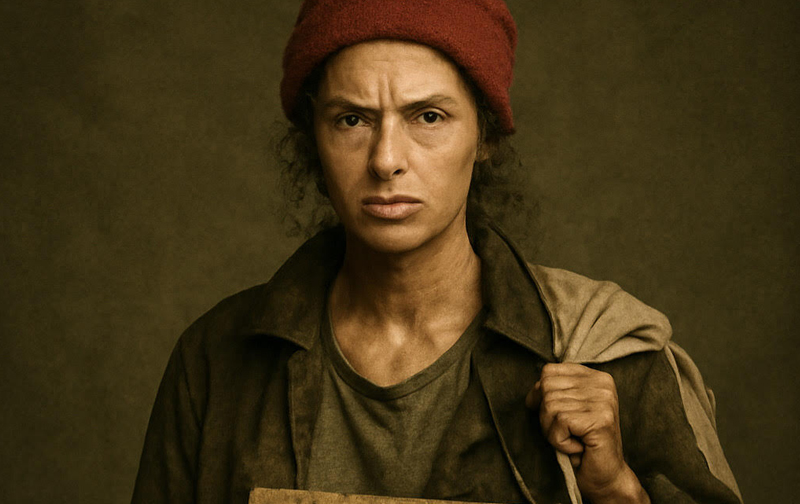
Costumes, often regarded as mere accessories to a theatrical performance, transcend their role as simple articles of clothing. They are potent symbols, often reflecting or critiquing the social, economic, and political forces at play within the society that produces them. In the world of theatre, the costume emerges not merely as a visual tool to distinguish character or time, but as a powerful vehicle for commentary on the world beyond the stage. From the beginning of modern theatre to the experimental work of the 20th century, costumes have served as more than just fabric. They are ideological markers that communicate the power dynamics of the time, the resistance of oppressed groups, and the struggles of those who have yet to find their place in the grand social order.
The Marxist analysis of theatre and its socio-political undertones places costumes at the heart of the class struggle. In their materiality, costumes can either reinforce or resist the capitalist structures that govern the lives of individuals. In his seminal work “Theatre and Revolution,” Bertolt Brecht demonstrated how the theatre could serve as a critical tool for ideological expression. Brecht’s “Epic Theatre” introduced the idea of distancing — a Brechtian technique that sought to disrupt the audience’s emotional involvement in the narrative, urging them to view the action from a critical, political standpoint. The costumes in Brecht’s work — plain, functional, and sometimes grotesque — were never designed to flatter or romanticize characters. Instead, they were built to remind the audience that they were witnessing a construct, a symbol of a larger ideological and social issue.
Brecht’s use of costumes as a critique of the bourgeois aesthetic was designed to deconstruct the very notion of realism in theatre. The costumes, far from being mere representations of characters’ social roles, were tools of ideological expression. They pointed directly to the social system, revealing the hierarchies, inequalities, and struggles of class. By stripping the character of any false pretense or luxurious attire, the costume itself became a visual representation of the social reality it critiqued. This was especially evident in works like Mother Courage and Her Children, where the protagonist’s simple, rugged costumes symbolized both her resilience and the harsh realities of war, while simultaneously highlighting the exploitation of the common people by the powers that be.
This ideological function of costume is not confined to Brechtian theatre. Across the world, costume has served as a tool for political resistance, as exemplified by the work of post-colonial theatre practitioners, who have used costumes to reframe the narratives imposed upon colonized peoples. The wearing of traditional costumes as a form of resistance against the colonial powers is perhaps most evident in the works of playwrights such as Wole Soyinka, who used costume as a medium to explore the tensions between traditional African identity and the forces of colonialism. Through the simple act of costuming, these playwrights challenged the imposition of Western values and sought to reclaim a sense of self that had been violently suppressed under colonial rule.
The Marxist critique of theatre, as articulated by thinkers such as Louis Althusser and Antonio Gramsci, connects directly with the analysis of costume as a tool of social commentary. For Althusser, the state perpetuates its ideological control through institutions such as education, the media, and indeed, the arts. Theatre, as a form of ideological apparatus, is capable of both reinforcing and challenging these dominant structures. The costume, in this context, is never neutral. It is either a symbol of submission, reinforcing class distinctions and the status quo, or it is a symbol of rebellion, an act of defiance against an oppressive system. In a Marxist reading of costume, every garment, every material, and every detail in a costume can be seen as a manifestation of the broader economic and political forces that shape a character’s life.
Costumes also hold deep anthropological significance, particularly when we consider how they symbolize the intersection of culture, identity, and social status. The anthropologist Clifford Geertz argued that culture is “a system of inherited conceptions expressed in symbolic forms.” Costume, as a symbolic form, carries these inherited conceptions on the stage. It is a reflection of the cultural, social, and political fabric of the society from which it emerges. In theatre, costumes are not simply articles of clothing; they are active participants in the ongoing dialogue between culture and politics. They are signifiers that represent societal norms, historical contexts, and ideologies that are constantly shifting.
Take, for instance, the costuming choices in productions centered around the working class. In a Marxist reading, the costumes of the working poor are a reflection of their exploitation, their role as laborers within a capitalist system. In plays like Les Misérables by Victor Hugo, the ragged, worn costumes of the characters symbolize not only their poverty but their dignity and their resistance to a society that seeks to keep them subjugated. Similarly, in the works of playwrights such as Tennessee Williams, the costumes serve as visual metaphors for the psychological and social limitations of the characters, often showcasing their repression and struggle within a restrictive society.
The anthropological significance of costume also touches on the role of gender and the politics of appearance. In many cultures, costume has historically been a means of asserting or challenging gender norms. Theatre, particularly through costume, has long been a battleground for ideological battles over gender identity. The costume choices in productions that question traditional gender roles—whether through drag, cross-dressing, or gender-neutral clothing—offer powerful critiques of the social systems that restrict personal identity. The costumed body is, after all, a battleground upon which cultural and political conflicts are played out. It is a site where the individual both conforms to and rebels against the constraints imposed by society.
In a post-colonial context, the political use of costume has taken on even greater significance. Post-colonial theatre practitioners have used costume to challenge the racial and cultural stereotypes imposed by colonial powers. The costume, in this context, becomes an instrument of resistance. By reclaiming and reinterpreting colonial symbols, these practitioners seek to subvert the dominant narratives of colonial history and present new, empowered representations of the colonized. In the work of playwrights such as Ngũgĩ wa Thiong’o and Derek Walcott, costume is used to reflect the complexity of post-colonial identities, highlighting the tensions between tradition and modernity, resistance and assimilation.
In post-colonial performance, the use of costume becomes not only a means of critiquing colonial history but also a way of reclaiming cultural identity. In this sense, costume is deeply connected to the anthropological concept of cultural hybridity—the blending of indigenous and colonial influences that gives rise to new, often contradictory identities. The costumes worn by characters in post-colonial theatre performances become a visual manifestation of this hybridity, reflecting the ways in which cultures collide, merge, and reinvent themselves in the face of historical oppression.
Costume also plays a pivotal role in contemporary political theatre, particularly in productions that critique issues such as capitalism, inequality, and the environment. In the work of radical theatre practitioners, the costume has been transformed from a passive element of performance into an active symbol of resistance. Consider the rise of street theatre, in which the costumes worn by performers are often drawn from everyday life, emphasizing the connection between the performance and the real-world struggles of the working class. In these performances, the costume is not just a visual representation of a character’s social position; it becomes a tool for engaging the audience in the political realities of their own lives.
Ultimately, the costume in theatre is never just about clothing—it is a deeply political statement. From Brecht’s stark, unadorned costumes to the culturally charged costumes of post-colonial theatre, the garments worn by characters serve as reflections of the power dynamics at play in society. Costumes are symbols, designed to comment on the oppression, resistance, and struggle that define the human experience. They are the fabric from which the ideological struggles of the world are woven, and in the world of theatre, they are never neutral. They are always a part of the dialogue between the individual and the system, between the oppressed and the oppressor, between tradition and transformation. They are the silent narrators of the political theatre that shapes the stage and, by extension, the world outside.