Feminist theatre has long served as a powerful medium for critiquing the patriarchal systems that define gender roles and norms, offering a unique lens through which to view the complexities of identity, power, and societal structures. At the heart of this artistic tradition is a subversive force that challenges conventional representations of gender and sexuality, interrogating not only the narratives that dominate mainstream theatre but also the very mechanisms that shape cultural perceptions of womanhood. Through the careful deployment of costume and set design, feminist theatre offers a powerful visual language to express its ideological goals. It is here, in the realms of aesthetics and performance, where the subversion of traditional gender roles occurs, providing a space for women to reclaim their bodies and narratives, engage in political discourse, and reimagine what is possible.
In feminist theatre, costume and set design are not simply decorative elements meant to enhance the production’s visual appeal. Rather, they are integral components of the storytelling process, strategically crafted to reflect the power dynamics at play, challenge gender stereotypes, and address the lived experiences of women in a patriarchal world. Costume and set design are, in many ways, an embodiment of feminist theory itself—transforming the stage into a battleground for political and cultural struggle, a place where the audience is forced to confront their assumptions about gender, power, and identity.
The critique of patriarchy in feminist theatre often begins with an exploration of how women’s bodies are objectified, commodified, and controlled. In mainstream theatre, women’s bodies are frequently portrayed as passive objects of male desire, their appearances and actions heavily coded by traditional gender expectations. Feminist theatre, however, subverts these representations by transforming the way that costumes and set designs function within the narrative. Instead of reinforcing the male gaze or depicting women as mere symbols of beauty and fragility, feminist theatre uses costume and set design to reframe the female body as a site of agency, resistance, and empowerment.
In many feminist productions, costume design becomes a powerful tool to deconstruct traditional gender roles and challenge the objectification of women. For example, the use of uniformity in the costumes of female characters can serve to break down the idea of the woman as a singular, monolithic entity. By dressing women in similar, often gender-neutral outfits, feminist theatre disrupts the conventional use of costumes to signal femininity and sexuality. This disruption challenges the notion that women must conform to specific, socially prescribed ideals of beauty and behavior. In productions such as these, the focus shifts away from physical appearance and towards the actions, choices, and voices of the female characters themselves, enabling them to transcend the limitations of their visual representation.
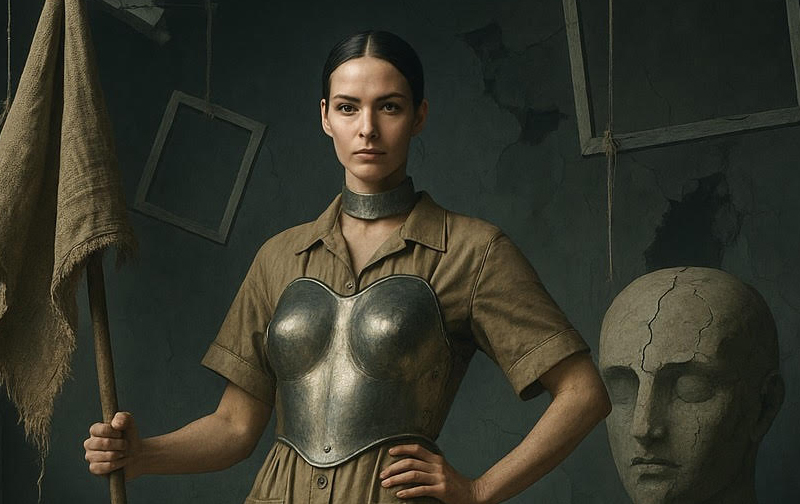
In contrast to the standardized costuming of mainstream theatre, feminist theatre often employs highly symbolic and politically charged costume choices. For instance, the deliberate use of unconventional materials, shapes, or colors can be used to signal resistance to the constraints imposed by patriarchal beauty standards. The costumes in feminist theatre productions may exaggerate the female form or use distorted proportions to comment on the unrealistic and harmful beauty ideals that society imposes upon women. The use of armor, for example, in a production about female warriors or revolutionaries, can function as a metaphor for the emotional and psychological armor that women are often forced to wear in order to navigate the challenges of a patriarchal world. Alternatively, costumes may be designed to deconstruct the female body entirely, obscuring it or transforming it into a non-human form to emphasize the notion that women’s bodies are not simply objects to be consumed or defined by men.
Similarly, set design in feminist theatre works in tandem with costume design to challenge societal expectations of femininity and masculinity. The set serves as the physical manifestation of the world in which the characters exist, and it is often imbued with political and cultural symbolism. For example, feminist theatre may intentionally create chaotic, disorienting, or fragmented environments to mirror the internal struggles of the characters as they grapple with the constraints placed on them by society. Set pieces may be distorted or fragmented, symbolizing the fractured nature of gender identity and the impact of patriarchal systems on the individual. Alternatively, the use of minimalism in set design—such as the reduction of the stage to stark, barren elements—can emphasize the stripping away of societal expectations, creating a space where gender norms are no longer present and where the potential for transformation is endless.
At times, set design in feminist theatre is used to interrogate the concept of space itself, asking how societal and cultural norms are built into the very architecture and layout of the spaces women inhabit. Feminist theatre may place female characters in spaces traditionally associated with masculinity, such as boardrooms, military settings, or other spaces of authority, in order to disrupt the conventional boundaries that define gendered spaces. In productions like these, the set becomes an active participant in the performance, forcing the audience to question why certain spaces are considered “masculine” or “feminine,” and what the implications of this division are for the people who inhabit them.
The body, as a political space, plays a significant role in feminist theatre, and both costume and set design function to highlight the ways in which women’s bodies have been historically controlled, regulated, and politicized. The feminist critique of patriarchy often involves a radical reclaiming of the female body, using it as a site of resistance and self-expression. In this context, costume design can become a powerful means of asserting ownership over the body, reclaiming it from the objectifying gaze of the male-dominated culture. Set design, too, contributes to this reclamation by creating spaces that allow women’s bodies to exist outside of traditional societal constraints, offering a space where women can express themselves freely, without fear of judgment or repression.
The feminist use of costume and set design is also closely tied to the deconstruction of traditional gender roles. In many feminist theatre productions, characters who defy conventional gender expectations are presented in ways that challenge the audience’s understanding of masculinity and femininity. The set and costumes work together to subvert the binary opposition between male and female, questioning the validity of these categories and offering alternative, more fluid understandings of gender identity. Costumes may be designed to be androgynous, blurring the lines between male and female, or to reflect the multiplicity of gender identities that exist outside of the binary framework. The set, likewise, may be designed to reflect the fluidity and complexity of gender, with elements that shift and transform throughout the performance to mirror the changing experiences and identities of the characters.
Throughout history, feminist theatre has used the visual language of costume and set design to challenge the established order and push the boundaries of what is considered acceptable in mainstream culture. The avant-garde productions of the early feminist theatre movements in the 1970s and 1980s, for example, often featured costumes that were deliberately grotesque or exaggerated, pushing the boundaries of what was considered “beautiful” or “feminine.” These productions aimed to disrupt the prevailing cultural norms that defined women’s bodies by rejecting traditional representations of beauty and replacing them with more radical, politically charged images. Similarly, the set design in these early feminist productions was often unconventional and experimental, reflecting the desire to create new, liberated spaces in which women could express their political and cultural identities freely.
The work of feminist playwrights and directors, too, has contributed significantly to the evolution of costume and set design in feminist theatre. Playwrights such as Caryl Churchill, Suzan-Lori Parks, and Sarah Kane have all used their work to explore the intersections of gender, power, and identity, with costume and set design playing a key role in the storytelling process. In plays such as Churchill’s Top Girls, for example, the costumes are highly symbolic, reflecting the characters’ complex relationships with power, gender, and femininity. The set design in Top Girls serves to highlight the tension between the individual and society, creating a space where gender roles can be interrogated and reimagined.
In conclusion, the political and cultural symbolism of costume and set design in feminist theatre is multifaceted and deeply intertwined with the broader aims of feminist theory and activism. Through the subversion of traditional gender roles, the critique of patriarchy, and the reclamation of the female body as a site of agency, feminist theatre uses costume and set design to engage in a radical cultural and political discourse. By challenging the visual and spatial representations of gender, feminist theatre redefines the boundaries of what is possible, creating a space where new, liberated identities and forms of resistance can emerge. Ultimately, feminist theatre offers a vision of the world in which gender is not a fixed or predetermined category but a fluid, dynamic process—one that is constantly being challenged, reimagined, and redefined through the power of artistic expression.