A lone knight plays chess with Death on a desolate beach – an iconic tableau from Ingmar Bergman’s The Seventh Seal – the grim reaper’s black cloak billowing against a stark horizon . In that silent image, a profound dialogue occurs without words: an existential confrontation rendered as visual poetry. Across global cinema and theatre, certain works achieve this rare alchemy of form and meaning, speaking in a language of light, color, movement and space more eloquent than any dialogue. These are the non-commercial, art-driven productions that eschew pure entertainment in favor of a poetic and symbolic visual language. They invite us to see and feel ideas – hope and despair, memory and dream, the sacred and the profane – through the artistry of set design, costume, art direction and cinematography. From the hushed minimalism of an empty stage to the baroque splendor of a crafted film frame, such works form a continuous, immersive essay on the human condition. They are milestones of aesthetic daring and design innovation, united by an intuition that what we behold can move us as deeply as what is said. “All art must carry man’s craving for the ideal,” wrote filmmaker Andrei Tarkovsky; it must give us “hope and faith” . In the most visually significant films and theatre pieces, that ideal is not told but shown, unfolding before our eyes in a succession of luminous images that imprint themselves on our souls.
Visual Poetry in Motion: Andrei Tarkovsky stands as a patron saint of cinematic visual poetry. The Russian auteur’s films – Andrei Rublev, Mirror, Stalker, and others – are famed for their “mysterious dreamlike visual imagery” and metaphysical depth. Tarkovsky believed cinema should sculpt time and confound literal explanation. In his hands, a dilapidated room dappled in rainwater or a field of wind-tossed grass becomes as expressive as a soliloquy. Long, meditative takes draw the viewer into a trance-like state; Stalker (1979), for instance, contains only 142 shots over 163 minutes, each held so long that the film “ventures into the territory of visual poetry” . With “slow and deliberate pacing” and subtle camera movement, Stalker “seamlessly captures our attention and mercilessly pulls us into a world of deep introspection” . The film’s forbidden Zone – an overgrown industrial wasteland where one’s innermost wish might be granted – is presented not with special-effects bombast but through textured, haunting mise-en-scène. An abandoned power plant dripping with rain and lichen, littered with sand dunes of grime, becomes an existential landscape that feels alive: “cracked, lichen-covered concrete, broken glass, oil stains,” a location whose “expressive texture” needed no embellishment beyond what reality provided . Tarkovsky’s reliance on the power of images to convey spiritual themes was absolute. As a critic observed, his poetic style – with its “captivating long takes, heavy reliance on the power of images and the visual, and frequent exploration of metaphysical and spiritual subjects” – yielded a body of work that continues to inspire filmmakers and artists . In Tarkovsky’s universe, a candle flame, a drifting cloud of milk in water, or a levitating woman can become densely layered symbols. He once described film as “sculpting in time” , and indeed his cinema elevates time and memory into almost tactile presences on screen. Each visual motif – water, fire, mirrors, sunlight – recurs like a note in a symphony, composing a “mysterious, dreamlike” visual language open to infinite interpretation . Ingmar Bergman, another giant of European art cinema, paid tribute to Tarkovsky’s gift: “He moves with such naturalness in the room of dreams. He doesn’t explain. What should he explain anyhow?” . That sentiment could apply to all great visual poets of cinema: they invite us into the dream, refusing to reduce it to prosaic explanation. Instead, meaning crystallizes through imagery. When we watch the climactic moment of Tarkovsky’s The Sacrifice – a wooden house consumed by flames in a single, unbroken shot – no thesis is spelled out, yet we grasp the totality of a man’s despair and transcendence. The camera simply beholds the fire until it becomes a kind of purification rite, a terrible beauty. These filmmakers trust the audience to feel truth in the flicker of light and shadow, the choreography of elements within the frame. As Tarkovsky’s contemporary, the Polish director Jerzy Grotowski, similarly sought in theatre, art can become “a vehicle for an inner journey” – less a story than an experience. Through Tarkovsky’s lingering images, as through Grotowski’s austere stage rituals, we confront the infinite. Each is a kind of prayer made visible.
If Tarkovsky is cinema’s poet of the ethereal, Ingmar Bergman might be its dramaturge of the soul, carving human faces and spaces with chiaroscuro intensity. Bergman too began as a theatre director, and his films retain a stage-like intimacy even as they deploy boldly cinematic techniques. Who can forget the iconic composition from The Seventh Seal (1957): Death and the Knight silhouetted on the hill at sunset, “passing from one life to the next atop a hill, not trudging to their demise but dancing, hands interlocked” . That indelible image condenses all the film’s contradictory emotions – terror and solace, despair and communal hope – into a single pictorial allegory. Bergman knew that a frame could be as charged as any line of dialogue. Working with cinematographer Sven Nykvist (a master of lighting), he created films renowned for their visual starkness and emotional clarity. Persona (1966), for example, pushes close-ups to an extreme, filling the screen with the faces of two women who mysteriously begin to merge. The camera scrutinizes every pore, tear, and flicker of expression, such that the boundary between self and other blurs in the very grain of the image. “Visually stunning and displaying more intense close-ups than probably any other film,” Persona uses the contrast of light and shadow – one face brightly lit, the other in partial darkness – to mirror the interplay of voice and silence . At one climactic moment, Bergman famously splits the image itself: the film seemingly burns and disintegrates on screen, a metatextual gesture that reminds us we are watching film – celluloid, light – even as we are absorbed in the characters’ psychic drama . Such bravura visual metaphors underscore Bergman’s theme (the fragility of identity) far more powerfully than words could. In his color films like Cries and Whispers (1972) and Fanny and Alexander (1982), Bergman likewise orchestrated design elements to reflect inner states. Cries and Whispers famously saturates every room in a deep blood-red hue – the walls, carpets, even the very air seem red – suggesting both the interior of a human body (the flow of blood, the throb of pain) and the abstract realm of emotions (love, anger, life-force) that entrap the characters. Fanny and Alexander, his late-career masterpiece, is the opposite: a lush period tapestry alive with rich period detail. In that film, Bergman and production designer Anna Asp created an immersive world of 1900s Sweden, “bursting with visual identity” – from the “stunning cinematography and rich period detail” to the lavish costumes and set decorations . The Ekdahl family’s home is first presented as a warmly lit sanctuary filled with ornate furniture, paintings, and theatrical props (even a miniature puppet theatre), celebrating the magic of storytelling and childhood imagination . But as the story darkens, the visuals shift: the colors become more muted and cold when young Alexander is trapped in the austere house of his cruel stepfather, the bishop. By the film’s end, Bergman gives us one more unforgettable image – Alexander under a table, watching a beam of light project the silhouette of a Grim Reaper dragging its scythe across the floor . It is a sly nod back to The Seventh Seal, a child’s nightmare vision intruding on reality, and a reminder that Bergman’s visual imagination remained, to the last, haunted by spectres of life and death. With Bergman and Tarkovsky, we see how auteur filmmakers make form itself carry philosophical meaning: the long take, the close-up, the single shaft of light on a stage – these become tools of a cinematic poet or metaphysician. As Bergman reflected in Images: My Life in Film, many of his recurring motifs (lonely coastlines, ticking clocks, puppet theatres, religious icons) came from the “strange wonders” of his childhood imagination and the Lutheran rituals of his upbringing . He poured these visual symbols into his films, forging a personal iconography that audiences recognize on a subconscious level. A blank, mask-like face half in shadow (Persona); an empty country road vanishing into the horizon (Wild Strawberries); a marionette theater’s curtain opening by itself (Fanny and Alexander) – each image is a poem unto itself, inviting us to contemplate mysteries beyond the literal plot.
Minimalism and the Empty Space: Not all visionary artists achieve their power through elaborate imagery; some do so through radical simplicity. In the realm of theatre, Peter Brook revolutionized modern stagecraft by insisting on the primacy of the bare stage and the audience’s imagination. “I can take any empty space and call it a stage,” Brook famously wrote. “A man walks across this empty space while someone else is watching him, and this is all that is needed for an act of theatre to be engaged” . With this opening line from The Empty Space (1968), Brook declared independence from literal scenery and realism. He demonstrated that minimalism, when purposeful, can ignite a viewer’s mind more strongly than any ornate set. Brook’s own productions often exemplified this. His landmark staging of King Lear in 1962 used a nearly empty white stage, forcing audiences to imagine the windswept heath and blasted landscapes through actors’ voices and a few stark props. In Marat/Sade (1964), though the content was chaotic and bawdy, the staging still relied on simple, striking images (the inmates of an asylum sitting in a bathhouse-like grid, illuminated by harsh light) to create its disturbing atmosphere. Brook’s most celebrated creation, The Mahabharata (1985), distilled the sprawling Indian epic into a nine-hour stage play performed in a dirt-filled quarry – an elemental environment where fire, earth, and water played as significant a role as any actor. The Mahabharata’s design was austere, but through movement, chant, and the flicker of torchlight on the earthen set, Brook achieved a sensation of epic breadth. He had an almost spiritual faith in simplicity: in his “Holy Theatre” ideal, the stage becomes a place where unseen forces can be felt once unnecessary clutter is removed. Brook’s contemporary Jerzy Grotowski took this ethos even further in his “Poor Theatre,” eliminating all but the essential. For Grotowski, the true “set” was the actors’ and spectators’ shared space and the human body in motion; everything else (lighting, costumes, makeup) was expendable if it did not serve the bond of here and now. This extreme minimalism aimed to strip theatre to a kind of ritual purity, a direct encounter between performer and audience. Yet even within such Spartan frameworks, visual imagination did not vanish – it became internalized or symbolic. In Grotowski’s Akropolis, for example, a handful of random objects on a bare stage (pillows, boards, scrap metal) were transformed by the actors into the ruins of a concentration camp and the palaces of Homeric Greece through sheer performative suggestion. The audience “saw” vast cathedrals and crematoria in their mind’s eye, proving Brook’s dictum that the imagination completes the picture. Robert Wilson, another visionary of the stage, might be seen as the flip side of Brook and Grotowski: he emphasizes visual composition to an extreme, yet often within a minimalist aesthetic. Wilson’s theatre has been called the Theatre of Images – his productions are like living paintings, slowly evolving tableaux of light, color, and gesture. He is notorious for long, hypnotic sequences where actors move in ultra-slow motion under shifting lights, with little or no dialogue. In Wilson’s otherworldly opera Einstein on the Beach (1976), co-created with composer Philip Glass, the stage is populated by a handful of repetitive images – a blindfolded violinist, a luminous spaceship-like object, numbers and solfège syllables projected on screens – that cycle in permutations for nearly five hours. Many audience members, expecting a conventional narrative, found themselves instead in a trance, experiencing time as if in a dream. This is precisely Wilson’s aim. “Usually in theater, the visual repeats the verbal,” he observes – sets merely illustrate the text, serving as decorative backdrops. “But I think with my eyes,” Wilson says. “For me, the visual is not an afterthought, not an illustration of the text. If it says the same thing as the words, why look? The visual must be so compelling that a deaf man would sit through the performance fascinated” . In Wilson’s work, indeed, a spectator could be deaf (or conversely, close their eyes and be deaf to the visuals) and still receive a full, self-sufficient experience. His stage images do not simply underline spoken ideas; they carry their own meanings. A tall chair, starkly lit in blue against a black void; a slowly rotating fan casting a moving shadow; a line of figures crossing the stage with tiny, synchronized steps – one might not “understand” these images at a rational level, yet they trigger a cascade of emotional and intellectual associations. Wilson’s art shows that minimalism can be married to formalism: stripped-down elements arranged with exquisite precision, like abstract art onstage. This has influenced countless stage designers and directors, encouraging them to treat visual dramaturgy as equal to text and actor. In short, Brook, Grotowski, and Wilson – each in his way – expanded the theatre’s visual language by paring it back. In doing so, paradoxically, they uncovered new expressive power. A single candle or a single gesture in an empty space, when charged with intention, can unleash our imagination to fill in an entire cosmos. Such is the paradox of minimalism: by giving us less, it makes us engage more, projecting our own psyche onto the space. “The visual must not dwindle into decoration,” Wilson reminds – it must command the performance in its own right . A deaf man, a blind man, any person of any culture, should be able to sit spellbound, sensing meaning in the light and movement itself. When theatre achieves that, it approaches the condition of ritual or dance, a language beyond words.
Baroque Maximalism and Surreal Tableaux: At the opposite end of the spectrum, many great directors have embraced a maximalist ethos – creating dense, baroque visual worlds where every frame or scene overflows with detail. These works use set design, costume and cinematography in elaborate, even excessive ways to evoke the richness of dreams, fantasies, or historical pageantry. One immediately thinks of Federico Fellini, the exuberant Italian auteur whose very name has become synonymous with imaginative visual style. Fellini’s films evolved from the poetic realism of La Strada (1954) to the flamboyant carnival of Fellini Satyricon (1969) and Amarcord (1973). Over time, he increasingly “demanded a kind of equivalent universe from his designers” – no longer aiming for any naturalistic world, but a self-contained artifice . By Satyricon, Fellini had fully embraced cinema as a visual spectacle: ancient Rome reimagined as a hallucinatory, alien planet of the psyche. Critics initially balked at this “fragmentary and picturesque tale of death and debauchery” , but in hindsight Satyricon stands as a milestone of design innovation. Its strength “lies in its image making,” with Fellini provocatively seeking an “‘anti-narrative’ onto which to hang his images, making his film a kind of experimental visual poem, the ultimate art film” . He openly stated his goal: “I want to take all the narrative sequences of traditional cinema out of the story… its sequences should be there for one to contemplate…” . In other words, Fellini strove for a cinema of pure perception, freed from the strictures of plot. In Fellini Satyricon, this approach yields scene after scene of jaw-dropping design: a decadent banquet in an orange-hued hall where Trimalchio’s guests lounge amid surreal foods and grotesque spectacles, lit in saturated oranges and blues ; the ship of the bearded demi-god Lichas, which looks “nothing so much as a flat, low-slung Civil War ironclad” cruising a painted sea ; a desert encounter with a hermaphrodite oracle in a ruined temple, its walls opening onto steep terraces of vegetation that are clearly an artificial stage set – a “fake landscape that, through its artifice, throws off a strange numinous vibe” . Fellini wants us to see that these landscapes are fake, contrived – like theatre sets. As one analysis notes, from 8½ (1963) onward he began to “skewer the sense of ‘realness’” by even placing fake trees and flowers outdoors, emphasizing their contrivance . This bold artificiality, far from alienating us, paradoxically creates a heightened reality – a universe where every object and costume is expressive. The designer Danilo Donati’s costumes in Satyricon clothe actors in outrageous wigs, masks, and body paint reminiscent of Roman frescoes and pagan rituals. Performers emerge “variously costumed and made-up… from the shadows, while the photography takes in bold and off-kilter compositions” . Fellini’s framing often places figures low in the screen with vast negative space above , making the human characters seem small amidst the cosmically indifferent landscape of history and myth. We do not watch Satyricon for a coherent story; we watch it to bathe in imagery that is by turns sumptuous, grotesque, and phantasmagoric – a ceremony of the eye. It is as if Fellini, having started as a cartoonist, treats each scene as an animated canvas where reality is exaggerated to reveal deeper truths. In one scene, a patrician couple calmly prepare for a double suicide, freeing their servants and bidding farewell to their children. Bergman-like, Fellini lingers on the children’s faces, filling the screen with their solemn eyes as the parents depart life . The set here is an “unearthly, artificial landscape” of pink sand and oversized fake flowers – blatantly stagey, yet strangely poignant in its artifice, as if saying: all the world’s a stage, even our most intimate life-and-death moments. Indeed, one scholar noted that in Fellini’s late works, every element “declares its artifice outright,” no longer pretending to represent “the world we live in” but rather an “equivalent universe” built purely for the film . Fellini’s maximalism thus becomes its own form of honesty: by being stylized and “painting” his world, he expresses the feeling of experiences (their emotional truth, their cultural resonance) more than any literal realism could. For example, Juliet of the Spirits (1965) uses gaudy Technicolor sets and flamboyant fashion to externalize a woman’s psyche; Roma (1972) features an unforgettable ecclesiastical fashion show scene, essentially a satire told through costumes and catwalk pomp (priests in illuminated robes, nuns in extravagant habits) without a word of explanatory dialogue. Such scenes exemplify Fellini’s belief that cinema is fundamentally image-driven. As film critic Gilberto Perez wrote, Fellini realized that narrative could be loosened or even dispensed with: Satyricon is a film of “many farcical episodes” only loosely connected, precisely so that viewers are not caught in plot but free to roam in a world of images . In this way, Fellini aligns with a broader trend in art cinema – what Peter Greenaway, another fervently visual director, has championed. “I wanted to make a cinema of ideas, not plots,” Greenaway has said, “and to use the same aesthetics as painting” . Greenaway’s own films (The Cook, the Thief, His Wife & Her Lover (1989), Prospero’s Books (1991), The Pillow Book (1996), etc.) are sumptuous feasts of color and composition, often with minimal concern for linear story. In The Cook, the Thief…, for instance, each room of the film’s setting (a gourmet restaurant) is lit in a dominating color – red dining hall, green kitchen, blue bathrooms – and costumes change color as characters move from room to room, an almost musical motif in design. Such chromatic dramaturgy, influenced by painterly and operatic traditions, communicates the shifts in mood and power without a single line to spell them out. Greenaway and Fellini, like some of their predecessors (Powell and Pressburger in The Red Shoes (1948) or Kurosawa in his color epics), understand cinema as a visual art first. “Please let cinema get on with doing what it does best, which is expressing ideas in visual terms,” Greenaway has urged . It is a credo many avant-garde filmmakers share.
The lineage of surrealism and avant-garde film further illustrates this devotion to visual expression. As far back as the 1920s, artists like Luis Buñuel and Salvador Dalí (with Un Chien Andalou (1929)) or Jean Cocteau (with Blood of a Poet (1932) and later Beauty and the Beast (1946)) crafted films that were essentially moving dream sequences. Here, set design and imagery weren’t just important – they were the film. Un Chien Andalou has no conventional plot at all, only a barrage of startling images (ants swarming from a hole in a hand, a razor slicing an eyeball) arranged according to dream logic and subconscious association. Cocteau’s Beauty and the Beast transforms a simple fairy tale into a surreal visual poem: the Beast’s castle is a chiaroscuro domain where candelabras are human arms and statues’ eyes move, and where Jean Marais’s Beast is costumed and made up so hauntingly that we feel Beauty’s simultaneously fearful and erotic response before any words are exchanged. Such films proved that cinema could dispense with theatrical narrative and rely on symbolic visuals like a painting or a poem. The audience might not “solve” their meaning intellectually, but would be moved and unsettled by them – engaged on a subconscious level. Alejandro Jodorowsky, a later surrealist and cult film director, explicitly sought this effect. “What I am trying to do when I use symbols is to awaken in your unconscious some reaction,” Jodorowsky said . He understood that images can be “very dangerous” because unlike language, which society trains us to analyze and defend against, visual symbols bypass our defenses . “When you start to speak, not with words, but only with images, the people cannot defend themselves” . Jodorowsky’s own films, such as El Topo (1970) and The Holy Mountain (1973), are overflowing pinwheels of symbolic imagery. In The Holy Mountain he presents one outrageous, esoteric tableau after another: a thief character who resembles Christ encounters tarot-card allegories in flesh, alchemical laboratories full of jeweled toads and skinned lambs, rainbow-clad jesters and grotesque art installations representing the planets. Virtually every costume and set piece in the film is laden with cryptic symbolism drawn from religion, alchemy or mythology. Watching it is like experiencing someone’s psychedelic hallucination or an occult ritual. It is baffling and mesmerizing in equal measure. One might not decipher each symbol, but Jodorowsky isn’t asking us to – he wants the cascade of unfiltered images to work directly on the psyche, provoking a spiritual or emotional epiphany beyond rational thought. In one interview he even likened the ideal film viewing to a transformative ritual: “You should not see my movies with your eyes, you should see them with your soul,” he said. Many avant-garde filmmakers share this trust in the primal power of imagery. Czech animator Jan Švankmajer in films like Alice (1988) uses tactile stop-motion visuals (dolls, food, inorganic matter coming to life) to tap into childhood fears and desires. The Brothers Quay create miniature dreamscapes of decay and clockwork in their short films, weaving moods of dread and nostalgia without any characters speaking. In theatre, one can draw a parallel with directors like Tadeusz Kantor or Robert Lepage, who conjure arresting dream-images onstage: Kantor’s Dead Class (1975) had the director himself as a ghostly teacher presiding over a classroom of life-sized doll-pupils, a nightmarish vision of memory; Lepage’s Needles and Opium (1991) put an actor in a rotating cube to depict weightlessness and heroin-induced delirium, effectively making the stage into a spinning optical illusion. In each case, visual imagination – sometimes nightmarish, sometimes oneiric – forms the core language of the piece. These creators follow surrealist master Antonin Artaud’s dictum that theatre (and by extension film) should be like a plague that infects the audience’s subconscious, a sensory revolt. By privileging image, sound, and movement over text, they aim to shatter complacency and liberate deeper truths. Even a mainstream auteur like David Lynch, heavily influenced by surrealism, incorporates this principle: consider the red-curtained Black Lodge of Twin Peaks, or the eerie stage with a radiating chevron floor in Eraserhead (1977) – these settings have the illogical potency of a recurring nightmare, imprinting themselves forever in the viewer’s mind, even if we can’t fully rationalize them.
Theatricality in Film, Cinematic Stagecraft: There is a fruitful cross-pollination when cinema adopts overtly theatrical techniques or when theatre adopts cinematic sensibilities. Visionary artists often blur the line between the two mediums to create new aesthetics. A striking example is Lars von Trier’s film Dogville (2003), which essentially is a piece of theatre captured on film. Von Trier chose to set this Depression-era allegory on a completely bare soundstage, with almost no set pieces – just a few props and chalk outlines on the floor marking houses and streets. As one commentator describes, Dogville “is set amid a spare stage setting with chalk lines on the floor marking the town’s locations, and there are only rudimentary furnishings” . There are no walls; a character might mime opening an invisible door, and the outline of a dog named Moses is simply drawn in chalk on the ground. This Brechtian minimalism forces the audience to imagine the entire town of Dogville. The bareness emphasizes the story’s fable-like, allegorical nature – “the film’s stark, Brechtian aesthetic… emphasizes its allegorical intent” . While Dogville divided critics and viewers, it undeniably showcased how theatricality can be a powerful tool in film. By removing realistic sets, von Trier shines a harsh light on the behaviors and dialogues of his characters, almost like a sociological experiment on a stage. The cinematography retains cinematic movement (e.g. God’s-eye-view crane shots that show the whole town layout drawn on the floor), yet the experience is akin to watching live theatre, where imagination fills the gaps. Interestingly, Dogville’s bareness also heightens certain visual elements that are present – for example, the lighting shifts to indicate time of day or mood, washing the floor in cold blues or warm ambers, like theatrical lighting cues that influence our emotional reception of each scene. The film demonstrates that a creative fusion of theatre techniques (minimal set, direct address narration, chapters, etc.) with cinematic ones (editing, close-ups, musical scoring) can yield a unique storytelling form. It is a reminder that “theatrical” need not mean static or dull – in von Trier’s hands it became boldly experimental, an anti-illusionist design that, ironically, brought focus to the very illusions and moral performances people carry out in society.
Conversely, many stage productions have adopted cinematic approaches to amplify their visual impact. High-speed scene changes, montages, projections, and filmic lighting have made the stage into a kind of 3D cinema screen in works by innovators like Robert Lepage, Complicité (Simon McBurney’s company), and The Wooster Group. But even before high technology, directors like Ariane Mnouchkine were crafting theatre so epic and visually dynamic that it felt “cinematic” in scope. Mnouchkine’s Théâtre du Soleil in Paris is renowned for its grand-scale, design-rich productions that draw on diverse performance traditions. Mnouchkine despises the cold term “production” – for her, theatre is “a ceremony, a ritual… you should go out of the theatre stronger and more human than when you went in.” . This philosophy is evident in the way she stages plays: as immersive, transformative events suffused with ritualistic visual elements. For her cycle Les Atrides (1990–92), a four-part staging of Greek tragedies, Mnouchkine famously blended the Western classical text with Eastern theatrical forms – Kathakali dance-drama from India and Kabuki from Japan – to create a hybrid visual language . Actors wore makeup and costumes inspired by Kathakali’s vivid palette (e.g. bold face paints, elaborate headdresses) and moved with stylized precision. Battle scenes and choral odes were choreographed in dance-like patterns rather than realistic scuffles. The stage was often filled with color and motion: in one scene from Les Atrides, as recounted by spectators, the chorus of women might enter spinning in fiery orange saris while men stomp rhythms on the floor – a burst of energy that evokes both an ancient ritual and an otherworldly spectacle. Mnouchkine’s Richard II (1981) had actors in stylized makeup, and her production of 1789 (about the French Revolution) broke the fourth wall to involve the audience as if attending a political rally in 18th-century Paris. Her theatre’s home, the Cartoucherie (a converted munitions factory), is transformed for each show so that entering it is like stepping into another world. As one critic wrote, “to enter a Mnouchkine production is to enter another world” – each play creates a complete visual universe with its own rules. Part of her genius is the integration of multicultural design elements: she borrows from Asian theatre’s emphasis on visual symbolism and movement vocabularies to enrich French storytelling. The result is theatre that feels universal, mythical, and visually eloquent beyond language. Mnouchkine’s work underscores that the core of theatre, as of film, is making pictures in time – pictures that affect us viscerally. In fact, she often collaborates with filmmakers (her early collective created the film Molière, 1978, and later she directed a film of 1789), and her staging shows a keen understanding of cinematic montage and framing. Montage on stage – rapidly alternating short scenes, or splitting the stage into simultaneous actions – can mimic film editing to tell complex narratives. Mnouchkine employs this to cover sweeping histories. At the same time, she retains the ritual potency of live performance: in her theatre the audience often sits in new configurations (for Les Naufragés du Fol Espoir (2010), she turned the space into a 1900s film studio to stage a play-within-a-film-within-a-play), and sometimes communal meals or interactions precede the play, enhancing the sense of event. When Mnouchkine says theatre should be a ritual that leaves us transformed , she is advocating for the same catharsis that Aristotle spoke of – but through an emphasis on spectacle and ceremony hand in hand with narrative and character. This harks back to ancient theatre origins (Greek or Sanskrit drama were as much music, dance, and design as text) and also pushes forward to a new, global theatre that is as audiovisually rich as a modern film.
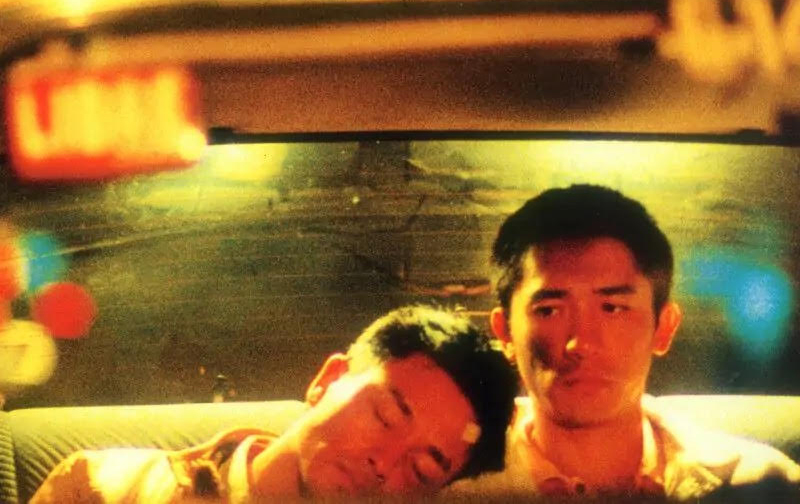
Cinematography and Design: The Synthesis of Elements: In both film and theatre, when we speak of “visual language,” we are really talking about a synthesis of many design elements – lighting, framing, color, texture, spatial composition, costume, and movement – into a cohesive artistic dialect. A master cinematographer or stage designer orchestrates these elements in concert to guide our eye and emotions. Consider the role of color on screen. Few have exploited it as masterfully as Wong Kar-Wai, the Hong Kong auteur known for lush, moody films like In the Mood for Love (2000) and Chungking Express (1994). Wong’s works are drenched in color and stylized lighting that convey the inchoate feelings of his lonely urban romantics. Working with his cinematographer Christopher Doyle, Wong developed a “truly distinctive visual style” marked by “schismatic camera movements and vibrant colours, including neon greens, yellows and reds” . In Wong’s hands, a busy Hong Kong street at night under flickering neon can become an emotional landscape as internal as a character’s thoughts. He frequently downplays dialogue and even plot (famously, he often begins shooting without a finished script, allowing the film’s form to emerge organically). Instead, he “expresses the inner thoughts and deepest emotions of characters visually, through his colour choices” . In In the Mood for Love, the recurring deep reds of Maggie Cheung’s exquisite cheongsam dresses and the warm golden light of cramped 1962 apartment hallways speak of a suppressed passion and nostalgia far more than explicit declarations could. Similarly, the lush green tones of a quiet park or the rich blue of evening rain communicate the melancholy of missed connections. Each hue is deliberate: “Blues highlight the melancholy of life, reds suggest passion and longing, and neon greens evoke the nostalgia and loneliness of everyday metropolitan existence.” Wong Kar-Wai’s cinematography (often shot in step-print slow motion, further poeticizing mundane moments) turns the ordinary – a woman walking with a food tin up a stairwell, a man lighting a cigarette alone at midnight – into something heightened, romantic, unforgettable. Doyle describes cinematography as balancing “the familiar and the dream” , and indeed in Wong’s films we often feel we are witnessing everyday life (familiar streets, cafés, taxis) but through the subjective haze of memory or longing (a dream). “I think the point of cinematography… is intimacy. Is intent, is the balance between the familiar and the dream,” Doyle explains – it is about being “engaged and yet standing back and noticing something… celebrating something that you feel is beautiful or valid, or true” . In Chungking Express, for example, Doyle’s roving handheld camera and step-printed slow shutter speed create streaky, impressionistic shots of a city in motion – the world as seen through the eyes of young people restless and lovesick. These techniques subjectify reality, blending objective environment with inner emotion. A simple repetitive action, like Faye (Faye Wong) secretly reordering the apartment of the man she loves, becomes a lyrical montage with California Dreamin’ playing and sunlight spilling in – a dance of poetry out of a repetitive life . Wong Kar-Wai’s films thereby achieve what many design-driven works do: they turn the prosaic into the poetic. The cinematographer and production designer (often the same person in Wong’s case, as his longtime collaborator William Chang designs costumes and sets) work hand in hand to make every frame dripping with atmosphere and meaning. It’s telling that Wong’s most famous works are often described as tone poems or mood pieces rather than narratives – their impact is primarily sensorial and emotional, the story carried by color, texture (cigarette smoke curling in slow-mo, the sheen of silk fabric), and movement (the sway of hips to a Nat King Cole song, the blur of cars and people in a nocturnal city). In such cinema, the line between cinematography and choreography blurs. Doyle himself likened the camera-actor relationship to a dance: “I really think music and movement… inform my visuals. The relationship between me, the camera and the actor is always a dance” . We sense this in the way Wong’s camera glides around two people passing each other on a narrow corridor, or circles a lonely policeman in a midnight snack shop. It is as though the camera were a wordless narrator, waltzing with the characters and lighting to the rhythm of their hearts.
In production design too, the greatest works show total cohesion of detail into theme. Akira Kurosawa, though a more traditional storyteller than Wong, was equally rigorous about visual composition supporting narrative and emotion. A painter by training, Kurosawa storyboarded his films in gorgeous sketches and demanded that every element in the frame contribute to the overall impact. Take Throne of Blood (1957), his transposition of Macbeth to feudal Japan. Kurosawa drew heavily on Noh theatre aesthetics to shape the film’s look and feel. Noh, the highly stylized classical Japanese theatre, is known for its masks, minimal sets, and ritualized movement. Kurosawa admired it as “the real heart, the core of all Japanese drama… full of symbols, full of subtlety” . In Throne of Blood, the influence is evident: the character of Lady Asaji (Lady Macbeth) moves with an eerie, gliding motion drawn from Noh performance, and her face is painted in a static white mask-like makeup, “with its suggestion of restrained or suppressed emotions hidden behind the mask” . The film’s mise-en-scène is accordingly spare and pregnant with meaning. Fog-shrouded plains and dark forests (filmed on Mount Fuji’s slopes) create a stark, monochrome “stage” upon which the tragic action unfolds with fateful slowness. When Lady Asaji enters a room, she does so almost as a ghost, in elegant silk robes that whisper along the floor, her face an impassive mask – a chilling visual embodiment of ruthless ambition. Kurosawa uses the mode of production of Noh – its unity of costume, movement, and space – to “enhance the theme of Macbeth”, drawing the audience into a heightened stylistic reality where psychological struggles are externalized in visual tropes . Later, in Ran (1985), his epic inspired by King Lear, Kurosawa went for a different but equally potent design strategy: color-coding and grand scale. Ran unfolds in widescreen compositions of breathtaking beauty – rolling hills and castles against enormous cloud-swept skies – within which armies clash in choreographed motion. Here Kurosawa and costume designer Emi Wada used color as an identifier of characters’ fates and personalities: the warlord’s three sons wear distinct primary colors (Taro in sunny yellow, Jiro in blood red, Saburo in cool blue), so that in battle scenes their forces form moving blocks of color on the field, like pieces in a grand artistic canvas. One famous sequence in Ran has almost no dialogue: the siege of a castle is portrayed with an expressionistic flourish – the soundtrack drops all diegetic sound and is replaced by Toru Takemitsu’s mournful score, while we witness carnage in stylized slow motion. The castle gates are engulfed in flames (a real set burned to the ground), and amidst the flames the Lord Hidetora (Tatsuya Nakadai) wanders in a daze, his once multicolored robe now a ghostly white and grey from ash, his face painted in white powder and red lines like a Noh demon. It’s a purely visual tour-de-force, “a scene of carnage born of consuming desire” as an intoning Noh-like chorus sings in the film’s prologue . The visual metaphor is rich: the burning castle as the hell of Hidetora’s own making, his drained costume showing the emptiness of his power, the stylized blood-red skies reflecting cosmic wrath. Kurosawa’s masterful integration of costume, setting and cinematic technique here creates an operatic image that needs no explanatory words. It’s no wonder that critics often describe Ran as painterly – Kurosawa was literally painting with armies and landscapes. He once said that “the Western viewer might not realize it, but the ending of Ran is meant to evoke a Zen painting of a man alone in the wilderness” (indeed, the final shot is a blind man standing precariously on a castle ruin’s edge against a void). Kurosawa proves that even a large-scale, action-filled film can be deeply art-driven, using design and framing to convey its tragic vision.
In all these examples – from Tarkovsky’s spiritual landscapes to Mnouchkine’s ritualistic tableaux, from Fellini’s carnivals to Wong’s neon city blues – the core principle is the same: form and content are inseparable. The visual form is the content to a great extent. The artists integrate set design, costume, light, space, texture, and movement so thoroughly into the storytelling that one cannot imagine the work looking any different. A change in color or composition would be a change in meaning. Such works demand of their creators a control of craft reminiscent of the great painters or architects. They also demand of the audience a heightened attention and openness – an ability to read the “text” written in shape and color. When we attune ourselves to this language, the reward is profound. These films and plays become what critic Susan Sontag called an “experience” rather than a mere statement – something to be felt in real time, not simply decoded. We find ourselves, as viewers, inside the visual and symbolic universe that the artists have built. Watching a Tarkovsky film can feel like wandering in a sacred ruin; attending a Robert Wilson opera can feel like meditating in a gallery of moving art; sitting in Mnouchkine’s theatre can feel like joining a communal rite. Form and meaning interweave until they are one and the same.
The impact of these art-driven visual masterpieces is often described in quasi-spiritual terms. Andrei Tarkovsky saw the artist’s mission as almost priestly: to offer images that reflect the soul and “make the human soul receptive to good” . Ariane Mnouchkine similarly suggests that theatre at its best can ennoble us, leaving us “more human” than before . Their confidence in the transformative power of art is justified when one considers how deeply form can shape our perception. A beautiful or startling image can linger in the mind for a lifetime, accruing meanings beyond those intended. (How many filmmakers have been influenced, consciously or not, by the sight of that knight and Death playing chess by the sea, or the image of a child’s hand reaching toward a giant monolith in Kubrick’s 2001: A Space Odyssey – images that have taken on lives of their own in culture.) The creators of the works we’ve discussed understand this legacy of the image. They treat their compositions like poetic stanzas or pieces of music, structured to elicit insight or epiphany.
Indeed, many have explicitly likened their process to composing music or poetry. Tarkovsky titled his memoir Sculpting in Time, implying that film is a temporal art like music; he even employed non-linear, associative editing in Mirror (1975) akin to the logic of a poem or a piece of memory. Peter Brook, in advocating the “immediate theatre,” compared the actor-audience exchange to the spark of connection in live music. Wong Kar-Wai often builds scenes around songs (Spanish boleros, American oldies) and lets the rhythm of a song dictate the editing and movement, effectively making music the invisible set designer of mood. In theatre, directors like Julie Taymor (known for visually opulent stagings like The Lion King on Broadway) have spoken of finding a production’s “visual book” – a guiding set of imagery and design motifs that carries the story like a musical score carries an opera. It might be an elemental motif (Taymor used sun images and Indonesian shadow puppetry aesthetics in The Lion King to evoke an African savanna mythically), or a stylistic one (she staged The Tempest in a kind of Balinese theatre style). These choices transform well-known narratives into fresh visual experiences that bypass our defenses and hit us in the gut or heart.
Ultimately, what distinguishes these global cinema and theatre milestones is their unity of vision. Every aspect of design is integrated to serve a coherent artistic intent, whether that intent is exploring metaphysical questions (Tarkovsky), satirizing society (Fellini, Greenaway), evoking longing (Wong), or enacting ritual (Mnouchkine, Grotowski). In these works, nothing is accidental or purely ornamental. This level of total design creates works that are often described as “pure cinema” or “total theatre” – art forms unto themselves. They are the farthest cry from commercial formula; they are closer to what we expect in fine art or classical music – richly layered, demanding, rewarding repeated viewings or viewings from multiple perspectives. Greenaway once quipped that a truly great film or artwork should be “infinitely viewable” – something one could return to again and again and always find new layers. These visually complex works achieve that. The spectator can notice a different detail each time: the symbolic placement of an object in the frame, the interplay of costume colors between characters, the foreshadowing built into the set architecture. For instance, on a second viewing of Persona, one might catch that in the opening montage Bergman flashes a split-second image of the two main women’s faces merged together – a clue to the film’s identity crisis theme, planted purely as subliminal imagery. Or in a stage production by Robert Wilson, one might notice how a certain gesture performed in Act 1 is mirrored by a light change in Act 3, a visual rhyme scheme. These are the kinds of subtleties only possible when visuals are treated not as background dressing but as a text in their own right.
In the end, experiencing a masterwork of visual theatre or film can be a revelatory encounter. We often emerge as if from a dream or from a holy place. Emotions have been stirred, but also our sense of time and reality may have been altered. We might feel we’ve lived through something rather than merely watched it. This immersive quality is precisely what sets these art-driven works apart from conventional entertainment. They strive to alter consciousness a little – to heighten our awareness of beauty, of complexity, of ambiguity. They do so not by preaching messages, but by sensitizing our perception through artifice. As viewers, we become collaborators in meaning-making, piecing together impressions and symbols, active rather than passive. Such engagement can indeed be transformative. One leaves a Tarkovsky film or a Mnouchkine play in a contemplative, soul-searching mood, possibly seeing one’s everyday environment with new eyes – noticing the play of light on a wall, or the silent story in a stranger’s face. This is art’s power: to “make the human soul receptive” to deeper experience .
Reflecting on this grand tapestry of global visual art, one is reminded of how young both cinema and modern theatre really are – just a little over a century of cinema, a few centuries of modern stagecraft – and yet how rich their vocabulary has grown. From the minimalist to the maximalist, from realist to surreal, artists have continually expanded the palette of what can be done before an audience’s eyes. They have drawn from painting, dance, architecture, ritual, and technology to forge new means of expression. The journey is ongoing. Contemporary auteurs like Béla Tarr (with his long-take, black-and-white meditations on desperation, e.g. The Turin Horse), Apichatpong Weerasethakul (who merges Thai spiritualism with languid nature imagery in films like Uncle Boonmee Who Can Recall His Past Lives), or stage directors like Ivo van Hove (who integrates live video and stark design in his theatre adaptations) are proof that the visual language keeps evolving. Each builds on the past – for instance, Weerasethakul openly cites Tarkovsky as an influence – while speaking to the present. Yet all share that commitment to cinematic and theatrical poetry.
Ingmar Bergman, who straddled film and theatre, once likened directing to playing a remarkable instrument: “I’ve occasionally imagined the shooting of a film to be like the sounding of an organ,” he wrote. “The director must try to lift audience’s experience to the level of their subconscious, to the level of dreams.” In much the same way, Peter Brook wrote of theatre as touching an invisible realm of shared myths and subconscious images – what he called the “Holy Theatre” where the unseen is made seen. When we witness the exquisite visual design of a great film or play, we feel we are, if only for a moment, in touch with something beyond the mundane – be it the collective dream of a culture, the mythic archetypes that live inside us, or the raw beauty of existence that daily life normally obscures.
The most visually significant works in cinema and theatre thus achieve a rare feat: they make form itself content, and by doing so they often reach beyond content to pure sensation and contemplation. This is not “art for art’s sake” in a trivial sense; it is art as a mode of understanding and connection. A film like Stalker can serve as a secular prayer, its dilapidated Zone an allegory for life’s search for meaning ; a production like Mnouchkine’s Les Atrides can function as an act of cultural healing, merging disparate traditions into a new whole onstage. Such works exemplify how form and meaning interweave through visual design and cinematic language. They remind us that, in skilled hands, a camera movement or a lighting cue can be as articulate as a line of poetry, and a stage picture can speak volumes about the human experience.
In an era dominated by fast-cut spectacle and commercial formulas, these art-driven creations stand apart like solitary beacons. They may not draw mass audiences, but those who seek them out often describe the experience in rapturous terms, as one might describe falling in love or a religious awakening. They become personal touchstones. And their influence trickles down: even big-budget directors and mainstream productions borrow techniques pioneered by these visionaries (for example, the use of color symbolism in today’s prestige television owes a debt to the likes of Wong Kar-Wai and Greenaway; the trend of minimalist “white box” sets in contemporary dance-theatre clearly follows Brook and Wilson). The dialogue between commerce and art is complex, but the legacy of aesthetic daring is unmistakable. Without Eisenstein’s angular Constructivist sets in Strike, we wouldn’t have today’s kinetic comic-book visuals; without Fellini’s circus of dreams, we might not have the fantastical worlds of directors like Guillermo del Toro or Terry Gilliam. The lineage extends and branches, but always at the root are these bold artists who insisted on visual storytelling as a noble pursuit in itself.
Let us return, then, to that lone knight on the beach, playing chess with Death. Why does that image remain so potent decades later, even for those who haven’t seen Bergman’s film? Perhaps because it distills a universal human question – our duel with mortality – into a single arresting picture. It bypasses language, striking us with the elemental power of a folk tale or a dream. In an age of incessant chatter and noise, such an image speaks with a clarion silence. It exemplifies what all the works discussed here aspire to: to integrate costume, light, space, texture, movement – all the elements of design – into a cohesive poetic and symbolic language that resonates across cultures and times. This is the highest aspiration of visual art in cinema and theatre.
The great Russian director Sergei Parajanov, whose film The Color of Pomegranates (1969) consists almost entirely of symbolic tableaux, once said that he strove to create “a film like a Persian carpet, a poem in cinema.” The great Polish theatre director Tadeusz Kantor said he aimed to “construct the space of memory” on stage, letting objects and images evoke what is lost. In these sentiments, we hear echoes of all the masters: Tarkovsky carving time like sculpture, Mnouchkine weaving a human ceremony, Wilson painting with light, Fellini dreaming on celluloid. They all seek to transform the prosaic reality into something enriched – patterned, colored, haloed with significance. They give us new eyes.
When we next sit in a dark theatre or before a glowing screen, we might recall the lessons of these innovators. Rather than asking “What will happen next in the story?”, we may find ourselves asking a different question: “What am I seeing, and how does it make me feel and think?” We become active participants, piecing together the mosaic of meaning from visual clues. And that is a deeply satisfying, uniquely cinematic or theatrical pleasure. As Christopher Doyle suggests, cinematography (and by extension all visual design) is about finding intimacy and insight in what is shown – about noticing “something that perhaps other people didn’t notice before, or celebrating something… beautiful or valid or true” . The auteurs and stage magicians we’ve celebrated in this essay notice things and present them to us in sublime form: the ripple of wind in grass (Mirror), the grotesque comedy of an emperor’s court (Satyricon), the melancholy of a fluorescent-lit corridor at midnight (In the Mood for Love), the dignity of an empty chair on stage that awaits a character (Endgame by Beckett, directed by Brook). In noticing, in seeing with fresh eyes, they compel us to do the same.
In the final analysis, the continuum from a bare stage with a lone actor to a film frame teeming with baroque detail is united by a singular purpose: to visually express what words alone cannot. These art-driven works of cinema and theatre are “dances of poetry” in motion, rituals of sight and sound that engage us on multiple levels. They prove that the image – the seen – can carry metaphysical weight. A room lit just so, a costume of a certain texture and color, a camera gliding towards a face at a decisive moment, a collective of bodies moving in harmony on stage: through such means, meaning is made palpable. If mainstream entertainment sometimes treats visuals as mere attraction or effect, these works treat them as essence.
And so, we celebrate the Tarkovskys, the Fellinis, the Bergmans, the Kurosawas, the Wong Kar-Wais, the Wilsons, the Brooks, the Mnouchkines – and many others, known and unknown, across all regions and eras – who have devoted themselves to this elevated craft. They remind us that film and theatre can rise to the level of pure art, engaging both our intellect and our spirit. As viewers, we emerge from their creations perhaps a bit changed, as Mnouchkine hopes – our senses sharpened, our empathy enlarged, our capacity for wonder renewed. We have experienced the marriage of form and meaning, and it resonates in our bones. In a sense, we have partaken in a modern form of the ancient mysteries – those old communal rituals where music, dance, costume, and story merged to lift participants into an encounter with the ineffable. Today’s cinephile or theatre-goer, sitting rapt before a masterful production, is not so different from a participant in an ancient Greek festival or a Balinese temple dance. The tools have evolved – projectors, cameras, electric lights, digital imagery – but the goal is timeless: to seek, through artifice, a pathway to the realest truths of human existence.
Looking at a sunbeam falling across a stage floor, Ingmar Bergman found the inspiration for a film image ; gazing at a bucket of rain in a ruined room, Tarkovsky found the canvas for a revelation. It is in these modest revelations that great art is born. We end, then, with gratitude for these revelations and with the invitation to all who care to look closer. In the temple of cinema and the ceremony of theatre, there will always be new visions to discover – “infinitely viewable” worlds where our familiar lives can meet the stuff of dreams.